A Simulation Using WRF-ARW
Model
A Internship Report Presentation
Presented by - Devanil Choudhury
Intern at – India Meteorological Department
Content

Introduction

Learning Objectives

Evaluation of the Internship

Project topic

Scientific Background

State of Art

About Data

WRF-ARW Model

The experimental configuration

The case event

The Results

Future works

Conclusion

References

Thanks Giving
Introduction

The Internship was carried out at NWP Division, India
Meteorological Department – New Delhi

Under the guidance of Dr. Someswar Das (Sc-G/ Project
Director)

First phase was all about on learning Installation and
simulation using WRF-ARW model

It was a very useful experience working with several
scientists and engineers at IMD
Learning Objectives

To learn UNIX and AIX (Advanced Interactive eXecutive)
operating system

To learn shell scripting (bash/c-shell) and vi editor

To learn the WRF-ARW installation on the server

To know briefly about WRF-ARW model for using and
running

To learn NCL (NCAR Coded Language) and GrADS for
visualizing the output
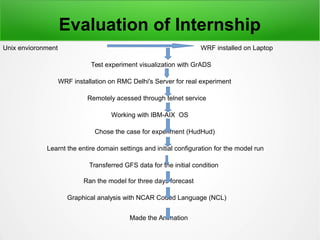
Evaluation of Internship
Unix envioronment WRF installed on Laptop
Test experiment visualization with GrADS
WRF installation on RMC Delhi's Server for real experiment
Remotely acessed through telnet service
Working with IBM-AIX OS
Chose the case for experiment (HudHud)
Learnt the entire domain settings and initial configuration for the model run
Transferred GFS data for the initial condition
Ran the model for three days forecast
Graphical analysis with NCAR Coded Language (NCL)
Made the Animation
Project Topic

Simulation of Tropical Cyclone and impact of Doppler Weather
Radar (DWR) data assimilation on the skill of track and
intensity forecasting based on the WRF-ARW model

Project consists two part of works
1) Simulation of some tropical cyclone using various scheme of
WRF-ARW without data assimilation
2) Simulation of some tropical cyclone with DWR data
assimilation
Scientific Background

The ARW has a good overall capability to predict TCs over
the NIO basin (Osuri et al.) but
still there is huge scope for further reduction in track forecast
error including 1)further improvement in initial condition 2)
assimilation of more data (DWR) etc. (Mohapatra et al.)

Synoptic studeies shown that assimilation of DWR can
improve NWP models (Liu et al. 2013)

DWR data may improve weather analysis and forecasts
because of their high temporal and spatial resolution (Maielno
et al.)
State of Art

The work was carried out using WRF-ARW model at NWP
division of IMD-Delhi

The High Performance Computing System (HPCS) with 16
processors, 1 node and IBM-AIX parallel computing environment
was used to carry out the works

The telnet service, ftp (file transfer protocol) service, internal LAN
connection etc assisted this work

WRF with ARW core model version 3.3.1 was used for the
simulation
About Data

The initial and lateral boundary condition for the WRF-ARW model are
obtained from analysis and forecast field of the NCEP-GFS model.

The lateral boundary condition are updated in 6-h interval with a fixed
sea-surface temperature throughout the model integration, with no
regional data assimilation used in this study.

The land surface boundary condition are taken from the U.S. Geological
survey data with a horizontal grid spacing of 10 min. To simulate the full
genesis of the experimental event five day

(7-10-2014 to 11-10-2014 ) 72 hrs GFS (Global Forecasting System)
analysis data at 00 UTC are taken for the initial condition of the model
WRF-ARW Model

Weather Research and Forecasting (WRF) – Advanced Research WRF
(ARW) model was developed by NCAR and UCAR and is a
community effort to develop a next generation mesoscale model and
data assimilation system.

This mesoscale model suitable for use in
1) Idealized simulations
2) Parameterization research
3) Data assimilation research
4) Forecast research
5) Real-time NWP
6) Hurricane research ....
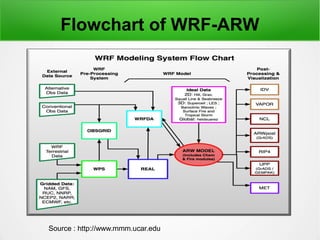
Flowchart of WRF-ARW
Source : http://www.mmm.ucar.edu
WRF Components
1. WRF Preprocessing System (WPS)
2. ARW Dynamics Solver
3. WRF-DA (Data Assimilation)
4. Graphics (NCL)
WPS
Source:http://www2.mmm.ucar.edu/wrf/users/docs/user_guide/users_guide_chap3.html
EXTERNAL
DATA
SOURCE
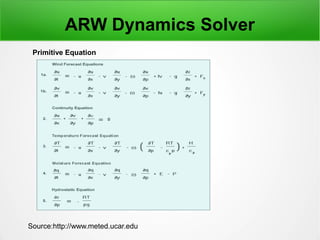
ARW Dynamics Solver
Source:http://www.meted.ucar.edu
Primitive Equation
WRF-DA & VISUALIZATION

WRF-DA is a data assimilation system for the WRF model on the basis of 3D
and 4D-var, ensemble and hybrid methods.

A wide variety of data from conventional observation, radar velocity and
reflectivity, satellite (radiance and derived data) and accumulated precipitation
can be handled by WRF-DA

NCL (NCAR Command Language) was used for visualization of wrfoutput

NCL is an interpreted language designed specifically for scientific data analysis
and visualization.

NCL can read many data formats like NetCDF, HDF, GRIB, ASCII, Binary and
more.
MODEL SUMMARY

Fully compressible Euler non-hydrostatic equations with hydrostatic option ;

scaler-conserving flux form for prognostic variables ;

complete coriolis and curvature terms ;

nesting : one way , two way with multiple nests and moving nests ;

mass based terrain folloing co-ordinate ; vertical grid spacing can vary with height ;

mapping to sphere : 3 map projections are supported for real data simulations (coriolis term
included) : polar stereographic , lambert conformal , mervator ;

Arakawa C-grid staggering ;

Runge-Kutta 2 nd and 3 rd order time step options ;

2 nd to 6 th order advection options (horizontal and vertical );

time-split small step for acoustic and gravity-wave modes;

lateral boundary conditions:
Idealized cases: periodic, symmetric, and open radiative;
Real cases: specified with relaxation zone;

full physics options for land-surface, PBL, radiation, microphysics and cumulus

Parameterization. (Source – Research & Forecasting Model WRF by Laura Bianco)
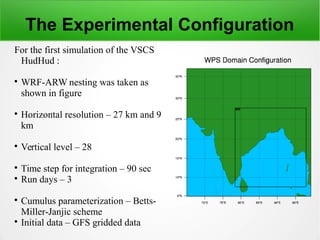
The Experimental Configuration
For the first simulation of the VSCS
HudHud :

WRF-ARW nesting was taken as
shown in figure

Horizontal resolution – 27 km and 9
km

Vertical level – 28

Time step for integration – 90 sec

Run days – 3

Cumulus parameterization – Betts-
Miller-Janjic scheme

Initial data – GFS gridded data
The Case Event
Track of HudHud (07-14 october)
Source: Joint Research Centre of
the European Commission (JRC)
HudHud VSCS taken as the case event
The Salient Features of HudHud

HudHud is the first cyclone that crossed Visakhapattanam coast in
the month of October after 1985 and it made landfall on the same
day as VSCS Phailin did in 2013.

At the time of landfall on 12 th October, the estimated maximum
sustained surface wind speed in association with the cyclone was
about 100 kts.

The estimated central pressure was 950 hpa with a pressure drop of
54 hpa at the centre compared to surroundings.

It caused very heavy to extremely heavy rainfall over North Andhra
Pradesh and South Odisha and strong gale winds leading to large
scale structural damage

Maximum 24 hour cumulative rainfall of 38 cm ending at 0830 hrs
IST of 13 th october was reported from Gantyada (Vizianagaram) in
AndhraPradesh. Source : IMD Report
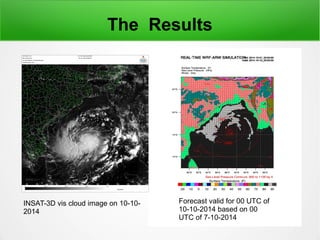
The Results
INSAT-3D vis cloud image on 10-10-
2014
Forecast valid for 00 UTC of
10-10-2014 based on 00
UTC of 7-10-2014
The Results
INSAT-3D vis cloud image on 11-10-
2014
Forecast valid for 00 UTC of
11-10-2014 based on 00 UTC
of 8-10-2014
The Results
INSAT-3D vis cloud image on 12-10-
2014
Forecast valid for 00 UTC of 12-
10-2014 based on 00 UTC of 9-
10-2014
The Results
INSAT-3D vis cloud image on 13-
10-2014
Forecast valid for 00 UTC of 13-
10-2014 based on 00 UTC of 10-
10-2014
The Results
Forecast on 9-10-2014
Based on 7-10-2014
Forecast on 11-10-
2014 based on 8-10-
2014
Forecast on 13-10-
2014 based on 10-10-
2014
Some forecast graphics based on different initial condition of parent domain
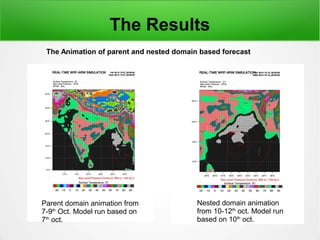
The Results
The Animation of parent and nested domain based forecast
Parent domain animation from
7-9th
Oct. Model run based on
7th
oct.
Nested domain animation
from 10-12th
oct. Model run
based on 10th
oct.
The Results
Full genesis of HudHud : A
animation from INSAT-3D vis cloud
image (07-14th
October)
A simulation from 09-11th
October : Forecast based on the
initial condition of 00 UTC 9-10-
2014
Comparison between observation and simulation
Future Works

The study of skill of WRF by taking more tropical
cyclones

The last possible work is to learn DWR data
assimilation technique and assimilate on the skill of
track and intensity forecast based on the WRF-ARW
model
Conclusion

The deatail investigation and many more experiment are needed
for better forecasting

Based on the initial configuration WRF-ARW predicted
HudHud closely compared to the observation

This internship was very useful experience for me by gaining
new knoledges, skills

Got the opprotunity to observe the operational forecasting and
professional practice at IMD

Helped me to define what skills and knowledge I have
to improve i the ensuing time.

Lastly It opened for me a new path to reach the higher research
in development of NWP models.
References

Liu et al. , A study on WRF radar data assimilation for hydrological
rainfall predictions; 2013: HESS

Maielno et al., Impact of radar data assimilation for the simulation
of a heavy rainfall case in central Italy using WRF-3D var; 2014:
AMT

Mohapatra et al. Evaluation of official tropical cyclone track
forecast over north Indian ocean issued by IMD, 2013; JESS

Osuri et al. Real-time track prediction of tropical cyclone over north
Indian ocean using ARW, 2013:JAM

VSCS, HUDHUD over BOB (07-14 October 2014) : A Report
by IMD
Thanks Giving
I would like to thank Dr. Someshwar Das (Sc-
G/Project Director) for giving this opportunity;
Mr. A. K. Das (Sc-D) and Mr. V. R. Durai (Sc-D)
for their enomormous support at IMD
&
THANK YOU ALL for your PATIENCES

report_present

  • 1.
    A Simulation UsingWRF-ARW Model A Internship Report Presentation Presented by - Devanil Choudhury Intern at – India Meteorological Department
  • 2.
    Content  Introduction  Learning Objectives  Evaluation ofthe Internship  Project topic  Scientific Background  State of Art  About Data  WRF-ARW Model  The experimental configuration  The case event  The Results  Future works  Conclusion  References  Thanks Giving
  • 3.
    Introduction  The Internship wascarried out at NWP Division, India Meteorological Department – New Delhi  Under the guidance of Dr. Someswar Das (Sc-G/ Project Director)  First phase was all about on learning Installation and simulation using WRF-ARW model  It was a very useful experience working with several scientists and engineers at IMD
  • 4.
    Learning Objectives  To learnUNIX and AIX (Advanced Interactive eXecutive) operating system  To learn shell scripting (bash/c-shell) and vi editor  To learn the WRF-ARW installation on the server  To know briefly about WRF-ARW model for using and running  To learn NCL (NCAR Coded Language) and GrADS for visualizing the output
  • 5.
    Evaluation of Internship Unixenvioronment WRF installed on Laptop Test experiment visualization with GrADS WRF installation on RMC Delhi's Server for real experiment Remotely acessed through telnet service Working with IBM-AIX OS Chose the case for experiment (HudHud) Learnt the entire domain settings and initial configuration for the model run Transferred GFS data for the initial condition Ran the model for three days forecast Graphical analysis with NCAR Coded Language (NCL) Made the Animation
  • 6.
    Project Topic  Simulation ofTropical Cyclone and impact of Doppler Weather Radar (DWR) data assimilation on the skill of track and intensity forecasting based on the WRF-ARW model  Project consists two part of works 1) Simulation of some tropical cyclone using various scheme of WRF-ARW without data assimilation 2) Simulation of some tropical cyclone with DWR data assimilation
  • 7.
    Scientific Background  The ARWhas a good overall capability to predict TCs over the NIO basin (Osuri et al.) but still there is huge scope for further reduction in track forecast error including 1)further improvement in initial condition 2) assimilation of more data (DWR) etc. (Mohapatra et al.)  Synoptic studeies shown that assimilation of DWR can improve NWP models (Liu et al. 2013)  DWR data may improve weather analysis and forecasts because of their high temporal and spatial resolution (Maielno et al.)
  • 8.
    State of Art  Thework was carried out using WRF-ARW model at NWP division of IMD-Delhi  The High Performance Computing System (HPCS) with 16 processors, 1 node and IBM-AIX parallel computing environment was used to carry out the works  The telnet service, ftp (file transfer protocol) service, internal LAN connection etc assisted this work  WRF with ARW core model version 3.3.1 was used for the simulation
  • 9.
    About Data  The initialand lateral boundary condition for the WRF-ARW model are obtained from analysis and forecast field of the NCEP-GFS model.  The lateral boundary condition are updated in 6-h interval with a fixed sea-surface temperature throughout the model integration, with no regional data assimilation used in this study.  The land surface boundary condition are taken from the U.S. Geological survey data with a horizontal grid spacing of 10 min. To simulate the full genesis of the experimental event five day  (7-10-2014 to 11-10-2014 ) 72 hrs GFS (Global Forecasting System) analysis data at 00 UTC are taken for the initial condition of the model
  • 10.
    WRF-ARW Model  Weather Researchand Forecasting (WRF) – Advanced Research WRF (ARW) model was developed by NCAR and UCAR and is a community effort to develop a next generation mesoscale model and data assimilation system.  This mesoscale model suitable for use in 1) Idealized simulations 2) Parameterization research 3) Data assimilation research 4) Forecast research 5) Real-time NWP 6) Hurricane research ....
  • 11.
    Flowchart of WRF-ARW Source: http://www.mmm.ucar.edu
  • 12.
    WRF Components 1. WRFPreprocessing System (WPS) 2. ARW Dynamics Solver 3. WRF-DA (Data Assimilation) 4. Graphics (NCL)
  • 13.
  • 14.
  • 15.
    WRF-DA & VISUALIZATION  WRF-DAis a data assimilation system for the WRF model on the basis of 3D and 4D-var, ensemble and hybrid methods.  A wide variety of data from conventional observation, radar velocity and reflectivity, satellite (radiance and derived data) and accumulated precipitation can be handled by WRF-DA  NCL (NCAR Command Language) was used for visualization of wrfoutput  NCL is an interpreted language designed specifically for scientific data analysis and visualization.  NCL can read many data formats like NetCDF, HDF, GRIB, ASCII, Binary and more.
  • 16.
    MODEL SUMMARY  Fully compressibleEuler non-hydrostatic equations with hydrostatic option ;  scaler-conserving flux form for prognostic variables ;  complete coriolis and curvature terms ;  nesting : one way , two way with multiple nests and moving nests ;  mass based terrain folloing co-ordinate ; vertical grid spacing can vary with height ;  mapping to sphere : 3 map projections are supported for real data simulations (coriolis term included) : polar stereographic , lambert conformal , mervator ;  Arakawa C-grid staggering ;  Runge-Kutta 2 nd and 3 rd order time step options ;  2 nd to 6 th order advection options (horizontal and vertical );  time-split small step for acoustic and gravity-wave modes;  lateral boundary conditions: Idealized cases: periodic, symmetric, and open radiative; Real cases: specified with relaxation zone;  full physics options for land-surface, PBL, radiation, microphysics and cumulus  Parameterization. (Source – Research & Forecasting Model WRF by Laura Bianco)
  • 17.
    The Experimental Configuration Forthe first simulation of the VSCS HudHud :  WRF-ARW nesting was taken as shown in figure  Horizontal resolution – 27 km and 9 km  Vertical level – 28  Time step for integration – 90 sec  Run days – 3  Cumulus parameterization – Betts- Miller-Janjic scheme  Initial data – GFS gridded data
  • 18.
    The Case Event Trackof HudHud (07-14 october) Source: Joint Research Centre of the European Commission (JRC) HudHud VSCS taken as the case event
  • 19.
    The Salient Featuresof HudHud  HudHud is the first cyclone that crossed Visakhapattanam coast in the month of October after 1985 and it made landfall on the same day as VSCS Phailin did in 2013.  At the time of landfall on 12 th October, the estimated maximum sustained surface wind speed in association with the cyclone was about 100 kts.  The estimated central pressure was 950 hpa with a pressure drop of 54 hpa at the centre compared to surroundings.  It caused very heavy to extremely heavy rainfall over North Andhra Pradesh and South Odisha and strong gale winds leading to large scale structural damage  Maximum 24 hour cumulative rainfall of 38 cm ending at 0830 hrs IST of 13 th october was reported from Gantyada (Vizianagaram) in AndhraPradesh. Source : IMD Report
  • 20.
    The Results INSAT-3D viscloud image on 10-10- 2014 Forecast valid for 00 UTC of 10-10-2014 based on 00 UTC of 7-10-2014
  • 21.
    The Results INSAT-3D viscloud image on 11-10- 2014 Forecast valid for 00 UTC of 11-10-2014 based on 00 UTC of 8-10-2014
  • 22.
    The Results INSAT-3D viscloud image on 12-10- 2014 Forecast valid for 00 UTC of 12- 10-2014 based on 00 UTC of 9- 10-2014
  • 23.
    The Results INSAT-3D viscloud image on 13- 10-2014 Forecast valid for 00 UTC of 13- 10-2014 based on 00 UTC of 10- 10-2014
  • 24.
    The Results Forecast on9-10-2014 Based on 7-10-2014 Forecast on 11-10- 2014 based on 8-10- 2014 Forecast on 13-10- 2014 based on 10-10- 2014 Some forecast graphics based on different initial condition of parent domain
  • 25.
    The Results The Animationof parent and nested domain based forecast Parent domain animation from 7-9th Oct. Model run based on 7th oct. Nested domain animation from 10-12th oct. Model run based on 10th oct.
  • 26.
    The Results Full genesisof HudHud : A animation from INSAT-3D vis cloud image (07-14th October) A simulation from 09-11th October : Forecast based on the initial condition of 00 UTC 9-10- 2014 Comparison between observation and simulation
  • 27.
    Future Works  The studyof skill of WRF by taking more tropical cyclones  The last possible work is to learn DWR data assimilation technique and assimilate on the skill of track and intensity forecast based on the WRF-ARW model
  • 28.
    Conclusion  The deatail investigationand many more experiment are needed for better forecasting  Based on the initial configuration WRF-ARW predicted HudHud closely compared to the observation  This internship was very useful experience for me by gaining new knoledges, skills  Got the opprotunity to observe the operational forecasting and professional practice at IMD  Helped me to define what skills and knowledge I have to improve i the ensuing time.  Lastly It opened for me a new path to reach the higher research in development of NWP models.
  • 29.
    References  Liu et al., A study on WRF radar data assimilation for hydrological rainfall predictions; 2013: HESS  Maielno et al., Impact of radar data assimilation for the simulation of a heavy rainfall case in central Italy using WRF-3D var; 2014: AMT  Mohapatra et al. Evaluation of official tropical cyclone track forecast over north Indian ocean issued by IMD, 2013; JESS  Osuri et al. Real-time track prediction of tropical cyclone over north Indian ocean using ARW, 2013:JAM  VSCS, HUDHUD over BOB (07-14 October 2014) : A Report by IMD
  • 30.
    Thanks Giving I wouldlike to thank Dr. Someshwar Das (Sc- G/Project Director) for giving this opportunity; Mr. A. K. Das (Sc-D) and Mr. V. R. Durai (Sc-D) for their enomormous support at IMD & THANK YOU ALL for your PATIENCES