WIND SPEED PREDICTION BY WEIBULL
DISTRIBUTION AND ANALYSIS OF HYBRID
WEIBULL-ANN TECHNIQUE
Presented by
Pratap Bhanu Mishra
M.TECH (PES)
Roll No: 1358011
Under the guidance of
Asst. Prof. Mrs. Lipika Nanda
14 January 2016 1Pratap Bhanu Mishra
M.Tech Project
Final Presentation
School of Electrical Engineering
KIIT University
Outline
14 January 2016 2Pratap Bhanu Mishra
 Introduction
 Present Status of Wind Speed Prediction
 Motivation
 Objective
 Weibull Distribution
 ANN Structure
 Data Analysis and Histograms
 Simulation and Evaluation of Hybrid Weibull-ANN
 Conclusion and Future Scope
 References
 Publication
Introduction
14 January 2016 3Pratap Bhanu Mishra
• The popularity of Wind Energy is increasing rapidly as the installation
capacity grows in excess of 30% every year.
• Wind energy production from conventional energy differs in many
aspects, it is largely influenced by random wind speed change[1].
• A small change of wind speed can result in a huge change of power
output of WTG[2].
• Setting up of a wind speed measuring station is not always possible
near a wind farm[3].
• This paper reports a Weibull distribution model used to analyse past
five years of data and then uses the result of that analysis to train the
ANN.
Present Status of Wind Speed Prediction
14 January 2016 4Pratap Bhanu Mishra
• For maintaining the stability of the power generation in wind farms,
forecasting the wind for every small time horizon with accuracy is
essential[4].
• Wind mill setups vary in range. Some of them are:
On-shore grid connected Wind Turbine systems
Off-shore Wind turbine systems Small Wind
Hybrid Energy Decentralized systems (Floating)
• It is estimated that with the current level of technology, the ‘on-shore’
potential of wind energy can be used to harness around 65,000 MW of
electricity in India.
• Areas which can be potential sites for wind power generation in India
can be identified in the based on the following wind power density map.
14 January 2016 5Pratap Bhanu Mishra
• MNRE's achievement report reveals that the installed capacity of Grid
Interactive Wind Energy in India is 23444 MW as of 31st March 2015.
• The Budget of 2015 targets 60 GW of wind power in India by 2022.
• Wind power has taken a back seat in recent years and accounts for only around
1.02% of India's total installed power capacity but still holds 65.52% of total
installed renewable energy[5].
• According to the sources, the worldwide installed capacity of wind power
reached 369,553 MW where China (114,763 MW), US (65,879 MW), Germany
(39,165 MW) and Spain (22,987 MW) are ahead of India in fifth position by the
end of 2014.
• According to REN21- Global Status Report 2011 (GSR-2011), Suzlon is
among the top ten manufacturers of Wind Turbine in the world with a world
market share of 6.7%.
Contd…
14 January 2016 6Pratap Bhanu Mishra
MotivAtion
• Wind speed forecasting is dragging a lot of attention in wind power
generation community.
• In past years, a lot of research work is going on regarding wind speed
prediction techniques.
• After studying various techniques, both statistical approach and ANN
model were found to be quite efficient in many past researches.
• Thus an attempt was made to hybridize both the methods to analyze the
potential hybrid technique.
14 January 2016 7Pratap Bhanu Mishra
Objective
• The following are the main objectives of this study:
To study various methods involving wind speed prediction
To Analyse the wind energy potential of Bhubaneswar by using
Weibull model
To evaluate the reliability of Weibull model by comparing with
original wind speed data
To study Artificial Neural Network using back propagation
algorithm
To analyse the performance of a Hybrid Weibull-ANN prediction
technique
14 January 2016 8Pratap Bhanu Mishra
Weibull Distribution
• To establish the wind speed model by Weibull distribution usually the
probability distribution method is used.
•The Weibull distribution is widely used to describe the long-term
records of wind speed.
•The probability density function of a Weibull distribution is given by
the equation:
where, v1 = wind speed (m/s)
k = shape parameter, which affects the shape of the distribution rather than simply
shifting it.
λ = scale parameter, which stretches/shrinks the distribution curve = vm/Γ (1+1/k)
vm = monthly mean wind speed
Γ = the gamma function
where, Γ(x) = (where, u= average wind velocity)[2]
14 January 2016 9Pratap Bhanu Mishra
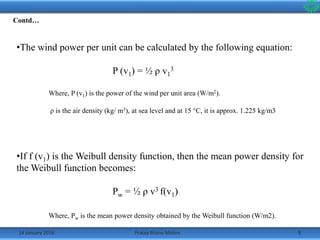
•The wind power per unit can be calculated by the following equation:
P (v1) = ½ ρ v1
3
Where, P (v1) is the power of the wind per unit area (W/m2).
ρ is the air density (kg/ m3), at sea level and at 15 °C, it is approx. 1.225 kg/m3
•If f (v1) is the Weibull density function, then the mean power density for
the Weibull function becomes:
Pw = ½ ρ v3 f(v1)
Where, Pw is the mean power density obtained by the Weibull function (W/m2).
Contd…
14 January 2016 10Pratap Bhanu Mishra
ANN Structure
• Originally made to mimic the biological central nervous system of
human beings, it is a large-scale parallel-distributed information
processing system which is composed of many inter-connected nonlinear
computational units (known as “neurons”).
•The network can perform many activities such as function
approximation, system identification, optimization, and adaptive control.
•The neural network based approach yields some valuable features over
traditional methods, such as adaptive learning, distributed association,
nonlinear mapping, as well as the ability to handle imprecise data.
•For predicting wind speed a neural network model can be trained by
taking a set of past measurement data .
14 January 2016 11Pratap Bhanu Mishra
• If there is a change in conditions, it can learn the change overtime, and
adjust itself for a more accurate prediction[6].
•So, it resembles the human brain in two respects:
Knowledge is acquired by the network from its environment through a learning
process.
Interneuron connection strengths, also known as synaptic weights, are used to
store the acquired knowledge.
•Mathematically, this process is described in the following figure:
Contd…
Where, x is the input
p is the no. of inputs.
k is the inputs received from input unit
The output of the neuron, yk, would therefore be the outcome of some
activation function on the value of vk.
14 January 2016 12Pratap Bhanu Mishra
• The back propagation algorithm (Rumelhart and McClelland, 1986) is
used in layered feed-forward ANNs.
• It uses supervised learning. The idea of the back propagation algorithm
is mainly to reduce this error, until the ANN learns the training data.
•The training begins with random weights, and the goal is to adjust them
so that the error will be minimal[3].
•The activation function of the artificial neurons in ANNs implementing
the back-propagation algorithm is a weighted sum (the sum of the inputs
xi multiplied by their respective weights wji) and is given by:
Contd…
14 January 2016 13Pratap Bhanu Mishra
Data Analysis and Histograms
• Preparing for modeling, to make the distribution of data approx. linear
normalization of data must be done, as the assumption in TS model is
that, the random noises follow Gussian distribution[7].
•The wind speed data was divided into linear bins from 0m/s to 25m/s
and the frequency at which they occurred on an average that year was
calculated.
•Then taking the shape factor k=2 as per Rayleigh distribution, the
histograms along with the predicted Weibull distribution curve were
made.
•Following are the histograms of the wind data from the year 2007 to
2012.
14 January 2016 14Pratap Bhanu Mishra
-0.1
0
0.1
0.2
0.3
0 1 2 3 4 5 6 7 8 9 10 11 12 13 14 15 16 17 18 19 20 21 22 23 24 25
PercentageofOccurance
Wind Speed in M/S
Series1 Series2
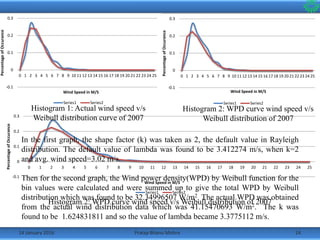
Histogram 1: Actual wind speed v/s Weibull distribution curve of 2007
-0.1
0
0.1
0.2
0.3
0 1 2 3 4 5 6 7 8 9 10 11 12 13 14 15 16 17 18 19 20 21 22 23 24 25
PercentageofOccurance
Wind Speed in M/S
Series1 Series2
Histogram 2: WPD curve wind speed v/s Weibull distribution of 2007
-0.1
0
0.1
0.2
0.3
0 1 2 3 4 5 6 7 8 9 10 11 12 13 14 15 16 17 18 19 20 21 22 23 24 25
PercentageofOccurance
Wind Speed in M/S
Series1 Series2
-0.1
0
0.1
0.2
0.3
0 1 2 3 4 5 6 7 8 9 10 11 12 13 14 15 16 17 18 19 20 21 22 23 24 25
PercentageofOccurance
Wind Speed in M/S
Series1 Series2
Histogram 2: WPD curve wind speed v/s
Weibull distribution of 2007
Histogram 1: Actual wind speed v/s
Weibull distribution curve of 2007
In the first graph, the shape factor (k) was taken as 2, the default value in Rayleigh
distribution. The default value of lambda was found to be 3.412274 m/s, when k=2
and avg. wind speed=3.02 m/s.
Then for the second graph, the Wind power density(WPD) by Weibull function for the
bin values were calculated and were summed up to give the total WPD by Weibull
distribution which was found to be 32.34996507 W/m2. The actual WPD was obtained
from the actual wind distribution data which was 41.15470693 W/m2. The k was
found to be 1.624831811 and so the value of lambda became 3.3775112 m/s.
14 January 2016 15Pratap Bhanu Mishra
-0.1
0
0.1
0.2
0.3
0.4
0 1 2 3 4 5 6 7 8 9 10 11 12 13 14 15 16 17 18 19 20 21 22 23 24 25
PercentageofOccurance
Wind Speed in M/S
Series1 Series2
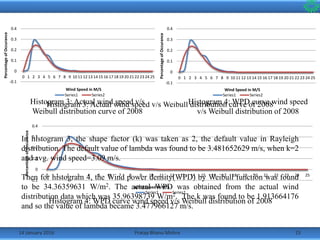
Histogram 3: Actual wind speed v/s Weibull distribution curve of 2008
-0.1
0
0.1
0.2
0.3
0.4
0 1 2 3 4 5 6 7 8 9 10 11 12 13 14 15 16 17 18 19 20 21 22 23 24 25
PercentageofOccurance
Wind Speed in M/S
Series1 Series2
Histogram 4: WPD curve wind speed v/s Weibull distribution of 2008
-0.1
0
0.1
0.2
0.3
0.4
0 1 2 3 4 5 6 7 8 9 10 11 12 13 14 15 16 17 18 19 20 21 22 23 24 25
PercentageofOccurance
Wind Speed in M/S
Series1 Series2
Histogram 3: Actual wind speed v/s
Weibull distribution curve of 2008
-0.1
0
0.1
0.2
0.3
0.4
0 1 2 3 4 5 6 7 8 9 10 11 12 13 14 15 16 17 18 19 20 21 22 23 24 25
PercentageofOccurance
Wind Speed in M/S
Series1 Series2
Histogram 4: WPD curve wind speed
v/s Weibull distribution of 2008
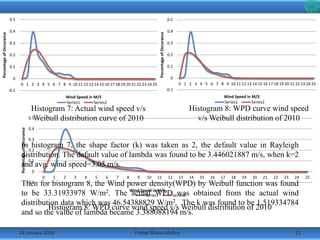
In histogram 3, the shape factor (k) was taken as 2, the default value in Rayleigh
distribution. The default value of lambda was found to be 3.481652629 m/s, when k=2
and avg. wind speed=3.09 m/s.
Then for histogram 4, the Wind power density(WPD) by Weibull function was found
to be 34.36359631 W/m2. The actual WPD was obtained from the actual wind
distribution data which was 35.96398739 W/m2. The k was found to be 1.913664176
and so the value of lambda became 3.477966127 m/s.
14 January 2016 16Pratap Bhanu Mishra
-0.1
0
0.1
0.2
0.3
0.4
0.5
0 1 2 3 4 5 6 7 8 9 10 11 12 13 14 15 16 17 18 19 20 21 22 23 24 25
PercentageofOccurance
Wind Speed in M/S
Series1 Series2
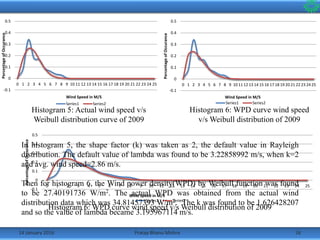
Histogram 5: Actual wind speed v/s Weibull distribution curve of 2009
-0.1
0
0.1
0.2
0.3
0.4
0.5
0 1 2 3 4 5 6 7 8 9 10 11 12 13 14 15 16 17 18 19 20 21 22 23 24 25
PercentageofOccurance
Wind Speed in M/S
Series1 Series2
-0.1
0
0.1
0.2
0.3
0.4
0.5
0 1 2 3 4 5 6 7 8 9 10 11 12 13 14 15 16 17 18 19 20 21 22 23 24 25
PercentageofOccurance
Wind Speed in M/S
Series1 Series2
-0.1
0
0.1
0.2
0.3
0.4
0.5
0 1 2 3 4 5 6 7 8 9 10 11 12 13 14 15 16 17 18 19 20 21 22 23 24 25
PercentageofOccurance
Wind Speed in M/S
Series1 Series2
Histogram 6: WPD curve wind speed
v/s Weibull distribution of 2009
Histogram 6: WPD curve wind speed v/s Weibull distribution of 2009
Histogram 5: Actual wind speed v/s
Weibull distribution curve of 2009
In histogram 5, the shape factor (k) was taken as 2, the default value in Rayleigh
distribution. The default value of lambda was found to be 3.22858992 m/s, when k=2
and avg. wind speed=2.86 m/s.
Then for histogram 6, the Wind power density(WPD) by Weibull function was found
to be 27.40191736 W/m2. The actual WPD was obtained from the actual wind
distribution data which was 34.81457393 W/m2. The k was found to be 1.626428207
and so the value of lambda became 3.195967114 m/s.
14 January 2016 17Pratap Bhanu Mishra
Histogram 8: WPD curve wind speed v/s Weibull distribution of 2010
-0.1
0
0.1
0.2
0.3
0.4
0.5
0 1 2 3 4 5 6 7 8 9 10 11 12 13 14 15 16 17 18 19 20 21 22 23 24 25
PercentageofOccurance
Wind Speed in M/S
Series1 Series2
Histogram 7: Actual wind speed v/s Weibull distribution curve of 2010
-0.1
0
0.1
0.2
0.3
0.4
0.5
0 1 2 3 4 5 6 7 8 9 10 11 12 13 14 15 16 17 18 19 20 21 22 23 24 25
PercentageofOccurance
Wind Speed in M/S
Series1 Series2
-0.1
0
0.1
0.2
0.3
0.4
0.5
0 1 2 3 4 5 6 7 8 9 10 11 12 13 14 15 16 17 18 19 20 21 22 23 24 25
PercentageofOccurance
Wind Speed in M/S
Series1 Series2
Histogram 7: Actual wind speed v/s
Weibull distribution curve of 2010
-0.1
0
0.1
0.2
0.3
0.4
0.5
0 1 2 3 4 5 6 7 8 9 10 11 12 13 14 15 16 17 18 19 20 21 22 23 24 25
PercentageofOccurance
Wind Speed in M/S
Series1 Series2
Histogram 8: WPD curve wind speed
v/s Weibull distribution of 2010
In histogram 7, the shape factor (k) was taken as 2, the default value in Rayleigh
distribution. The default value of lambda was found to be 3.446021887 m/s, when k=2
and avg. wind speed=3.05 m/s.
Then for histogram 8, the Wind power density(WPD) by Weibull function was found
to be 33.31933978 W/m2. The actual WPD was obtained from the actual wind
distribution data which was 46.54388829 W/m2. The k was found to be 1.519334784
and so the value of lambda became 3.388088194 m/s.
14 January 2016 18Pratap Bhanu Mishra
-0.1
0
0.1
0.2
0.3
0.4
0.5
0 1 2 3 4 5 6 7 8 9 10 11 12 13 14 15 16 17 18 19 20 21 22 23 24 25
PercentageofOccurance
Wind Speed in M/S
Series1 Series2
Histogram 9: Actual wind speed v/s Weibull distribution curve of 2011
-0.1
0
0.1
0.2
0.3
0.4
0.5
0 1 2 3 4 5 6 7 8 9 10 11 12 13 14 15 16 17 18 19 20 21 22 23 24 25
PercentageofOccurance
Wind Speed in M/S
Series1 Series2
Histogram 10: WPD curve wind speed v/s Weibull distribution of 2011
-0.1
0
0.1
0.2
0.3
0.4
0.5
0 1 2 3 4 5 6 7 8 9 10 11 12 13 14 15 16 17 18 19 20 21 22 23 24 25
PercentageofOccurance
Wind Speed in M/S
Series1 Series2
Histogram 9: Actual wind speed v/s
Weibull distribution curve of 2011
-0.1
0
0.1
0.2
0.3
0.4
0.5
0 1 2 3 4 5 6 7 8 9 10 11 12 13 14 15 16 17 18 19 20 21 22 23 24 25
PercentageofOccurance
Wind Speed in M/S
Series1 Series2
Histogram 10: WPD curve wind speed
v/s Weibull distribution of 2011
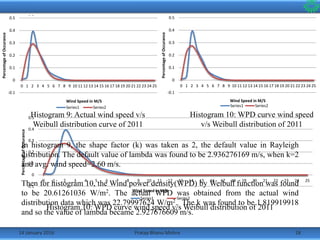
In histogram 9, the shape factor (k) was taken as 2, the default value in Rayleigh
distribution. The default value of lambda was found to be 2.936276169 m/s, when k=2
and avg. wind speed=2.60 m/s.
Then for histogram 10, the Wind power density(WPD) by Weibull function was found
to be 20.61261036 W/m2. The actual WPD was obtained from the actual wind
distribution data which was 22.79997624 W/m2. The k was found to be 1.819919918
and so the value of lambda became 2.927676609 m/s.
14 January 2016 19Pratap Bhanu Mishra
-0.1
0
0.1
0.2
0.3
0.4
0 1 2 3 4 5 6 7 8 9 10 11 12 13 14 15 16 17 18 19 20 21 22 23 24 25
PERCENTAGEOFOCCURANCE
WIND SPEED IN M/S
Series1 Series2
-0.1
0
0.1
0.2
0.3
0.4
0 1 2 3 4 5 6 7 8 9 10 11 12 13 14 15 16 17 18 19 20 21 22 23 24 25
PercentageofOccurance
Wind Speed in M/S
Series1 Series2
Histogram 11: Actual wind speed v/s Weibull distribution curve of 2012
Histogram 12: WPD curve wind speed v/s Weibull distribution of 2012
-0.1
0
0.1
0.2
0.3
0.4
0 1 2 3 4 5 6 7 8 9 10 11 12 13 14 15 16 17 18 19 20 21 22 23 24 25
PERCENTAGEOFOCCURANCE
WIND SPEED IN M/S
Series1 Series2
-0.1
0
0.1
0.2
0.3
0.4
0 1 2 3 4 5 6 7 8 9 10 11 12 13 14 15 16 17 18 19 20 21 22 23 24 25
PercentageofOccurance
Wind Speed in M/S
Series1 Series2
Histogram 11: Actual wind speed v/s
Weibull distribution curve of 2012
Histogram 12: WPD curve wind speed
v/s Weibull distribution of 2012
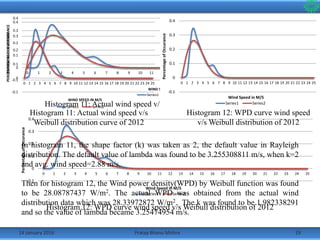
In histogram 11, the shape factor (k) was taken as 2, the default value in Rayleigh
distribution. The default value of lambda was found to be 3.255308811 m/s, when k=2
and avg. wind speed=2.88 m/s.
Then for histogram 12, the Wind power density(WPD) by Weibull function was found
to be 28.08787437 W/m2. The actual WPD was obtained from the actual wind
distribution data which was 28.33972872 W/m2. The k was found to be 1.982338291
and so the value of lambda became 3.25474954 m/s.
14 January 2016 20Pratap Bhanu Mishra
Simulation and Evaluation of Hybrid Weibull-ANN
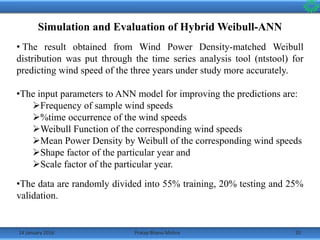
• The result obtained from Wind Power Density-matched Weibull
distribution was put through the time series analysis tool (ntstool) for
predicting wind speed of the three years under study more accurately.
•The input parameters to ANN model for improving the predictions are:
Frequency of sample wind speeds
%time occurrence of the wind speeds
Weibull Function of the corresponding wind speeds
Mean Power Density by Weibull of the corresponding wind speeds
Shape factor of the particular year and
Scale factor of the particular year.
•The data are randomly divided into 55% training, 20% testing and 25%
validation.
14 January 2016 21Pratap Bhanu Mishra
• The training data, adjust network weight according to error.
•The validation data, measures network generalization and stop training
when generalization stops improving.
•The testing data have no effect on training and provide an independent
measure of network performance during and after training.
•Calculation of Hidden Layers was done using the following equation:
where, Hn and Sn are number of hidden layer neurons and number of
data samples used in ANN model, In and On denotes number of input and
output parameters [7].
Contd…
14 January 2016 22Pratap Bhanu Mishra
-1.00
1.00
3.00
5.00
7.00
9.00
11.00
0 50 100 150 200 250 300 350 400
WindSpeed(m/s)
Days
2010
-1.00
0.00
1.00
2.00
3.00
4.00
5.00
6.00
7.00
8.00
9.00
0 100 200 300 400
WindSpeed(m/s)
Days
2011
0.00
1.00
2.00
3.00
4.00
5.00
6.00
7.00
8.00
9.00
0 100 200 300 400
WindSpeed(m/s)
Days
2012
Contd…
14 January 2016 23Pratap Bhanu Mishra
Contd…
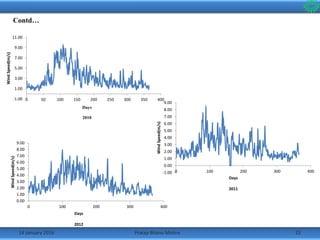
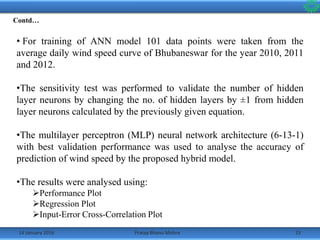
• For training of ANN model 101 data points were taken from the
average daily wind speed curve of Bhubaneswar for the year 2010, 2011
and 2012.
•The sensitivity test was performed to validate the number of hidden
layer neurons by changing the no. of hidden layers by ±1 from hidden
layer neurons calculated by the previously given equation.
•The multilayer perceptron (MLP) neural network architecture (6-13-1)
with best validation performance was used to analyse the accuracy of
prediction of wind speed by the proposed hybrid model.
•The results were analysed using:
Performance Plot
Regression Plot
Input-Error Cross-Correlation Plot
14 January 2016 24Pratap Bhanu Mishra
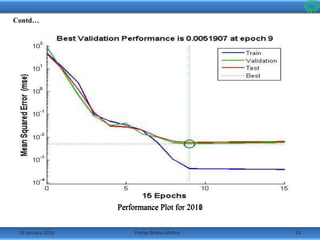
•The performance plots of ANN model demonstrates that mean square
error becomes minimum as number of epochs increases. The epoch is
one complete sweep of training, testing and validation.
Contd…
Performance Plot for 2010Performance Plot for 2011Performance Plot for 2012
14 January 2016 25Pratap Bhanu Mishra
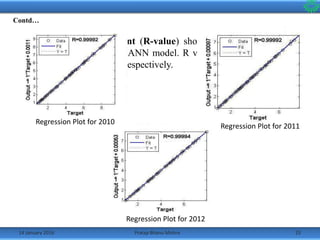
• The correlation coefficient (R-value) shows the association among
outputs and target value of ANN model. R value of 1and 0 measures a
strong, random association respectively.
Regression Plot for 2011
Regression Plot for 2010
Regression Plot for 2012
Contd…
14 January 2016 26Pratap Bhanu Mishra
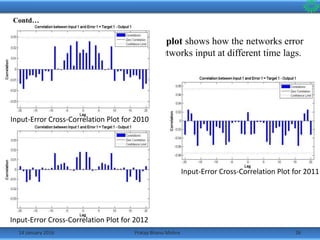
• The Input-Error cross-correlation plot shows how the networks error
at any given time is correlated with networks input at different time lags.
Contd…
Input-Error Cross-Correlation Plot for 2010
Input-Error Cross-Correlation Plot for 2011
Input-Error Cross-Correlation Plot for 2012
14 January 2016 27Pratap Bhanu Mishra
conclusion
• The data collected was matched with the Weibull distribution in the
context of both wind power density and wind speed distribution for
accuracy purpose.
•Then an ANN model was developed with Time-series tool (ntstool) for
improving wind speed curves created by Weibull distribution.
•The correlation coefficient (R-value) of 0.99992 and slope 1 was
achieved forboth 2010 and 2011 while anR-value of 0.99994and slope
1was achieved for 2012 for the whole data set, showing high prediction
accuracy of the developed ANN Model.
•Data analysis confirms that the Weibull distribution is an adequate
technique for describing the daily average wind speed distribution. But
using a Hybrid ANN method gives superior result and can help in more
accurate forecasting.
14 January 2016 28Pratap Bhanu Mishra
Future scope
• In future the equations of Weibull distribution can be merged with
other non-linear equations for handling nonlinearity and stochastic
uncertainty problems associated with wind speed data and then
hybridising it with ANN will be more effective.
•Addition of any GUI which helps in predicting future data with
MATLAB will be helpful for validating the results as well as finding the
MAPE.
•Also wind data of a windier region will give better forecasting results.
References
14 January 2016 29Pratap Bhanu Mishra
[1] Wang Ruigang, Wenyi Li, and B. Bagen. "Development of Wind Speed
Forecasting Model Based on the Weibull Probability Distribution", 2011
International Conference on Computer Distributed Control and Intelligent
Environmental Monitoring, 2011.
[2] Yuehua, Liu, Jiang Yingni, and Gong Qingge. "Analysis of wind energy
potential using the Weibull model at Zhurihe", 2011 International
Conference on Consumer Electronics Communications and Networks
(CECNet), 2011.
[3] Liang Wu. "A study on wind speed prediction using artificial neural network
at Jeju Island in Korea-I", 2009 Transmission & Distribution Conference &
Exposition Asia and Pacific, 10/2009.
[4] M. Negnevitsky, P. Mandal, A. K. Srivastava, "An overview of forecasting
problems and techniques in power systems," Power & Energy Society
General Meeting, 2009. PES '09. IEEE, vol., no., pp.1-4, 26-30 July 2009.
14 January 2016 30Pratap Bhanu Mishra
[5] http://www.indianwindpower.com/
[6] Xiao-Hua Yu. "Applications of Neural Networks to Dynamical System
Identification and Adaptive Control", Studies in Computational Intelligence,
2008.
[7] P. Ramasamy, S.S. Chandel, Amit Kumar Yadav. "Wind speed prediction in
the mountainous region of India using an artificial neural network model",
Renewable Energy, Volume 80, August 2015, Pages 338–347.
Contd…
Publications
14 January 2016 31Pratap Bhanu Mishra
• Pratap Bhanu Mishra, Dr. S.M Ali. “Advances in Wind Energy”, 2014
All India Seminar on Modern Trends in Power System Operation,
Control & Management, Instiute of Engineers, pp. 158-163.
• Mrs. Lipika Nanda, P.B Mishra. “Analysis of Wind Speed Prediction
Techinque by hybrid Weibull-ANN Model”, 2015 IEEE Power,
Communication and Information Technology Conference (PCITC)
Siksha ‘O’Anusandhan University, Bhubaneswar, India.

Presentation1

  • 1.
    WIND SPEED PREDICTIONBY WEIBULL DISTRIBUTION AND ANALYSIS OF HYBRID WEIBULL-ANN TECHNIQUE Presented by Pratap Bhanu Mishra M.TECH (PES) Roll No: 1358011 Under the guidance of Asst. Prof. Mrs. Lipika Nanda 14 January 2016 1Pratap Bhanu Mishra M.Tech Project Final Presentation School of Electrical Engineering KIIT University
  • 2.
    Outline 14 January 20162Pratap Bhanu Mishra  Introduction  Present Status of Wind Speed Prediction  Motivation  Objective  Weibull Distribution  ANN Structure  Data Analysis and Histograms  Simulation and Evaluation of Hybrid Weibull-ANN  Conclusion and Future Scope  References  Publication
  • 3.
    Introduction 14 January 20163Pratap Bhanu Mishra • The popularity of Wind Energy is increasing rapidly as the installation capacity grows in excess of 30% every year. • Wind energy production from conventional energy differs in many aspects, it is largely influenced by random wind speed change[1]. • A small change of wind speed can result in a huge change of power output of WTG[2]. • Setting up of a wind speed measuring station is not always possible near a wind farm[3]. • This paper reports a Weibull distribution model used to analyse past five years of data and then uses the result of that analysis to train the ANN.
  • 4.
    Present Status ofWind Speed Prediction 14 January 2016 4Pratap Bhanu Mishra • For maintaining the stability of the power generation in wind farms, forecasting the wind for every small time horizon with accuracy is essential[4]. • Wind mill setups vary in range. Some of them are: On-shore grid connected Wind Turbine systems Off-shore Wind turbine systems Small Wind Hybrid Energy Decentralized systems (Floating) • It is estimated that with the current level of technology, the ‘on-shore’ potential of wind energy can be used to harness around 65,000 MW of electricity in India. • Areas which can be potential sites for wind power generation in India can be identified in the based on the following wind power density map.
  • 5.
    14 January 20165Pratap Bhanu Mishra • MNRE's achievement report reveals that the installed capacity of Grid Interactive Wind Energy in India is 23444 MW as of 31st March 2015. • The Budget of 2015 targets 60 GW of wind power in India by 2022. • Wind power has taken a back seat in recent years and accounts for only around 1.02% of India's total installed power capacity but still holds 65.52% of total installed renewable energy[5]. • According to the sources, the worldwide installed capacity of wind power reached 369,553 MW where China (114,763 MW), US (65,879 MW), Germany (39,165 MW) and Spain (22,987 MW) are ahead of India in fifth position by the end of 2014. • According to REN21- Global Status Report 2011 (GSR-2011), Suzlon is among the top ten manufacturers of Wind Turbine in the world with a world market share of 6.7%. Contd…
  • 6.
    14 January 20166Pratap Bhanu Mishra MotivAtion • Wind speed forecasting is dragging a lot of attention in wind power generation community. • In past years, a lot of research work is going on regarding wind speed prediction techniques. • After studying various techniques, both statistical approach and ANN model were found to be quite efficient in many past researches. • Thus an attempt was made to hybridize both the methods to analyze the potential hybrid technique.
  • 7.
    14 January 20167Pratap Bhanu Mishra Objective • The following are the main objectives of this study: To study various methods involving wind speed prediction To Analyse the wind energy potential of Bhubaneswar by using Weibull model To evaluate the reliability of Weibull model by comparing with original wind speed data To study Artificial Neural Network using back propagation algorithm To analyse the performance of a Hybrid Weibull-ANN prediction technique
  • 8.
    14 January 20168Pratap Bhanu Mishra Weibull Distribution • To establish the wind speed model by Weibull distribution usually the probability distribution method is used. •The Weibull distribution is widely used to describe the long-term records of wind speed. •The probability density function of a Weibull distribution is given by the equation: where, v1 = wind speed (m/s) k = shape parameter, which affects the shape of the distribution rather than simply shifting it. λ = scale parameter, which stretches/shrinks the distribution curve = vm/Γ (1+1/k) vm = monthly mean wind speed Γ = the gamma function where, Γ(x) = (where, u= average wind velocity)[2]
  • 9.
    14 January 20169Pratap Bhanu Mishra •The wind power per unit can be calculated by the following equation: P (v1) = ½ ρ v1 3 Where, P (v1) is the power of the wind per unit area (W/m2). ρ is the air density (kg/ m3), at sea level and at 15 °C, it is approx. 1.225 kg/m3 •If f (v1) is the Weibull density function, then the mean power density for the Weibull function becomes: Pw = ½ ρ v3 f(v1) Where, Pw is the mean power density obtained by the Weibull function (W/m2). Contd…
  • 10.
    14 January 201610Pratap Bhanu Mishra ANN Structure • Originally made to mimic the biological central nervous system of human beings, it is a large-scale parallel-distributed information processing system which is composed of many inter-connected nonlinear computational units (known as “neurons”). •The network can perform many activities such as function approximation, system identification, optimization, and adaptive control. •The neural network based approach yields some valuable features over traditional methods, such as adaptive learning, distributed association, nonlinear mapping, as well as the ability to handle imprecise data. •For predicting wind speed a neural network model can be trained by taking a set of past measurement data .
  • 11.
    14 January 201611Pratap Bhanu Mishra • If there is a change in conditions, it can learn the change overtime, and adjust itself for a more accurate prediction[6]. •So, it resembles the human brain in two respects: Knowledge is acquired by the network from its environment through a learning process. Interneuron connection strengths, also known as synaptic weights, are used to store the acquired knowledge. •Mathematically, this process is described in the following figure: Contd… Where, x is the input p is the no. of inputs. k is the inputs received from input unit The output of the neuron, yk, would therefore be the outcome of some activation function on the value of vk.
  • 12.
    14 January 201612Pratap Bhanu Mishra • The back propagation algorithm (Rumelhart and McClelland, 1986) is used in layered feed-forward ANNs. • It uses supervised learning. The idea of the back propagation algorithm is mainly to reduce this error, until the ANN learns the training data. •The training begins with random weights, and the goal is to adjust them so that the error will be minimal[3]. •The activation function of the artificial neurons in ANNs implementing the back-propagation algorithm is a weighted sum (the sum of the inputs xi multiplied by their respective weights wji) and is given by: Contd…
  • 13.
    14 January 201613Pratap Bhanu Mishra Data Analysis and Histograms • Preparing for modeling, to make the distribution of data approx. linear normalization of data must be done, as the assumption in TS model is that, the random noises follow Gussian distribution[7]. •The wind speed data was divided into linear bins from 0m/s to 25m/s and the frequency at which they occurred on an average that year was calculated. •Then taking the shape factor k=2 as per Rayleigh distribution, the histograms along with the predicted Weibull distribution curve were made. •Following are the histograms of the wind data from the year 2007 to 2012.
  • 14.
    14 January 201614Pratap Bhanu Mishra -0.1 0 0.1 0.2 0.3 0 1 2 3 4 5 6 7 8 9 10 11 12 13 14 15 16 17 18 19 20 21 22 23 24 25 PercentageofOccurance Wind Speed in M/S Series1 Series2 Histogram 1: Actual wind speed v/s Weibull distribution curve of 2007 -0.1 0 0.1 0.2 0.3 0 1 2 3 4 5 6 7 8 9 10 11 12 13 14 15 16 17 18 19 20 21 22 23 24 25 PercentageofOccurance Wind Speed in M/S Series1 Series2 Histogram 2: WPD curve wind speed v/s Weibull distribution of 2007 -0.1 0 0.1 0.2 0.3 0 1 2 3 4 5 6 7 8 9 10 11 12 13 14 15 16 17 18 19 20 21 22 23 24 25 PercentageofOccurance Wind Speed in M/S Series1 Series2 -0.1 0 0.1 0.2 0.3 0 1 2 3 4 5 6 7 8 9 10 11 12 13 14 15 16 17 18 19 20 21 22 23 24 25 PercentageofOccurance Wind Speed in M/S Series1 Series2 Histogram 2: WPD curve wind speed v/s Weibull distribution of 2007 Histogram 1: Actual wind speed v/s Weibull distribution curve of 2007 In the first graph, the shape factor (k) was taken as 2, the default value in Rayleigh distribution. The default value of lambda was found to be 3.412274 m/s, when k=2 and avg. wind speed=3.02 m/s. Then for the second graph, the Wind power density(WPD) by Weibull function for the bin values were calculated and were summed up to give the total WPD by Weibull distribution which was found to be 32.34996507 W/m2. The actual WPD was obtained from the actual wind distribution data which was 41.15470693 W/m2. The k was found to be 1.624831811 and so the value of lambda became 3.3775112 m/s.
  • 15.
    14 January 201615Pratap Bhanu Mishra -0.1 0 0.1 0.2 0.3 0.4 0 1 2 3 4 5 6 7 8 9 10 11 12 13 14 15 16 17 18 19 20 21 22 23 24 25 PercentageofOccurance Wind Speed in M/S Series1 Series2 Histogram 3: Actual wind speed v/s Weibull distribution curve of 2008 -0.1 0 0.1 0.2 0.3 0.4 0 1 2 3 4 5 6 7 8 9 10 11 12 13 14 15 16 17 18 19 20 21 22 23 24 25 PercentageofOccurance Wind Speed in M/S Series1 Series2 Histogram 4: WPD curve wind speed v/s Weibull distribution of 2008 -0.1 0 0.1 0.2 0.3 0.4 0 1 2 3 4 5 6 7 8 9 10 11 12 13 14 15 16 17 18 19 20 21 22 23 24 25 PercentageofOccurance Wind Speed in M/S Series1 Series2 Histogram 3: Actual wind speed v/s Weibull distribution curve of 2008 -0.1 0 0.1 0.2 0.3 0.4 0 1 2 3 4 5 6 7 8 9 10 11 12 13 14 15 16 17 18 19 20 21 22 23 24 25 PercentageofOccurance Wind Speed in M/S Series1 Series2 Histogram 4: WPD curve wind speed v/s Weibull distribution of 2008 In histogram 3, the shape factor (k) was taken as 2, the default value in Rayleigh distribution. The default value of lambda was found to be 3.481652629 m/s, when k=2 and avg. wind speed=3.09 m/s. Then for histogram 4, the Wind power density(WPD) by Weibull function was found to be 34.36359631 W/m2. The actual WPD was obtained from the actual wind distribution data which was 35.96398739 W/m2. The k was found to be 1.913664176 and so the value of lambda became 3.477966127 m/s.
  • 16.
    14 January 201616Pratap Bhanu Mishra -0.1 0 0.1 0.2 0.3 0.4 0.5 0 1 2 3 4 5 6 7 8 9 10 11 12 13 14 15 16 17 18 19 20 21 22 23 24 25 PercentageofOccurance Wind Speed in M/S Series1 Series2 Histogram 5: Actual wind speed v/s Weibull distribution curve of 2009 -0.1 0 0.1 0.2 0.3 0.4 0.5 0 1 2 3 4 5 6 7 8 9 10 11 12 13 14 15 16 17 18 19 20 21 22 23 24 25 PercentageofOccurance Wind Speed in M/S Series1 Series2 -0.1 0 0.1 0.2 0.3 0.4 0.5 0 1 2 3 4 5 6 7 8 9 10 11 12 13 14 15 16 17 18 19 20 21 22 23 24 25 PercentageofOccurance Wind Speed in M/S Series1 Series2 -0.1 0 0.1 0.2 0.3 0.4 0.5 0 1 2 3 4 5 6 7 8 9 10 11 12 13 14 15 16 17 18 19 20 21 22 23 24 25 PercentageofOccurance Wind Speed in M/S Series1 Series2 Histogram 6: WPD curve wind speed v/s Weibull distribution of 2009 Histogram 6: WPD curve wind speed v/s Weibull distribution of 2009 Histogram 5: Actual wind speed v/s Weibull distribution curve of 2009 In histogram 5, the shape factor (k) was taken as 2, the default value in Rayleigh distribution. The default value of lambda was found to be 3.22858992 m/s, when k=2 and avg. wind speed=2.86 m/s. Then for histogram 6, the Wind power density(WPD) by Weibull function was found to be 27.40191736 W/m2. The actual WPD was obtained from the actual wind distribution data which was 34.81457393 W/m2. The k was found to be 1.626428207 and so the value of lambda became 3.195967114 m/s.
  • 17.
    14 January 201617Pratap Bhanu Mishra Histogram 8: WPD curve wind speed v/s Weibull distribution of 2010 -0.1 0 0.1 0.2 0.3 0.4 0.5 0 1 2 3 4 5 6 7 8 9 10 11 12 13 14 15 16 17 18 19 20 21 22 23 24 25 PercentageofOccurance Wind Speed in M/S Series1 Series2 Histogram 7: Actual wind speed v/s Weibull distribution curve of 2010 -0.1 0 0.1 0.2 0.3 0.4 0.5 0 1 2 3 4 5 6 7 8 9 10 11 12 13 14 15 16 17 18 19 20 21 22 23 24 25 PercentageofOccurance Wind Speed in M/S Series1 Series2 -0.1 0 0.1 0.2 0.3 0.4 0.5 0 1 2 3 4 5 6 7 8 9 10 11 12 13 14 15 16 17 18 19 20 21 22 23 24 25 PercentageofOccurance Wind Speed in M/S Series1 Series2 Histogram 7: Actual wind speed v/s Weibull distribution curve of 2010 -0.1 0 0.1 0.2 0.3 0.4 0.5 0 1 2 3 4 5 6 7 8 9 10 11 12 13 14 15 16 17 18 19 20 21 22 23 24 25 PercentageofOccurance Wind Speed in M/S Series1 Series2 Histogram 8: WPD curve wind speed v/s Weibull distribution of 2010 In histogram 7, the shape factor (k) was taken as 2, the default value in Rayleigh distribution. The default value of lambda was found to be 3.446021887 m/s, when k=2 and avg. wind speed=3.05 m/s. Then for histogram 8, the Wind power density(WPD) by Weibull function was found to be 33.31933978 W/m2. The actual WPD was obtained from the actual wind distribution data which was 46.54388829 W/m2. The k was found to be 1.519334784 and so the value of lambda became 3.388088194 m/s.
  • 18.
    14 January 201618Pratap Bhanu Mishra -0.1 0 0.1 0.2 0.3 0.4 0.5 0 1 2 3 4 5 6 7 8 9 10 11 12 13 14 15 16 17 18 19 20 21 22 23 24 25 PercentageofOccurance Wind Speed in M/S Series1 Series2 Histogram 9: Actual wind speed v/s Weibull distribution curve of 2011 -0.1 0 0.1 0.2 0.3 0.4 0.5 0 1 2 3 4 5 6 7 8 9 10 11 12 13 14 15 16 17 18 19 20 21 22 23 24 25 PercentageofOccurance Wind Speed in M/S Series1 Series2 Histogram 10: WPD curve wind speed v/s Weibull distribution of 2011 -0.1 0 0.1 0.2 0.3 0.4 0.5 0 1 2 3 4 5 6 7 8 9 10 11 12 13 14 15 16 17 18 19 20 21 22 23 24 25 PercentageofOccurance Wind Speed in M/S Series1 Series2 Histogram 9: Actual wind speed v/s Weibull distribution curve of 2011 -0.1 0 0.1 0.2 0.3 0.4 0.5 0 1 2 3 4 5 6 7 8 9 10 11 12 13 14 15 16 17 18 19 20 21 22 23 24 25 PercentageofOccurance Wind Speed in M/S Series1 Series2 Histogram 10: WPD curve wind speed v/s Weibull distribution of 2011 In histogram 9, the shape factor (k) was taken as 2, the default value in Rayleigh distribution. The default value of lambda was found to be 2.936276169 m/s, when k=2 and avg. wind speed=2.60 m/s. Then for histogram 10, the Wind power density(WPD) by Weibull function was found to be 20.61261036 W/m2. The actual WPD was obtained from the actual wind distribution data which was 22.79997624 W/m2. The k was found to be 1.819919918 and so the value of lambda became 2.927676609 m/s.
  • 19.
    14 January 201619Pratap Bhanu Mishra -0.1 0 0.1 0.2 0.3 0.4 0 1 2 3 4 5 6 7 8 9 10 11 12 13 14 15 16 17 18 19 20 21 22 23 24 25 PERCENTAGEOFOCCURANCE WIND SPEED IN M/S Series1 Series2 -0.1 0 0.1 0.2 0.3 0.4 0 1 2 3 4 5 6 7 8 9 10 11 12 13 14 15 16 17 18 19 20 21 22 23 24 25 PercentageofOccurance Wind Speed in M/S Series1 Series2 Histogram 11: Actual wind speed v/s Weibull distribution curve of 2012 Histogram 12: WPD curve wind speed v/s Weibull distribution of 2012 -0.1 0 0.1 0.2 0.3 0.4 0 1 2 3 4 5 6 7 8 9 10 11 12 13 14 15 16 17 18 19 20 21 22 23 24 25 PERCENTAGEOFOCCURANCE WIND SPEED IN M/S Series1 Series2 -0.1 0 0.1 0.2 0.3 0.4 0 1 2 3 4 5 6 7 8 9 10 11 12 13 14 15 16 17 18 19 20 21 22 23 24 25 PercentageofOccurance Wind Speed in M/S Series1 Series2 Histogram 11: Actual wind speed v/s Weibull distribution curve of 2012 Histogram 12: WPD curve wind speed v/s Weibull distribution of 2012 In histogram 11, the shape factor (k) was taken as 2, the default value in Rayleigh distribution. The default value of lambda was found to be 3.255308811 m/s, when k=2 and avg. wind speed=2.88 m/s. Then for histogram 12, the Wind power density(WPD) by Weibull function was found to be 28.08787437 W/m2. The actual WPD was obtained from the actual wind distribution data which was 28.33972872 W/m2. The k was found to be 1.982338291 and so the value of lambda became 3.25474954 m/s.
  • 20.
    14 January 201620Pratap Bhanu Mishra Simulation and Evaluation of Hybrid Weibull-ANN • The result obtained from Wind Power Density-matched Weibull distribution was put through the time series analysis tool (ntstool) for predicting wind speed of the three years under study more accurately. •The input parameters to ANN model for improving the predictions are: Frequency of sample wind speeds %time occurrence of the wind speeds Weibull Function of the corresponding wind speeds Mean Power Density by Weibull of the corresponding wind speeds Shape factor of the particular year and Scale factor of the particular year. •The data are randomly divided into 55% training, 20% testing and 25% validation.
  • 21.
    14 January 201621Pratap Bhanu Mishra • The training data, adjust network weight according to error. •The validation data, measures network generalization and stop training when generalization stops improving. •The testing data have no effect on training and provide an independent measure of network performance during and after training. •Calculation of Hidden Layers was done using the following equation: where, Hn and Sn are number of hidden layer neurons and number of data samples used in ANN model, In and On denotes number of input and output parameters [7]. Contd…
  • 22.
    14 January 201622Pratap Bhanu Mishra -1.00 1.00 3.00 5.00 7.00 9.00 11.00 0 50 100 150 200 250 300 350 400 WindSpeed(m/s) Days 2010 -1.00 0.00 1.00 2.00 3.00 4.00 5.00 6.00 7.00 8.00 9.00 0 100 200 300 400 WindSpeed(m/s) Days 2011 0.00 1.00 2.00 3.00 4.00 5.00 6.00 7.00 8.00 9.00 0 100 200 300 400 WindSpeed(m/s) Days 2012 Contd…
  • 23.
    14 January 201623Pratap Bhanu Mishra Contd… • For training of ANN model 101 data points were taken from the average daily wind speed curve of Bhubaneswar for the year 2010, 2011 and 2012. •The sensitivity test was performed to validate the number of hidden layer neurons by changing the no. of hidden layers by ±1 from hidden layer neurons calculated by the previously given equation. •The multilayer perceptron (MLP) neural network architecture (6-13-1) with best validation performance was used to analyse the accuracy of prediction of wind speed by the proposed hybrid model. •The results were analysed using: Performance Plot Regression Plot Input-Error Cross-Correlation Plot
  • 24.
    14 January 201624Pratap Bhanu Mishra •The performance plots of ANN model demonstrates that mean square error becomes minimum as number of epochs increases. The epoch is one complete sweep of training, testing and validation. Contd… Performance Plot for 2010Performance Plot for 2011Performance Plot for 2012
  • 25.
    14 January 201625Pratap Bhanu Mishra • The correlation coefficient (R-value) shows the association among outputs and target value of ANN model. R value of 1and 0 measures a strong, random association respectively. Regression Plot for 2011 Regression Plot for 2010 Regression Plot for 2012 Contd…
  • 26.
    14 January 201626Pratap Bhanu Mishra • The Input-Error cross-correlation plot shows how the networks error at any given time is correlated with networks input at different time lags. Contd… Input-Error Cross-Correlation Plot for 2010 Input-Error Cross-Correlation Plot for 2011 Input-Error Cross-Correlation Plot for 2012
  • 27.
    14 January 201627Pratap Bhanu Mishra conclusion • The data collected was matched with the Weibull distribution in the context of both wind power density and wind speed distribution for accuracy purpose. •Then an ANN model was developed with Time-series tool (ntstool) for improving wind speed curves created by Weibull distribution. •The correlation coefficient (R-value) of 0.99992 and slope 1 was achieved forboth 2010 and 2011 while anR-value of 0.99994and slope 1was achieved for 2012 for the whole data set, showing high prediction accuracy of the developed ANN Model. •Data analysis confirms that the Weibull distribution is an adequate technique for describing the daily average wind speed distribution. But using a Hybrid ANN method gives superior result and can help in more accurate forecasting.
  • 28.
    14 January 201628Pratap Bhanu Mishra Future scope • In future the equations of Weibull distribution can be merged with other non-linear equations for handling nonlinearity and stochastic uncertainty problems associated with wind speed data and then hybridising it with ANN will be more effective. •Addition of any GUI which helps in predicting future data with MATLAB will be helpful for validating the results as well as finding the MAPE. •Also wind data of a windier region will give better forecasting results.
  • 29.
    References 14 January 201629Pratap Bhanu Mishra [1] Wang Ruigang, Wenyi Li, and B. Bagen. "Development of Wind Speed Forecasting Model Based on the Weibull Probability Distribution", 2011 International Conference on Computer Distributed Control and Intelligent Environmental Monitoring, 2011. [2] Yuehua, Liu, Jiang Yingni, and Gong Qingge. "Analysis of wind energy potential using the Weibull model at Zhurihe", 2011 International Conference on Consumer Electronics Communications and Networks (CECNet), 2011. [3] Liang Wu. "A study on wind speed prediction using artificial neural network at Jeju Island in Korea-I", 2009 Transmission & Distribution Conference & Exposition Asia and Pacific, 10/2009. [4] M. Negnevitsky, P. Mandal, A. K. Srivastava, "An overview of forecasting problems and techniques in power systems," Power & Energy Society General Meeting, 2009. PES '09. IEEE, vol., no., pp.1-4, 26-30 July 2009.
  • 30.
    14 January 201630Pratap Bhanu Mishra [5] http://www.indianwindpower.com/ [6] Xiao-Hua Yu. "Applications of Neural Networks to Dynamical System Identification and Adaptive Control", Studies in Computational Intelligence, 2008. [7] P. Ramasamy, S.S. Chandel, Amit Kumar Yadav. "Wind speed prediction in the mountainous region of India using an artificial neural network model", Renewable Energy, Volume 80, August 2015, Pages 338–347. Contd…
  • 31.
    Publications 14 January 201631Pratap Bhanu Mishra • Pratap Bhanu Mishra, Dr. S.M Ali. “Advances in Wind Energy”, 2014 All India Seminar on Modern Trends in Power System Operation, Control & Management, Instiute of Engineers, pp. 158-163. • Mrs. Lipika Nanda, P.B Mishra. “Analysis of Wind Speed Prediction Techinque by hybrid Weibull-ANN Model”, 2015 IEEE Power, Communication and Information Technology Conference (PCITC) Siksha ‘O’Anusandhan University, Bhubaneswar, India.