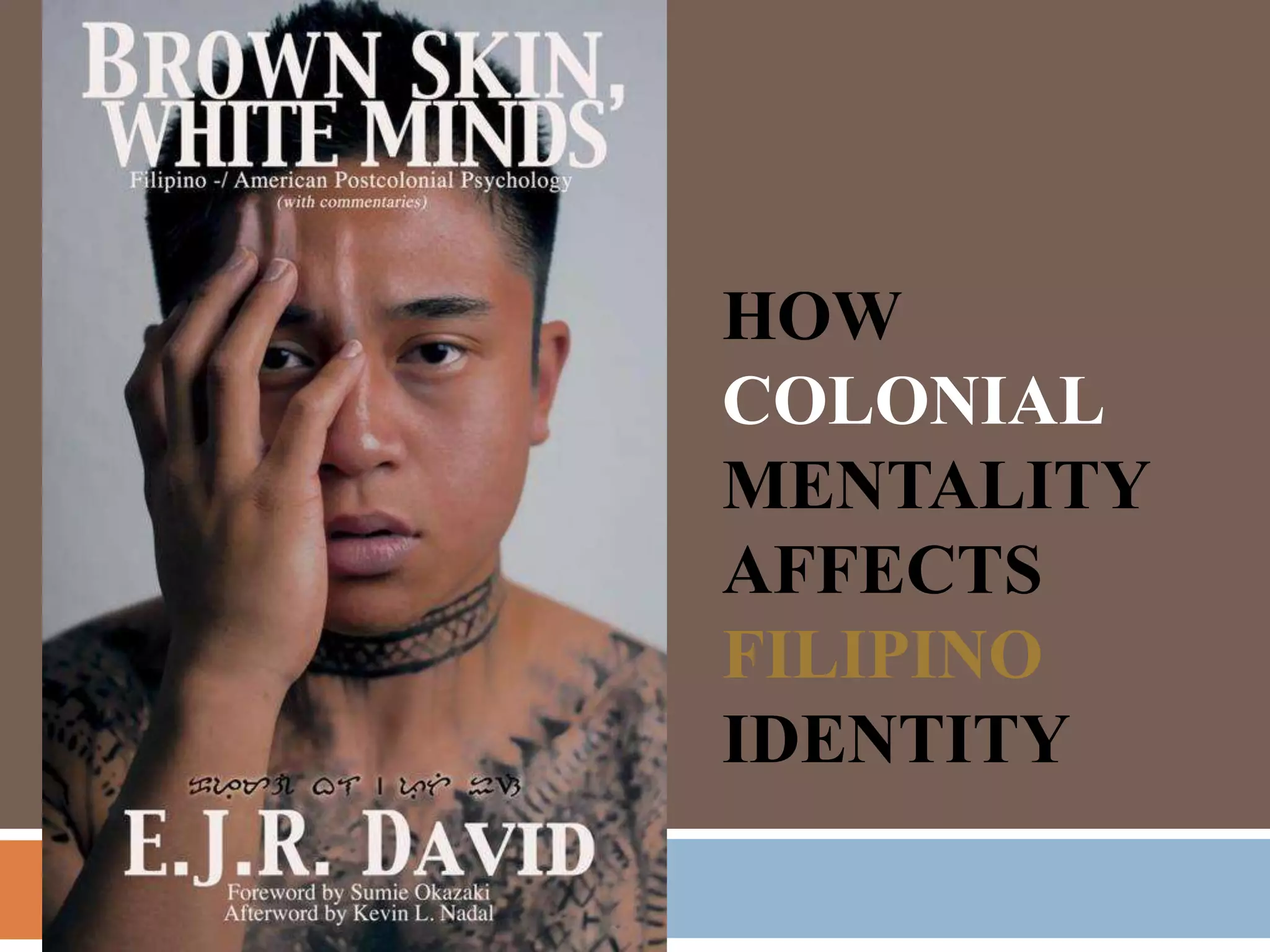
HOW
COLONIAL
MENTALITY
AFFECTS
FILIPINO
IDENTITY
According to Constantino,
colonial mentality, as commonly
understood, “encompasses our
subservient attitudes towards
the colonial ruler as well as our
predisposition towards aping
Western ways”.
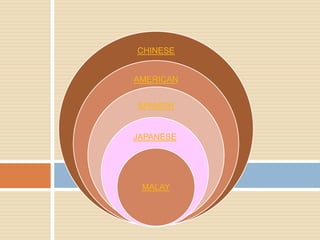
CHINESE
AMERICAN
SPANISH
JAPANESE
MALAY
MALAY
-are one of the ethnicities who came and stayed in
the Philippines.
- Some sources state that they are quite nice and
law-abiding.
-The physical appearance of most Filipinos could
also be traced to the Malays.
- it is believed that the Malays are trained
seafarers—ones who could brave the oceans where
land bridges used to stand.
Japan
Japan conquered the Philippines
for only a few years and was
never truly embraced by the
country. Historians point to the
fact that unlike Spain they were
only here for a few years and
unlike the Americans, they were
very harsh on the Filipinos. As a
result, people did not want to be
like them and their influence has
been minimal.
- One of the most important influences of
the Spanish is Christianity where most
Filipinos had peacefully accepted the
faith.
- the Spanish also changed our
surnames and in 1849, Governor
General Narciso Claveris implemented a
systematic distribution of our surnames
and a Spanish naming system. Thus,
majority of Filipino surnames sound like
Spanish names.
-the Spanish also influenced our cuisine.
Because of this, Philippine cuisine has
become a flavorful and unique
- Through the church, many Filipinos were
also trained in agriculture, language, and
the arts. They brought western
architecture and facilitated the
construction of baroque churches where
Filipinos were able to express their
artistry.
- the Spanish taught us some of the little
pleasures in life such as
procrastination—also known as the
mañana habit—and the joys of having
AMERICAN
- as if they were saving us from another country (first
the Spanish, then the Japanese), we easily loved the
Americans and we embraced their culture quite well.
- Western influence further entered our culture
especially with the spread of education. Filipinos
were taught the English language and we were able to
learn and adapt it easily.
-But perhaps one of the most evident influences that
they have imparted on us is democracy
-Americans basically made the country
look like a mini-US. Today, the
Philippines is very much “westernized”
or Americanized. For the longest time,
products would sell better if it were
called “stateside” and “imported”.
-Filipinos love a lot of things
about American culture such as fast
food, sitcoms and music.
-Furthermore, most Filipinos can
speak a little bit of
English making it very easy to
communicate even
for foreigners. Hollywood movi
es
are flocked, Starbucks is always
filled to the brim and the
latest fashion is followed or
replicated.
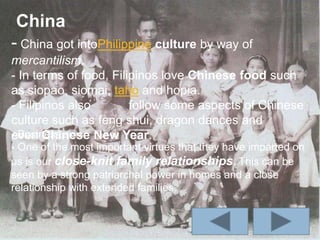
China
- China got intoPhilippine culture by way of
mercantilism.
- In terms of food, Filipinos love Chinese food such
as siopao, siomai, taho and hopia.
- Filipinos also follow some aspects of Chinese
culture such as feng shui, dragon dances and
even Chinese New Year.- Business .
- One of the most important virtues that they have imparted on
us is our close-knit family relationships. This can be
seen by a strong patriarchal power in homes and a close
relationship with extended families.
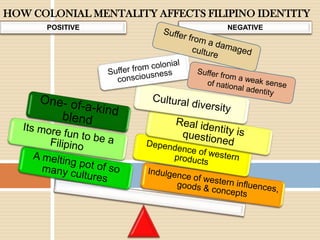
HOW COLONIAL MENTALITY AFFECTS FILIPINO IDENTITY
POSITIVE NEGATIVE
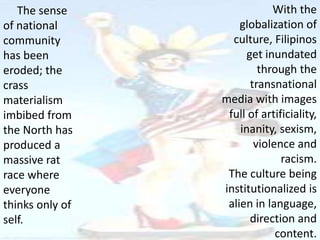
The sense
of national
community
has been
eroded; the
crass
materialism
imbibed from
the North has
produced a
massive rat
race where
everyone
thinks only of
self.
With the
globalization of
culture, Filipinos
get inundated
through the
transnational
media with images
full of artificiality,
inanity, sexism,
violence and
racism.
The culture being
institutionalized is
alien in language,
direction and
content.
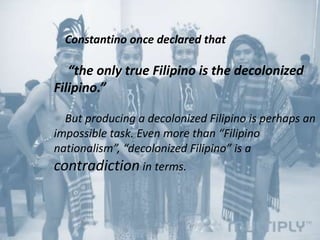
Constantino once declared that
“the only true Filipino is the decolonized
Filipino.”
But producing a decolonized Filipino is perhaps an
impossible task. Even more than “Filipino
nationalism”, “decolonized Filipino” is a
contradiction in terms.

Report(how colonial mentality affects Filipino identity)

  • 1.
  • 2.
    According to Constantino, colonialmentality, as commonly understood, “encompasses our subservient attitudes towards the colonial ruler as well as our predisposition towards aping Western ways”.
  • 3.
  • 4.
    MALAY -are one ofthe ethnicities who came and stayed in the Philippines. - Some sources state that they are quite nice and law-abiding. -The physical appearance of most Filipinos could also be traced to the Malays. - it is believed that the Malays are trained seafarers—ones who could brave the oceans where land bridges used to stand.
  • 5.
    Japan Japan conquered thePhilippines for only a few years and was never truly embraced by the country. Historians point to the fact that unlike Spain they were only here for a few years and unlike the Americans, they were very harsh on the Filipinos. As a result, people did not want to be like them and their influence has been minimal.
  • 6.
    - One ofthe most important influences of the Spanish is Christianity where most Filipinos had peacefully accepted the faith. - the Spanish also changed our surnames and in 1849, Governor General Narciso Claveris implemented a systematic distribution of our surnames and a Spanish naming system. Thus, majority of Filipino surnames sound like Spanish names.
  • 7.
    -the Spanish alsoinfluenced our cuisine. Because of this, Philippine cuisine has become a flavorful and unique - Through the church, many Filipinos were also trained in agriculture, language, and the arts. They brought western architecture and facilitated the construction of baroque churches where Filipinos were able to express their artistry. - the Spanish taught us some of the little pleasures in life such as procrastination—also known as the mañana habit—and the joys of having
  • 8.
    AMERICAN - as ifthey were saving us from another country (first the Spanish, then the Japanese), we easily loved the Americans and we embraced their culture quite well. - Western influence further entered our culture especially with the spread of education. Filipinos were taught the English language and we were able to learn and adapt it easily. -But perhaps one of the most evident influences that they have imparted on us is democracy
  • 9.
    -Americans basically madethe country look like a mini-US. Today, the Philippines is very much “westernized” or Americanized. For the longest time, products would sell better if it were called “stateside” and “imported”. -Filipinos love a lot of things about American culture such as fast food, sitcoms and music.
  • 10.
    -Furthermore, most Filipinoscan speak a little bit of English making it very easy to communicate even for foreigners. Hollywood movi es are flocked, Starbucks is always filled to the brim and the latest fashion is followed or replicated.
  • 11.
    China - China gotintoPhilippine culture by way of mercantilism. - In terms of food, Filipinos love Chinese food such as siopao, siomai, taho and hopia. - Filipinos also follow some aspects of Chinese culture such as feng shui, dragon dances and even Chinese New Year.- Business . - One of the most important virtues that they have imparted on us is our close-knit family relationships. This can be seen by a strong patriarchal power in homes and a close relationship with extended families.
  • 12.
    HOW COLONIAL MENTALITYAFFECTS FILIPINO IDENTITY POSITIVE NEGATIVE
  • 13.
    The sense of national community hasbeen eroded; the crass materialism imbibed from the North has produced a massive rat race where everyone thinks only of self. With the globalization of culture, Filipinos get inundated through the transnational media with images full of artificiality, inanity, sexism, violence and racism. The culture being institutionalized is alien in language, direction and content.
  • 14.
    Constantino once declaredthat “the only true Filipino is the decolonized Filipino.” But producing a decolonized Filipino is perhaps an impossible task. Even more than “Filipino nationalism”, “decolonized Filipino” is a contradiction in terms.