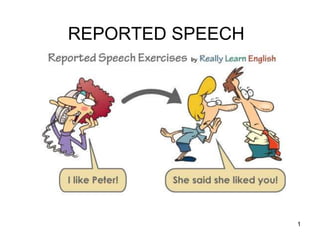
REPORTED SPEECH
1
REPORTED STATEMENTS.
There are no changes in the verbal tenses when the
introductory verb (says, tells, comments, asks, orders..) is
in the present tense:
- “My brother studies German.”
He says (that) his brother studies German.
-“I can hear a bird now.”
-He says (that) he can hear a bird now.
2
However, when the introductory verb is in the past tense
( said, said to me, told me, asked, commented,
suggested, ordered…) there are some changes in the
verbal tenses as well as in personal pronouns, possessive
adjectives, demonstrative and adverbial expressions of
time. All these changes are pretty much the same as those
in Spanish.
3
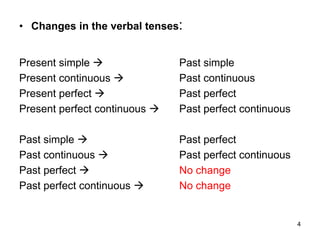
• Changes in the verbal tenses:
Present simple  Past simple
Present continuous  Past continuous
Present perfect  Past perfect
Present perfect continuous  Past perfect continuous
Past simple  Past perfect
Past continuous  Past perfect continuous
Past perfect  No change
Past perfect continuous  No change
4
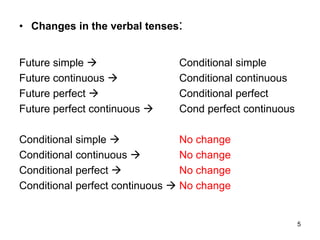
• Changes in the verbal tenses:
Future simple  Conditional simple
Future continuous  Conditional continuous
Future perfect  Conditional perfect
Future perfect continuous  Cond perfect continuous
Conditional simple  No change
Conditional continuous  No change
Conditional perfect  No change
Conditional perfect continuous  No change
5
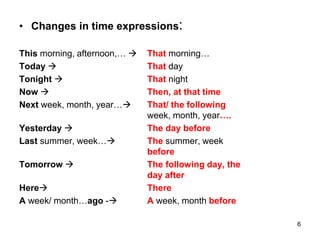
• Changes in time expressions:
This morning, afternoon,…  That morning…
Today  That day
Tonight  That night
Now  Then, at that time
Next week, month, year… That/ the following
week, month, year….
Yesterday  The day before
Last summer, week… The summer, week
before
Tomorrow  The following day, the
day after
Here There
A week/ month…ago - A week, month before
6
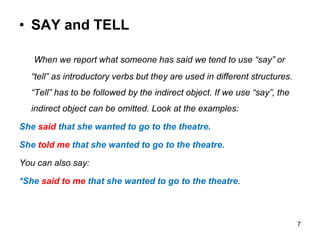
• SAY and TELL
When we report what someone has said we tend to use “say” or
“tell” as introductory verbs but they are used in different structures.
“Tell” has to be followed by the indirect object. If we use “say”, the
indirect object can be omitted. Look at the examples:
She said that she wanted to go to the theatre.
She told me that she wanted to go to the theatre.
You can also say:
*She said to me that she wanted to go to the theatre.
7
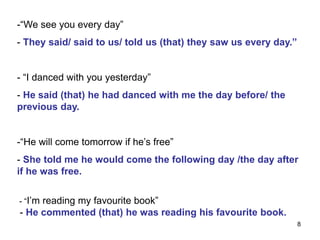
-“We see you every day”
- They said/ said to us/ told us (that) they saw us every day.”
- “I danced with you yesterday”
- He said (that) he had danced with me the day before/ the
previous day.
-“He will come tomorrow if he’s free”
- She told me he would come the following day /the day after
if he was free.
- “I’m reading my favourite book”
- He commented (that) he was reading his favourite book.
8
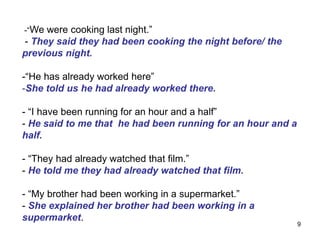
-“We were cooking last night.”
- They said they had been cooking the night before/ the
previous night.
-“He has already worked here”
-She told us he had already worked there.
- “I have been running for an hour and a half”
- He said to me that he had been running for an hour and a
half.
- “They had already watched that film.”
- He told me they had already watched that film.
- “My brother had been working in a supermarket.”
- She explained her brother had been working in a
supermarket.
9
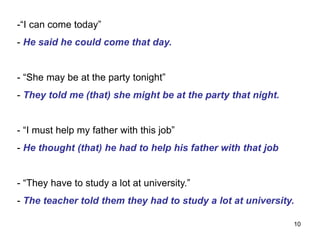
-“I can come today”
- He said he could come that day.
- “She may be at the party tonight”
- They told me (that) she might be at the party that night.
- “I must help my father with this job”
- He thought (that) he had to help his father with that job
- “They have to study a lot at university.”
- The teacher told them they had to study a lot at university.
10
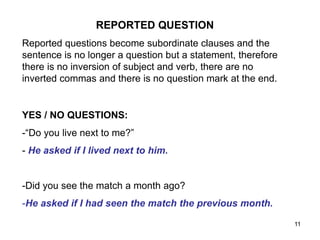
REPORTED QUESTION
Reported questions become subordinate clauses and the
sentence is no longer a question but a statement, therefore
there is no inversion of subject and verb, there are no
inverted commas and there is no question mark at the end.
YES / NO QUESTIONS:
-“Do you live next to me?”
- He asked if I lived next to him.
-Did you see the match a month ago?
-He asked if I had seen the match the previous month.
11
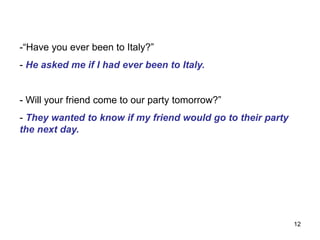
-“Have you ever been to Italy?”
- He asked me if I had ever been to Italy.
- Will your friend come to our party tomorrow?”
- They wanted to know if my friend would go to their party
the next day.
12
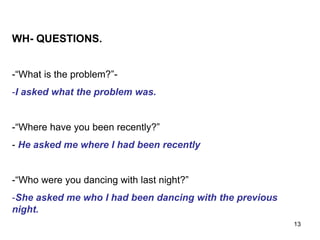
WH- QUESTIONS.
-“What is the problem?”-
-I asked what the problem was.
-“Where have you been recently?”
- He asked me where I had been recently
-“Who were you dancing with last night?”
-She asked me who I had been dancing with the previous
night.
13
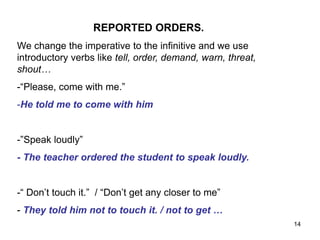
REPORTED ORDERS.
We change the imperative to the infinitive and we use
introductory verbs like tell, order, demand, warn, threat,
shout…
-“Please, come with me.”
-He told me to come with him
-”Speak loudly”
- The teacher ordered the student to speak loudly.
-“ Don’t touch it.” / “Don’t get any closer to me”
- They told him not to touch it. / not to get …
14
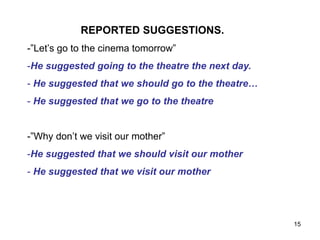
REPORTED SUGGESTIONS.
-”Let’s go to the cinema tomorrow”
-He suggested going to the theatre the next day.
- He suggested that we should go to the theatre…
- He suggested that we go to the theatre
-”Why don’t we visit our mother”
-He suggested that we should visit our mother
- He suggested that we visit our mother
15
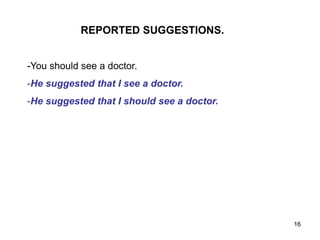
REPORTED SUGGESTIONS.
-You should see a doctor.
-He suggested that I see a doctor.
-He suggested that I should see a doctor.
16

Reported speech

  • 1.
  • 2.
    REPORTED STATEMENTS. There areno changes in the verbal tenses when the introductory verb (says, tells, comments, asks, orders..) is in the present tense: - “My brother studies German.” He says (that) his brother studies German. -“I can hear a bird now.” -He says (that) he can hear a bird now. 2
  • 3.
    However, when theintroductory verb is in the past tense ( said, said to me, told me, asked, commented, suggested, ordered…) there are some changes in the verbal tenses as well as in personal pronouns, possessive adjectives, demonstrative and adverbial expressions of time. All these changes are pretty much the same as those in Spanish. 3
  • 4.
    • Changes inthe verbal tenses: Present simple  Past simple Present continuous  Past continuous Present perfect  Past perfect Present perfect continuous  Past perfect continuous Past simple  Past perfect Past continuous  Past perfect continuous Past perfect  No change Past perfect continuous  No change 4
  • 5.
    • Changes inthe verbal tenses: Future simple  Conditional simple Future continuous  Conditional continuous Future perfect  Conditional perfect Future perfect continuous  Cond perfect continuous Conditional simple  No change Conditional continuous  No change Conditional perfect  No change Conditional perfect continuous  No change 5
  • 6.
    • Changes intime expressions: This morning, afternoon,…  That morning… Today  That day Tonight  That night Now  Then, at that time Next week, month, year… That/ the following week, month, year…. Yesterday  The day before Last summer, week… The summer, week before Tomorrow  The following day, the day after Here There A week/ month…ago - A week, month before 6
  • 7.
    • SAY andTELL When we report what someone has said we tend to use “say” or “tell” as introductory verbs but they are used in different structures. “Tell” has to be followed by the indirect object. If we use “say”, the indirect object can be omitted. Look at the examples: She said that she wanted to go to the theatre. She told me that she wanted to go to the theatre. You can also say: *She said to me that she wanted to go to the theatre. 7
  • 8.
    -“We see youevery day” - They said/ said to us/ told us (that) they saw us every day.” - “I danced with you yesterday” - He said (that) he had danced with me the day before/ the previous day. -“He will come tomorrow if he’s free” - She told me he would come the following day /the day after if he was free. - “I’m reading my favourite book” - He commented (that) he was reading his favourite book. 8
  • 9.
    -“We were cookinglast night.” - They said they had been cooking the night before/ the previous night. -“He has already worked here” -She told us he had already worked there. - “I have been running for an hour and a half” - He said to me that he had been running for an hour and a half. - “They had already watched that film.” - He told me they had already watched that film. - “My brother had been working in a supermarket.” - She explained her brother had been working in a supermarket. 9
  • 10.
    -“I can cometoday” - He said he could come that day. - “She may be at the party tonight” - They told me (that) she might be at the party that night. - “I must help my father with this job” - He thought (that) he had to help his father with that job - “They have to study a lot at university.” - The teacher told them they had to study a lot at university. 10
  • 11.
    REPORTED QUESTION Reported questionsbecome subordinate clauses and the sentence is no longer a question but a statement, therefore there is no inversion of subject and verb, there are no inverted commas and there is no question mark at the end. YES / NO QUESTIONS: -“Do you live next to me?” - He asked if I lived next to him. -Did you see the match a month ago? -He asked if I had seen the match the previous month. 11
  • 12.
    -“Have you everbeen to Italy?” - He asked me if I had ever been to Italy. - Will your friend come to our party tomorrow?” - They wanted to know if my friend would go to their party the next day. 12
  • 13.
    WH- QUESTIONS. -“What isthe problem?”- -I asked what the problem was. -“Where have you been recently?” - He asked me where I had been recently -“Who were you dancing with last night?” -She asked me who I had been dancing with the previous night. 13
  • 14.
    REPORTED ORDERS. We changethe imperative to the infinitive and we use introductory verbs like tell, order, demand, warn, threat, shout… -“Please, come with me.” -He told me to come with him -”Speak loudly” - The teacher ordered the student to speak loudly. -“ Don’t touch it.” / “Don’t get any closer to me” - They told him not to touch it. / not to get … 14
  • 15.
    REPORTED SUGGESTIONS. -”Let’s goto the cinema tomorrow” -He suggested going to the theatre the next day. - He suggested that we should go to the theatre… - He suggested that we go to the theatre -”Why don’t we visit our mother” -He suggested that we should visit our mother - He suggested that we visit our mother 15
  • 16.
    REPORTED SUGGESTIONS. -You shouldsee a doctor. -He suggested that I see a doctor. -He suggested that I should see a doctor. 16