
Report Writing
Presidential Security Inc.
The goal of good note taking is to allow the writers to
record a concise, accurate account of daily occurrences
in theirnotebooks.
The purposes of yournotebook
Presidential Security Inc.
 To aid you in recalling details, and providing
accurate testimony - Names and addresses of
witnesses, descriptions of things,
measurements that are taken, locations of key
events, and so on.
 As a basis for writing a report - A good
notebook will allow you to accurately portray
the chain of events that took place for the
police, your supervisor, or the client.
The purposes of yournotebook
Presidential Security Inc
 As an investigative aid – Taking notes may
help you organize the material you have
accumulated. Going over the facts and
placing them in chronological order may
assist you in putting the entire puzzle
together.
 As a reflection of your work and ability - An
efficient, neat, and well-organized notebook
reflects your organizational skills and abilities.
The quality of your notes reflects the amount
of effort that you put into your work.
How should you keep your
notebook?
Presidential Security Inc.
 As neat as possible
 Organized Chronologically
 No obliterations ( A page torn out may give the
impression that you were trying to remove
information)
 Entries should be as legible as possible
(remember that the notebook is property of
your employer)
Important tips
Presidential Security Inc
 Carry your notebook with you at all times when you are
on duty;
 Only use the special notebook with numbered pages
that your employer gives you;
 Make sure your notes are detailed and easy to read
because they may be read by many different people for
many different reasons;
 Use an objective voice - Avoid writing opinions;
 Use the 24 hour clock to make writing your timings
clearer;
 You can improve your report writing skills at all parts of
the process: before writing, during writing or after
writing;
 Good notes can help you prepare to make a reliable
testimony in court.
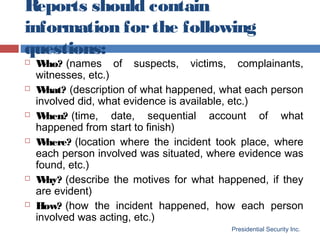
Reports should contain
information forthe following
questions:
Presidential Security Inc.
 Who? (names of suspects, victims, complainants,
witnesses, etc.)
 What? (description of what happened, what each person
involved did, what evidence is available, etc.)
 When? (time, date, sequential account of what
happened from start to finish)
 Where? (location where the incident took place, where
each person involved was situated, where evidence was
found, etc.)
 Why? (describe the motives for what happened, if they
are evident)
 How? (how the incident happened, how each person
involved was acting, etc.)
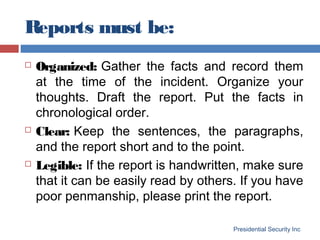
Reports must be:
Presidential Security Inc
 Organized: Gather the facts and record them
at the time of the incident. Organize your
thoughts. Draft the report. Put the facts in
chronological order.
 Clear: Keep the sentences, the paragraphs,
and the report short and to the point.
 Legible: If the report is handwritten, make sure
that it can be easily read by others. If you have
poor penmanship, please print the report.
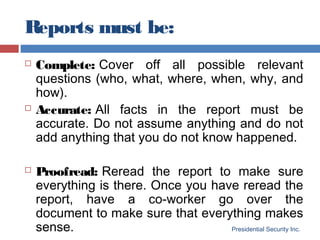
Reports must be:
Presidential Security Inc.
 Complete: Cover off all possible relevant
questions (who, what, where, when, why, and
how).
 Accurate: All facts in the report must be
accurate. Do not assume anything and do not
add anything that you do not know happened.
 Proofread: Reread the report to make sure
everything is there. Once you have reread the
report, have a co-worker go over the
document to make sure that everything makes
sense.
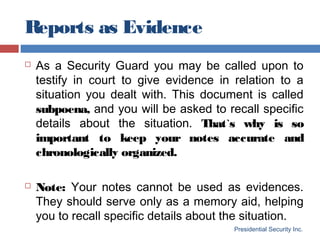
Reports as Evidence
Presidential Security Inc.
 As a Security Guard you may be called upon to
testify in court to give evidence in relation to a
situation you dealt with. This document is called
subpoena, and you will be asked to recall specific
details about the situation. That`s why is so
important to keep your notes accurate and
chronologically organized.
 Note: Your notes cannot be used as evidences.
They should serve only as a memory aid, helping
you to recall specific details about the situation.
Remember
Presidential Security Inc.
 Reports should contain factual information
and observation.
 Reports should not contain personal opinions
or assumptions.

Report writing

  • 1.
    Report Writing Presidential SecurityInc. The goal of good note taking is to allow the writers to record a concise, accurate account of daily occurrences in theirnotebooks.
  • 2.
    The purposes ofyournotebook Presidential Security Inc.  To aid you in recalling details, and providing accurate testimony - Names and addresses of witnesses, descriptions of things, measurements that are taken, locations of key events, and so on.  As a basis for writing a report - A good notebook will allow you to accurately portray the chain of events that took place for the police, your supervisor, or the client.
  • 3.
    The purposes ofyournotebook Presidential Security Inc  As an investigative aid – Taking notes may help you organize the material you have accumulated. Going over the facts and placing them in chronological order may assist you in putting the entire puzzle together.  As a reflection of your work and ability - An efficient, neat, and well-organized notebook reflects your organizational skills and abilities. The quality of your notes reflects the amount of effort that you put into your work.
  • 4.
    How should youkeep your notebook? Presidential Security Inc.  As neat as possible  Organized Chronologically  No obliterations ( A page torn out may give the impression that you were trying to remove information)  Entries should be as legible as possible (remember that the notebook is property of your employer)
  • 5.
    Important tips Presidential SecurityInc  Carry your notebook with you at all times when you are on duty;  Only use the special notebook with numbered pages that your employer gives you;  Make sure your notes are detailed and easy to read because they may be read by many different people for many different reasons;  Use an objective voice - Avoid writing opinions;  Use the 24 hour clock to make writing your timings clearer;  You can improve your report writing skills at all parts of the process: before writing, during writing or after writing;  Good notes can help you prepare to make a reliable testimony in court.
  • 6.
    Reports should contain informationforthe following questions: Presidential Security Inc.  Who? (names of suspects, victims, complainants, witnesses, etc.)  What? (description of what happened, what each person involved did, what evidence is available, etc.)  When? (time, date, sequential account of what happened from start to finish)  Where? (location where the incident took place, where each person involved was situated, where evidence was found, etc.)  Why? (describe the motives for what happened, if they are evident)  How? (how the incident happened, how each person involved was acting, etc.)
  • 7.
    Reports must be: PresidentialSecurity Inc  Organized: Gather the facts and record them at the time of the incident. Organize your thoughts. Draft the report. Put the facts in chronological order.  Clear: Keep the sentences, the paragraphs, and the report short and to the point.  Legible: If the report is handwritten, make sure that it can be easily read by others. If you have poor penmanship, please print the report.
  • 8.
    Reports must be: PresidentialSecurity Inc.  Complete: Cover off all possible relevant questions (who, what, where, when, why, and how).  Accurate: All facts in the report must be accurate. Do not assume anything and do not add anything that you do not know happened.  Proofread: Reread the report to make sure everything is there. Once you have reread the report, have a co-worker go over the document to make sure that everything makes sense.
  • 9.
    Reports as Evidence PresidentialSecurity Inc.  As a Security Guard you may be called upon to testify in court to give evidence in relation to a situation you dealt with. This document is called subpoena, and you will be asked to recall specific details about the situation. That`s why is so important to keep your notes accurate and chronologically organized.  Note: Your notes cannot be used as evidences. They should serve only as a memory aid, helping you to recall specific details about the situation.
  • 10.
    Remember Presidential Security Inc. Reports should contain factual information and observation.  Reports should not contain personal opinions or assumptions.