TECHNICAL ENGLISH 1
(TECHNICAL REPORT
WRITING AND
PRESENTATION)
UNIT III – TYPES AND FORMATS OF POLICE
REPORTS
• Police Blotter
• Certification of Police Blotter Excerpt
• Memorandum
POLICE REPORTS
are document that states all of the
facts, circumstances, and timeline of
events surrounding an incident
POLICE REPORTS
may vary from agency to agency
including the protocol which is to be
followed when completing one
POLICE BLOTTER
POLICE BLOTTER
record of daily events occurring within
the territories/jurisdiction of a given
police unit or command
POLICE BLOTTER
contains material detail concerning
the event for legal and statistical
purposes
POLICE BLOTTER
an informational record book that is
utilized for evidentiary or referral
purposes
• Circular Number 05, issued by the
General Headquarters, Philippine
National Police, dated December 10,
1992, is the rule “Prescribing a
Uniform Police Blotter for the
Philippine National Police”
•This rule shall be followed by the
different police officers and units
throughout the country in making
an entry of events and incidents
on the police blotter.
A. Contents of Entry
• The entry in the police blotter should
answer the following cardinal
elements of a police record, to wit:
who; what; why; where; when; how;
and disposition of the case
B. Incidents to be recorded
1. All violations of laws and ordinances
reported and discovered;
2. All calls in which any member of the
police force is dispatched or has taken
an official action;
B. Incidents to be recorded
3. All legal papers handled such warrants,
subpoenas, summonses, citations, and
the like;
4. All fire alarm reports and information
received by the stations;
B. Incidents to be recorded
5. Movements of prisoners with
corresponding notations on the
authority for such movements;
6. Cases of missing and found persons,
animals and properties;
B. Incidents to be recorded
7. Vehicular and other types of accidents
which require police actions;
8. All personal injuries, bodies found, and
suicides;
9. Damage to property;
B. Incidents to be recorded
10.All cases in which a police member
is involved;
11.All arrests and returns made; and
B. Incidents to be recorded
12.Miscellaneous cases, general and
special orders, violations of rules
and regulations and any other
reportable incident that the Chief of
Police desires to be recorded.
C. Procedure in Making Entries
1. All entries in the police blotter shall be
handwritten in a clear, concise and
simple manner but answering as far as
practicable the 5Ws and 1H. Clarity
should not be sacrificed for brevity.
C. Procedure in Making Entries
2. Only facts, not opinions, are entered
in the blotter.
3. No erasures shall be made on the
entries.
C. Procedure in Making Entries
4. A ball pen with blue, black or blue
black ink is used for making the
entries.
C. Procedure in Making Entries
5. Misrepresentation in the blotter or
any attempt to suppress any
information therein are punishable
criminally and administratively.
C. Procedure in Making Entries
6. The entries must be legibly written
in long hand and consecutively
numbered.
C. Procedure in Making Entries
7. Every page of the blotter shall be
consecutively or chronologically
filled up. No line of space shall be
left blank between any two entries.
C. Procedure in Making Entries
8. Any development of a case to be
reflected in the blotter should be a new
entry at the time and day it was
reported. A reference to the previous
entry number of the case, however,
should be made.
C. Procedure in Making Entries
9. In every shift, the Duty Sergeant, under the
supervision of the Duty Officer or Complaint
Desk Officer, shall make the actual entries in the
blotter and at the end of his tour of duty, both the
Duty Sergeant and Duty Complaint Desk Officer
shall sign the blotter.
CERTIFICATION OF
POLICE BLOTTER
EXCERPT
•It should be copied verbatimly,
meaning, it should be copied word
for word and not correction in the
grammar or in any mistake should
be made in the entry.
MEMORANDUM
MEMORANDUM
common practices of inter office
communication in the police service
MEMORANDUM
“a note to help the memory”
•It maybe general in application,
requiring compliance by, or
information of a majority of all the
officers and members of the
police organization.
• It may be also of a limited
application, such as those directed
to, or group of individuals, within a
particular police unit, directorate,
service, region, province, station or
section.
•Police executives may issue
administrative instructions in the
form of a memorandum.
•Subordinate officials may use this
form, only on matters advisory or
informative in nature.
A. Tones of memorandum
• From a chief of office to his
subordinates, the tone is impersonal
“For guidance and strict compliance.”
A. Tones of memorandum
• From a writer sending a memorandum to
somebody of equal rank, the tone is
casually personal
“The undersigned noticed changes in. . .”
A. Tones of memorandum
• A subordinate police officer writing a
memorandum to a higher police officer
uses a more formal tone
“For info and request acknowledge.”
• Police organization adopts memoranda in the ff
general usage:
to inform;
to answer;
to record a significant event;
special reports;
basic transmittals, and
for some other purposes.
B. Parts of a Memorandum
1. Heading
B. Parts of a Memorandum
1. Heading
a. Letterhead
B. Parts of a Memorandum
1. Heading
b. File Reference or Office Symbol
B. Parts of a Memorandum
1. Heading
c. Addressee
B. Parts of a Memorandum
1. Heading
d. Addressor
B. Parts of a Memorandum
1. Heading
e. Channels
B. Parts of a Memorandum
1. Heading
f. Attention Address
B. Parts of a Memorandum
1. Heading
g. Subject
B. Parts of a Memorandum
1. Heading
h. Date
B. Parts of a Memorandum
2. Body
B. Parts of a Memorandum
2. Body
a. Paragraphing
B. Parts of a Memorandum
2. Body
b. Abbreviations
a) PDIR – stands for Police Director
b) PCSUPT – stands for Police Chief
Superintendent
c) PSINP – stands for Police Senior Inspector
B. Parts of a Memorandum
2. Body
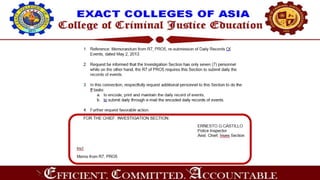
c. References
B. Parts of a Memorandum
2. Body
d. Page Numbering
B. Parts of a Memorandum
2. Body
e. Dividing a Paragraph
B. Parts of a Memorandum
3. Complimentary Ending
B. Parts of a Memorandum
3. Complimentary Ending
a. Authority Line
B. Parts of a Memorandum
3. Complimentary Ending
b. Signature
• The use of double signatures should
be avoided. Instead of this, a
designated individual may sign his
own name and add the word “FOR”
in front of the typewritten name in the
signature.
B. Parts of a Memorandum
3. Complimentary Ending
c. Enclosures
ANY
QUESTION/S?

technical report writing presentation -3.pptx

  • 1.
    TECHNICAL ENGLISH 1 (TECHNICALREPORT WRITING AND PRESENTATION)
  • 2.
    UNIT III –TYPES AND FORMATS OF POLICE REPORTS • Police Blotter • Certification of Police Blotter Excerpt • Memorandum
  • 3.
    POLICE REPORTS are documentthat states all of the facts, circumstances, and timeline of events surrounding an incident
  • 4.
    POLICE REPORTS may varyfrom agency to agency including the protocol which is to be followed when completing one
  • 5.
  • 6.
    POLICE BLOTTER record ofdaily events occurring within the territories/jurisdiction of a given police unit or command
  • 7.
    POLICE BLOTTER contains materialdetail concerning the event for legal and statistical purposes
  • 8.
    POLICE BLOTTER an informationalrecord book that is utilized for evidentiary or referral purposes
  • 9.
    • Circular Number05, issued by the General Headquarters, Philippine National Police, dated December 10, 1992, is the rule “Prescribing a Uniform Police Blotter for the Philippine National Police”
  • 10.
    •This rule shallbe followed by the different police officers and units throughout the country in making an entry of events and incidents on the police blotter.
  • 13.
    A. Contents ofEntry • The entry in the police blotter should answer the following cardinal elements of a police record, to wit: who; what; why; where; when; how; and disposition of the case
  • 14.
    B. Incidents tobe recorded 1. All violations of laws and ordinances reported and discovered; 2. All calls in which any member of the police force is dispatched or has taken an official action;
  • 15.
    B. Incidents tobe recorded 3. All legal papers handled such warrants, subpoenas, summonses, citations, and the like; 4. All fire alarm reports and information received by the stations;
  • 16.
    B. Incidents tobe recorded 5. Movements of prisoners with corresponding notations on the authority for such movements; 6. Cases of missing and found persons, animals and properties;
  • 17.
    B. Incidents tobe recorded 7. Vehicular and other types of accidents which require police actions; 8. All personal injuries, bodies found, and suicides; 9. Damage to property;
  • 18.
    B. Incidents tobe recorded 10.All cases in which a police member is involved; 11.All arrests and returns made; and
  • 19.
    B. Incidents tobe recorded 12.Miscellaneous cases, general and special orders, violations of rules and regulations and any other reportable incident that the Chief of Police desires to be recorded.
  • 20.
    C. Procedure inMaking Entries 1. All entries in the police blotter shall be handwritten in a clear, concise and simple manner but answering as far as practicable the 5Ws and 1H. Clarity should not be sacrificed for brevity.
  • 21.
    C. Procedure inMaking Entries 2. Only facts, not opinions, are entered in the blotter. 3. No erasures shall be made on the entries.
  • 22.
    C. Procedure inMaking Entries 4. A ball pen with blue, black or blue black ink is used for making the entries.
  • 23.
    C. Procedure inMaking Entries 5. Misrepresentation in the blotter or any attempt to suppress any information therein are punishable criminally and administratively.
  • 24.
    C. Procedure inMaking Entries 6. The entries must be legibly written in long hand and consecutively numbered.
  • 25.
    C. Procedure inMaking Entries 7. Every page of the blotter shall be consecutively or chronologically filled up. No line of space shall be left blank between any two entries.
  • 26.
    C. Procedure inMaking Entries 8. Any development of a case to be reflected in the blotter should be a new entry at the time and day it was reported. A reference to the previous entry number of the case, however, should be made.
  • 27.
    C. Procedure inMaking Entries 9. In every shift, the Duty Sergeant, under the supervision of the Duty Officer or Complaint Desk Officer, shall make the actual entries in the blotter and at the end of his tour of duty, both the Duty Sergeant and Duty Complaint Desk Officer shall sign the blotter.
  • 28.
  • 29.
    •It should becopied verbatimly, meaning, it should be copied word for word and not correction in the grammar or in any mistake should be made in the entry.
  • 30.
  • 31.
    MEMORANDUM common practices ofinter office communication in the police service
  • 32.
    MEMORANDUM “a note tohelp the memory”
  • 33.
    •It maybe generalin application, requiring compliance by, or information of a majority of all the officers and members of the police organization.
  • 34.
    • It maybe also of a limited application, such as those directed to, or group of individuals, within a particular police unit, directorate, service, region, province, station or section.
  • 35.
    •Police executives mayissue administrative instructions in the form of a memorandum.
  • 36.
    •Subordinate officials mayuse this form, only on matters advisory or informative in nature.
  • 37.
    A. Tones ofmemorandum • From a chief of office to his subordinates, the tone is impersonal “For guidance and strict compliance.”
  • 38.
    A. Tones ofmemorandum • From a writer sending a memorandum to somebody of equal rank, the tone is casually personal “The undersigned noticed changes in. . .”
  • 39.
    A. Tones ofmemorandum • A subordinate police officer writing a memorandum to a higher police officer uses a more formal tone “For info and request acknowledge.”
  • 40.
    • Police organizationadopts memoranda in the ff general usage: to inform; to answer; to record a significant event; special reports; basic transmittals, and for some other purposes.
  • 41.
    B. Parts ofa Memorandum 1. Heading
  • 43.
    B. Parts ofa Memorandum 1. Heading a. Letterhead
  • 45.
    B. Parts ofa Memorandum 1. Heading b. File Reference or Office Symbol
  • 47.
    B. Parts ofa Memorandum 1. Heading c. Addressee
  • 50.
    B. Parts ofa Memorandum 1. Heading d. Addressor
  • 52.
    B. Parts ofa Memorandum 1. Heading e. Channels
  • 54.
    B. Parts ofa Memorandum 1. Heading f. Attention Address
  • 56.
    B. Parts ofa Memorandum 1. Heading g. Subject
  • 58.
    B. Parts ofa Memorandum 1. Heading h. Date
  • 60.
    B. Parts ofa Memorandum 2. Body
  • 62.
    B. Parts ofa Memorandum 2. Body a. Paragraphing
  • 64.
    B. Parts ofa Memorandum 2. Body b. Abbreviations a) PDIR – stands for Police Director b) PCSUPT – stands for Police Chief Superintendent c) PSINP – stands for Police Senior Inspector
  • 65.
    B. Parts ofa Memorandum 2. Body c. References
  • 67.
    B. Parts ofa Memorandum 2. Body d. Page Numbering
  • 68.
    B. Parts ofa Memorandum 2. Body e. Dividing a Paragraph
  • 69.
    B. Parts ofa Memorandum 3. Complimentary Ending
  • 71.
    B. Parts ofa Memorandum 3. Complimentary Ending a. Authority Line
  • 73.
    B. Parts ofa Memorandum 3. Complimentary Ending b. Signature
  • 75.
    • The useof double signatures should be avoided. Instead of this, a designated individual may sign his own name and add the word “FOR” in front of the typewritten name in the signature.
  • 77.
    B. Parts ofa Memorandum 3. Complimentary Ending c. Enclosures
  • 79.

Editor's Notes

  • #14 The names of the suspect/s ; the victim/s; the eyewitness/es, if any; the nature of the action or offense; the possible motive/s; the place; the date and time of occurrence; significant circumstances that aggravate or mitigate the event or the crime should be entered along with the identity of the officer to whom the case is assigned – officer-on-cases; and the status of the case
  • #30 For whatever legal purpose, interested persons always seek a copy of a police blotter. Obviously mistakes in the entry should be consulted to the Desk Officer who made the entry and he is the only person authorized to correct it based on the procedures previously discussed.
  • #37 ROUTINE MEMORANDUM is presently resorting to a “bottom line” technique to enable the police executives to know right away what had been done about the problem at hand.
  • #38 There is no strict rule governing the tone of memorandum. However, it is usually noted that the tone differs in accordance with the person/persons reading it.
  • #42 All the materials above the first line of the body comprise the heading
  • #44 Printed Letterhead stationery is normally used for the first page. If not available, a typed letterhead may be used. Each office has its own letterhead. In offices where more than one kind of letterhead is used, the nature of the letter will determine which letterhead is proper. The top edge of the letterhead is normally placed ¾ inch or on the fifth line below the top edge of the paper.
  • #46 It is placed at the left margin, usually two (2) spaces below the letterhead. Each part of the references are also used as identifying information on the second and subsequent pages.
  • #48 The title of the addressee is entered after the “MEMORANDUM FOR” if sent to a superior office, “MEMORANDUM TO” if sent to subordinates. It should be written in block style with open punctuation and normally placed two (2) spaces after the file reference
  • #51 The title of the addressor (sender) is entered after “FROM”. Authorized abbreviations are used.
  • #53 Correspondence can be routed THRU channels, through a lower Chief or Supervisor expected to exercise control, taken action or to be concerned and normally placed two (2) spaces after the addressee.
  • #55 To speed routing, correspondence may be addressed to the attention of an individual or head of a subdivision of an agency, or an office, either by reference to the name of the subdivision or by the use of an office symbol. The name will be used only when there is a special reason for calling the letter to the attention of the individual known to handle the type of correspondence concerned and when it is known that he/she will at the place addressed.
  • #57 The subject line should contain not exceeding ten (10) words. It starts two (2) spaces below the addressor. Titles capitalization rules may be used. This means capital letter for the first letter and other important words, and small letters for the unimportant ones. When the subject extends to two lines, the second line is blocked under the first letter of the first word i the subject.
  • #59 This refers to the date of signature and it is placed at the left portion of the page on the last line below the subject. The day and year are numerals and the month may be spelled out or abbreviated. If the month is abbreviated, the year must be shortened to.
  • #61 The body of the letter is the message itself. It is the substance of the typed letter as distinct from the formal beginning and ending. This part of the letter is single-spaced. The use of the third person, such as “the undersigned”, “this unit” or “this office” is prescribed to achieve objectivity.
  • #63 When a letter consists of only one paragraph, the paragraph will not be numbered, although its sub-paragraph will be lettered, If there are two or more. When there are two (2) or more paragraph, they will be numbered consecutively. The second succeeding lines will begin at the left margin.
  • #65 This kind of communication allows abbreviations which are generally accepted in the police service. They are usually written without spacing or periods, except geographical locations which can be written with or without periods. If the full name is used, the abbreviated rank is permissible, if family name only, the rank is spelled out. However, good practice tells the writer to use abbreviations sparingly. But definitely, abbreviations are not used in correspondence going outside the Philippine National Police.
  • #66 References to publications must be specific and fully identified. References will not be made to a publication or document which is not available to the addresses of the correspondence. References to correspondence will include the type of correspondence, file reference, office origin, date and subject.
  • #68 The first page should not be numbered (silent Pagination). Subsequent pages, including those on which endorsements are prepared, will be numbered consecutively, beginning with the second page as 2. Page number will be centered 1 inch from the bottom of the page. The number will stand by itself; it will not be set off by dashes, parenthesis or other punctuations.
  • #69 Three (3) or fewer lines will not be divided between pages. In dividing a sentence between pages, at least two (2) words will appear on each page. The complimentary ending will not appear alone on a page without a part of a body or text. When the space below the text is not sufficient for the close, at least two (2) lines of the paragraph or sub-paragraph which in it’s entirely consist of only one (1) line may be placed on the last page together with the complimentary ending. The complimentary ending will not appear alone on a page without a part of a body or text. When the space below the text is not sufficient for the close, at least two (2) lines of the paragraph or sub-paragraph which in it’s entirely consist of only one (1) line may be placed on the last page together with the complimentary ending
  • #70 Complimentary Ending refers to the material found below the last paragraph of the body.
  • #71 The authority line will begin on the second line below the last paragraph directly under the first letter of the first word of the preceding main paragraph. It is typed in capital letter without abbreviations. Note: A staff officer may sign under the authority line only when authorized to do so.
  • #72 An authority line will be shown when the correspondence is signed for the chief or head of office by an individual authorized to do so. This reflects the fact that the communication is an expression of the will of the chief or head of office.
  • #73 The authority line will begin on the second line below the last paragraph directly under the first letter of the first word of the preceding main paragraph. It is typed in capital letter without abbreviations. Note: A staff officer may sign under the authority line only when authorized to do so.
  • #74 The signature contains the name of the officer, sign in ink (black or blue-black, never blue or any other color); the name being typed, stamped or printed in capital letters identical with the written name, the officer’s rank or service and title or designation.
  • #78 Enclosures are supplementary documents which are sent with communications to provide additional information. When a letter has one or more enclosures, this fact is entered at the left side of the page.