Theme 
The Search for Meaning
What is a Theme? 
Theme: Life lesson, meaning, moral, or 
message about life or human nature that 
is communicated by a literary work. 
In other words… 
Theme is what the story teaches readers.
Themes 
A theme is not a word, it is a sentence. 
You don’t have to agree with the theme to 
identify it. 
.
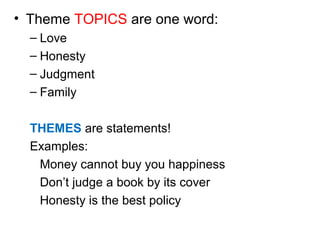
• Theme TOPICS are one word: 
– Love 
– Honesty 
– Judgment 
– Family 
THEMES are statements! 
Examples: 
Money cannot buy you happiness 
Don’t judge a book by its cover 
Honesty is the best policy
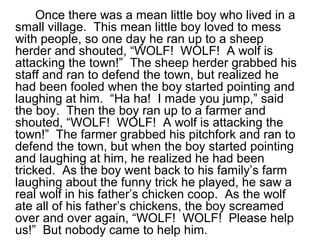
Once there was a mean little boy who lived in a 
small village. This mean little boy loved to mess 
with people, so one day he ran up to a sheep 
herder and shouted, “WOLF! WOLF! A wolf is 
attacking the town!” The sheep herder grabbed his 
staff and ran to defend the town, but realized he 
had been fooled when the boy started pointing and 
laughing at him. “Ha ha! I made you jump,” said 
the boy. Then the boy ran up to a farmer and 
shouted, “WOLF! WOLF! A wolf is attacking the 
town!” The farmer grabbed his pitchfork and ran to 
defend the town, but when the boy started pointing 
and laughing at him, he realized he had been 
tricked. As the boy went back to his family’s farm 
laughing about the funny trick he played, he saw a 
real wolf in his father’s chicken coop. As the wolf 
ate all of his father’s chickens, the boy screamed 
over and over again, “WOLF! WOLF! Please help 
us!” But nobody came to help him.
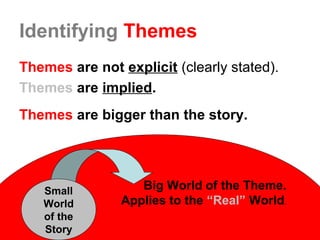
Identifying Themes 
Themes are not explicit (clearly stated). 
Themes are implied. 
Themes are bigger than the story. 
Big World of the Theme. 
Applies to the “Real” World. 
Small 
World 
of the 
Story
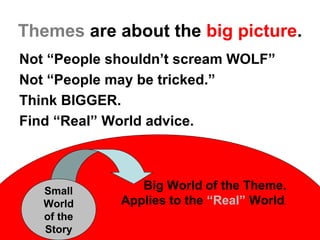
Themes are about the big picture. 
Not “People shouldn’t scream WOLF” 
Not “People may be tricked.” 
Think BIGGER. 
Find “Real” World advice. 
Big World of the Theme. 
Applies to the “Real” World. 
Small 
World 
of the 
Story
Identifying Themes 
Themes can be identified through: 
-character’s actions 
-character’s words/thoughts 
-events in the story
Review 
1. Theme is what we can learn from a 
story. 
2. Themes must be inferred. 
3. Themes are about the BIG world.
Practice 
1. We’ll read each story. 
2. Write what you think the theme is. 
3. Write another sentence explaining what 
happens in the story that leads you to 
believe this. 
How does the small world of the story 
connect to the big world theme?

Finding Theme

  • 1.
    Theme The Searchfor Meaning
  • 2.
    What is aTheme? Theme: Life lesson, meaning, moral, or message about life or human nature that is communicated by a literary work. In other words… Theme is what the story teaches readers.
  • 3.
    Themes A themeis not a word, it is a sentence. You don’t have to agree with the theme to identify it. .
  • 4.
    • Theme TOPICSare one word: – Love – Honesty – Judgment – Family THEMES are statements! Examples: Money cannot buy you happiness Don’t judge a book by its cover Honesty is the best policy
  • 5.
    Once there wasa mean little boy who lived in a small village. This mean little boy loved to mess with people, so one day he ran up to a sheep herder and shouted, “WOLF! WOLF! A wolf is attacking the town!” The sheep herder grabbed his staff and ran to defend the town, but realized he had been fooled when the boy started pointing and laughing at him. “Ha ha! I made you jump,” said the boy. Then the boy ran up to a farmer and shouted, “WOLF! WOLF! A wolf is attacking the town!” The farmer grabbed his pitchfork and ran to defend the town, but when the boy started pointing and laughing at him, he realized he had been tricked. As the boy went back to his family’s farm laughing about the funny trick he played, he saw a real wolf in his father’s chicken coop. As the wolf ate all of his father’s chickens, the boy screamed over and over again, “WOLF! WOLF! Please help us!” But nobody came to help him.
  • 6.
    Identifying Themes Themesare not explicit (clearly stated). Themes are implied. Themes are bigger than the story. Big World of the Theme. Applies to the “Real” World. Small World of the Story
  • 7.
    Themes are aboutthe big picture. Not “People shouldn’t scream WOLF” Not “People may be tricked.” Think BIGGER. Find “Real” World advice. Big World of the Theme. Applies to the “Real” World. Small World of the Story
  • 8.
    Identifying Themes Themescan be identified through: -character’s actions -character’s words/thoughts -events in the story
  • 9.
    Review 1. Themeis what we can learn from a story. 2. Themes must be inferred. 3. Themes are about the BIG world.
  • 10.
    Practice 1. We’llread each story. 2. Write what you think the theme is. 3. Write another sentence explaining what happens in the story that leads you to believe this. How does the small world of the story connect to the big world theme?