INCIDENT REPORT WRITING
Kelila Ranney
What is an Incident report?
An incident report is a detailed description of what took
place.
The report should only consist of factual statements and
opinions should be left out completely.
Most incident reports will be written by certain
professionals, like police officers, or loss prevention.
However, it is good information for everyone to have
because you may witness an incident and be asked to
write a witness statement.
The best witness statements will contain all the detailed
facts you can remember, and it will leave out any opinions
you had about what you saw.
WHAT SHOULD GO INTO AN INCIDENT REPORT?
Make sure to have in report•

Your basic who, what, where, when, and why.

•

Specifics on the people involved.
Victims, subjects, accomplices, persons of interest, who
you are and why you are reporting. Descriptions of
physical appearance. Who they are by name if known.

•

Give detailed specifics of where the incident occurred.
The address, date, time, and location of the incident
should be documented.

•

Emotions and opinions of what happened should be
left out of the incident report. The people that the
report will be passed on to will form there own
opinion on the incident based on the facts.

•

Irrelevant details that do not pertain to the incident. If
there is any question on whether or not the detail
applies to the case, it should be added. It is much
more important to have all the details you need that
be missing something.

•

Assumptions about what happened that you cannot
prove or did not observe.

Detailed description of what happened in the order that
it happened. It is also recommended to add specifics on
what did not occur.

•

Leave out of the report-

•

Sometimes why the incident happened is not known.
Still give details on why you did what you did.
LOSS PREVENTION INCIDENT REPORT WRITING

As an example of incident report writing we will
look at how a Loss prevention apprehension
report is created. This report will go through
details of• what the incident was
• who was involved
• any vehicle information
• what merchandise was taken
• when law enforcement was notified and who
responded
• what pictures should be attached.
SYNOPSIS

Having a synopsis is very helpful for the potential reader. They will understand what kind of incident they are going to
read about in the narrative. The synopsis should be kept short and give the main facts.

Example
John Smith was apprehended for the attempted theft of three Jawbone Jambox minis. He was taken to jail on felony
theft charges.
STARTING THE NARRATIVE
•

The first line of the narrative should be introducing who you are as the writer, your name and title.

•

You should also state whether you observed the incident or whether you were informed of the incident by
someone else.

Example
I, Kelila Ranney, Senior Target Protection Specialist at the Sandy South Towne Target, observed the following.
Or
I, Kelila Ranney, Senior Target Protection Specialist at the Sandy South Towne Target, was informed of the following.
GIVE THE DATE AND TIME OF THE INCIDENT
I, Kelila Ranney, Senior Target Protection Specialist at the Sandy South Towne Target, observed the following. On November
24, 2013, at approximately 11:30AM, I noticed a known theft subject enter the store through the north entrance.
-always use the word approximately before stating the time- it will cover you if the time is slightly off. The court may throw the
case out if something as simple as the time is off.
STATING THE FACTS

It is important to state all the facts that show intent and give you the right to stop that person from doing what they are
doing. We are going to following 5 steps to prove what is happening for the loss prevention apprehension.
1.

The subjects enters the store or area of the store without the merchandise.

2.

You see selection of the merchandise from the home location in the store.

3.

You see concealment of the merchandise or the merchandise remains visible while the subject attempts to exit.

4.

You keep 100% surveillance on the subject so you know that they have not dropped the merchandise
somewhere.

5.

The subject passes all points of sale without offering payment for the merchandise.
WHO
•

In the narrative you want to use the subjects last
name if it is known. State the subjects full name
the first time you identify them, and then refer to
them with their last name throughout the
narrative.

•

Any other people that were involved follow the
same pattern. Identify who they are by name
and title, and then refer to them by their last
name throughout the narrative.
VEHICLE INFORMATION

•

Vehicle information is also important
in helping identify a person.

•

Vehicles are registered to the owner
and having the police run a license
plate through their system could
give you a possible subject.

•

The license plate (number and
state), make, model, and color are
the most important things to note.
Any unique identifiers are also
helpful (i.e. rust spots, racing stripes
etc.)
MERCHANDISE INFORMATION

•

note what the merchandise was and the total value. There are laws in
place that can increase a theft charge from a misdemeanor to a
felony if the total value is above $1000.

•

The merchandise should match the report.

•

If there has been any damage to the merchandise that makes it
unsellable, it should be photographed and documented as damaged.
POLICE INFORMATION
•

document when the police were contacted, when they arrived to the
location, who the responding officer was, and what the case number is
for that department.

•

keep a time line of events so that you can not be accused of keeping a
subject detained for an unreasonable amount of time. Time stamps on
pictures help with this also.

•

If video is available for the incident make sure a copy is saved and
another copy is given to the police department with the narrative.

•

Record the case number just in case you must reference it to another
officer or dispatch at some point in the future.
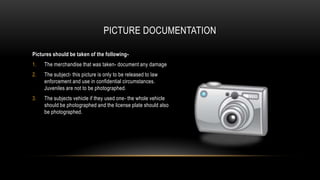
PICTURE DOCUMENTATION
Pictures should be taken of the following1.

The merchandise that was taken- document any damage

2.

The subject- this picture is only to be released to law
enforcement and use in confidential circumstances.
Juveniles are not to be photographed.

3.

The subjects vehicle if they used one- the whole vehicle
should be photographed and the license plate should also
be photographed.
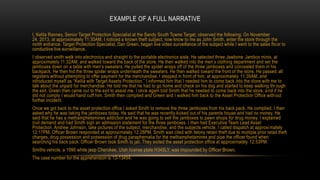
EXAMPLE OF A FULL NARRATIVE
I, Kelila Ranney, Senior Target Protection Specialist at the Sandy South Towne Target, observed the following. On November
24, 2013, at approximately 11:30AM, I noticed a known theft subject, now know to me as John Smith, enter the store through the
north entrance. Target Protection Specialist, Dan Green, began live video surveillance of the subject while I went to the sales flo or to
conductive live surveillance.
I observed smith walk into electronics and straight to the portable electronics aisle. He selected three Jawbone Jambox minis, at
approximately 11:32AM, and walked toward the back of the store. He then walked into the men’s clothing department and set the
jamboxes down on a table with men’s sweaters. He pulled the spider wraps off of the three jamboxes and concealed them in his
backpack. He then hid the three spider wraps underneath the sweaters. He then walked toward the front of the store. He passed all
registers without attempting to offer payment for the merchandise. I stepped in front of him, at approximately 11:39AM, and
introduced myself as “Kelila with Target Assets Protection.” I informed him that I needed him to come back into the store with me to
talk about the unpaid for merchandise. He told me that he had to go home and check on his dog and started to keep walking thr ough
the exit. Green then came out to the exit to assist me. I once again told Smith that he needed to come back into the store, a nd if he
did not comply I would hand cuff him. Smith then complied and Green and I walked him back to the Asset Protection Office with out
further incident.
Once we got back to the asset protection office I asked Smith to remove the three jamboxes from his back pack. He complied. I then
asked why he was taking the jamboxes today. He said that he was recently kicked out of his parents house and had no money. He
said that he has a methamphetamines addiction and he was going to sell the jamboxes to pawn shops for drug money. I explained
civil demand and had Smith sign an admission statement for the three jamboxes. I then had Executive Team Lead Asset
Protection, Andrew Johnson, take pictures of the subject, merchandise, and the subjects vehicle. I called dispatch at approxi mately
12:17PM. Officer Brown responded at approximately 12:28PM. Smith was cited with felony retain theft due to multiple prior retail theft
charges, drug possession and possession of drug paraphernalia for the methamphetamines and pipe the officer found when
searching his back pack. Officer Brown took Smith to jail. They exited the asset protection office at approximately 12:53PM.
Smiths vehicle, a 1990 white jeep Cherokee, Utah license plate H345LY, was impounded by Officer Brown.
The case number for the apprehension is 13-13454.
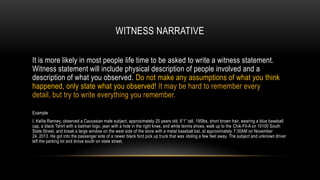
WITNESS NARRATIVE
It is more likely in most people life time to be asked to write a witness statement.
Witness statement will include physical description of people involved and a
description of what you observed. Do not make any assumptions of what you think
happened, only state what you observed! It may be hard to remember every
detail, but try to write everything you remember.
Example
I, Kelila Ranney, observed a Caucasian male subject, approximately 25 years old, 6’1” tall, 195lbs, short brown hair, wearing a blue baseball
cap, a black Tshirt with a batman logo, jean with a hole in the right knee, and white tennis shoes, walk up to the Chik-Fil-A on 10100 South
State Street, and break a large window on the west side of the store with a metal baseball bat, at approximately 7:30AM on November
24, 2013. He got into the passenger side of a newer black ford pick up truck that was idoling a few feet away. The subject and unknown driver
left the parking lot and drove south on state street.

Incident report

  • 1.
  • 2.
    What is anIncident report? An incident report is a detailed description of what took place. The report should only consist of factual statements and opinions should be left out completely. Most incident reports will be written by certain professionals, like police officers, or loss prevention. However, it is good information for everyone to have because you may witness an incident and be asked to write a witness statement. The best witness statements will contain all the detailed facts you can remember, and it will leave out any opinions you had about what you saw.
  • 3.
    WHAT SHOULD GOINTO AN INCIDENT REPORT? Make sure to have in report• Your basic who, what, where, when, and why. • Specifics on the people involved. Victims, subjects, accomplices, persons of interest, who you are and why you are reporting. Descriptions of physical appearance. Who they are by name if known. • Give detailed specifics of where the incident occurred. The address, date, time, and location of the incident should be documented. • Emotions and opinions of what happened should be left out of the incident report. The people that the report will be passed on to will form there own opinion on the incident based on the facts. • Irrelevant details that do not pertain to the incident. If there is any question on whether or not the detail applies to the case, it should be added. It is much more important to have all the details you need that be missing something. • Assumptions about what happened that you cannot prove or did not observe. Detailed description of what happened in the order that it happened. It is also recommended to add specifics on what did not occur. • Leave out of the report- • Sometimes why the incident happened is not known. Still give details on why you did what you did.
  • 4.
    LOSS PREVENTION INCIDENTREPORT WRITING As an example of incident report writing we will look at how a Loss prevention apprehension report is created. This report will go through details of• what the incident was • who was involved • any vehicle information • what merchandise was taken • when law enforcement was notified and who responded • what pictures should be attached.
  • 5.
    SYNOPSIS Having a synopsisis very helpful for the potential reader. They will understand what kind of incident they are going to read about in the narrative. The synopsis should be kept short and give the main facts. Example John Smith was apprehended for the attempted theft of three Jawbone Jambox minis. He was taken to jail on felony theft charges.
  • 6.
    STARTING THE NARRATIVE • Thefirst line of the narrative should be introducing who you are as the writer, your name and title. • You should also state whether you observed the incident or whether you were informed of the incident by someone else. Example I, Kelila Ranney, Senior Target Protection Specialist at the Sandy South Towne Target, observed the following. Or I, Kelila Ranney, Senior Target Protection Specialist at the Sandy South Towne Target, was informed of the following.
  • 7.
    GIVE THE DATEAND TIME OF THE INCIDENT I, Kelila Ranney, Senior Target Protection Specialist at the Sandy South Towne Target, observed the following. On November 24, 2013, at approximately 11:30AM, I noticed a known theft subject enter the store through the north entrance. -always use the word approximately before stating the time- it will cover you if the time is slightly off. The court may throw the case out if something as simple as the time is off.
  • 8.
    STATING THE FACTS Itis important to state all the facts that show intent and give you the right to stop that person from doing what they are doing. We are going to following 5 steps to prove what is happening for the loss prevention apprehension. 1. The subjects enters the store or area of the store without the merchandise. 2. You see selection of the merchandise from the home location in the store. 3. You see concealment of the merchandise or the merchandise remains visible while the subject attempts to exit. 4. You keep 100% surveillance on the subject so you know that they have not dropped the merchandise somewhere. 5. The subject passes all points of sale without offering payment for the merchandise.
  • 9.
    WHO • In the narrativeyou want to use the subjects last name if it is known. State the subjects full name the first time you identify them, and then refer to them with their last name throughout the narrative. • Any other people that were involved follow the same pattern. Identify who they are by name and title, and then refer to them by their last name throughout the narrative.
  • 10.
    VEHICLE INFORMATION • Vehicle informationis also important in helping identify a person. • Vehicles are registered to the owner and having the police run a license plate through their system could give you a possible subject. • The license plate (number and state), make, model, and color are the most important things to note. Any unique identifiers are also helpful (i.e. rust spots, racing stripes etc.)
  • 11.
    MERCHANDISE INFORMATION • note whatthe merchandise was and the total value. There are laws in place that can increase a theft charge from a misdemeanor to a felony if the total value is above $1000. • The merchandise should match the report. • If there has been any damage to the merchandise that makes it unsellable, it should be photographed and documented as damaged.
  • 12.
    POLICE INFORMATION • document whenthe police were contacted, when they arrived to the location, who the responding officer was, and what the case number is for that department. • keep a time line of events so that you can not be accused of keeping a subject detained for an unreasonable amount of time. Time stamps on pictures help with this also. • If video is available for the incident make sure a copy is saved and another copy is given to the police department with the narrative. • Record the case number just in case you must reference it to another officer or dispatch at some point in the future.
  • 13.
    PICTURE DOCUMENTATION Pictures shouldbe taken of the following1. The merchandise that was taken- document any damage 2. The subject- this picture is only to be released to law enforcement and use in confidential circumstances. Juveniles are not to be photographed. 3. The subjects vehicle if they used one- the whole vehicle should be photographed and the license plate should also be photographed.
  • 14.
    EXAMPLE OF AFULL NARRATIVE I, Kelila Ranney, Senior Target Protection Specialist at the Sandy South Towne Target, observed the following. On November 24, 2013, at approximately 11:30AM, I noticed a known theft subject, now know to me as John Smith, enter the store through the north entrance. Target Protection Specialist, Dan Green, began live video surveillance of the subject while I went to the sales flo or to conductive live surveillance. I observed smith walk into electronics and straight to the portable electronics aisle. He selected three Jawbone Jambox minis, at approximately 11:32AM, and walked toward the back of the store. He then walked into the men’s clothing department and set the jamboxes down on a table with men’s sweaters. He pulled the spider wraps off of the three jamboxes and concealed them in his backpack. He then hid the three spider wraps underneath the sweaters. He then walked toward the front of the store. He passed all registers without attempting to offer payment for the merchandise. I stepped in front of him, at approximately 11:39AM, and introduced myself as “Kelila with Target Assets Protection.” I informed him that I needed him to come back into the store with me to talk about the unpaid for merchandise. He told me that he had to go home and check on his dog and started to keep walking thr ough the exit. Green then came out to the exit to assist me. I once again told Smith that he needed to come back into the store, a nd if he did not comply I would hand cuff him. Smith then complied and Green and I walked him back to the Asset Protection Office with out further incident. Once we got back to the asset protection office I asked Smith to remove the three jamboxes from his back pack. He complied. I then asked why he was taking the jamboxes today. He said that he was recently kicked out of his parents house and had no money. He said that he has a methamphetamines addiction and he was going to sell the jamboxes to pawn shops for drug money. I explained civil demand and had Smith sign an admission statement for the three jamboxes. I then had Executive Team Lead Asset Protection, Andrew Johnson, take pictures of the subject, merchandise, and the subjects vehicle. I called dispatch at approxi mately 12:17PM. Officer Brown responded at approximately 12:28PM. Smith was cited with felony retain theft due to multiple prior retail theft charges, drug possession and possession of drug paraphernalia for the methamphetamines and pipe the officer found when searching his back pack. Officer Brown took Smith to jail. They exited the asset protection office at approximately 12:53PM. Smiths vehicle, a 1990 white jeep Cherokee, Utah license plate H345LY, was impounded by Officer Brown. The case number for the apprehension is 13-13454.
  • 15.
    WITNESS NARRATIVE It ismore likely in most people life time to be asked to write a witness statement. Witness statement will include physical description of people involved and a description of what you observed. Do not make any assumptions of what you think happened, only state what you observed! It may be hard to remember every detail, but try to write everything you remember. Example I, Kelila Ranney, observed a Caucasian male subject, approximately 25 years old, 6’1” tall, 195lbs, short brown hair, wearing a blue baseball cap, a black Tshirt with a batman logo, jean with a hole in the right knee, and white tennis shoes, walk up to the Chik-Fil-A on 10100 South State Street, and break a large window on the west side of the store with a metal baseball bat, at approximately 7:30AM on November 24, 2013. He got into the passenger side of a newer black ford pick up truck that was idoling a few feet away. The subject and unknown driver left the parking lot and drove south on state street.