Mini Action Research Tutoring Project - Report

by: Dr. Eirini Gouleta

(Source: http://www.breathing-
underwater.com/portfolio/documents/standards/standard8/Tutoring%20Project.pdf)


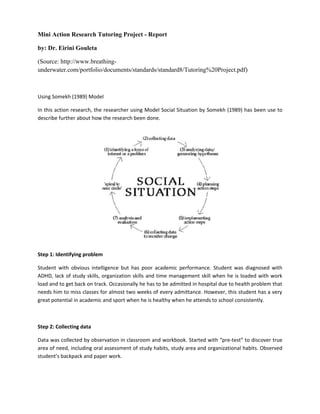
Using Somekh (1989) Model

In this action research, the researcher using Model Social Situation by Somekh (1989) has been use to
describe further about how the research been done.


Step 1: Identifying problem

Student with obvious intelligence but has poor academic performance. Student was diagnosed with
ADHD, lack of study skills, organization skills and time management skill when he is loaded with work
load and to get back on track. Occasionally he has to be admitted in hospital due to health problem that
needs him to miss classes for almost two weeks of every admittance. However, this student has a very
great potential in academic and sport when he is healthy when he attends to school consistently.


Step 2: Collecting data

Data was collected by observation in classroom and workbook. Started with “pre-test” to discover true
area of need, including oral assessment of study habits, study area and organizational habits. Observed
student’s backpack and paper work.
Step 3: Analyzing data/generating hypothesis

Tutoring session would help the student to perform better in school that he initially predicted by
creating and establishing organizational, time management and study skill routines. Introducing and
practicing planned routines are expected to make the students to study efficiently and doing excellent in
school.


Step 4: Planning action step

       Six tutoring session will take place for 1 and 2 hours.

       Instrument: “Pre-test”, “Post-test”, Planbook Rubric Assessment, Binder Rubric assessment,
        Time management Assessment, Time Management Project Planning Assessment.

       Tools:

            ◦    Time Management Chart,

                         Created Time Management Chart for a final project for student’s Music Class

            ◦    ‘To-do-list’,

                         Discussed organizational techniques and strategies

            ◦    Planbook,

                         Used planbook/binder rubrics for initial assessments. Assisted student with
                          organization of binder. Discussed how to properly organize a planbook.

            ◦    Binder rubrics.

                         Created rubrics (with student) to assess progress of personal planbook and
                          binder organization. • Assessed planbook/binder progress


Step 5 : Implementing action step

Firstly, researcher worked on his metacognitive skills. Student were introduced with the assessment and
discussed based on the result of rubric assessment. All papers and homework were restructured and
organized into binder so that session would run smoothly. Six tutoring session has been done according
to action plan. Researcher has set a couple or two of objectives to be achieved at the end of the session.
Each session lasts for one or two hours.
Step 6 : Collecting data/monitor change

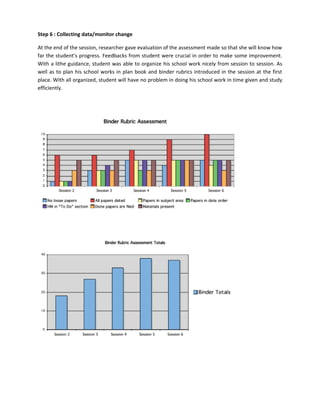
At the end of the session, researcher gave evaluation of the assessment made so that she will know how
far the student’s progress. Feedbacks from student were crucial in order to make some improvement.
With a lithe guidance, student was able to organize his school work nicely from session to session. As
well as to plan his school works in plan book and binder rubrics introduced in the session at the first
place. With all organized, student will have no problem in doing his school work in time given and study
efficiently.
Step 7 : Analysis and evaluation

Planning chart: Student can submit school work in time given. He also can manage his time effectively.

Binder: Student can organize and filed paper works nicely, in correct place and can track them all with
no effort.

 “Post-test” report: Overall, sessions were a success for the most part. Even though this brilliant kid has
problem with time management, organization and study skill, he can be thought to study smart by
nurturing routines that has been done.

Student behavior: Student’s performances were interestingly improving better compared to the first
session where he was under prepared with work load and unorganized paper works.

Student emotion: Student’s grade has raised as well his confidence. Student found the session very
helpful, end up studying efficiently and able to stay consistently organized.

Researcher point of view: Increasing the ability of student in organize, time management and study
skills. Student able to see the urgency, understand and implement it. Focusing on the process flow is the
key before implementing the elements above. Student will able to manage their self, thus will derive the
final result.

Step 8 : ‘Spiral to next circle’

Teachers can apply the organizational rubrics and time management charts to ensure student will focus
on their tasks and assignment in defined time. Student will independently organize themselves by the
routine to strength their executive skills. Parents should give whole support to this kind of kids as well to
check their planbook and binder consistently. Both parties have to communicate to each other if the
student seems to be having trouble.

Report review 1st article

  • 1.
    Mini Action ResearchTutoring Project - Report by: Dr. Eirini Gouleta (Source: http://www.breathing- underwater.com/portfolio/documents/standards/standard8/Tutoring%20Project.pdf) Using Somekh (1989) Model In this action research, the researcher using Model Social Situation by Somekh (1989) has been use to describe further about how the research been done. Step 1: Identifying problem Student with obvious intelligence but has poor academic performance. Student was diagnosed with ADHD, lack of study skills, organization skills and time management skill when he is loaded with work load and to get back on track. Occasionally he has to be admitted in hospital due to health problem that needs him to miss classes for almost two weeks of every admittance. However, this student has a very great potential in academic and sport when he is healthy when he attends to school consistently. Step 2: Collecting data Data was collected by observation in classroom and workbook. Started with “pre-test” to discover true area of need, including oral assessment of study habits, study area and organizational habits. Observed student’s backpack and paper work.
  • 2.
    Step 3: Analyzingdata/generating hypothesis Tutoring session would help the student to perform better in school that he initially predicted by creating and establishing organizational, time management and study skill routines. Introducing and practicing planned routines are expected to make the students to study efficiently and doing excellent in school. Step 4: Planning action step  Six tutoring session will take place for 1 and 2 hours.  Instrument: “Pre-test”, “Post-test”, Planbook Rubric Assessment, Binder Rubric assessment, Time management Assessment, Time Management Project Planning Assessment.  Tools: ◦ Time Management Chart,  Created Time Management Chart for a final project for student’s Music Class ◦ ‘To-do-list’,  Discussed organizational techniques and strategies ◦ Planbook,  Used planbook/binder rubrics for initial assessments. Assisted student with organization of binder. Discussed how to properly organize a planbook. ◦ Binder rubrics.  Created rubrics (with student) to assess progress of personal planbook and binder organization. • Assessed planbook/binder progress Step 5 : Implementing action step Firstly, researcher worked on his metacognitive skills. Student were introduced with the assessment and discussed based on the result of rubric assessment. All papers and homework were restructured and organized into binder so that session would run smoothly. Six tutoring session has been done according to action plan. Researcher has set a couple or two of objectives to be achieved at the end of the session. Each session lasts for one or two hours.
  • 3.
    Step 6 :Collecting data/monitor change At the end of the session, researcher gave evaluation of the assessment made so that she will know how far the student’s progress. Feedbacks from student were crucial in order to make some improvement. With a lithe guidance, student was able to organize his school work nicely from session to session. As well as to plan his school works in plan book and binder rubrics introduced in the session at the first place. With all organized, student will have no problem in doing his school work in time given and study efficiently.
  • 4.
    Step 7 :Analysis and evaluation Planning chart: Student can submit school work in time given. He also can manage his time effectively. Binder: Student can organize and filed paper works nicely, in correct place and can track them all with no effort. “Post-test” report: Overall, sessions were a success for the most part. Even though this brilliant kid has problem with time management, organization and study skill, he can be thought to study smart by nurturing routines that has been done. Student behavior: Student’s performances were interestingly improving better compared to the first session where he was under prepared with work load and unorganized paper works. Student emotion: Student’s grade has raised as well his confidence. Student found the session very helpful, end up studying efficiently and able to stay consistently organized. Researcher point of view: Increasing the ability of student in organize, time management and study skills. Student able to see the urgency, understand and implement it. Focusing on the process flow is the key before implementing the elements above. Student will able to manage their self, thus will derive the final result. Step 8 : ‘Spiral to next circle’ Teachers can apply the organizational rubrics and time management charts to ensure student will focus on their tasks and assignment in defined time. Student will independently organize themselves by the routine to strength their executive skills. Parents should give whole support to this kind of kids as well to check their planbook and binder consistently. Both parties have to communicate to each other if the student seems to be having trouble.