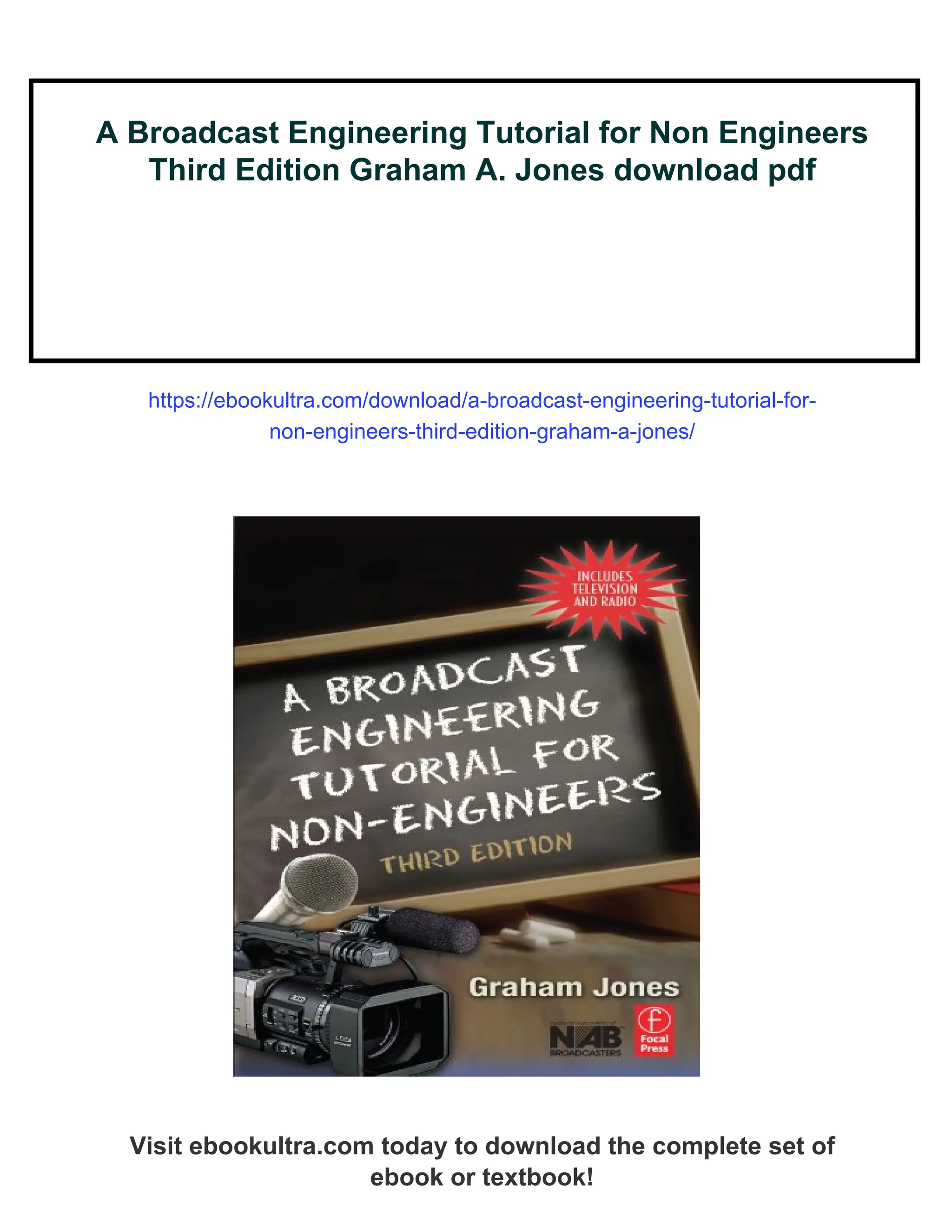
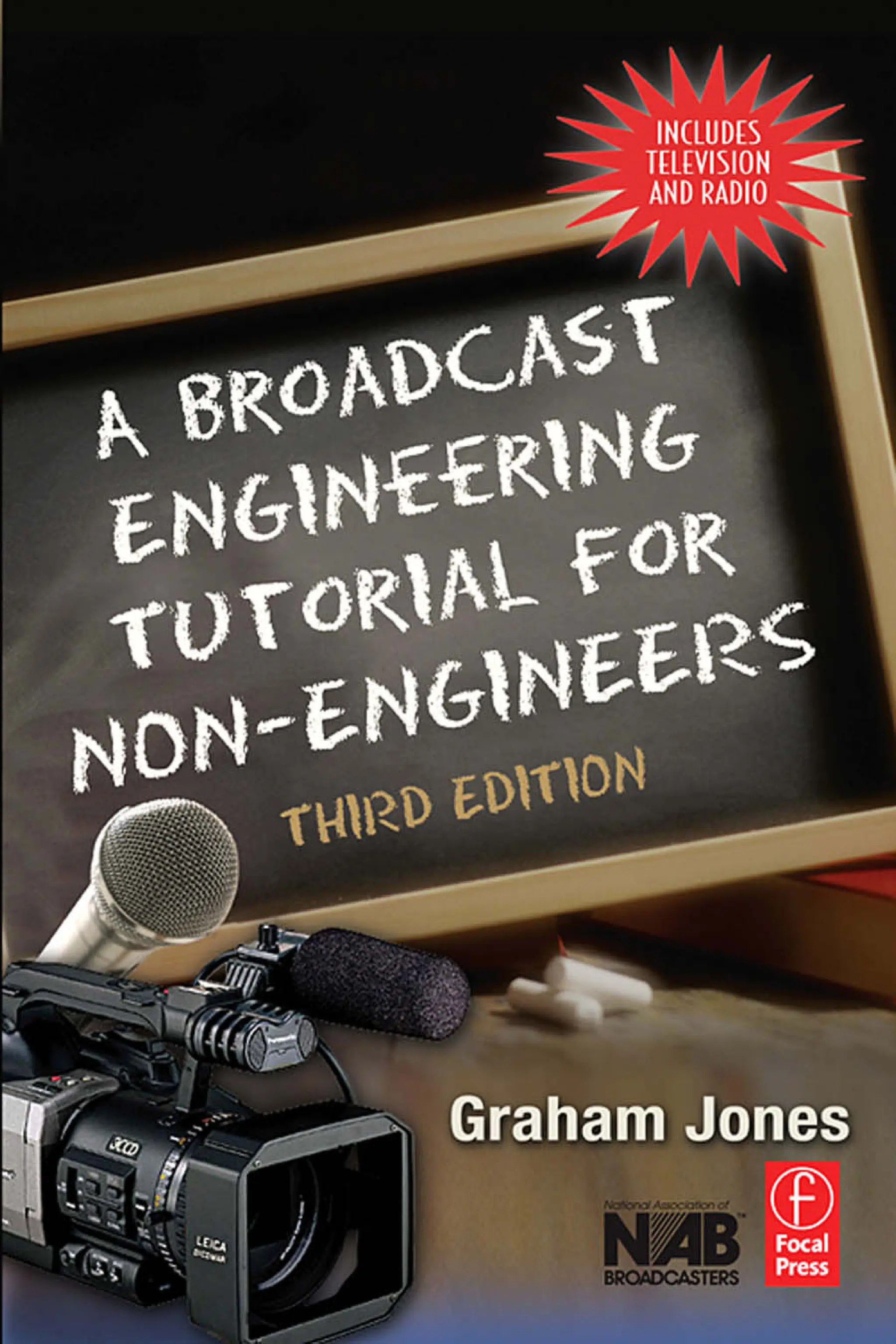
A Broadcast Engineering Tutorial for Non Engineers Third Edition Graham A. Jones
A Broadcast Engineering Tutorial for Non Engineers Third Edition Graham A. Jones
A Broadcast Engineering Tutorial for Non Engineers Third Edition Graham A. Jones
A Broadcast Engineering Tutorial for Non Engineers Third Edition Graham A. Jones
A Broadcast Engineering Tutorial for Non Engineers Third Edition Graham A. Jones
1.
A Broadcast EngineeringTutorial for Non Engineers
Third Edition Graham A. Jones download pdf
https://ebookultra.com/download/a-broadcast-engineering-tutorial-for-
non-engineers-third-edition-graham-a-jones/
Visit ebookultra.com today to download the complete set of
ebook or textbook!
2.
Here are somerecommended products for you. Click the link to
download, or explore more at ebookultra.com
Introduction to Communications Technologies A Guide for
Non Engineers 1st Edition Stephan Jones
https://ebookultra.com/download/introduction-to-communications-
technologies-a-guide-for-non-engineers-1st-edition-stephan-jones/
Accounting for Non accountants A Manual for Managers and
Students 6th Edition Graham Mott
https://ebookultra.com/download/accounting-for-non-accountants-a-
manual-for-managers-and-students-6th-edition-graham-mott/
Continuum Mechanics for Engineers Third Edition G. Thomas
Mase
https://ebookultra.com/download/continuum-mechanics-for-engineers-
third-edition-g-thomas-mase/
Science for Engineering Third Edition John Bird
https://ebookultra.com/download/science-for-engineering-third-edition-
john-bird/
3.
Applied Statistics andProbability for Engineers Third
Edition Douglas C. Montgomery
https://ebookultra.com/download/applied-statistics-and-probability-
for-engineers-third-edition-douglas-c-montgomery/
Probabilistic Machine Learning for Civil Engineers James-A
Goulet
https://ebookultra.com/download/probabilistic-machine-learning-for-
civil-engineers-james-a-goulet/
Practical Guide to ICP MS A Tutorial for Beginners 2nd
Edition Robert Thomas
https://ebookultra.com/download/practical-guide-to-icp-ms-a-tutorial-
for-beginners-2nd-edition-robert-thomas/
Engineering strategies for greenhouse gas mitigation 1st
Edition Ian Jones
https://ebookultra.com/download/engineering-strategies-for-greenhouse-
gas-mitigation-1st-edition-ian-jones/
Human Factors for Highway Engineers 1st Edition J. A.
Santos
https://ebookultra.com/download/human-factors-for-highway-
engineers-1st-edition-j-a-santos/
5.
A Broadcast EngineeringTutorial for Non Engineers
Third Edition Graham A. Jones Digital Instant Download
Author(s): GrahamA. Jones
ISBN(s): 9780240807003, 0240807006
Edition: 3
File Details: PDF, 3.09 MB
Year: 2005
Language: english
A Broadcast EngineeringTutorial
for Non-Engineers
THIRD EDITION
Graham Jones
National Association of Broadcasters
AMSTERDAM • BOSTON • HEIDELBERG
LONDON • NEW YORK • OXFORD • PARIS
SAN DIEGO • SAN FRANCISCO • SINGAPORE
SYDNEY • TOKYO
Focal Press is an imprint of Elsevier
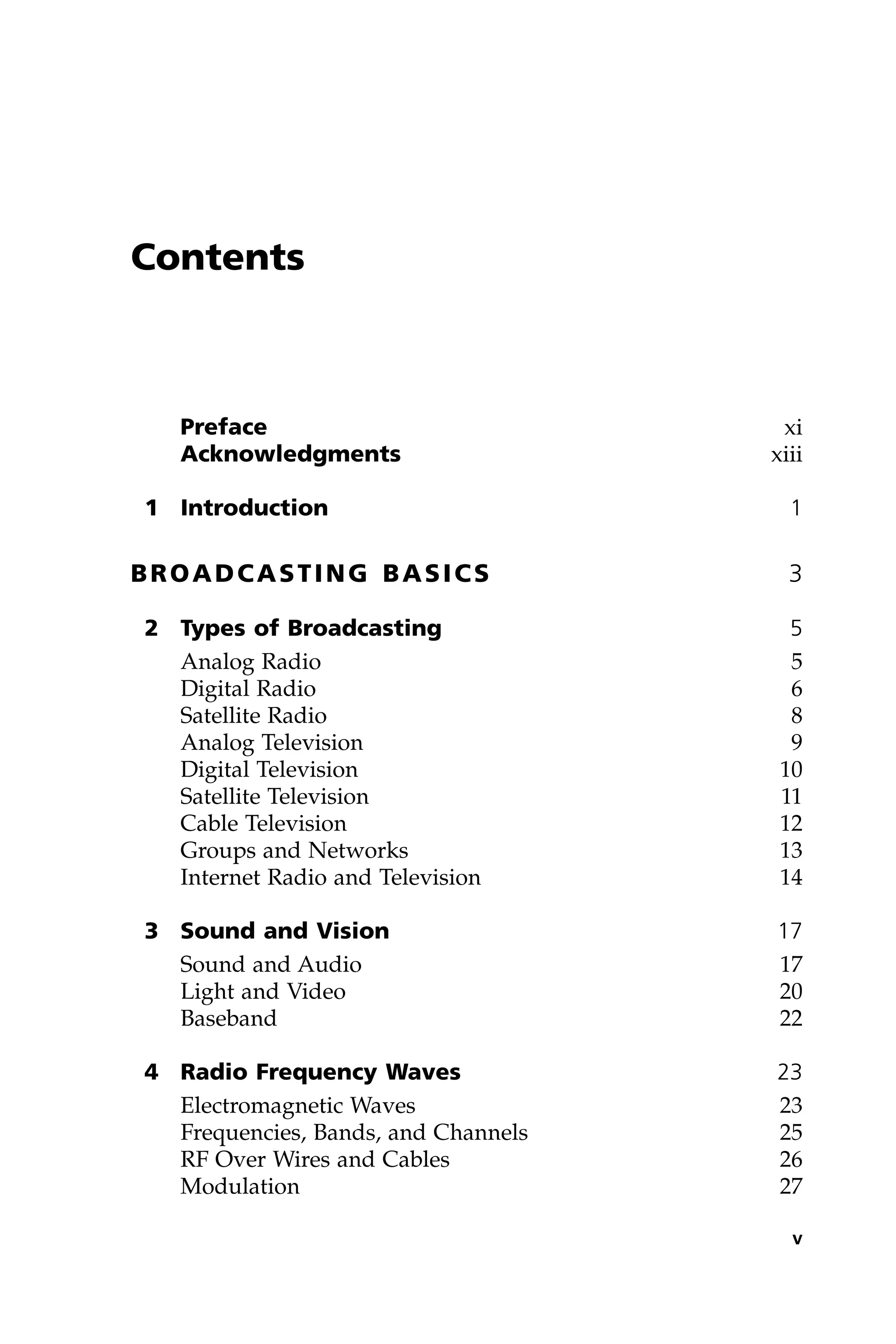
Contents
Preface xi
Acknowledgments xiii
1Introduction 1
BROADCASTING BASICS 3
2 Types of Broadcasting 5
Analog Radio 5
Digital Radio 6
Satellite Radio 8
Analog Television 9
Digital Television 10
Satellite Television 11
Cable Television 12
Groups and Networks 13
Internet Radio and Television 14
3 Sound and Vision 17
Sound and Audio 17
Light and Video 20
Baseband 22
4 Radio Frequency Waves 23
Electromagnetic Waves 23
Frequencies, Bands, and Channels 25
RF Over Wires and Cables 26
Modulation 27
v
12.
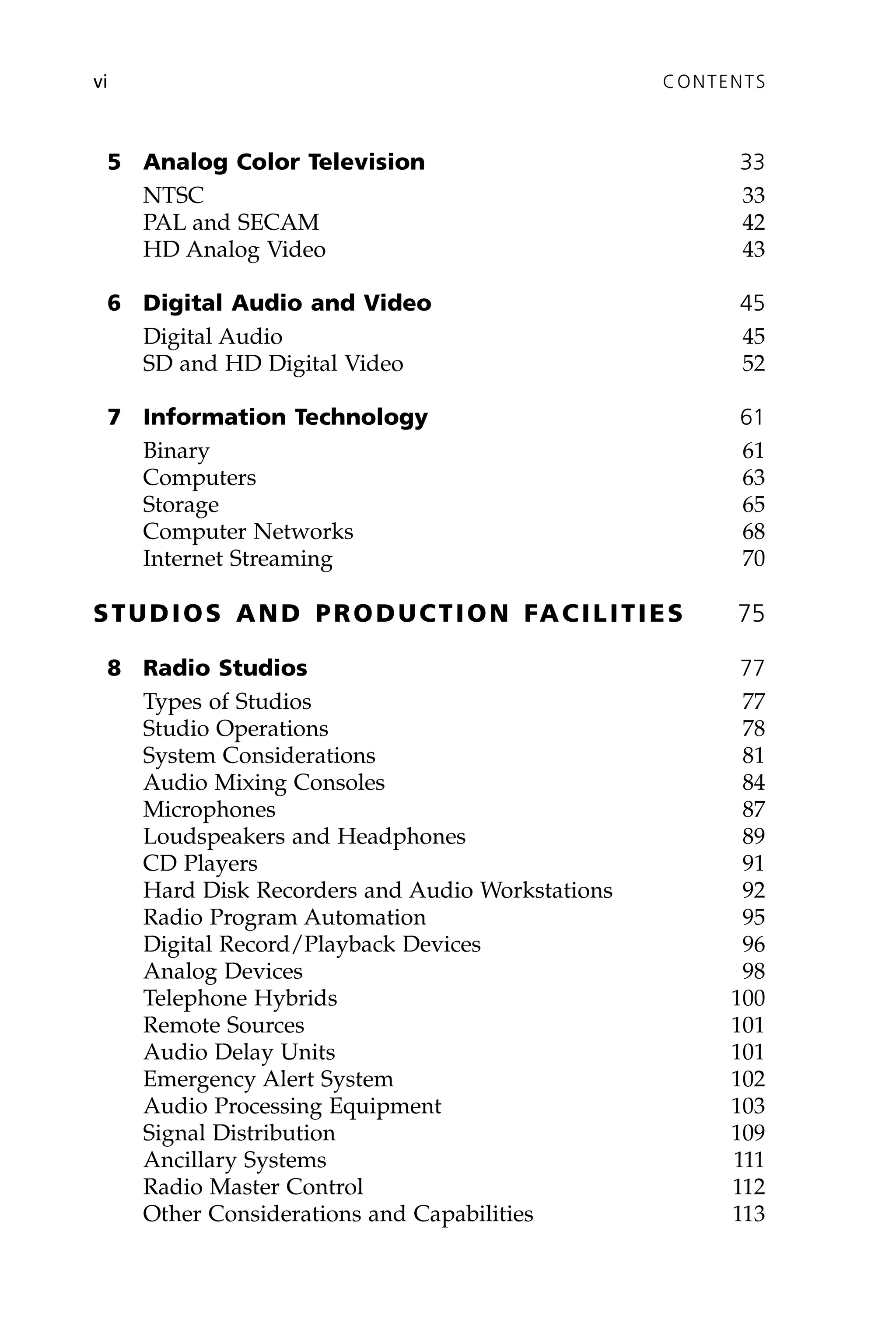
5 Analog ColorTelevision 33
NTSC 33
PAL and SECAM 42
HD Analog Video 43
6 Digital Audio and Video 45
Digital Audio 45
SD and HD Digital Video 52
7 Information Technology 61
Binary 61
Computers 63
Storage 65
Computer Networks 68
Internet Streaming 70
STUDIOS AND PRODUCTION FACILITIES 75
8 Radio Studios 77
Types of Studios 77
Studio Operations 78
System Considerations 81
Audio Mixing Consoles 84
Microphones 87
Loudspeakers and Headphones 89
CD Players 91
Hard Disk Recorders and Audio Workstations 92
Radio Program Automation 95
Digital Record/Playback Devices 96
Analog Devices 98
Telephone Hybrids 100
Remote Sources 101
Audio Delay Units 101
Emergency Alert System 102
Audio Processing Equipment 103
Signal Distribution 109
Ancillary Systems 111
Radio Master Control 112
Other Considerations and Capabilities 113
vi CONTENTS
13.
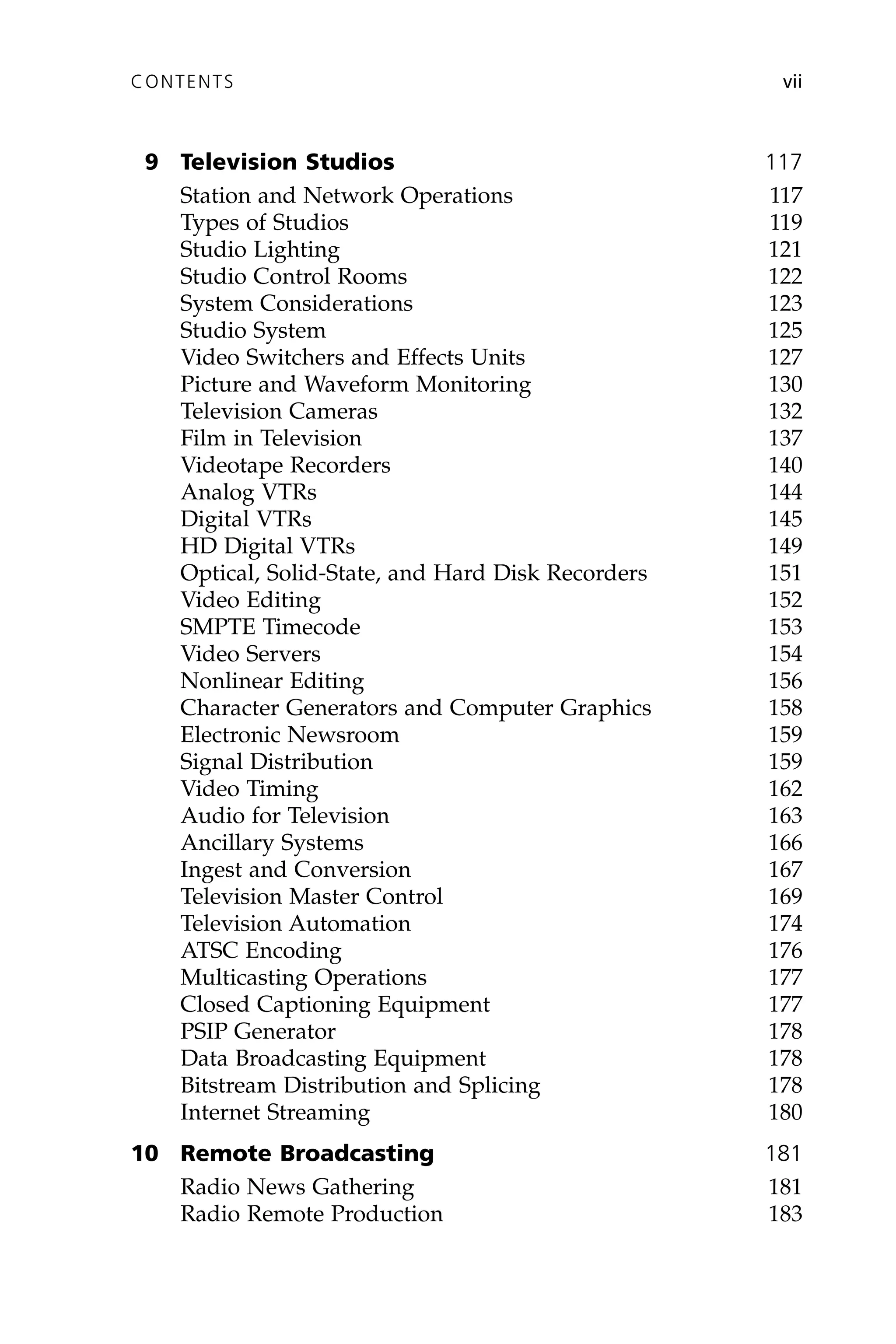
9 Television Studios117
Station and Network Operations 117
Types of Studios 119
Studio Lighting 121
Studio Control Rooms 122
System Considerations 123
Studio System 125
Video Switchers and Effects Units 127
Picture and Waveform Monitoring 130
Television Cameras 132
Film in Television 137
Videotape Recorders 140
Analog VTRs 144
Digital VTRs 145
HD Digital VTRs 149
Optical, Solid-State, and Hard Disk Recorders 151
Video Editing 152
SMPTE Timecode 153
Video Servers 154
Nonlinear Editing 156
Character Generators and Computer Graphics 158
Electronic Newsroom 159
Signal Distribution 159
Video Timing 162
Audio for Television 163
Ancillary Systems 166
Ingest and Conversion 167
Television Master Control 169
Television Automation 174
ATSC Encoding 176
Multicasting Operations 177
Closed Captioning Equipment 177
PSIP Generator 178
Data Broadcasting Equipment 178
Bitstream Distribution and Splicing 178
Internet Streaming 180
10 Remote Broadcasting 181
Radio News Gathering 181
Radio Remote Production 183
CONTENTS vii
14.
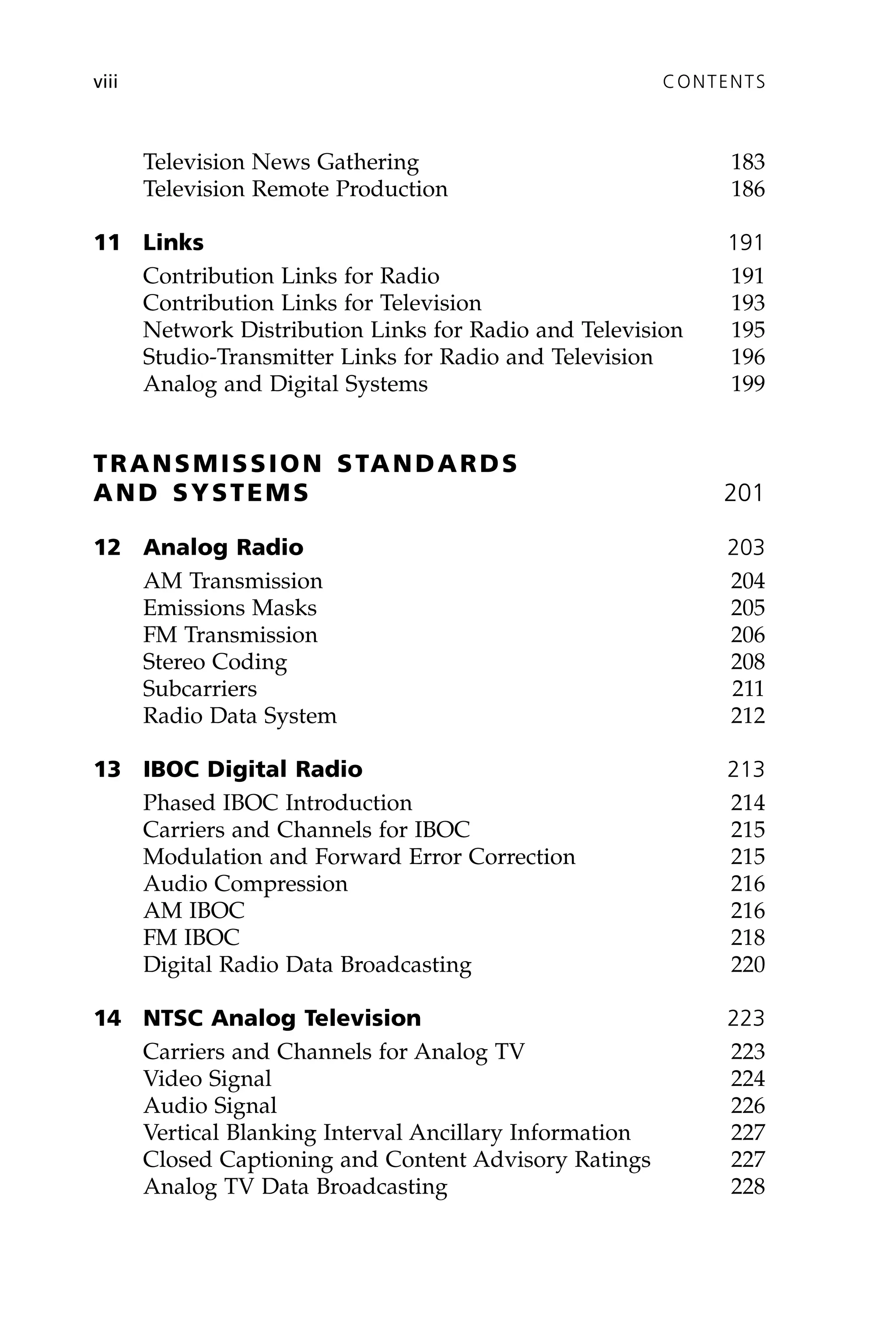
Television News Gathering183
Television Remote Production 186
11 Links 191
Contribution Links for Radio 191
Contribution Links for Television 193
Network Distribution Links for Radio and Television 195
Studio-Transmitter Links for Radio and Television 196
Analog and Digital Systems 199
TRANSMISSION STANDARDS
AND SYSTEMS 201
12 Analog Radio 203
AM Transmission 204
Emissions Masks 205
FM Transmission 206
Stereo Coding 208
Subcarriers 211
Radio Data System 212
13 IBOC Digital Radio 213
Phased IBOC Introduction 214
Carriers and Channels for IBOC 215
Modulation and Forward Error Correction 215
Audio Compression 216
AM IBOC 216
FM IBOC 218
Digital Radio Data Broadcasting 220
14 NTSC Analog Television 223
Carriers and Channels for Analog TV 223
Video Signal 224
Audio Signal 226
Vertical Blanking Interval Ancillary Information 227
Closed Captioning and Content Advisory Ratings 227
Analog TV Data Broadcasting 228
viii CONTENTS
15.
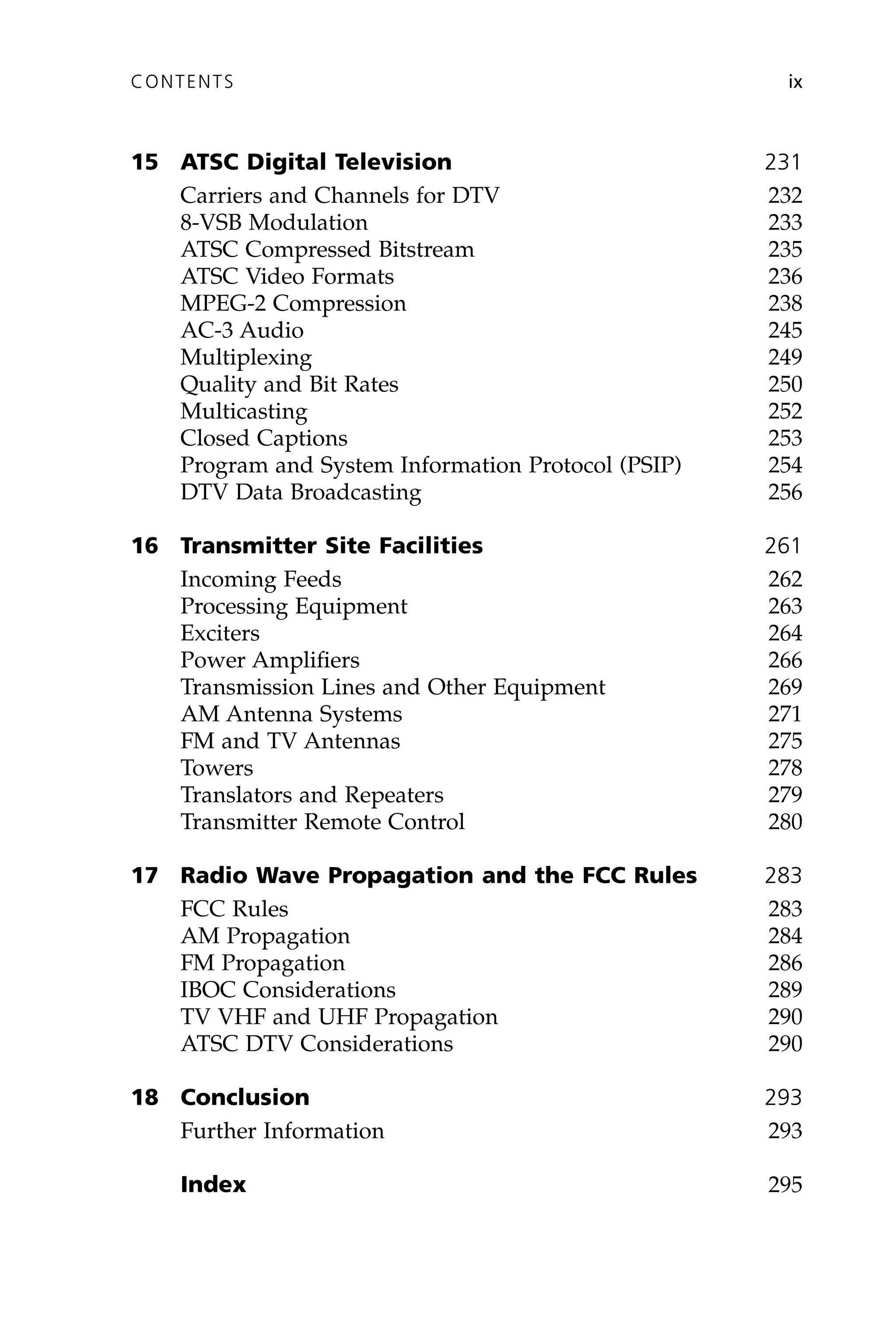
15 ATSC DigitalTelevision 231
Carriers and Channels for DTV 232
8-VSB Modulation 233
ATSC Compressed Bitstream 235
ATSC Video Formats 236
MPEG-2 Compression 238
AC-3 Audio 245
Multiplexing 249
Quality and Bit Rates 250
Multicasting 252
Closed Captions 253
Program and System Information Protocol (PSIP) 254
DTV Data Broadcasting 256
16 Transmitter Site Facilities 261
Incoming Feeds 262
Processing Equipment 263
Exciters 264
Power Amplifiers 266
Transmission Lines and Other Equipment 269
AM Antenna Systems 271
FM and TV Antennas 275
Towers 278
Translators and Repeaters 279
Transmitter Remote Control 280
17 Radio Wave Propagation and the FCC Rules 283
FCC Rules 283
AM Propagation 284
FM Propagation 286
IBOC Considerations 289
TV VHF and UHF Propagation 290
ATSC DTV Considerations 290
18 Conclusion 293
Further Information 293
Index 295
CONTENTS ix
17.
Preface
There are manypeople without engineering backgrounds who
need to have a general understanding of broadcast engineering
principles. They may be broadcast managers, program producers,
or other professionals who deal with broadcast clients. This tuto-
rial is intended to help non-engineers who want to learn something
about the technicalities of radio and television. It should also be
useful for engineers in training, or those in technical occupations
who want an overview of areas outside their area of expertise. We
explain the jargon of broadcasting and describe the underlying
principles, standards, and equipment for broadcast facilities, in
terms a layperson can understand.
The third edition has been completely revised to reflect the increas-
ing use of digital techniques in all aspects of television and radio
broadcasting. It has been reorganized and some obsolete material
removed, while also updating the basic information on traditional
analog technologies. New chapters have been added to provide an
overview of first principles and current standards in the broadcast
industry. We concentrate on over-the-air broadcasting from U.S.
radio and television stations, but also mention some of the other
methods of program delivery to the home and outline some of the
different standards and technologies used in other countries.
Although later chapters build on information in earlier sections,
this book can be consulted for information about a particular topic.
We hope that the information in these pages will help readers
further their understanding of our trade, and thus enhance their
ability to perform the broadcast-related functions of their jobs.
NAB Science and Technology Department
xi
19.
Acknowledgments
As the principalauthor and editor of the third edition of this tuto-
rial, I would like to acknowledge the contributions I have received
in preparing the book. The foundation, of course, was the second
edition, which came from NAB Science and Technology, although
very little of that work remains unchanged. I have received advice
and support from my colleagues at NAB: Art Allison, Janet Elliott,
David Layer, John Marino, and Kelly Williams, and from the Senior
Vice President of Science and Technology, Lynn Claudy. James
Snyder provided input on Internet broadcasting and advised on
several other topics, as did Ed Williams. Advice on information
technology came from Andrew Jones and John Roberts. Finally,
thanks to my wife, Linda, for putting up with the long hours spent
in putting this work together and for being the ultimate “non-
engineer” who had to understand everything in the book.
Graham Jones
Washington, D.C.
xiii
20.
CHAPTER 1
Introduction
In itssimplest form, a radio or television broadcast station consists
of two basic facilities: the studio complex and a transmitter site.
The studio complex is the place where the programming originates.
The transmitter is the device that, with an antenna, actually broad-
casts the program material out over the air. In between the two is
a connection called the studio transmitter link. In reality, there are
many components that make up the chain from program origina-
tion through to the final viewer or listener. This tutorial
provides an introduction to the technologies and equipment that
constitute modern broadcasting systems.
Traditionally, broadcasting was based on analog techniques, but for
more than 20 years there has been a steady migration to digital
systems, which provide many benefits for studio operations. The
increasing use of computer-based information technology has
revolutionized both radio and television studios. More recently,
new standards have evolved that now allow digital transmission
to the home for both radio and television.
All types of broadcast stations used for domestic broadcasting
(AM, FM, and TV) are covered in this tutorial, with descriptions of
both analog and digital studio and transmission systems where
appropriate. For completeness, satellite, cable, and Internet deliv-
ery are also briefly mentioned.
Jargon words and phrases are shown in italics the first time they
are used in each section. They may be explained there or covered
in detail in other chapters. Some of these jargon words are unique
to broadcasting, but some are regular words that are used in
1
21.
a special way—wewill try to make their meaning clear for the
reader.
Chapters in the first section of the book, Broadcasting Basics,
discuss the main methods used for radio and television broadcast-
ing and explain some of the basic science and the terms used later
in the book. Chapters in the second section, Studios and Produc-
tion Facilities, describe radio and television studios and remote
operations, covering the main items of equipment used and how
they work together. Chapters in the third section, Transmission
Standards and Systems, discuss the standards and technologies
used for U.S. radio and television transmission, and cover trans-
mitter site facilities and equipment. The final chapter discusses
radio wave propagation and the Federal Communications Com-
mission (FCC) Technical Rules.
In each section or chapter, we generally talk about topics related to
audio and radio first, and then deal with video and television.
2 1 INTRODUCTION
CHAPTER 2
Types ofBroadcasting
By definition, broadcasting means “to transmit by radio or tele-
vision,” but, with developments in technology that have taken
place, that simple phrase now includes many different types of
transmission. Let’s start with a summary of the main types in use
today in the United States and overseas. Many of the systems men-
tioned below differ only in the way they are transmitted—studio
systems for radio and television generally have fewer variations.
Don’t worry if you don’t fully understand all of the terms used
in this chapter: they will be explained later in the appropriate
sections.
Analog Radio
Radio broadcasting for local stations in the United States, and
throughout the world falls into two main types: AM and FM—
standing for amplitude modulation and frequency modulation, respec-
tively. These are the particular methods of radio transmission, used
for many years for traditional broadcasting to home, car, and
portable receivers. In North America, AM is used in the medium fre-
quency (MF) (also known as medium wave) band, whereas FM uses
the very high frequency (VHF) band.
One radio station frequently feeds only one transmitter, and there-
fore is referred to as an AM station or an FM station. It is, however,
quite possible for a station to feed both AM and FM transmitters
in the same area, or to feed more than one transmitter covering dif-
ferent areas, in which case the term AM or FM may refer only to a
particular transmitter and not to the station as a whole.
5
25.
In some overseascountries, AM is also used in the long wave band,
with frequencies somewhat lower than the MF band, and slightly
different propagation characteristics—good for broadcasting over
a wide area. AM is also used for shortwave radio broadcasting—also
known as HF from the name of the high frequency band that is used.
This is used for broadcasting over very long distances (usually
internationally).
We cover analog radio in more detail in Chapters 12 and 16.
Digital Radio
There are four main over-the-air digital radio systems in the world,
all different from each other in several respects: IBOC, DAB, ISDB-
TSB, and DRM.
IBOC
Digital radio broadcasting for local stations in the United States,
introduced for regular use in 2003, uses a proprietary system called
HD Radio, generically known as IBOC. IBOC stands for In-Band
On-Channel and is the particular method of digital radio transmis-
sion. There are two versions: one for AM broadcasting and one for
FM. They offer significant quality improvements over equivalent
analog AM and FM transmission, while broadcasting to the same
destinations of home, car, and portable receivers. FM IBOC can also
carry additional data information services. A key feature of IBOC is
that it can share the same band and channel as an analog radio
transmitter (hence, the name), so no additional radio spectrum
space is needed for a radio station to add an IBOC digital service.
We cover IBOC in more detail in Chapters 13 and 16.
DAB
Digital radio for national and some local services outside the
United States—in Europe, Canada, and elsewhere—primarily uses
6 2 TYPES OF BROADCASTING
Section 4. Informationabout Donations to
the Project Gutenberg Literary Archive
Foundation
Project Gutenberg™ depends upon and cannot survive without
widespread public support and donations to carry out its mission
of increasing the number of public domain and licensed works
that can be freely distributed in machine-readable form
accessible by the widest array of equipment including outdated
equipment. Many small donations ($1 to $5,000) are particularly
important to maintaining tax exempt status with the IRS.
The Foundation is committed to complying with the laws
regulating charities and charitable donations in all 50 states of
the United States. Compliance requirements are not uniform
and it takes a considerable effort, much paperwork and many
fees to meet and keep up with these requirements. We do not
solicit donations in locations where we have not received written
confirmation of compliance. To SEND DONATIONS or determine
the status of compliance for any particular state visit
www.gutenberg.org/donate.
While we cannot and do not solicit contributions from states
where we have not met the solicitation requirements, we know
of no prohibition against accepting unsolicited donations from
donors in such states who approach us with offers to donate.
International donations are gratefully accepted, but we cannot
make any statements concerning tax treatment of donations
received from outside the United States. U.S. laws alone swamp
our small staff.
Please check the Project Gutenberg web pages for current
donation methods and addresses. Donations are accepted in a
number of other ways including checks, online payments and
28.
credit card donations.To donate, please visit:
www.gutenberg.org/donate.
Section 5. General Information About
Project Gutenberg™ electronic works
Professor Michael S. Hart was the originator of the Project
Gutenberg™ concept of a library of electronic works that could
be freely shared with anyone. For forty years, he produced and
distributed Project Gutenberg™ eBooks with only a loose
network of volunteer support.
Project Gutenberg™ eBooks are often created from several
printed editions, all of which are confirmed as not protected by
copyright in the U.S. unless a copyright notice is included. Thus,
we do not necessarily keep eBooks in compliance with any
particular paper edition.
Most people start at our website which has the main PG search
facility: www.gutenberg.org.
This website includes information about Project Gutenberg™,
including how to make donations to the Project Gutenberg
Literary Archive Foundation, how to help produce our new
eBooks, and how to subscribe to our email newsletter to hear
about new eBooks.
29.
Welcome to ourwebsite – the ideal destination for book lovers and
knowledge seekers. With a mission to inspire endlessly, we offer a
vast collection of books, ranging from classic literary works to
specialized publications, self-development books, and children's
literature. Each book is a new journey of discovery, expanding
knowledge and enriching the soul of the reade
Our website is not just a platform for buying books, but a bridge
connecting readers to the timeless values of culture and wisdom. With
an elegant, user-friendly interface and an intelligent search system,
we are committed to providing a quick and convenient shopping
experience. Additionally, our special promotions and home delivery
services ensure that you save time and fully enjoy the joy of reading.
Let us accompany you on the journey of exploring knowledge and
personal growth!
ebookultra.com











![Presentation1[1]abiout nhnfdfkmdjbf.pptx](https://cdn.slidesharecdn.com/ss_thumbnails/presentation11-240718051625-2893c777-thumbnail.jpg?width=640&height=640&fit=bounds)


