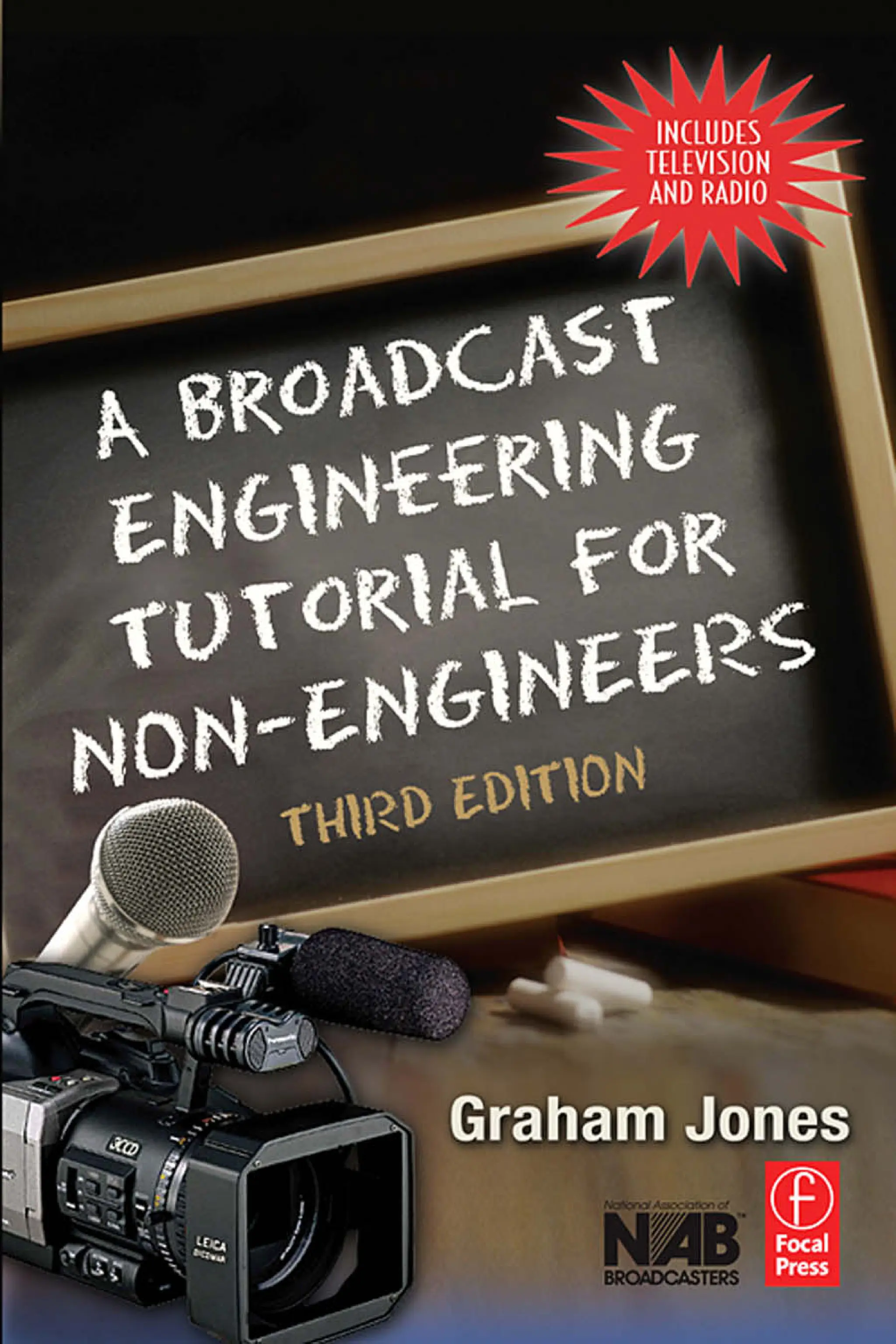
A Broadcast Engineering Tutorial for Non Engineers Third Edition Graham A. Jones
A Broadcast Engineering Tutorial for Non Engineers Third Edition Graham A. Jones
A Broadcast Engineering Tutorial for Non Engineers Third Edition Graham A. Jones
A Broadcast Engineering Tutorial for Non Engineers Third Edition Graham A. Jones
A Broadcast Engineering Tutorial for Non Engineers Third Edition Graham A. Jones
1.
Visit https://ebookultra.com todownload the full version and
explore more ebooks or textbooks
A Broadcast Engineering Tutorial for Non Engineers
Third Edition Graham A. Jones
_____ Click the link below to download _____
https://ebookultra.com/download/a-broadcast-engineering-
tutorial-for-non-engineers-third-edition-graham-a-jones/
Explore and download more ebooks or textbooks at ebookultra.com
2.
Here are somerecommended products that we believe you will be
interested in. You can click the link to download.
Introduction to Communications Technologies A Guide for
Non Engineers 1st Edition Stephan Jones
https://ebookultra.com/download/introduction-to-communications-
technologies-a-guide-for-non-engineers-1st-edition-stephan-jones/
Accounting for Non accountants A Manual for Managers and
Students 6th Edition Graham Mott
https://ebookultra.com/download/accounting-for-non-accountants-a-
manual-for-managers-and-students-6th-edition-graham-mott/
Continuum Mechanics for Engineers Third Edition G. Thomas
Mase
https://ebookultra.com/download/continuum-mechanics-for-engineers-
third-edition-g-thomas-mase/
Science for Engineering Third Edition John Bird
https://ebookultra.com/download/science-for-engineering-third-edition-
john-bird/
3.
Applied Statistics andProbability for Engineers Third
Edition Douglas C. Montgomery
https://ebookultra.com/download/applied-statistics-and-probability-
for-engineers-third-edition-douglas-c-montgomery/
Probabilistic Machine Learning for Civil Engineers James-A
Goulet
https://ebookultra.com/download/probabilistic-machine-learning-for-
civil-engineers-james-a-goulet/
Practical Guide to ICP MS A Tutorial for Beginners 2nd
Edition Robert Thomas
https://ebookultra.com/download/practical-guide-to-icp-ms-a-tutorial-
for-beginners-2nd-edition-robert-thomas/
Engineering strategies for greenhouse gas mitigation 1st
Edition Ian Jones
https://ebookultra.com/download/engineering-strategies-for-greenhouse-
gas-mitigation-1st-edition-ian-jones/
Human Factors for Highway Engineers 1st Edition J. A.
Santos
https://ebookultra.com/download/human-factors-for-highway-
engineers-1st-edition-j-a-santos/
5.
A Broadcast EngineeringTutorial for Non Engineers
Third Edition Graham A. Jones Digital Instant Download
Author(s): GrahamA. Jones
ISBN(s): 9780240807003, 0240807006
Edition: 3
File Details: PDF, 3.09 MB
Year: 2005
Language: english
A Broadcast EngineeringTutorial
for Non-Engineers
THIRD EDITION
Graham Jones
National Association of Broadcasters
AMSTERDAM • BOSTON • HEIDELBERG
LONDON • NEW YORK • OXFORD • PARIS
SAN DIEGO • SAN FRANCISCO • SINGAPORE
SYDNEY • TOKYO
Focal Press is an imprint of Elsevier
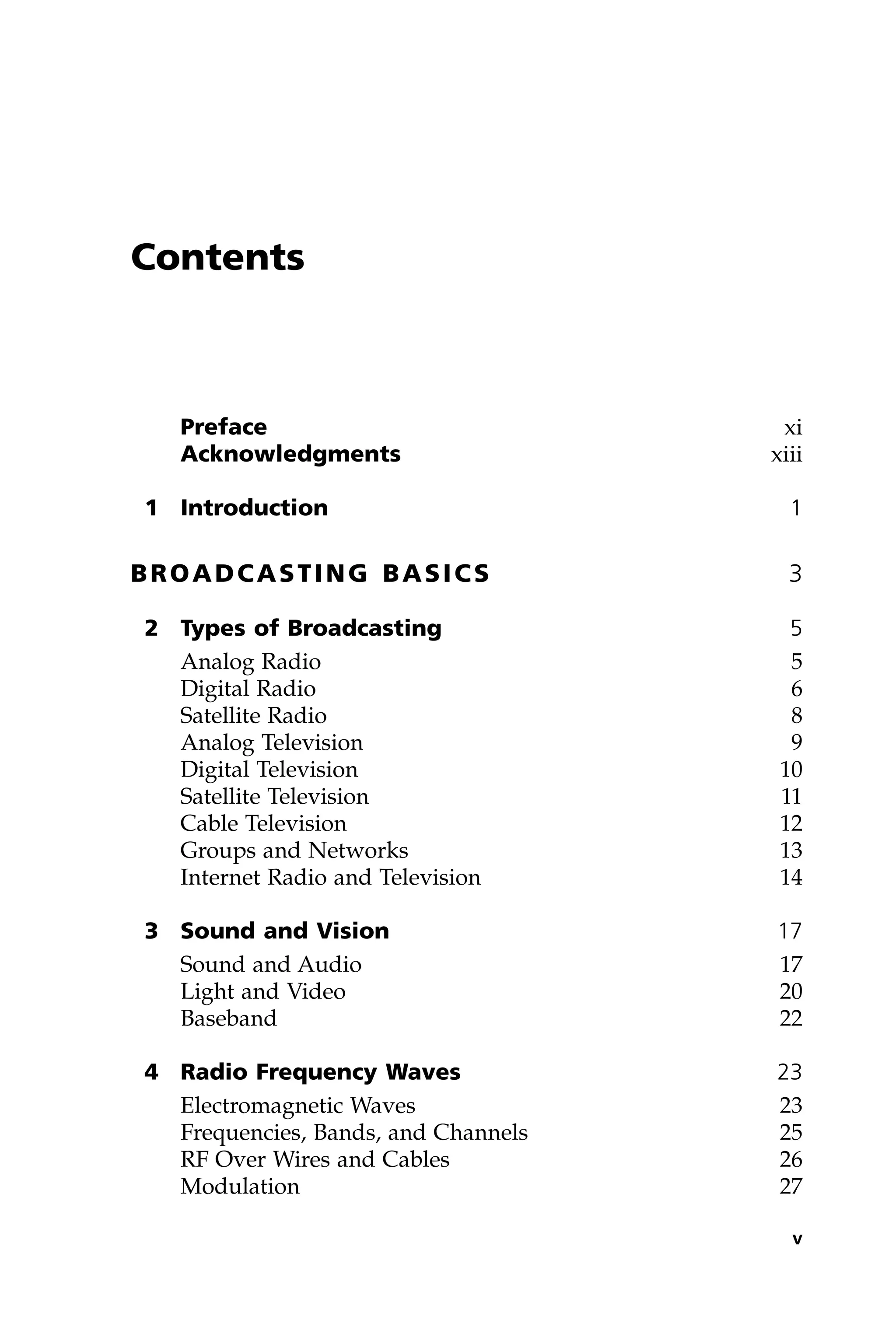
Contents
Preface xi
Acknowledgments xiii
1Introduction 1
BROADCASTING BASICS 3
2 Types of Broadcasting 5
Analog Radio 5
Digital Radio 6
Satellite Radio 8
Analog Television 9
Digital Television 10
Satellite Television 11
Cable Television 12
Groups and Networks 13
Internet Radio and Television 14
3 Sound and Vision 17
Sound and Audio 17
Light and Video 20
Baseband 22
4 Radio Frequency Waves 23
Electromagnetic Waves 23
Frequencies, Bands, and Channels 25
RF Over Wires and Cables 26
Modulation 27
v
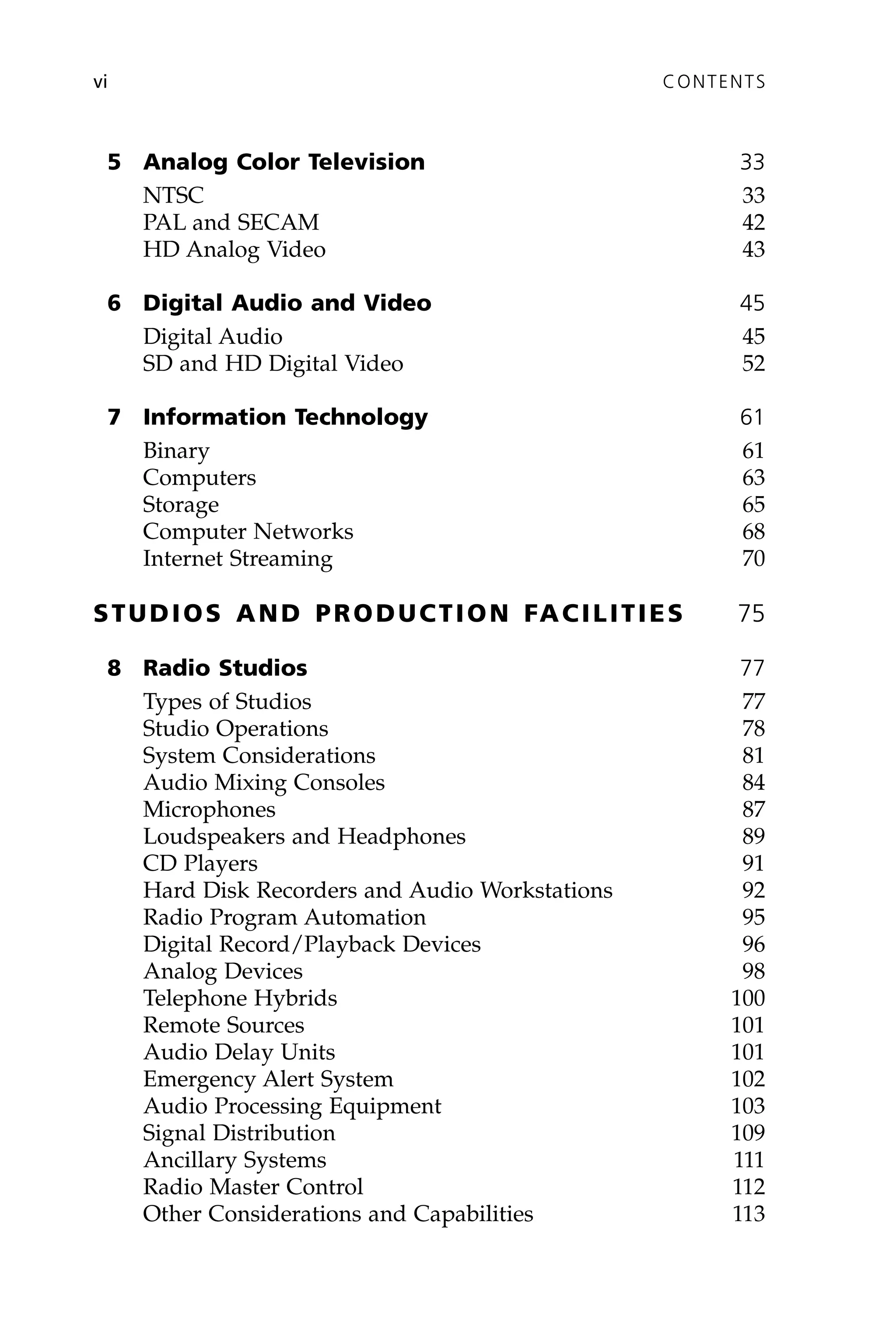
12.
5 Analog ColorTelevision 33
NTSC 33
PAL and SECAM 42
HD Analog Video 43
6 Digital Audio and Video 45
Digital Audio 45
SD and HD Digital Video 52
7 Information Technology 61
Binary 61
Computers 63
Storage 65
Computer Networks 68
Internet Streaming 70
STUDIOS AND PRODUCTION FACILITIES 75
8 Radio Studios 77
Types of Studios 77
Studio Operations 78
System Considerations 81
Audio Mixing Consoles 84
Microphones 87
Loudspeakers and Headphones 89
CD Players 91
Hard Disk Recorders and Audio Workstations 92
Radio Program Automation 95
Digital Record/Playback Devices 96
Analog Devices 98
Telephone Hybrids 100
Remote Sources 101
Audio Delay Units 101
Emergency Alert System 102
Audio Processing Equipment 103
Signal Distribution 109
Ancillary Systems 111
Radio Master Control 112
Other Considerations and Capabilities 113
vi CONTENTS
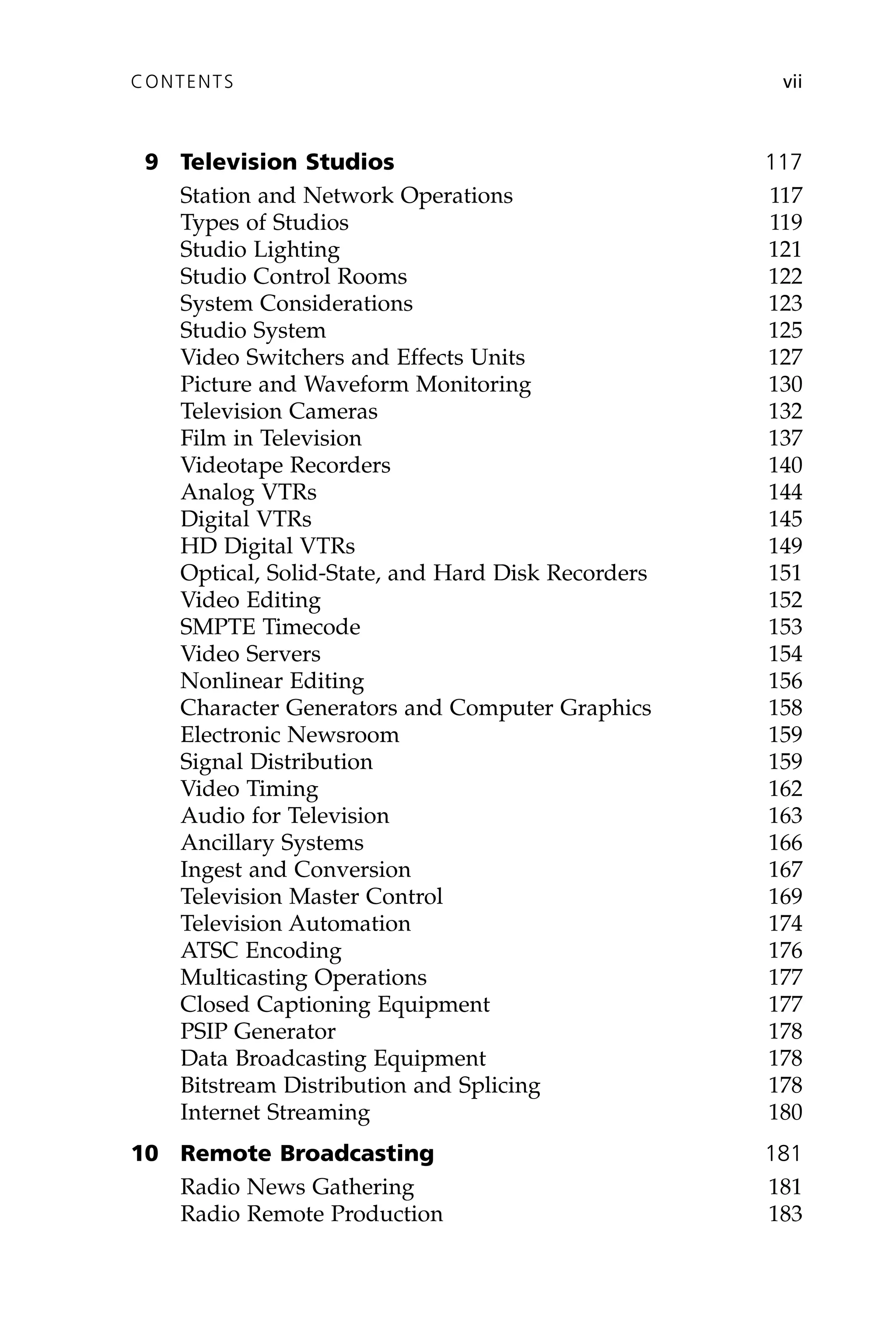
13.
9 Television Studios117
Station and Network Operations 117
Types of Studios 119
Studio Lighting 121
Studio Control Rooms 122
System Considerations 123
Studio System 125
Video Switchers and Effects Units 127
Picture and Waveform Monitoring 130
Television Cameras 132
Film in Television 137
Videotape Recorders 140
Analog VTRs 144
Digital VTRs 145
HD Digital VTRs 149
Optical, Solid-State, and Hard Disk Recorders 151
Video Editing 152
SMPTE Timecode 153
Video Servers 154
Nonlinear Editing 156
Character Generators and Computer Graphics 158
Electronic Newsroom 159
Signal Distribution 159
Video Timing 162
Audio for Television 163
Ancillary Systems 166
Ingest and Conversion 167
Television Master Control 169
Television Automation 174
ATSC Encoding 176
Multicasting Operations 177
Closed Captioning Equipment 177
PSIP Generator 178
Data Broadcasting Equipment 178
Bitstream Distribution and Splicing 178
Internet Streaming 180
10 Remote Broadcasting 181
Radio News Gathering 181
Radio Remote Production 183
CONTENTS vii
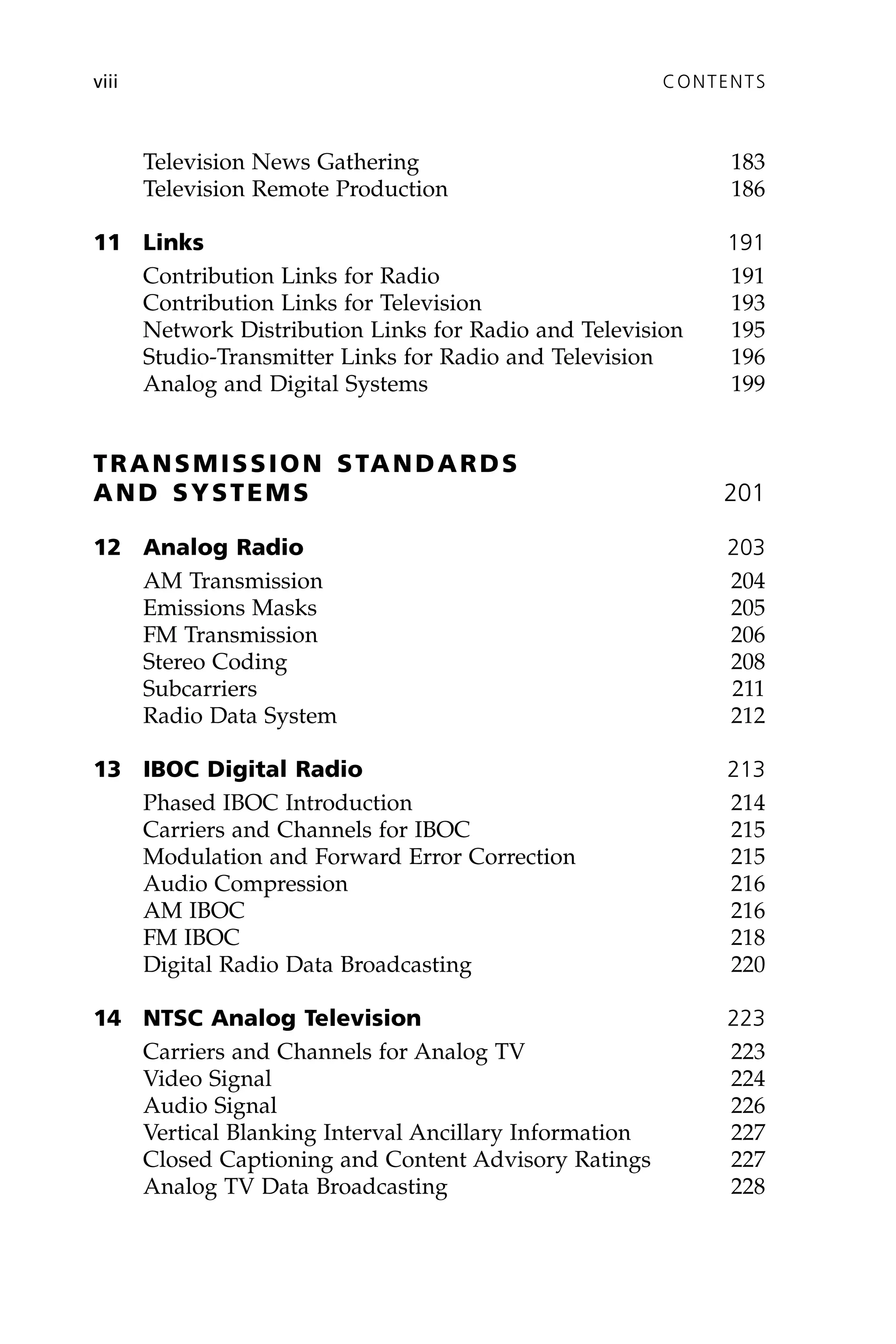
14.
Television News Gathering183
Television Remote Production 186
11 Links 191
Contribution Links for Radio 191
Contribution Links for Television 193
Network Distribution Links for Radio and Television 195
Studio-Transmitter Links for Radio and Television 196
Analog and Digital Systems 199
TRANSMISSION STANDARDS
AND SYSTEMS 201
12 Analog Radio 203
AM Transmission 204
Emissions Masks 205
FM Transmission 206
Stereo Coding 208
Subcarriers 211
Radio Data System 212
13 IBOC Digital Radio 213
Phased IBOC Introduction 214
Carriers and Channels for IBOC 215
Modulation and Forward Error Correction 215
Audio Compression 216
AM IBOC 216
FM IBOC 218
Digital Radio Data Broadcasting 220
14 NTSC Analog Television 223
Carriers and Channels for Analog TV 223
Video Signal 224
Audio Signal 226
Vertical Blanking Interval Ancillary Information 227
Closed Captioning and Content Advisory Ratings 227
Analog TV Data Broadcasting 228
viii CONTENTS
15.
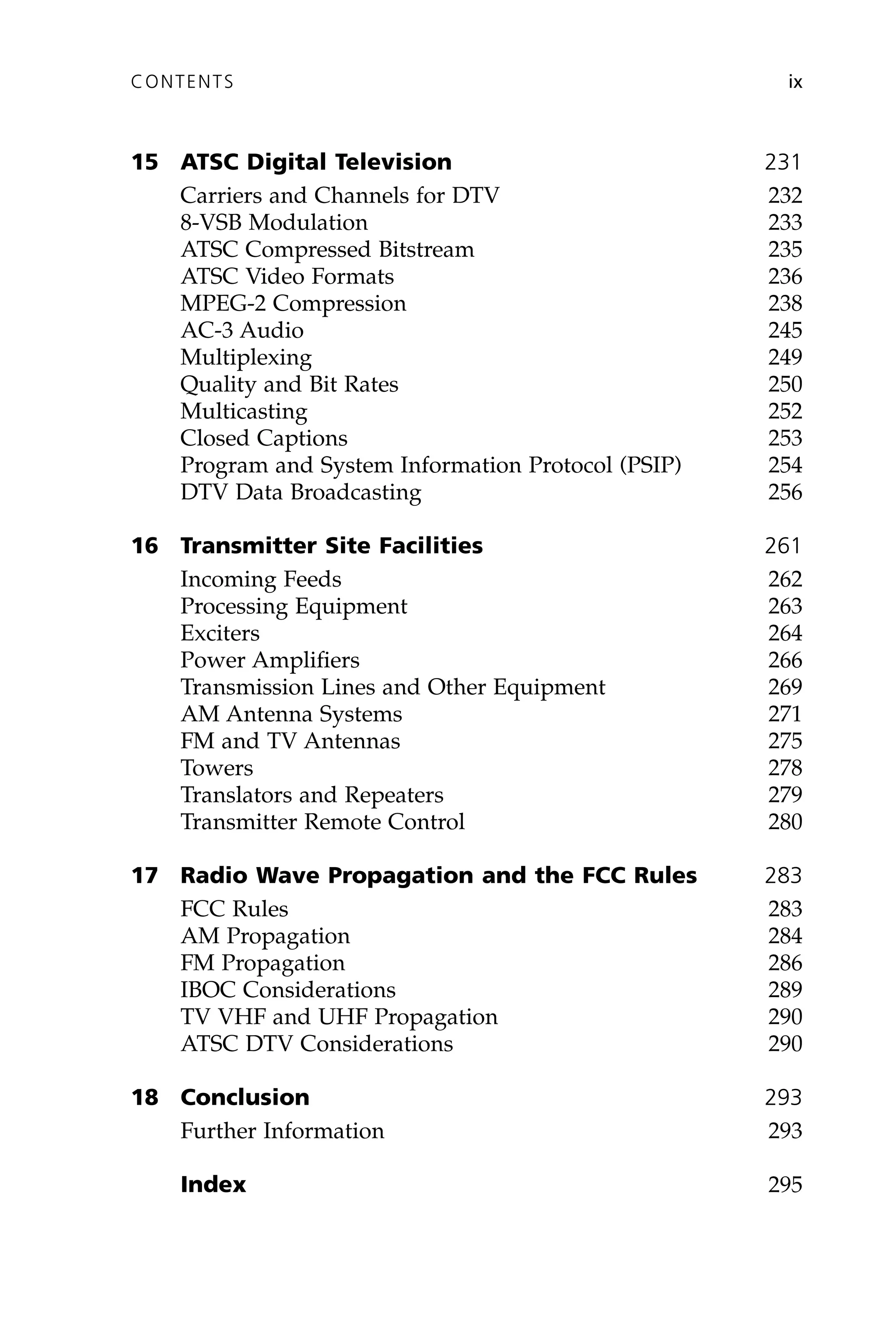
15 ATSC DigitalTelevision 231
Carriers and Channels for DTV 232
8-VSB Modulation 233
ATSC Compressed Bitstream 235
ATSC Video Formats 236
MPEG-2 Compression 238
AC-3 Audio 245
Multiplexing 249
Quality and Bit Rates 250
Multicasting 252
Closed Captions 253
Program and System Information Protocol (PSIP) 254
DTV Data Broadcasting 256
16 Transmitter Site Facilities 261
Incoming Feeds 262
Processing Equipment 263
Exciters 264
Power Amplifiers 266
Transmission Lines and Other Equipment 269
AM Antenna Systems 271
FM and TV Antennas 275
Towers 278
Translators and Repeaters 279
Transmitter Remote Control 280
17 Radio Wave Propagation and the FCC Rules 283
FCC Rules 283
AM Propagation 284
FM Propagation 286
IBOC Considerations 289
TV VHF and UHF Propagation 290
ATSC DTV Considerations 290
18 Conclusion 293
Further Information 293
Index 295
CONTENTS ix
17.
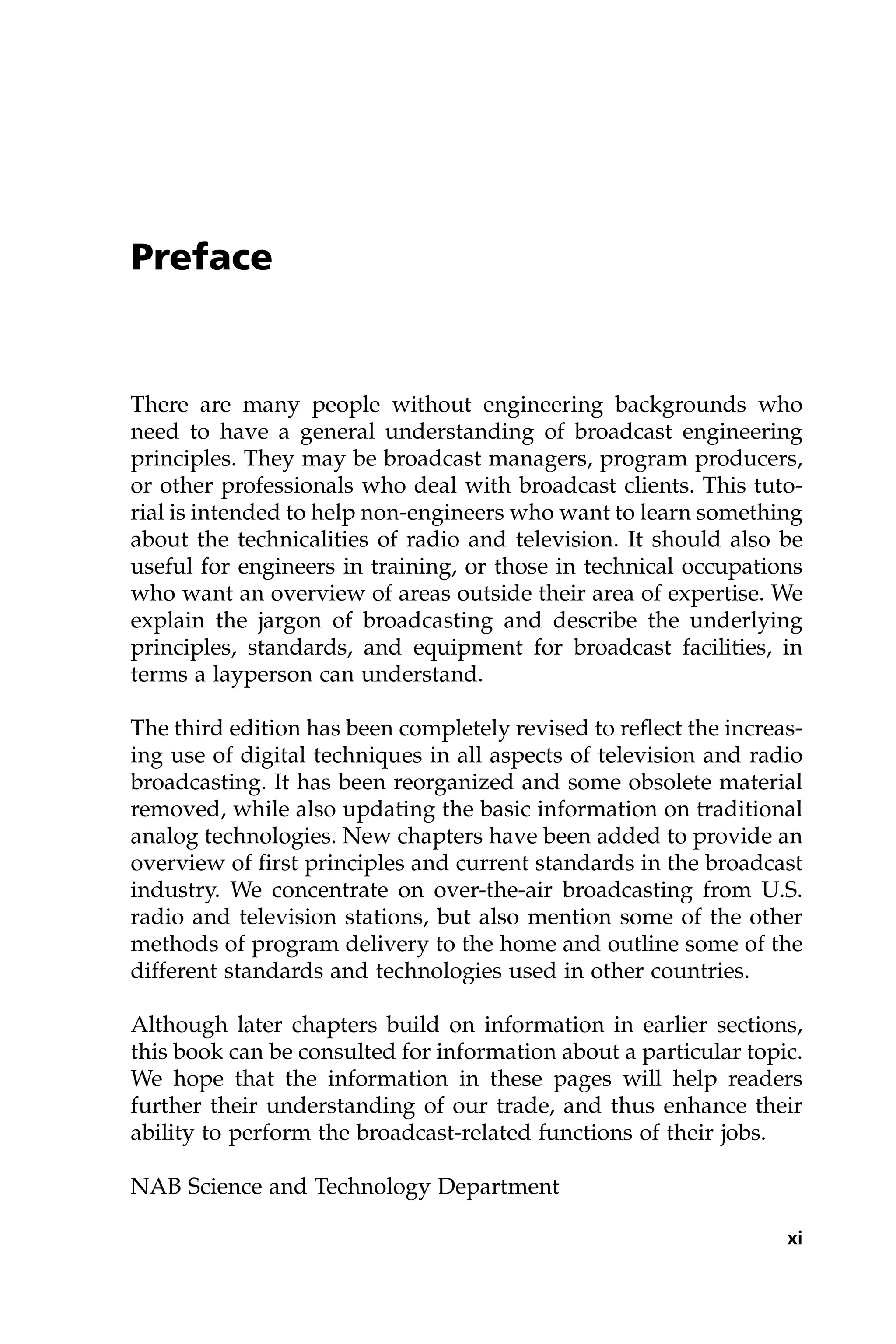
Preface
There are manypeople without engineering backgrounds who
need to have a general understanding of broadcast engineering
principles. They may be broadcast managers, program producers,
or other professionals who deal with broadcast clients. This tuto-
rial is intended to help non-engineers who want to learn something
about the technicalities of radio and television. It should also be
useful for engineers in training, or those in technical occupations
who want an overview of areas outside their area of expertise. We
explain the jargon of broadcasting and describe the underlying
principles, standards, and equipment for broadcast facilities, in
terms a layperson can understand.
The third edition has been completely revised to reflect the increas-
ing use of digital techniques in all aspects of television and radio
broadcasting. It has been reorganized and some obsolete material
removed, while also updating the basic information on traditional
analog technologies. New chapters have been added to provide an
overview of first principles and current standards in the broadcast
industry. We concentrate on over-the-air broadcasting from U.S.
radio and television stations, but also mention some of the other
methods of program delivery to the home and outline some of the
different standards and technologies used in other countries.
Although later chapters build on information in earlier sections,
this book can be consulted for information about a particular topic.
We hope that the information in these pages will help readers
further their understanding of our trade, and thus enhance their
ability to perform the broadcast-related functions of their jobs.
NAB Science and Technology Department
xi
19.
Acknowledgments
As the principalauthor and editor of the third edition of this tuto-
rial, I would like to acknowledge the contributions I have received
in preparing the book. The foundation, of course, was the second
edition, which came from NAB Science and Technology, although
very little of that work remains unchanged. I have received advice
and support from my colleagues at NAB: Art Allison, Janet Elliott,
David Layer, John Marino, and Kelly Williams, and from the Senior
Vice President of Science and Technology, Lynn Claudy. James
Snyder provided input on Internet broadcasting and advised on
several other topics, as did Ed Williams. Advice on information
technology came from Andrew Jones and John Roberts. Finally,
thanks to my wife, Linda, for putting up with the long hours spent
in putting this work together and for being the ultimate “non-
engineer” who had to understand everything in the book.
Graham Jones
Washington, D.C.
xiii
20.
CHAPTER 1
Introduction
In itssimplest form, a radio or television broadcast station consists
of two basic facilities: the studio complex and a transmitter site.
The studio complex is the place where the programming originates.
The transmitter is the device that, with an antenna, actually broad-
casts the program material out over the air. In between the two is
a connection called the studio transmitter link. In reality, there are
many components that make up the chain from program origina-
tion through to the final viewer or listener. This tutorial
provides an introduction to the technologies and equipment that
constitute modern broadcasting systems.
Traditionally, broadcasting was based on analog techniques, but for
more than 20 years there has been a steady migration to digital
systems, which provide many benefits for studio operations. The
increasing use of computer-based information technology has
revolutionized both radio and television studios. More recently,
new standards have evolved that now allow digital transmission
to the home for both radio and television.
All types of broadcast stations used for domestic broadcasting
(AM, FM, and TV) are covered in this tutorial, with descriptions of
both analog and digital studio and transmission systems where
appropriate. For completeness, satellite, cable, and Internet deliv-
ery are also briefly mentioned.
Jargon words and phrases are shown in italics the first time they
are used in each section. They may be explained there or covered
in detail in other chapters. Some of these jargon words are unique
to broadcasting, but some are regular words that are used in
1
21.
a special way—wewill try to make their meaning clear for the
reader.
Chapters in the first section of the book, Broadcasting Basics,
discuss the main methods used for radio and television broadcast-
ing and explain some of the basic science and the terms used later
in the book. Chapters in the second section, Studios and Produc-
tion Facilities, describe radio and television studios and remote
operations, covering the main items of equipment used and how
they work together. Chapters in the third section, Transmission
Standards and Systems, discuss the standards and technologies
used for U.S. radio and television transmission, and cover trans-
mitter site facilities and equipment. The final chapter discusses
radio wave propagation and the Federal Communications Com-
mission (FCC) Technical Rules.
In each section or chapter, we generally talk about topics related to
audio and radio first, and then deal with video and television.
2 1 INTRODUCTION
CHAPTER 2
Types ofBroadcasting
By definition, broadcasting means “to transmit by radio or tele-
vision,” but, with developments in technology that have taken
place, that simple phrase now includes many different types of
transmission. Let’s start with a summary of the main types in use
today in the United States and overseas. Many of the systems men-
tioned below differ only in the way they are transmitted—studio
systems for radio and television generally have fewer variations.
Don’t worry if you don’t fully understand all of the terms used
in this chapter: they will be explained later in the appropriate
sections.
Analog Radio
Radio broadcasting for local stations in the United States, and
throughout the world falls into two main types: AM and FM—
standing for amplitude modulation and frequency modulation, respec-
tively. These are the particular methods of radio transmission, used
for many years for traditional broadcasting to home, car, and
portable receivers. In North America, AM is used in the medium fre-
quency (MF) (also known as medium wave) band, whereas FM uses
the very high frequency (VHF) band.
One radio station frequently feeds only one transmitter, and there-
fore is referred to as an AM station or an FM station. It is, however,
quite possible for a station to feed both AM and FM transmitters
in the same area, or to feed more than one transmitter covering dif-
ferent areas, in which case the term AM or FM may refer only to a
particular transmitter and not to the station as a whole.
5
25.
In some overseascountries, AM is also used in the long wave band,
with frequencies somewhat lower than the MF band, and slightly
different propagation characteristics—good for broadcasting over
a wide area. AM is also used for shortwave radio broadcasting—also
known as HF from the name of the high frequency band that is used.
This is used for broadcasting over very long distances (usually
internationally).
We cover analog radio in more detail in Chapters 12 and 16.
Digital Radio
There are four main over-the-air digital radio systems in the world,
all different from each other in several respects: IBOC, DAB, ISDB-
TSB, and DRM.
IBOC
Digital radio broadcasting for local stations in the United States,
introduced for regular use in 2003, uses a proprietary system called
HD Radio, generically known as IBOC. IBOC stands for In-Band
On-Channel and is the particular method of digital radio transmis-
sion. There are two versions: one for AM broadcasting and one for
FM. They offer significant quality improvements over equivalent
analog AM and FM transmission, while broadcasting to the same
destinations of home, car, and portable receivers. FM IBOC can also
carry additional data information services. A key feature of IBOC is
that it can share the same band and channel as an analog radio
transmitter (hence, the name), so no additional radio spectrum
space is needed for a radio station to add an IBOC digital service.
We cover IBOC in more detail in Chapters 13 and 16.
DAB
Digital radio for national and some local services outside the
United States—in Europe, Canada, and elsewhere—primarily uses
6 2 TYPES OF BROADCASTING
composition. The fluoridesare lowest in the scale, while quartz,
corundum, the sulphides and arsenides, are among the highest.
From these particulars it will be understood that researches into
mineralogy have a prospect of becoming more and more interesting.
As we have a British Association for the Advancement of Science, so
our neighbours across the Channel have a French Association. It met
last August at Havre, and in a few of its fifteen sections manifested
signs of activity. Among the meteorologists, diagrams were exhibited
shewing clearly that the 'changes of pressure in the upper regions of
the atmosphere are by no means similar to those at the surface of
the earth; for when the pressure at the lower station decreases, it
rises at the upper station, and the reverse; or when it is steady at
the one, it rises or falls at the other.' A line of telegraph for
meteorological purposes is now erected from Bagnères to the Pic du
Midi, seventeen miles. The Pic is nine thousand feet high, and will be
an interesting observing station, in constant communication with the
lower regions. A proposition was made that the Transatlantic steam-
ship companies should be requested to institute regular
meteorological observations on board their vessels; and that the
captive balloon of next year's Great Exhibition at Paris should be an
observing station. Paris is chosen as the meeting-place of the
Association for next year, and at the same time a free international
meteorological congress will be held.
During recent years it has been said that the marshes and saltish
depressions in the territory of Algiers and other parts of North Africa
were once covered by the sea, and schemes have been announced
for readmitting the sea by cutting channels from the Mediterranean.
Mr Le Chatelier, a French chemist, says—the existence of the salts is
not due to the drying up of a former sea, but to the masses of rock-
salt which exist in the mountains. From these the salt is dissolved
out by rain or by subterranean waters, and the saline solution
percolates the soil to feed the artesian reservoirs which underlie the
desert. These observations will require attention from geographers.
28.
If any apologywere required for a somewhat late notice of Dr
Sayre's method of rectifying curvature of the spine, it would be
found in the fact that among the arts the healing art holds an
eminent place, and has special claims on every one's attention. Dr
Sayre, an American, has this year visited England to make known his
method of curing those malformations of the backbone under which
many persons remain cripples for the whole of their life; and now
that it is known, the wonder is that it was not thought of before. In
carrying out the operation, the patient is lifted from the ground, and
suspended by a support under the chin and back of the head:
sometimes a support is placed under the armpits, and sometimes
the arms are raised. In this position the weight of the pelvis acts on
the crook in the spine, and pulls it straight; a bandage dipped in
plaster of Paris is then bound round the body; a few iron splints are
inserted in the bandage, and as the plaster dries, a mould is formed,
which keeps the straightened bones in place. The suspension is now
at an end; the patient is found to be an inch or two inches taller
than before the operation, and can walk without limping. After a few
days, the plaster-mould is cut up each side, to allow of removal for
washing the body; but the two halves are quickly replaced and held
in position by a bandage. In some instances six months' wearing of
the plaster-mould effects a cure, and the patient enjoys an ease and
activity never before experienced.
This method of cure contrasts favourably with the treatment which
keeps the patient supine many weary months. As may be imagined,
it succeeds better with children than with adults; but even adults
have been cured. A case occurred at Cork, the patient being a
woman aged twenty-two, and requiring a little mechanical pulling to
assist in the straightening; but it was accomplished, and she walked
out of the room two inches taller than she entered it.
Mr Hoppe-Seyler, a learned German, has published a paper on
Differences of Chemical Structure and of Digestion among Animals,
supported by numerous examples, which shew that according to the
organism so is the power to form differences of tissue; and he sums
up thus: 'Looking at the question broadly, we find that the chemical
29.
composition of thetissues and the chemical functions of the organs
present undoubted relations to the stages of development, which
shew themselves in the zoological system, as well as in the early
stages of development of each individual higher organism. These
relations deserve further notice and investigation, and are qualified
in many respects to prevent and correct errors in the classification of
animals. It is generally supposed that the study of development is a
purely morphological science, but it also presents a large field for
chemical research.' This concluding sentence is significant, and
should have serious consideration.
Waste pyrites from the manufacture of sulphuric acid is, as regards
hardness, a good material for roads when mixed with gravel; but
chemically it is not good. In the neighbourhood of Nienburg,
Hanover, where roads and paths were covered with waste pyrites, it
was found that grass and corn ceased to grow; and a farmer on
mixing well-water with warm milk, observed that the milk curdled.
The explanation is, that the waste pyrites 'contained not only
sulphide of iron and earthy constituents, but also sulphide of zinc,
and that by the influence of the oxygen of the atmosphere and the
presence of water, these sulphides were gradually converted into the
corresponding sulphates;' and these, continually extracted by the
rain-water, soaked into the soil, contaminated the wells, and
produced other injurious effects.
The want of really efficient names to distinguish various kinds of
manufactured iron has long been felt in the iron trade. The
Philadelphia Exhibition gave rise to a Commission which, after
discussion of the question, have recommended that all malleable
compounds of iron similar to the substance called wrought-iron shall
be called 'weld-iron;' that compounds similar to the product hitherto
known as puddled steel, shall be called 'weld-steel;' that compounds
which cannot be appreciably hardened when placed in water while
red-hot shall be called 'ingot-iron;' and that compounds of this latter
which from any cause are capable of being tempered, shall be called
'ingot-steel.'
30.
By further exerciseof his inventive abilities, Major Moncrieff has
produced a hydro-pneumatic spring gun-carriage perfectly adapted
for use in the field. A gun mounted on this carriage could be made
ready for action within ten minutes after its arrival in the trenches.
The Science and Art Department have commenced the publication of
a 'Universal Art Inventory, consisting of brief Notes of Fine and
Ornamental Art executed before the year 1800 chiefly to be found in
Europe.' This is a praiseworthy undertaking, for there are so many
rarities of art which can never be seen by the multitude, which can
never be moved from their place or purchased, that an inventory
thereof with descriptive notes cannot fail to be of great utility. Nearly
all the governments of Europe and many royal personages are co-
operating in this work, which includes reproductions in possible
instances. Some of these reproductions are well known to the
frequenters of the South Kensington Museum; for example, the
great mantel-piece from the Palais de Justice at Bruges; Trajan's
Column from Rome; a Buddhist gateway from India, of the first
century; a monument from Nuremberg, and other elaborate works.
As a means of reference, this Inventory will be welcome to many a
student, and as it necessarily will take many years to complete,
there will be the pleasure of watching for fresh instalments of
information. But all students should remember that 'the laws of
design are as definite as those of language, with much the same
questions as to order, relationship, construction or elegance;
differing for dissimilar styles as for divers tongues. The pupil in
design has similar obstacles to encounter with those of the
schoolboy in his alphabet and grammar; the ability to use the pencil
or the brush will no more produce an artist than the acquirement of
the writing-master's art with Lindley Murray's rules will make a poet.'
Professor Justin Winsor, one of the American delegates to the
conference of librarians held last month, points out with much
earnestness that by the extension of libraries a great impetus may
be given to national education, and an opening made at the same
time for the employment of women. In America, pains have been
taken to engage men and women in the work who are content to
31.
labour to attainthe level of a far higher standard than the public at
large have been usually willing to allow as the test of efficiency. 'We
believe,' remarks the Professor, 'that libraries are in the highest
sense public charities; that they are missionary enterprises; that it is
to be supine if we are simply willing to let them do their unassisted
work; that it is their business to see two books read instead of one,
and good books instead of bad. To this end it has been urged that
one of our principal universities shall have a course of bibliography
and training in library economy.'
In reply to various correspondents, we beg to state that the
information regarding the manufacture of vegetable isinglass in
Rouen, which appeared under the head of A Few French Notes in
No. 717 of this Journal, was taken from L'Armée Scientifique, a work
compiled by the well-known French savant, M. L. Figuier. As there
seems to be some difficulty in reconciling M. Figuier's statements
with the present state of the process as carried on in France, we are
making further inquiry, and hope to be able to give early and definite
information.
32.
A FEARFUL SWING.
The'Shaftmen' at our collieries are selected for their physical
strength and pluck, in addition to the skill and practical knowledge
required for their particular work. The incident we are about to
relate will shew how severely the former of these qualifications may
at times be tested.
The work of these men is confined to the shaft of the pit, and
consists mainly in repairing the 'tubbing' or lining of the shaft,
stopping leaks, or removing any obstructions interfering with the
free passage of the cages up and down the pit. The coal-pit at N——
has a double shaft, divided by a 'bratticing' or wooden partition.
These divisions we will call A and B. Two cages (the vehicles of
transport up and down the pit) ascend and descend alternately in
shaft A. At a certain point the shaft is widened, to allow the cages to
pass each other, and their simultaneous arrival at this point is
insured by the arrangement of the wire-ropes on the winding-wheels
over the pit-mouth. The oscillation of the cages is guarded against
by wooden guiders running down each side of the shaft, which fit
into grooves in the sides of the cage.
On one occasion during a very severe frost these guiders had
become coated with ice, and thus their free passage in the grooves
of the cages was interfered with. Before this obstruction was
discovered, the engine having been set in motion, the downward
cage, which fortunately was empty at the time, stuck fast in the
shaft before arriving at the passing-point. The ascending cage,
whose only occupant was a small boy returning to 'bank,' proceeding
on its upward course, crashed into the downward cage in the narrow
part of the shaft, where of course there was only a single passage.
Though the shock was something terrific, the steel rope was not
broken; as the engineman, whose responsible position entails the
33.
greatest presence ofmind and watchfulness, had stopped the
engine on the first indication of an unusual tremor in the rope. Yet
such was the violence of the meeting, that both cages, though
strongly constructed of iron, were bent and broken—in fact rendered
useless—by being thus jammed together in a narrow space. The
greatest anxiety was felt as to the fate of the boy, as it was seen
that even if he had escaped with his life after such a severe crash,
his rescue would be a work of great danger and difficulty.
We may imagine the horror of the poor little fellow while suspended
in the shattered cage over a gulf some four hundred feet deep, both
cages firmly wedged in the shaft, and the ropes rendered useless for
any means of descent to the scene of the catastrophe. The readiest
way of approach seemed to be by shaft B, the position of which we
have indicated above. Down this then, a Shaftman, whom we will
call Johnson, descended in a cage until he arrived at an opening in
the brattice-work by which he could enter shaft A. He found himself
(as he supposed) at a point a little above where the accident had
occurred; and this conclusion he came to from seeing two ropes
leading downwards, which he naturally took to be those by which
the cages were suspended. Under this impression he formed the
design of sliding down one of the ropes, with a view to liberating, if
possible, the entangled cages and securing the safety of the
unfortunate boy. The hardy fellow was soon gliding through the
darkness on his brave and dangerous errand. He had descended
about forty feet, when, to his horror and amazement, his course was
suddenly checked by a bend in the rope; and the terrible discovery
flashed upon him, that he was suspended in the loop of the slack
rope, which here took a return course to the top of the downward
cage!
It will be understood that when the descending cage stuck upon the
runners, as the rope continued to unwind from the pulley it hung
down in a loop, descending lower and lower, until the engine was
stopped by the meeting of the cages. This loop or 'bight' was
naturally mistaken by Johnson for the two ropes, and he did not
discover until he found himself in the fearful situation described, that
34.
he had enteredthrough the brattice into shaft A below instead of
above where the cages were fixed. There he hung then, over a
yawning abyss many fathoms deep—closed from above by the
locked cages—all below looming dark and horrible.
None of course knew his danger; his hands were chilled by the
freezing rope; his arms, already fully exercised, began to ache and
stiffen with the strain and intense cold, added to the bewildering
sense of hopeless peril. Good need there was then that pluck and
endurance be found in the Shaftman! His square sturdy frame and
unflinching spirit were now on their trial. Had his presence of mind
gone or his nerve failed, he must have been paralysed with fear, lost
his hold, and been dashed into an unrecognisable mass.
But self-preservation is a potent law, and working in such a spirit he
framed a desperate plan for a struggle for life. The guiders running
down the inside of the shaft are fastened on to cross-beams about
six feet apart. Johnson hoped that if he could reach one of these, he
might obtain a footing whereon to rest, and by their means clamber
up to the opening in the brattice-work. How to reach them was the
next question that flashed lightning-like through his brain. This he
essayed to do by causing the rope to oscillate from side to side,
hoping thus to bring himself within reach of one of the cross-beams.
And now commenced a fearful swing. Gaining a lodgment with one
knee in the loop, he set the rope swinging by the motion of his body,
grasping out wildly with one hand each time he approached the side
of the shaft. Once, twice, thrice! he felt the cold icy face of the
'tubbing,' but as yet nothing except slimy boards met his grasp,
affording no more hold than the glassy side of an iceberg. At last he
touched a cross-beam, to which his iron muscles, now fully roused to
their work, held on like a vice. He soon found footing on the beam
below, and then letting go the treacherous rope, rested in
comparative security before beginning the perilous ascent. With
incredible endurance of nerve and muscle he clambered upward
alongside the guider, by the aid of the cross-beams, and by thrusting
his hands through the crevices of the timber. In this manner he
reached the opening into shaft B, where the cage in which he had
35.
descended was waiting.Chilled, cramped, and frozen, and barely
able to give the signal, he was drawn to the pit-mouth prostrate and
exhausted. The boy was rescued unhurt by a man being lowered to
the top of the cages in shaft A. Johnson suffered no ill
consequences, and though a hero above many known to fame, he
still pursues his hardy task as a Shaftman; while beneath the homely
exterior still lives the pluck and sinew of iron that did not fail him
even in his Fearful Swing.
36.
TO MY ROBINREDBREAST.
The following lines are taken from The Captive Chief, a
Tale of Flodden Field, by James Thomson (H. H. Blair,
Alnwick, 1871).
Now keenly blows the northern blast;
Like winter hail the leaves fall fast,
And my pet Robin's come at last
To our old thorn;
With warbling throat and eye upcast
He greets the morn;
Like some true friend you come to cheer,
When all around is dark and drear.
And oh! what friend to me more dear
Than your sweet sel'?
Your mellow voice falls on my ear
Like some sweet spell.
Oft at the gloaming's pensive hour,
When clouds above me darkly lower,
I've sought a seat in some lone bower,
With heart opprest;
You soothed me with your magic power,
And calmed my breast.
When Morning dons her sober gray
To usher in the coming day,
And Phœbus shines with sickly ray
On all around,
No warblers greet him from the spray
With joyous sound.
37.
But you, sweetbird, unlike the throng,
Salute him with a joyous song.
When heavy rains and sleet prolong
The dreary day,
You chant to him your evening song
Upon the spray.
No blackbird whistles in the grove,
Where late in chorus sweet they strove;
No warbler's tongue is heard to move,
But all is sad;
No cushat woos his amorous love
In hazel glade.
Printed and Published by W. & R. Chambers, 47 Paternoster Row,
London, and 339 High Street, Edinburgh.
All Rights Reserved.
38.
*** END OFTHE PROJECT GUTENBERG EBOOK CHAMBERS'S
JOURNAL OF POPULAR LITERATURE, SCIENCE, AND ART, NO. 726
***
Updated editions will replace the previous one—the old editions
will be renamed.
Creating the works from print editions not protected by U.S.
copyright law means that no one owns a United States
copyright in these works, so the Foundation (and you!) can copy
and distribute it in the United States without permission and
without paying copyright royalties. Special rules, set forth in the
General Terms of Use part of this license, apply to copying and
distributing Project Gutenberg™ electronic works to protect the
PROJECT GUTENBERG™ concept and trademark. Project
Gutenberg is a registered trademark, and may not be used if
you charge for an eBook, except by following the terms of the
trademark license, including paying royalties for use of the
Project Gutenberg trademark. If you do not charge anything for
copies of this eBook, complying with the trademark license is
very easy. You may use this eBook for nearly any purpose such
as creation of derivative works, reports, performances and
research. Project Gutenberg eBooks may be modified and
printed and given away—you may do practically ANYTHING in
the United States with eBooks not protected by U.S. copyright
law. Redistribution is subject to the trademark license, especially
commercial redistribution.
START: FULL LICENSE
PLEASE READ THISBEFORE YOU DISTRIBUTE OR USE THIS WORK
To protect the Project Gutenberg™ mission of promoting the
free distribution of electronic works, by using or distributing this
work (or any other work associated in any way with the phrase
“Project Gutenberg”), you agree to comply with all the terms of
the Full Project Gutenberg™ License available with this file or
online at www.gutenberg.org/license.
Section 1. General Terms of Use and
Redistributing Project Gutenberg™
electronic works
1.A. By reading or using any part of this Project Gutenberg™
electronic work, you indicate that you have read, understand,
agree to and accept all the terms of this license and intellectual
property (trademark/copyright) agreement. If you do not agree
to abide by all the terms of this agreement, you must cease
using and return or destroy all copies of Project Gutenberg™
electronic works in your possession. If you paid a fee for
obtaining a copy of or access to a Project Gutenberg™
electronic work and you do not agree to be bound by the terms
of this agreement, you may obtain a refund from the person or
entity to whom you paid the fee as set forth in paragraph 1.E.8.
1.B. “Project Gutenberg” is a registered trademark. It may only
be used on or associated in any way with an electronic work by
people who agree to be bound by the terms of this agreement.
There are a few things that you can do with most Project
Gutenberg™ electronic works even without complying with the
full terms of this agreement. See paragraph 1.C below. There
are a lot of things you can do with Project Gutenberg™
electronic works if you follow the terms of this agreement and
help preserve free future access to Project Gutenberg™
electronic works. See paragraph 1.E below.
41.
1.C. The ProjectGutenberg Literary Archive Foundation (“the
Foundation” or PGLAF), owns a compilation copyright in the
collection of Project Gutenberg™ electronic works. Nearly all the
individual works in the collection are in the public domain in the
United States. If an individual work is unprotected by copyright
law in the United States and you are located in the United
States, we do not claim a right to prevent you from copying,
distributing, performing, displaying or creating derivative works
based on the work as long as all references to Project
Gutenberg are removed. Of course, we hope that you will
support the Project Gutenberg™ mission of promoting free
access to electronic works by freely sharing Project Gutenberg™
works in compliance with the terms of this agreement for
keeping the Project Gutenberg™ name associated with the
work. You can easily comply with the terms of this agreement
by keeping this work in the same format with its attached full
Project Gutenberg™ License when you share it without charge
with others.
1.D. The copyright laws of the place where you are located also
govern what you can do with this work. Copyright laws in most
countries are in a constant state of change. If you are outside
the United States, check the laws of your country in addition to
the terms of this agreement before downloading, copying,
displaying, performing, distributing or creating derivative works
based on this work or any other Project Gutenberg™ work. The
Foundation makes no representations concerning the copyright
status of any work in any country other than the United States.
1.E. Unless you have removed all references to Project
Gutenberg:
1.E.1. The following sentence, with active links to, or other
immediate access to, the full Project Gutenberg™ License must
appear prominently whenever any copy of a Project
Gutenberg™ work (any work on which the phrase “Project
42.
Gutenberg” appears, orwith which the phrase “Project
Gutenberg” is associated) is accessed, displayed, performed,
viewed, copied or distributed:
This eBook is for the use of anyone anywhere in the United
States and most other parts of the world at no cost and
with almost no restrictions whatsoever. You may copy it,
give it away or re-use it under the terms of the Project
Gutenberg License included with this eBook or online at
www.gutenberg.org. If you are not located in the United
States, you will have to check the laws of the country
where you are located before using this eBook.
1.E.2. If an individual Project Gutenberg™ electronic work is
derived from texts not protected by U.S. copyright law (does not
contain a notice indicating that it is posted with permission of
the copyright holder), the work can be copied and distributed to
anyone in the United States without paying any fees or charges.
If you are redistributing or providing access to a work with the
phrase “Project Gutenberg” associated with or appearing on the
work, you must comply either with the requirements of
paragraphs 1.E.1 through 1.E.7 or obtain permission for the use
of the work and the Project Gutenberg™ trademark as set forth
in paragraphs 1.E.8 or 1.E.9.
1.E.3. If an individual Project Gutenberg™ electronic work is
posted with the permission of the copyright holder, your use and
distribution must comply with both paragraphs 1.E.1 through
1.E.7 and any additional terms imposed by the copyright holder.
Additional terms will be linked to the Project Gutenberg™
License for all works posted with the permission of the copyright
holder found at the beginning of this work.
1.E.4. Do not unlink or detach or remove the full Project
Gutenberg™ License terms from this work, or any files
43.
containing a partof this work or any other work associated with
Project Gutenberg™.
1.E.5. Do not copy, display, perform, distribute or redistribute
this electronic work, or any part of this electronic work, without
prominently displaying the sentence set forth in paragraph 1.E.1
with active links or immediate access to the full terms of the
Project Gutenberg™ License.
1.E.6. You may convert to and distribute this work in any binary,
compressed, marked up, nonproprietary or proprietary form,
including any word processing or hypertext form. However, if
you provide access to or distribute copies of a Project
Gutenberg™ work in a format other than “Plain Vanilla ASCII” or
other format used in the official version posted on the official
Project Gutenberg™ website (www.gutenberg.org), you must,
at no additional cost, fee or expense to the user, provide a copy,
a means of exporting a copy, or a means of obtaining a copy
upon request, of the work in its original “Plain Vanilla ASCII” or
other form. Any alternate format must include the full Project
Gutenberg™ License as specified in paragraph 1.E.1.
1.E.7. Do not charge a fee for access to, viewing, displaying,
performing, copying or distributing any Project Gutenberg™
works unless you comply with paragraph 1.E.8 or 1.E.9.
1.E.8. You may charge a reasonable fee for copies of or
providing access to or distributing Project Gutenberg™
electronic works provided that:
• You pay a royalty fee of 20% of the gross profits you derive
from the use of Project Gutenberg™ works calculated using the
method you already use to calculate your applicable taxes. The
fee is owed to the owner of the Project Gutenberg™ trademark,
but he has agreed to donate royalties under this paragraph to
the Project Gutenberg Literary Archive Foundation. Royalty
44.
payments must bepaid within 60 days following each date on
which you prepare (or are legally required to prepare) your
periodic tax returns. Royalty payments should be clearly marked
as such and sent to the Project Gutenberg Literary Archive
Foundation at the address specified in Section 4, “Information
about donations to the Project Gutenberg Literary Archive
Foundation.”
• You provide a full refund of any money paid by a user who
notifies you in writing (or by e-mail) within 30 days of receipt
that s/he does not agree to the terms of the full Project
Gutenberg™ License. You must require such a user to return or
destroy all copies of the works possessed in a physical medium
and discontinue all use of and all access to other copies of
Project Gutenberg™ works.
• You provide, in accordance with paragraph 1.F.3, a full refund of
any money paid for a work or a replacement copy, if a defect in
the electronic work is discovered and reported to you within 90
days of receipt of the work.
• You comply with all other terms of this agreement for free
distribution of Project Gutenberg™ works.
1.E.9. If you wish to charge a fee or distribute a Project
Gutenberg™ electronic work or group of works on different
terms than are set forth in this agreement, you must obtain
permission in writing from the Project Gutenberg Literary
Archive Foundation, the manager of the Project Gutenberg™
trademark. Contact the Foundation as set forth in Section 3
below.
1.F.
1.F.1. Project Gutenberg volunteers and employees expend
considerable effort to identify, do copyright research on,
transcribe and proofread works not protected by U.S. copyright
45.
law in creatingthe Project Gutenberg™ collection. Despite these
efforts, Project Gutenberg™ electronic works, and the medium
on which they may be stored, may contain “Defects,” such as,
but not limited to, incomplete, inaccurate or corrupt data,
transcription errors, a copyright or other intellectual property
infringement, a defective or damaged disk or other medium, a
computer virus, or computer codes that damage or cannot be
read by your equipment.
1.F.2. LIMITED WARRANTY, DISCLAIMER OF DAMAGES - Except
for the “Right of Replacement or Refund” described in
paragraph 1.F.3, the Project Gutenberg Literary Archive
Foundation, the owner of the Project Gutenberg™ trademark,
and any other party distributing a Project Gutenberg™ electronic
work under this agreement, disclaim all liability to you for
damages, costs and expenses, including legal fees. YOU AGREE
THAT YOU HAVE NO REMEDIES FOR NEGLIGENCE, STRICT
LIABILITY, BREACH OF WARRANTY OR BREACH OF CONTRACT
EXCEPT THOSE PROVIDED IN PARAGRAPH 1.F.3. YOU AGREE
THAT THE FOUNDATION, THE TRADEMARK OWNER, AND ANY
DISTRIBUTOR UNDER THIS AGREEMENT WILL NOT BE LIABLE
TO YOU FOR ACTUAL, DIRECT, INDIRECT, CONSEQUENTIAL,
PUNITIVE OR INCIDENTAL DAMAGES EVEN IF YOU GIVE
NOTICE OF THE POSSIBILITY OF SUCH DAMAGE.
1.F.3. LIMITED RIGHT OF REPLACEMENT OR REFUND - If you
discover a defect in this electronic work within 90 days of
receiving it, you can receive a refund of the money (if any) you
paid for it by sending a written explanation to the person you
received the work from. If you received the work on a physical
medium, you must return the medium with your written
explanation. The person or entity that provided you with the
defective work may elect to provide a replacement copy in lieu
of a refund. If you received the work electronically, the person
or entity providing it to you may choose to give you a second
opportunity to receive the work electronically in lieu of a refund.
46.
If the secondcopy is also defective, you may demand a refund
in writing without further opportunities to fix the problem.
1.F.4. Except for the limited right of replacement or refund set
forth in paragraph 1.F.3, this work is provided to you ‘AS-IS’,
WITH NO OTHER WARRANTIES OF ANY KIND, EXPRESS OR
IMPLIED, INCLUDING BUT NOT LIMITED TO WARRANTIES OF
MERCHANTABILITY OR FITNESS FOR ANY PURPOSE.
1.F.5. Some states do not allow disclaimers of certain implied
warranties or the exclusion or limitation of certain types of
damages. If any disclaimer or limitation set forth in this
agreement violates the law of the state applicable to this
agreement, the agreement shall be interpreted to make the
maximum disclaimer or limitation permitted by the applicable
state law. The invalidity or unenforceability of any provision of
this agreement shall not void the remaining provisions.
1.F.6. INDEMNITY - You agree to indemnify and hold the
Foundation, the trademark owner, any agent or employee of the
Foundation, anyone providing copies of Project Gutenberg™
electronic works in accordance with this agreement, and any
volunteers associated with the production, promotion and
distribution of Project Gutenberg™ electronic works, harmless
from all liability, costs and expenses, including legal fees, that
arise directly or indirectly from any of the following which you
do or cause to occur: (a) distribution of this or any Project
Gutenberg™ work, (b) alteration, modification, or additions or
deletions to any Project Gutenberg™ work, and (c) any Defect
you cause.
Section 2. Information about the Mission
of Project Gutenberg™
47.
Project Gutenberg™ issynonymous with the free distribution of
electronic works in formats readable by the widest variety of
computers including obsolete, old, middle-aged and new
computers. It exists because of the efforts of hundreds of
volunteers and donations from people in all walks of life.
Volunteers and financial support to provide volunteers with the
assistance they need are critical to reaching Project
Gutenberg™’s goals and ensuring that the Project Gutenberg™
collection will remain freely available for generations to come. In
2001, the Project Gutenberg Literary Archive Foundation was
created to provide a secure and permanent future for Project
Gutenberg™ and future generations. To learn more about the
Project Gutenberg Literary Archive Foundation and how your
efforts and donations can help, see Sections 3 and 4 and the
Foundation information page at www.gutenberg.org.
Section 3. Information about the Project
Gutenberg Literary Archive Foundation
The Project Gutenberg Literary Archive Foundation is a non-
profit 501(c)(3) educational corporation organized under the
laws of the state of Mississippi and granted tax exempt status
by the Internal Revenue Service. The Foundation’s EIN or
federal tax identification number is 64-6221541. Contributions
to the Project Gutenberg Literary Archive Foundation are tax
deductible to the full extent permitted by U.S. federal laws and
your state’s laws.
The Foundation’s business office is located at 809 North 1500
West, Salt Lake City, UT 84116, (801) 596-1887. Email contact
links and up to date contact information can be found at the
Foundation’s website and official page at
www.gutenberg.org/contact
48.
Section 4. Informationabout Donations to
the Project Gutenberg Literary Archive
Foundation
Project Gutenberg™ depends upon and cannot survive without
widespread public support and donations to carry out its mission
of increasing the number of public domain and licensed works
that can be freely distributed in machine-readable form
accessible by the widest array of equipment including outdated
equipment. Many small donations ($1 to $5,000) are particularly
important to maintaining tax exempt status with the IRS.
The Foundation is committed to complying with the laws
regulating charities and charitable donations in all 50 states of
the United States. Compliance requirements are not uniform
and it takes a considerable effort, much paperwork and many
fees to meet and keep up with these requirements. We do not
solicit donations in locations where we have not received written
confirmation of compliance. To SEND DONATIONS or determine
the status of compliance for any particular state visit
www.gutenberg.org/donate.
While we cannot and do not solicit contributions from states
where we have not met the solicitation requirements, we know
of no prohibition against accepting unsolicited donations from
donors in such states who approach us with offers to donate.
International donations are gratefully accepted, but we cannot
make any statements concerning tax treatment of donations
received from outside the United States. U.S. laws alone swamp
our small staff.
Please check the Project Gutenberg web pages for current
donation methods and addresses. Donations are accepted in a
number of other ways including checks, online payments and
49.
credit card donations.To donate, please visit:
www.gutenberg.org/donate.
Section 5. General Information About
Project Gutenberg™ electronic works
Professor Michael S. Hart was the originator of the Project
Gutenberg™ concept of a library of electronic works that could
be freely shared with anyone. For forty years, he produced and
distributed Project Gutenberg™ eBooks with only a loose
network of volunteer support.
Project Gutenberg™ eBooks are often created from several
printed editions, all of which are confirmed as not protected by
copyright in the U.S. unless a copyright notice is included. Thus,
we do not necessarily keep eBooks in compliance with any
particular paper edition.
Most people start at our website which has the main PG search
facility: www.gutenberg.org.
This website includes information about Project Gutenberg™,
including how to make donations to the Project Gutenberg
Literary Archive Foundation, how to help produce our new
eBooks, and how to subscribe to our email newsletter to hear
about new eBooks.
50.
Welcome to ourwebsite – the ideal destination for book lovers and
knowledge seekers. With a mission to inspire endlessly, we offer a
vast collection of books, ranging from classic literary works to
specialized publications, self-development books, and children's
literature. Each book is a new journey of discovery, expanding
knowledge and enriching the soul of the reade
Our website is not just a platform for buying books, but a bridge
connecting readers to the timeless values of culture and wisdom. With
an elegant, user-friendly interface and an intelligent search system,
we are committed to providing a quick and convenient shopping
experience. Additionally, our special promotions and home delivery
services ensure that you save time and fully enjoy the joy of reading.
Let us accompany you on the journey of exploring knowledge and
personal growth!
ebookultra.com

















![Presentation1[1]abiout nhnfdfkmdjbf.pptx](https://cdn.slidesharecdn.com/ss_thumbnails/presentation11-240718051625-2893c777-thumbnail.jpg?width=640&height=640&fit=bounds)


