Md. Ahad khan 103-23-2272
Md. Momin khan 103-23-2273
Md. mamun 103-23-2271
Md. Bappy mia robin 103-23-2270
Md. norunnobi 111-23-2482
It started from the Mughal
age in the Indian
subcontinent through
Dhakai Musline.
Ready made garment
industry started to
contribute in our economy
from late eighties (1977).
The industry has grown
during the 1990s roughly
at the rate of 22%.
• At present now There
are now about 3000
garments producers
in Bangladesh.
• About 50 lacks of
people are employed
in this industry and 85
percent of them are
women.
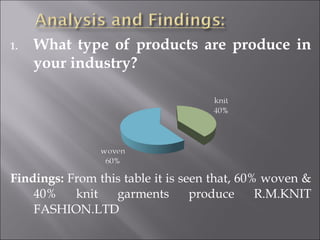
1. What type of products are produce in
your industry?
Findings: From this table it is seen that, 60% woven &
40% knit garments produce R.M.KNIT
FASHION.LTD
Findings: From this table it is seen that, 30% USA
&Others is 70% market where my company does
their business.
Findings: From this table it is seen that, strongly
agree 30% and agree 70%.
Unskilled garments worker is the main problem for
this industry.
Findings: Above the table it is seen that, yes 70% &
no 30%.
Findings: From this table it is seen that, agree 20%,
disagree 30% & strongly disagree 50%.
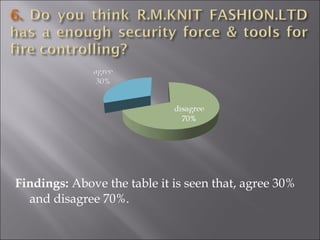
Findings: Above the table it is seen that, agree 30%
and disagree 70%.
Findings: From the table it is seen that, agree 40%
and disagree 60%.
Findings: From the table it is seen that, agree 30%
and disagree 70%.
Findings: From the table it is seen that, yes 30% and
no 70%.
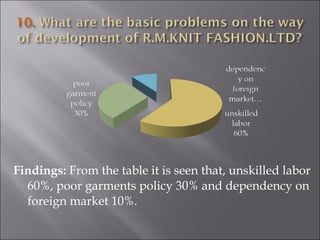
Findings: From the table it is seen that, unskilled labor
60%, poor garments policy 30% and dependency on
foreign market 10%.
Findings: From the table it is seen that, try to increase the
area of export 10%, establish new infrastructure and
conducting training and development program 60%
and increase investment in this sector 30%.
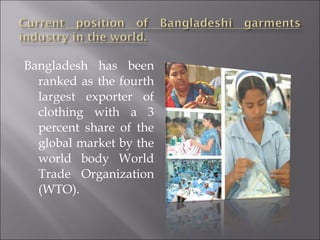
Bangladesh has been
ranked as the fourth
largest exporter of
clothing with a 3
percent share of the
global market by the
world body World
Trade Organization
(WTO).
• At present about 20
countries of the world
are importer of our
garments.
• Around 75 percent of
the total export
earnings come from
this industry.
• Creating jobs for
about 2 million people
of which 70 percent
are women.
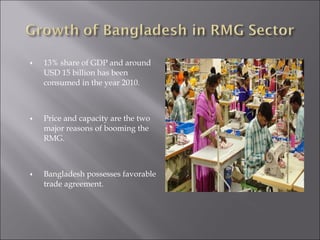
♦ 13% share of GDP and around
USD 15 billion has been
consumed in the year 2010.
♦ Price and capacity are the two
major reasons of booming the
RMG.
♦ Bangladesh possesses favorable
trade agreement.
Financial
year
UE U.S.A Total
productio
n
Knit Woven RMG Knit Woven RMG
FY 2009 140000
pcs
220000pcs 360000pcs 170000pcs 250000pcs 420000pcs 780000pcs
FY 2010 165000pcs 230000pcs 395000pcs 176000pcs 258000pcs 434000pcs 829000pcs
FY 2011 167000pcs 232000pcs 399000pcs 170000pcs 255000pcs 425000pcs 824000pcs
Graph: Growth &
trends of R.M.KNIT
FASHION.LTD
Competition From Overseas
Companies With Access to Inexpensive
Labor
Shortage of Available US Textile
Workers
Difficulty in Applying Modern
Automation Technologies to Fabrics
Processing
 1. Raw materials:
 2. Unskilled workers: 
 3. Improper working environment:
 4. Lack of managerial knowledge:
 5. Gendered division of labor:
 6. Insufficient of loan:
 8. Working hours:
And………
 Bangladesh has the cheapest unit labor cost in
South Asia. It costs only 11 cents to produce a
shirt in Bangladesh, whereas it costs 79 cents in
Sri Lanka and 26 cents in India. Clearly,
Bangladesh’s comparative advantage lies in
having the cheapest unit labor cost.
 The collapse on April
24,2013 of Rana
Plaza,Died 1000+
 The Factory Fire on
November 10,2012 of
Tazreen germants
,died more than 100+
 Benetton
 The Children's Place
 MANGO
 Cato
 Primark
 Joe Fresh
Re-Evaluate their Contract.
 People who believe they have access to justice
behave differently in dispute situations to those who
have not faith in the system;
 In developing institutions of justice, credibility can
be more important than power;
 Support from stakeholders is crucial to the
effectiveness of the process;
♦ Current infrastructures should be
modified from the government
side.
♦ A long term strategy should be
developed to secure the raw
materials supply as well.
♦ Achieving ethical labor
standards and sourcing
practices are main requisites in
apparel industry.
♦ Provide structured in-house
training for workers and
managers.
♦ Ensure fair wages and incentive
schemes.
♦ The positive branding should be
intensified said the prominent
author Philip Kotler when he
visited in Bangladesh.
 Give Proper Safety
 Good working Environment
 Maintain Labor Law
 Give smart Wages
 Proper monitoring Team
Time to think choose the right decision…
Report on garments

Report on garments

  • 1.
    Md. Ahad khan103-23-2272 Md. Momin khan 103-23-2273 Md. mamun 103-23-2271 Md. Bappy mia robin 103-23-2270 Md. norunnobi 111-23-2482
  • 3.
    It started fromthe Mughal age in the Indian subcontinent through Dhakai Musline. Ready made garment industry started to contribute in our economy from late eighties (1977). The industry has grown during the 1990s roughly at the rate of 22%.
  • 4.
    • At presentnow There are now about 3000 garments producers in Bangladesh. • About 50 lacks of people are employed in this industry and 85 percent of them are women.
  • 5.
    1. What typeof products are produce in your industry? Findings: From this table it is seen that, 60% woven & 40% knit garments produce R.M.KNIT FASHION.LTD
  • 6.
    Findings: From thistable it is seen that, 30% USA &Others is 70% market where my company does their business.
  • 7.
    Findings: From thistable it is seen that, strongly agree 30% and agree 70%. Unskilled garments worker is the main problem for this industry.
  • 8.
    Findings: Above thetable it is seen that, yes 70% & no 30%.
  • 9.
    Findings: From thistable it is seen that, agree 20%, disagree 30% & strongly disagree 50%.
  • 10.
    Findings: Above thetable it is seen that, agree 30% and disagree 70%.
  • 11.
    Findings: From thetable it is seen that, agree 40% and disagree 60%.
  • 12.
    Findings: From thetable it is seen that, agree 30% and disagree 70%.
  • 13.
    Findings: From thetable it is seen that, yes 30% and no 70%.
  • 14.
    Findings: From thetable it is seen that, unskilled labor 60%, poor garments policy 30% and dependency on foreign market 10%.
  • 15.
    Findings: From thetable it is seen that, try to increase the area of export 10%, establish new infrastructure and conducting training and development program 60% and increase investment in this sector 30%.
  • 16.
    Bangladesh has been rankedas the fourth largest exporter of clothing with a 3 percent share of the global market by the world body World Trade Organization (WTO).
  • 17.
    • At presentabout 20 countries of the world are importer of our garments. • Around 75 percent of the total export earnings come from this industry. • Creating jobs for about 2 million people of which 70 percent are women.
  • 18.
    ♦ 13% shareof GDP and around USD 15 billion has been consumed in the year 2010. ♦ Price and capacity are the two major reasons of booming the RMG. ♦ Bangladesh possesses favorable trade agreement.
  • 19.
    Financial year UE U.S.A Total productio n KnitWoven RMG Knit Woven RMG FY 2009 140000 pcs 220000pcs 360000pcs 170000pcs 250000pcs 420000pcs 780000pcs FY 2010 165000pcs 230000pcs 395000pcs 176000pcs 258000pcs 434000pcs 829000pcs FY 2011 167000pcs 232000pcs 399000pcs 170000pcs 255000pcs 425000pcs 824000pcs Graph: Growth & trends of R.M.KNIT FASHION.LTD
  • 20.
    Competition From Overseas CompaniesWith Access to Inexpensive Labor Shortage of Available US Textile Workers Difficulty in Applying Modern Automation Technologies to Fabrics Processing
  • 21.
     1. Rawmaterials:  2. Unskilled workers:   3. Improper working environment:  4. Lack of managerial knowledge:  5. Gendered division of labor:  6. Insufficient of loan:  8. Working hours: And………
  • 22.
     Bangladesh hasthe cheapest unit labor cost in South Asia. It costs only 11 cents to produce a shirt in Bangladesh, whereas it costs 79 cents in Sri Lanka and 26 cents in India. Clearly, Bangladesh’s comparative advantage lies in having the cheapest unit labor cost.
  • 25.
     The collapseon April 24,2013 of Rana Plaza,Died 1000+  The Factory Fire on November 10,2012 of Tazreen germants ,died more than 100+
  • 26.
     Benetton  TheChildren's Place  MANGO  Cato  Primark  Joe Fresh Re-Evaluate their Contract.
  • 30.
     People whobelieve they have access to justice behave differently in dispute situations to those who have not faith in the system;  In developing institutions of justice, credibility can be more important than power;  Support from stakeholders is crucial to the effectiveness of the process;
  • 33.
    ♦ Current infrastructuresshould be modified from the government side. ♦ A long term strategy should be developed to secure the raw materials supply as well.
  • 34.
    ♦ Achieving ethicallabor standards and sourcing practices are main requisites in apparel industry. ♦ Provide structured in-house training for workers and managers. ♦ Ensure fair wages and incentive schemes.
  • 35.
    ♦ The positivebranding should be intensified said the prominent author Philip Kotler when he visited in Bangladesh.
  • 36.
     Give ProperSafety  Good working Environment  Maintain Labor Law  Give smart Wages  Proper monitoring Team
  • 37.
    Time to thinkchoose the right decision…