WELCOME
USE OF QUALITY TOOLS
IN RMG INDUSTRY OF
BANGLADESH
Business Dynamics
Group Members of
Business Dynamics
Name ID
Md. Nurul Hudda 253
Al- Amin 255
Rabiul Hasan 256
Md. Fahad Hossain 258
MD. Shahriar Sharif 262
Md. Abir Hossan 271
Quality and Quality Control
◦ Quality denotes an excellence in goods
and services, especially to the degree
they conform to requirements and satisfy
customers.
◦W. Edwards Deming defined quality as
follows: Good quality means a
predictable degree of uniformity and
dependability with a quality standard
suited to the customer.
Quality and Quality Control
◦ In RMG sector of Bangladesh
Md. Muzahidul Islam and others’ study found
80% of total defects are found by Pareto
analysis.
◦ Causes are classified into four categories-
Man
Machines
Materials and
Method (Cause and Effect Diagram)
Quality and Quality Control
◦ Continuous Quality Improvement is first
proposed by Shewhart in 1931.
It suggests-
A small constant incremental change for
improvement.
◦ Deming introduced four fact-based approach
in quality control, aka; PDCA cycle:
Plan, Do, Check, Act
◦ Total Quality Management (TQM) practices
create positive learning environments by
providing workers with a rich and diverse set of
learning tools and repeatedly encouraging
them to reexamine their work processes
History of Garments Factory
In 1831 first Ready made garment established in
New York.
In the 1950s, labors in the Western World became
highly organized; forming trade unions. These changes
provided workers greater rights including higher pay;
which resulted in higher cost of production. Retailers
started searching for places where the cost of
production was cheaper. Developing economies like
Hong Kong, Taiwan and South Korea presented them
selves as good destinations for relocations because
they had open economic policies and had non-
unionized and highly disciplined labor force that could
produce high quality products at much cheaper costs
Short and Long term forecast of
global RMG sector
◦ Developing countries like Bangladesh and
China are improving their position by RMG
industry.
◦ In future developed countries will provide
capital and formula only.
◦ In near future it will be fully automated.
Recent Developments in
Global RMG Sectors
◦ In the age of technology people are
developing many new machines so it
becomes easy to work.
◦ There are also development in safety and
security measures.
Recent Incidents
◦ 4th may in Pakistan
◦ 13th January in Cambodia.
◦ 21st June in Sri Lanka.
Leading Global RMG
Companies
◦ Denim.
◦ Calvin Klein.
◦ Diesel
◦ Hennes & Mauritz.
◦ Levi Straus & Co.
◦ Youngon.
◦ Lululemon.
Bangladesh RMG sectors
The Ready–Made Garments (RMG) sector has emerged as the
biggest earner of foreign currency.
It also provides employment to around 4.2 million
Bangladeshis, mainly women from low income families.
Within a short period, Bangladeshi entrepreneurs got familiar
with the world apparel markets and marketing.
USA is the largest importer of Bangladeshi RMG products,
followed by Germany, UK, France and other E.U countries.
◦ OPPORTUNITIES & CHALLENGES:
A new class of attractive customers for Bangladesh's RMG
industry is also growing swiftly.
McKinsey forecasts the RMG market in Bangladesh to
realistically grow at an annual rate of 7 to 9 per cent up to
2020, resulting in an export value of up to US$ 42 billion in
2020.
Though RMG is in favor of Bangladesh, challenges like
infrastructure and governance, workforce supply, raw materials
and economic and political instability are may be the hinders.
◦ RECENT DEVELOPMENT IN DOMESTIC
RMG SECTORS:
The government inaugurated the BATEXPO-2000 called
upon all, especially the private sector entrepreneurs, to play a
more prominent role in boosting investment, industries and
exports.
It is also mentioned that the government is sincerely working
to create an enabling environment for increasing production
by restoring political stability and democratic management.
The BATEXPO has been playing an important role in the
promotion of trade of local RMG and textile products since
1989.
◦ RECENT INCINDENCES (Fire and collapse like
as RANA plaza and TAJRIN garments)
On the 24 April 2013 an eight-story building, the Rana Plaza,
housing several garment factories collapsed in Savar, near
Bangladesh’s capital killing at least 1,133 innocent people.
Greed, corruption and ignorance are some of the reasons
behind such disasters, according to US Ambassador to
Bangladesh.
Rana Plaza is not the only factory disaster in Bangladesh in
recent years. The following accidents occurred in the recent
years in the readymade garment industry alone.
Company Profiles
Sadia Garments ltd
Sadia Garments ltd is a sister concern of
Century group. It is 100% export oriented
company. They produce on their own
factory. Some time they give subcontract
to small garments. They mainly exports to
European countries. Recently it is
exporting their products to Turkey.
 Ratul Garments Ltd
Ratul garments is a small RMG Company. Right
now they are taking sub contracts from large
garments. But they are trying to get direct
orders from foreign buyers. Ratul garment is
currently planning to change the location of
their factory.
Goals and objectives
Sadia garments ltd
Goals: Is to be the consumer’s number one choice in
apparel products by providing our valued customers with
a range of the finest quality through
◦ Commitment to innovation
◦ Service
◦ Value
Objectives
◦ Provide Maximum Satisfaction to our valued customers.
◦ Continuous improvement of operational efficiencies.
◦ Cost effectiveness.
◦ Latest design and talents at our work force.
◦ Maintain Shipment date within the contract period.
Ratul garments ltd
 Goals: To become a prominent RMG firm by
producing quality products and maintaining safety
of working conditions.
Objectives
• Getting Orders from direct foreign buyers.
• Following the compliance monitoring criteria's.
• Producing new designs
• Workers efficiency.
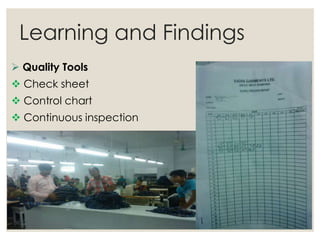
Learning and Findings
 Quality Tools
 Check sheet
 Control chart
 Continuous inspection
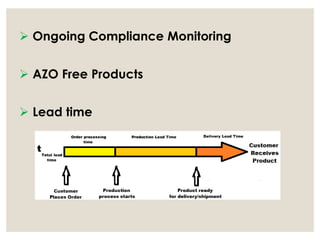
 Ongoing Compliance Monitoring
 AZO Free Products
 Lead time
Use of ERP system
 Cost And Complexity
 Unskilled workers:

Operation Management

  • 1.
  • 2.
    USE OF QUALITYTOOLS IN RMG INDUSTRY OF BANGLADESH Business Dynamics
  • 3.
    Group Members of BusinessDynamics Name ID Md. Nurul Hudda 253 Al- Amin 255 Rabiul Hasan 256 Md. Fahad Hossain 258 MD. Shahriar Sharif 262 Md. Abir Hossan 271
  • 4.
    Quality and QualityControl ◦ Quality denotes an excellence in goods and services, especially to the degree they conform to requirements and satisfy customers. ◦W. Edwards Deming defined quality as follows: Good quality means a predictable degree of uniformity and dependability with a quality standard suited to the customer.
  • 5.
    Quality and QualityControl ◦ In RMG sector of Bangladesh Md. Muzahidul Islam and others’ study found 80% of total defects are found by Pareto analysis. ◦ Causes are classified into four categories- Man Machines Materials and Method (Cause and Effect Diagram)
  • 6.
    Quality and QualityControl ◦ Continuous Quality Improvement is first proposed by Shewhart in 1931. It suggests- A small constant incremental change for improvement. ◦ Deming introduced four fact-based approach in quality control, aka; PDCA cycle: Plan, Do, Check, Act ◦ Total Quality Management (TQM) practices create positive learning environments by providing workers with a rich and diverse set of learning tools and repeatedly encouraging them to reexamine their work processes
  • 7.
    History of GarmentsFactory In 1831 first Ready made garment established in New York. In the 1950s, labors in the Western World became highly organized; forming trade unions. These changes provided workers greater rights including higher pay; which resulted in higher cost of production. Retailers started searching for places where the cost of production was cheaper. Developing economies like Hong Kong, Taiwan and South Korea presented them selves as good destinations for relocations because they had open economic policies and had non- unionized and highly disciplined labor force that could produce high quality products at much cheaper costs
  • 8.
    Short and Longterm forecast of global RMG sector ◦ Developing countries like Bangladesh and China are improving their position by RMG industry. ◦ In future developed countries will provide capital and formula only. ◦ In near future it will be fully automated.
  • 9.
    Recent Developments in GlobalRMG Sectors ◦ In the age of technology people are developing many new machines so it becomes easy to work. ◦ There are also development in safety and security measures.
  • 10.
    Recent Incidents ◦ 4thmay in Pakistan ◦ 13th January in Cambodia. ◦ 21st June in Sri Lanka.
  • 11.
    Leading Global RMG Companies ◦Denim. ◦ Calvin Klein. ◦ Diesel ◦ Hennes & Mauritz. ◦ Levi Straus & Co. ◦ Youngon. ◦ Lululemon.
  • 12.
    Bangladesh RMG sectors TheReady–Made Garments (RMG) sector has emerged as the biggest earner of foreign currency. It also provides employment to around 4.2 million Bangladeshis, mainly women from low income families. Within a short period, Bangladeshi entrepreneurs got familiar with the world apparel markets and marketing. USA is the largest importer of Bangladeshi RMG products, followed by Germany, UK, France and other E.U countries.
  • 13.
    ◦ OPPORTUNITIES &CHALLENGES: A new class of attractive customers for Bangladesh's RMG industry is also growing swiftly. McKinsey forecasts the RMG market in Bangladesh to realistically grow at an annual rate of 7 to 9 per cent up to 2020, resulting in an export value of up to US$ 42 billion in 2020. Though RMG is in favor of Bangladesh, challenges like infrastructure and governance, workforce supply, raw materials and economic and political instability are may be the hinders.
  • 14.
    ◦ RECENT DEVELOPMENTIN DOMESTIC RMG SECTORS: The government inaugurated the BATEXPO-2000 called upon all, especially the private sector entrepreneurs, to play a more prominent role in boosting investment, industries and exports. It is also mentioned that the government is sincerely working to create an enabling environment for increasing production by restoring political stability and democratic management. The BATEXPO has been playing an important role in the promotion of trade of local RMG and textile products since 1989.
  • 15.
    ◦ RECENT INCINDENCES(Fire and collapse like as RANA plaza and TAJRIN garments) On the 24 April 2013 an eight-story building, the Rana Plaza, housing several garment factories collapsed in Savar, near Bangladesh’s capital killing at least 1,133 innocent people. Greed, corruption and ignorance are some of the reasons behind such disasters, according to US Ambassador to Bangladesh. Rana Plaza is not the only factory disaster in Bangladesh in recent years. The following accidents occurred in the recent years in the readymade garment industry alone.
  • 16.
    Company Profiles Sadia Garmentsltd Sadia Garments ltd is a sister concern of Century group. It is 100% export oriented company. They produce on their own factory. Some time they give subcontract to small garments. They mainly exports to European countries. Recently it is exporting their products to Turkey.
  • 17.
     Ratul GarmentsLtd Ratul garments is a small RMG Company. Right now they are taking sub contracts from large garments. But they are trying to get direct orders from foreign buyers. Ratul garment is currently planning to change the location of their factory.
  • 18.
    Goals and objectives Sadiagarments ltd Goals: Is to be the consumer’s number one choice in apparel products by providing our valued customers with a range of the finest quality through ◦ Commitment to innovation ◦ Service ◦ Value Objectives ◦ Provide Maximum Satisfaction to our valued customers. ◦ Continuous improvement of operational efficiencies. ◦ Cost effectiveness. ◦ Latest design and talents at our work force. ◦ Maintain Shipment date within the contract period.
  • 19.
    Ratul garments ltd Goals: To become a prominent RMG firm by producing quality products and maintaining safety of working conditions. Objectives • Getting Orders from direct foreign buyers. • Following the compliance monitoring criteria's. • Producing new designs • Workers efficiency.
  • 20.
    Learning and Findings Quality Tools  Check sheet  Control chart  Continuous inspection
  • 21.
     Ongoing ComplianceMonitoring  AZO Free Products  Lead time
  • 22.
    Use of ERPsystem  Cost And Complexity  Unskilled workers: