September 30, 2014 
1 
MANAGING MARKETING PROCESSES 
Marketing Plan Group Assignment 
Introduction 
In your teams, you will assume the role of a “marketing manager” and select a 
company within a specified industry and develop a marketing plan for a product or 
service not currently offered by your company to be launched on the Swedish market. 
The product or service can be completely new-to-the-world or can be new just to 
Sweden. You are to write a comprehensive marketing plan profiling the competitive 
strategy to bring that product or service to the Swedish market. 
Choosing your company and product/service 
In this class, we will work with a variety of industries, companies, and offerings. Send 
me by email (robin.teigland@hhs.se) your first and second choices of the industry, 
company, offering combination. I will assign teams on a “first come, first served 
basis”. 
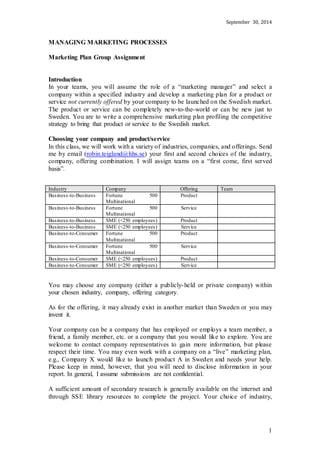
Industry Company Offering Team 
Business-to-Business Fortune 500 
Multinational 
Product 
Business-to-Business Fortune 500 
Multinational 
Service 
Business-to-Business SME (<250 employees) Product 
Business-to-Business SME (<250 employees) Service 
Business-to-Consumer Fortune 500 
Multinational 
Product 
Business-to-Consumer Fortune 500 
Multinational 
Service 
Business-to-Consumer SME (<250 employees) Product 
Business-to-Consumer SME (<250 employees) Service 
You may choose any company (either a publicly-held or private company) within 
your chosen industry, company, offering category. 
As for the offering, it may already exist in another market than Sweden or you may 
invent it. 
Your company can be a company that has employed or employs a team member, a 
friend, a family member, etc. or a company that you would like to explore. You are 
welcome to contact company representatives to gain more information, but please 
respect their time. You may even work with a company on a “live” marketing plan, 
e.g., Company X would like to launch product A in Sweden and needs your help. 
Please keep in mind, however, that you will need to disclose information in your 
report. In general, I assume submissions are not confidential. 
A sufficient amount of secondary research is generally available on the internet and 
through SSE library resources to complete the project. Your choice of industry,
September 30, 2014 
company, and offering should be based on being able to locate the relevant 
information to complete the Marketing Plan. 
Marketing plans often cover a full year, although some may cover a longer period, 
e.g., when covering new-product introductions. The planning process usually starts 
many months before the marketing plan is scheduled to go into operation. 
2 
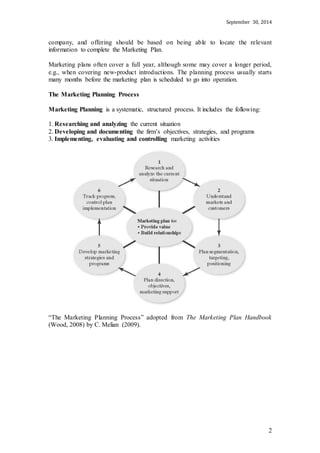
The Marketing Planning Process 
Marketing Planning is a systematic, structured process. It includes the following: 
1. Researching and analyzing the current situation 
2. Developing and documenting the firm’s objectives, strategies, and programs 
3. Implementing, evaluating and controlling marketing activities 
“The Marketing Planning Process” adopted from The Marketing Plan Handbook 
(Wood, 2008) by C. Melian (2009).
September 30, 2014 
3 
Marketing Plan Format 
Although the exact contents, length, and format may vary, most marketing plans do 
contain the following sections, not necessarily in this exact order:1 
1. Executive Summary and Table of Contents – a condensed overview of the 
marketing plan briefly reviewing highlights and objectives of the plan, linking 
the marketing effort to higher- lever strategies and goals, then followed by a 
table of contents. 
2. Summary of Current Situation - Provides a description of the business; 
product/service analysis. The situational analysis encompasses internal and 
external factors, e.g., the company’s mission, strategy, offerings, and financial 
status; the economic and political climate; demand trends, and competitors. 
Discuss PESTEL, five forces, SWOT. 
3. Focused Assessment of the Market Opportunity - Explains the 
segmentation, targeting, and positioning decisions. Discusses which segments 
are to be targeted, with an overview of customer and prospect needs, wants, 
behaviors, attitudes, loyalty, and purchasing patterns as well as the 
competitive challenges faced by the company and its offerings. 
4. Financial and Marketing Goals and Budgets - Details on expected revenues, 
budgets, and profits based on the marketing programs in the plan as well as 
marketing goals in unit sales or market shares. Forecast month-to-month 
marketing budget and unit sales and revenues. 
5. Marketing Strategy - Shows the overall strategy to be used in achieving the 
marketing plan objectives by creating, communicating, and delivering value to 
the target market through positioning, distribution, and pricing. Describes the 
programs supporting the marketing strategy including specific activities, 
schedules, and responsibilities related to product, price, place, and promotion 
as well as people, processes, programs, and performance. 
6. Implementation and Controls – Indicates how the plan will be implemented, 
monitored, and evaluated and shows how adjustments will be made to keep 
programs on track toward objectives, and includes contingency plans as 
needed. 
In addition, I suggest that you look at a number of external sources to help you 
develop your marketing plan. There are a considerable number of guides and 
templates online as well as reference books and software: 
1. Creating a Marketing Plan: An Overview (2006), Harvard Business School 
Press (on Courseweb). 
2. Marketing Planning: Principles into Practice (2004) by Marian Burk Wood, 
Pearson Education/Prentice Hall. 
3. The Marketing Plan Handbook (2008) by Marian Burk Wood, Pearson 
Education/Prentice Hall. 
1 Adapted from Creating a Marketing Plan: An Overview (2006), Harvard 
Business School Press
September 30, 2014 
Data Collection 
A working understanding of the electronic databases available at SSE Library is 
required to successfully complete the project. Part of the project also involves reading 
and interpreting current business events. 
All data sources, including interviews, websites, company reports, magazine articles, 
and others, must be referenced in the written report. Any material taken directly from 
another source must be placed in “quotes” or properly reworded and sourced. The 
failure to give full credit can be grounds for plagiarism. See www.plagiarism.org for 
more information. In addition, you are expected to share resources and links found 
outside of class with each other. 
SSE also offers the free use of an online survey tool, Qualtrics. For more information, 
please see the information at the end of the Managing Marketing Processes course 
description. 
4 
Submissions (See Course Description for due dates) 
1. Choice of industry, company, offering for Marketing Plan: “First come, first 
served”. 
2. Initial Presentation: See “Group Assignment for Seminar 5” for information. 
3. Feedback on Another Team’s Initial Presentation - See “Group Assignment 
for Seminar 5” for information. Submit Feedback on another team’s Initial 
Presentation. The Feedback should add value to the other Team’s presentation 
content and the communication of the Team’s message. Your Feedback is also 
to include a summary of the main points made by the other students during 
their presentation. Your Feedback is to be in MS Word Doc (max 2 pages) 
format and have points on both strengths and weaknesses regarding content 
and communication style. Feedback teams will be assigned in class. 
4. Final Presentation: Prepare a 15 min max Final PPT Presentation on your 
marketing plan. 
5. Submit Feedback on another team’s Final Presentation. The Feedback should 
add value to the other Team’s presentation content and the communication of 
the Team’s message to help them finalize their Final Report. Your Feedback is 
also to include a summary of the main points made by the other s tudents 
during the Final Presentation. Your Feedback is to be in MS Word Doc (max 3 
pages) format and have points on both strengths and weaknesses regarding 
content and communication style. Feedback teams will be assigned later in the 
course. 
6. Submit the Marketing Plan of maximum 15 pages (MS Word Doc not 
including title page, executive summary, table of contents, references or 
appendices).
September 30, 2014 
5 
Assessment Criteria 
Below are the criteria I will use to assess both your written and oral communications. 
Professional Written and Oral Communications (10%) 
 Professional presentation (in MS Word or MS PPT only when applicable) and 
when applicable, with title page, executive summary, introduction, layout, 
figures, tables. 
 Easy to follow, well written, and logical storyline that keeps the reader’s or 
listener’s attention. Make your deliverables eye-catching by using headings, 
bullet points, figures, photos, videos, etc. Make PPT slides well structured and 
provide a clear, logical storyline. Make sure each slide has a concise, 
convincing key message that is supported through data or detail. Make the 
slides well designed and clearly visualized. 
 Stand-alone, self-explanatory document, i.e., if anyone looks at the presentation 
or final report, he or she can understand what it is about without having it 
explained or presented. For presentations, more information can be provided 
in the speaker notes of each ppt slide but no more than can fit on the page 
when printed (12 pt Times New Roman minimum size in notes). 
 Strict adherence to the assignment format guidelines 
o Include title page with SSE logo, name of program and course, names 
of group members and emails. 
o Include 1-2 page executive summary on MS Word report. 
o Include page numbers. 
o Include sources and bibliography. 
o Use minimum 18 point Times New Roman (or the equivalent of 
another font) on the ppt slides and minimum 12 point Times New 
Roman (or equivalent) in the slide notes. 
o Use single-spaced, 12 point Times New Roman for MS Word 
documents, margins minimum 2.54 on all sides. 
o Submit only one document for each assignment and in its original 
program format, i.e., ppt - No PDFs. 
 Any props/other media appropriate and integrated in presentations. 
 Well-delivered presentation and strict adherence to time requirements when 
presenting. 
 All sources documented in proper manner - see www.plagiarism.org for more 
information on how to cite and document sources. 
Critical Thinking Involving Analysis and Understanding of Theoretical Concepts and 
Frameworks that Build Your Argument (60%) 
 Understanding of relevant concepts from readings and class discussions, 
providing definitions when applicable. 
 Ability to incorporate various concepts in an integrated, comprehensive 
approach. 
 Analysis clearly related to the assignment. 
 Ability to critically conduct consistent and logical analysis - supporting 
assumptions with sound argumentation/rationalization. For example, does 
your plan clearly show how goals are linked to situation analysis factors, and
September 30, 2014 
how action plans are linked to goals? Perhaps tables or diagrams will 
occasionally help convey your ideas. 
 Specific facts from the company, external sources, readings, and/or from 
personal experience analyzed and used to support your assertions and 
statements. 
 Provide convincing evidence that you understand the dynamics of the company 
6 
and its market relationships. 
Creative and Original Content Yet Feasible Plan (30%) 
 Originality and creativity in your analysis and plan, bringing fresh perspectives. 
But creative does not mean style-artistic creative. Rather, creative refers to 
whether you drew interesting and non-obvious conclusions, or perhaps 
whether you analyzed something in multiple ways that was clever and added 
value to your plan (as opposed to clever but so what). Being clever and 
creative is essentially the art of making insightful observations and then using 
these observations meaningfully. 
 A plan that is sound and feasible and that flows from the analysis. 
 Assumptions used in analysis presented. 
 Limitations that could impact the plan incorporated in presentation. 
 Answer questions during oral presentations (again using all the data you have 
presented from the case study and other sources). 
Teamwork 
The success of your team will greatly depend on the ability of the team members to 
work together. Working well as a team requires that each member learn to cope with 
different personalities of the other team members. A strong team does not let 
differences in schedules, age, gender, or experiences inter fere with their performance. 
If a team member does not carry his or her share of the work, that individual should 
be warned of the need for improvement. I should be considered an ex officio member 
of each group and kept apprised of developments, especially when the team is 
considering removing a team member for non-performance.

Marketing Plan Group Assignment 2014

  • 1.
    September 30, 2014 1 MANAGING MARKETING PROCESSES Marketing Plan Group Assignment Introduction In your teams, you will assume the role of a “marketing manager” and select a company within a specified industry and develop a marketing plan for a product or service not currently offered by your company to be launched on the Swedish market. The product or service can be completely new-to-the-world or can be new just to Sweden. You are to write a comprehensive marketing plan profiling the competitive strategy to bring that product or service to the Swedish market. Choosing your company and product/service In this class, we will work with a variety of industries, companies, and offerings. Send me by email (robin.teigland@hhs.se) your first and second choices of the industry, company, offering combination. I will assign teams on a “first come, first served basis”. Industry Company Offering Team Business-to-Business Fortune 500 Multinational Product Business-to-Business Fortune 500 Multinational Service Business-to-Business SME (<250 employees) Product Business-to-Business SME (<250 employees) Service Business-to-Consumer Fortune 500 Multinational Product Business-to-Consumer Fortune 500 Multinational Service Business-to-Consumer SME (<250 employees) Product Business-to-Consumer SME (<250 employees) Service You may choose any company (either a publicly-held or private company) within your chosen industry, company, offering category. As for the offering, it may already exist in another market than Sweden or you may invent it. Your company can be a company that has employed or employs a team member, a friend, a family member, etc. or a company that you would like to explore. You are welcome to contact company representatives to gain more information, but please respect their time. You may even work with a company on a “live” marketing plan, e.g., Company X would like to launch product A in Sweden and needs your help. Please keep in mind, however, that you will need to disclose information in your report. In general, I assume submissions are not confidential. A sufficient amount of secondary research is generally available on the internet and through SSE library resources to complete the project. Your choice of industry,
  • 2.
    September 30, 2014 company, and offering should be based on being able to locate the relevant information to complete the Marketing Plan. Marketing plans often cover a full year, although some may cover a longer period, e.g., when covering new-product introductions. The planning process usually starts many months before the marketing plan is scheduled to go into operation. 2 The Marketing Planning Process Marketing Planning is a systematic, structured process. It includes the following: 1. Researching and analyzing the current situation 2. Developing and documenting the firm’s objectives, strategies, and programs 3. Implementing, evaluating and controlling marketing activities “The Marketing Planning Process” adopted from The Marketing Plan Handbook (Wood, 2008) by C. Melian (2009).
  • 3.
    September 30, 2014 3 Marketing Plan Format Although the exact contents, length, and format may vary, most marketing plans do contain the following sections, not necessarily in this exact order:1 1. Executive Summary and Table of Contents – a condensed overview of the marketing plan briefly reviewing highlights and objectives of the plan, linking the marketing effort to higher- lever strategies and goals, then followed by a table of contents. 2. Summary of Current Situation - Provides a description of the business; product/service analysis. The situational analysis encompasses internal and external factors, e.g., the company’s mission, strategy, offerings, and financial status; the economic and political climate; demand trends, and competitors. Discuss PESTEL, five forces, SWOT. 3. Focused Assessment of the Market Opportunity - Explains the segmentation, targeting, and positioning decisions. Discusses which segments are to be targeted, with an overview of customer and prospect needs, wants, behaviors, attitudes, loyalty, and purchasing patterns as well as the competitive challenges faced by the company and its offerings. 4. Financial and Marketing Goals and Budgets - Details on expected revenues, budgets, and profits based on the marketing programs in the plan as well as marketing goals in unit sales or market shares. Forecast month-to-month marketing budget and unit sales and revenues. 5. Marketing Strategy - Shows the overall strategy to be used in achieving the marketing plan objectives by creating, communicating, and delivering value to the target market through positioning, distribution, and pricing. Describes the programs supporting the marketing strategy including specific activities, schedules, and responsibilities related to product, price, place, and promotion as well as people, processes, programs, and performance. 6. Implementation and Controls – Indicates how the plan will be implemented, monitored, and evaluated and shows how adjustments will be made to keep programs on track toward objectives, and includes contingency plans as needed. In addition, I suggest that you look at a number of external sources to help you develop your marketing plan. There are a considerable number of guides and templates online as well as reference books and software: 1. Creating a Marketing Plan: An Overview (2006), Harvard Business School Press (on Courseweb). 2. Marketing Planning: Principles into Practice (2004) by Marian Burk Wood, Pearson Education/Prentice Hall. 3. The Marketing Plan Handbook (2008) by Marian Burk Wood, Pearson Education/Prentice Hall. 1 Adapted from Creating a Marketing Plan: An Overview (2006), Harvard Business School Press
  • 4.
    September 30, 2014 Data Collection A working understanding of the electronic databases available at SSE Library is required to successfully complete the project. Part of the project also involves reading and interpreting current business events. All data sources, including interviews, websites, company reports, magazine articles, and others, must be referenced in the written report. Any material taken directly from another source must be placed in “quotes” or properly reworded and sourced. The failure to give full credit can be grounds for plagiarism. See www.plagiarism.org for more information. In addition, you are expected to share resources and links found outside of class with each other. SSE also offers the free use of an online survey tool, Qualtrics. For more information, please see the information at the end of the Managing Marketing Processes course description. 4 Submissions (See Course Description for due dates) 1. Choice of industry, company, offering for Marketing Plan: “First come, first served”. 2. Initial Presentation: See “Group Assignment for Seminar 5” for information. 3. Feedback on Another Team’s Initial Presentation - See “Group Assignment for Seminar 5” for information. Submit Feedback on another team’s Initial Presentation. The Feedback should add value to the other Team’s presentation content and the communication of the Team’s message. Your Feedback is also to include a summary of the main points made by the other students during their presentation. Your Feedback is to be in MS Word Doc (max 2 pages) format and have points on both strengths and weaknesses regarding content and communication style. Feedback teams will be assigned in class. 4. Final Presentation: Prepare a 15 min max Final PPT Presentation on your marketing plan. 5. Submit Feedback on another team’s Final Presentation. The Feedback should add value to the other Team’s presentation content and the communication of the Team’s message to help them finalize their Final Report. Your Feedback is also to include a summary of the main points made by the other s tudents during the Final Presentation. Your Feedback is to be in MS Word Doc (max 3 pages) format and have points on both strengths and weaknesses regarding content and communication style. Feedback teams will be assigned later in the course. 6. Submit the Marketing Plan of maximum 15 pages (MS Word Doc not including title page, executive summary, table of contents, references or appendices).
  • 5.
    September 30, 2014 5 Assessment Criteria Below are the criteria I will use to assess both your written and oral communications. Professional Written and Oral Communications (10%)  Professional presentation (in MS Word or MS PPT only when applicable) and when applicable, with title page, executive summary, introduction, layout, figures, tables.  Easy to follow, well written, and logical storyline that keeps the reader’s or listener’s attention. Make your deliverables eye-catching by using headings, bullet points, figures, photos, videos, etc. Make PPT slides well structured and provide a clear, logical storyline. Make sure each slide has a concise, convincing key message that is supported through data or detail. Make the slides well designed and clearly visualized.  Stand-alone, self-explanatory document, i.e., if anyone looks at the presentation or final report, he or she can understand what it is about without having it explained or presented. For presentations, more information can be provided in the speaker notes of each ppt slide but no more than can fit on the page when printed (12 pt Times New Roman minimum size in notes).  Strict adherence to the assignment format guidelines o Include title page with SSE logo, name of program and course, names of group members and emails. o Include 1-2 page executive summary on MS Word report. o Include page numbers. o Include sources and bibliography. o Use minimum 18 point Times New Roman (or the equivalent of another font) on the ppt slides and minimum 12 point Times New Roman (or equivalent) in the slide notes. o Use single-spaced, 12 point Times New Roman for MS Word documents, margins minimum 2.54 on all sides. o Submit only one document for each assignment and in its original program format, i.e., ppt - No PDFs.  Any props/other media appropriate and integrated in presentations.  Well-delivered presentation and strict adherence to time requirements when presenting.  All sources documented in proper manner - see www.plagiarism.org for more information on how to cite and document sources. Critical Thinking Involving Analysis and Understanding of Theoretical Concepts and Frameworks that Build Your Argument (60%)  Understanding of relevant concepts from readings and class discussions, providing definitions when applicable.  Ability to incorporate various concepts in an integrated, comprehensive approach.  Analysis clearly related to the assignment.  Ability to critically conduct consistent and logical analysis - supporting assumptions with sound argumentation/rationalization. For example, does your plan clearly show how goals are linked to situation analysis factors, and
  • 6.
    September 30, 2014 how action plans are linked to goals? Perhaps tables or diagrams will occasionally help convey your ideas.  Specific facts from the company, external sources, readings, and/or from personal experience analyzed and used to support your assertions and statements.  Provide convincing evidence that you understand the dynamics of the company 6 and its market relationships. Creative and Original Content Yet Feasible Plan (30%)  Originality and creativity in your analysis and plan, bringing fresh perspectives. But creative does not mean style-artistic creative. Rather, creative refers to whether you drew interesting and non-obvious conclusions, or perhaps whether you analyzed something in multiple ways that was clever and added value to your plan (as opposed to clever but so what). Being clever and creative is essentially the art of making insightful observations and then using these observations meaningfully.  A plan that is sound and feasible and that flows from the analysis.  Assumptions used in analysis presented.  Limitations that could impact the plan incorporated in presentation.  Answer questions during oral presentations (again using all the data you have presented from the case study and other sources). Teamwork The success of your team will greatly depend on the ability of the team members to work together. Working well as a team requires that each member learn to cope with different personalities of the other team members. A strong team does not let differences in schedules, age, gender, or experiences inter fere with their performance. If a team member does not carry his or her share of the work, that individual should be warned of the need for improvement. I should be considered an ex officio member of each group and kept apprised of developments, especially when the team is considering removing a team member for non-performance.