
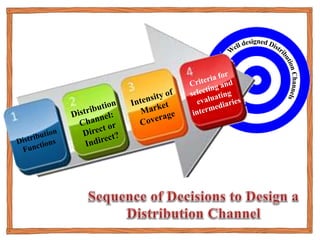
Distribution Channels
Marketing Management
MANUEL OCAMPO JR. MBA - PCU
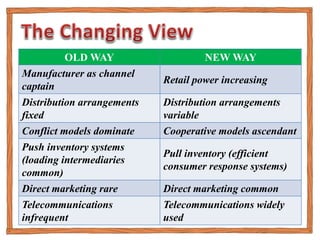
OLD WAY NEW WAY
Manufacturer as channel
captain
Retail power increasing
Distribution arrangements
fixed
Distribution arrangements
variable
Conflict models dominate Cooperative models ascendant
Push inventory systems
(loading intermediaries
common)
Pull inventory (efficient
consumer response systems)
Direct marketing rare Direct marketing common
Telecommunications
infrequent
Telecommunications widely
used
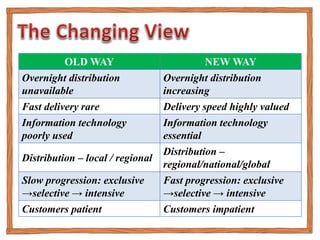
OLD WAY NEW WAY
Overnight distribution
unavailable
Overnight distribution
increasing
Fast delivery rare Delivery speed highly valued
Information technology
poorly used
Information technology
essential
Distribution – local / regional
Distribution –
regional/national/global
Slow progression: exclusive
→selective → intensive
Fast progression: exclusive
→selective → intensive
Customers patient Customers impatient
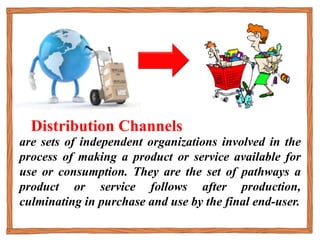
are sets of independent organizations involved in the
process of making a product or service available for
use or consumption. They are the set of pathways a
product or service follows after production,
culminating in purchase and use by the final end-user.
Distribution Channels
Why do business need
to use Distribution
Channels?
Because selling through
wholesalers and retailers
usually is much more
efficient and cost effective
than direct sales
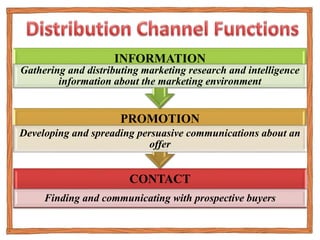
CONTACT
Finding and communicating with prospective buyers
PROMOTION
Developing and spreading persuasive communications about an
offer
INFORMATION
Gathering and distributing marketing research and intelligence
information about the marketing environment
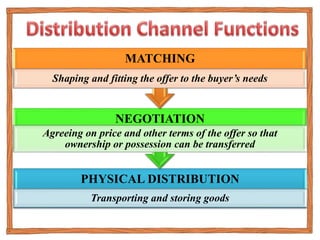
PHYSICAL DISTRIBUTION
Transporting and storing goods
NEGOTIATION
Agreeing on price and other terms of the offer so that
ownership or possession can be transferred
MATCHING
Shaping and fitting the offer to the buyer’s needs
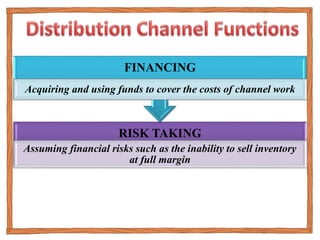
RISK TAKING
Assuming financial risks such as the inability to sell inventory
at full margin
FINANCING
Acquiring and using funds to cover the costs of channel work
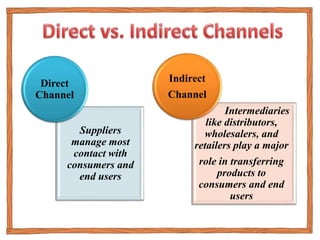
Suppliers
manage most
contact with
consumers and
end users
Direct
Channel
Intermediaries
like distributors,
wholesalers, and
retailers play a major
role in transferring
products to
consumers and end
users
Indirect
Channel
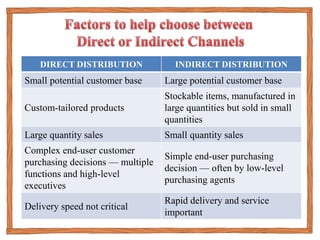
DIRECT DISTRIBUTION INDIRECT DISTRIBUTION
Small potential customer base Large potential customer base
Custom-tailored products
Stockable items, manufactured in
large quantities but sold in small
quantities
Large quantity sales Small quantity sales
Complex end-user customer
purchasing decisions — multiple
functions and high-level
executives
Simple end-user purchasing
decision — often by low-level
purchasing agents
Delivery speed not critical
Rapid delivery and service
important
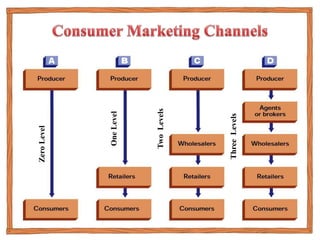
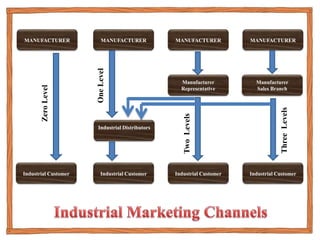
ZeroLevel
OneLevel
TwoLevels
ThreeLevels
MANUFACTURER MANUFACTURER MANUFACTURER MANUFACTURER
Industrial Customer Industrial Customer Industrial Customer Industrial Customer
Industrial Distributors
Manufacturer
Representative
Manufacturer
Sales Branch
ZeroLevel
OneLevel
TwoLevels
ThreeLevels
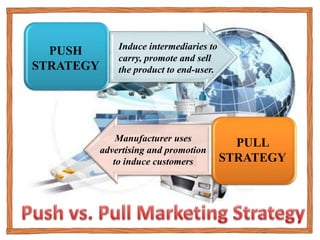
PUSH
STRATEGY
Induce intermediaries to
carry, promote and sell
the product to end-user.
PULL
STRATEGY
Manufacturer uses
advertising and promotion
to induce customers
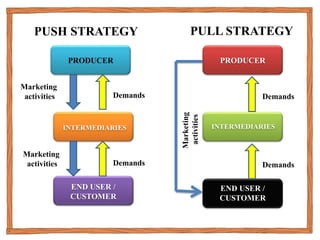
PRODUCER
INTERMEDIARIES
END USER /
CUSTOMER
PRODUCER
INTERMEDIARIES
END USER /
CUSTOMER
PUSH STRATEGY PULL STRATEGY
Marketing
activities
Marketing
activities
Demands
Demands
Demands
Demands
Marketing
activities
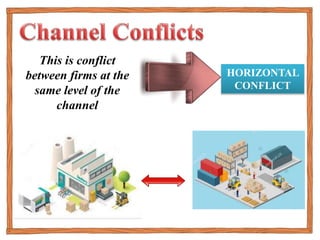
HORIZONTAL
CONFLICT
This is conflict
between firms at the
same level of the
channel
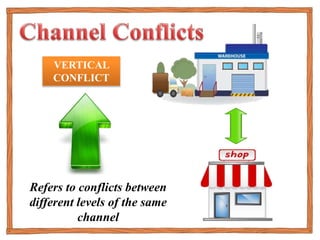
VERTICAL
CONFLICT
Refers to conflicts between
different levels of the same
channel
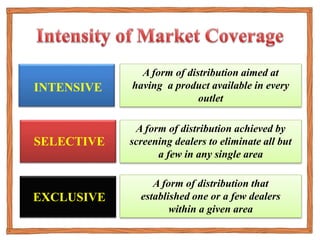
INTENSIVE
SELECTIVE
EXCLUSIVE
A form of distribution aimed at
having a product available in every
outlet
A form of distribution achieved by
screening dealers to eliminate all but
a few in any single area
A form of distribution that
established one or a few dealers
within a given area
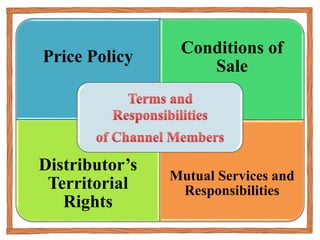
Price Policy Conditions of
Sale
Distributor’s
Territorial
Rights
Mutual Services and
Responsibilities
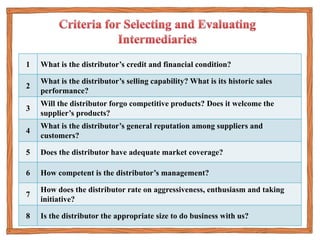
1 What is the distributor’s credit and financial condition?
2
What is the distributor’s selling capability? What is its historic sales
performance?
3
Will the distributor forgo competitive products? Does it welcome the
supplier’s products?
4
What is the distributor’s general reputation among suppliers and
customers?
5 Does the distributor have adequate market coverage?
6 How competent is the distributor’s management?
7
How does the distributor rate on aggressiveness, enthusiasm and taking
initiative?
8 Is the distributor the appropriate size to do business with us?
REFERENCES
1. Kotler, Philip, Marketing Management
Millennium Ed. Pearson Custom Publishing:
New Jersey, 2000.
2. Stone, Marilyn and John Desmond,
Fundamentals of Marketing. Routledge; New
York, 2007.
3. Capon, Noel, Managing Marketing in the 21st
Century. Wessex: New York, 2009.
4. Kotanabe, Masaaki and Kristaan Helsen, Global
Marketing Management, 5th Ed. Wiley and Sons:
New York, 2010.

Report on Distribution Channels

  • 1.
  • 2.
    OLD WAY NEWWAY Manufacturer as channel captain Retail power increasing Distribution arrangements fixed Distribution arrangements variable Conflict models dominate Cooperative models ascendant Push inventory systems (loading intermediaries common) Pull inventory (efficient consumer response systems) Direct marketing rare Direct marketing common Telecommunications infrequent Telecommunications widely used
  • 3.
    OLD WAY NEWWAY Overnight distribution unavailable Overnight distribution increasing Fast delivery rare Delivery speed highly valued Information technology poorly used Information technology essential Distribution – local / regional Distribution – regional/national/global Slow progression: exclusive →selective → intensive Fast progression: exclusive →selective → intensive Customers patient Customers impatient
  • 4.
    are sets ofindependent organizations involved in the process of making a product or service available for use or consumption. They are the set of pathways a product or service follows after production, culminating in purchase and use by the final end-user. Distribution Channels
  • 5.
    Why do businessneed to use Distribution Channels? Because selling through wholesalers and retailers usually is much more efficient and cost effective than direct sales
  • 12.
    CONTACT Finding and communicatingwith prospective buyers PROMOTION Developing and spreading persuasive communications about an offer INFORMATION Gathering and distributing marketing research and intelligence information about the marketing environment
  • 13.
    PHYSICAL DISTRIBUTION Transporting andstoring goods NEGOTIATION Agreeing on price and other terms of the offer so that ownership or possession can be transferred MATCHING Shaping and fitting the offer to the buyer’s needs
  • 14.
    RISK TAKING Assuming financialrisks such as the inability to sell inventory at full margin FINANCING Acquiring and using funds to cover the costs of channel work
  • 15.
    Suppliers manage most contact with consumersand end users Direct Channel Intermediaries like distributors, wholesalers, and retailers play a major role in transferring products to consumers and end users Indirect Channel
  • 16.
    DIRECT DISTRIBUTION INDIRECTDISTRIBUTION Small potential customer base Large potential customer base Custom-tailored products Stockable items, manufactured in large quantities but sold in small quantities Large quantity sales Small quantity sales Complex end-user customer purchasing decisions — multiple functions and high-level executives Simple end-user purchasing decision — often by low-level purchasing agents Delivery speed not critical Rapid delivery and service important
  • 17.
  • 18.
    MANUFACTURER MANUFACTURER MANUFACTURERMANUFACTURER Industrial Customer Industrial Customer Industrial Customer Industrial Customer Industrial Distributors Manufacturer Representative Manufacturer Sales Branch ZeroLevel OneLevel TwoLevels ThreeLevels
  • 19.
    PUSH STRATEGY Induce intermediaries to carry,promote and sell the product to end-user. PULL STRATEGY Manufacturer uses advertising and promotion to induce customers
  • 20.
    PRODUCER INTERMEDIARIES END USER / CUSTOMER PRODUCER INTERMEDIARIES ENDUSER / CUSTOMER PUSH STRATEGY PULL STRATEGY Marketing activities Marketing activities Demands Demands Demands Demands Marketing activities
  • 21.
    HORIZONTAL CONFLICT This is conflict betweenfirms at the same level of the channel
  • 22.
    VERTICAL CONFLICT Refers to conflictsbetween different levels of the same channel
  • 23.
    INTENSIVE SELECTIVE EXCLUSIVE A form ofdistribution aimed at having a product available in every outlet A form of distribution achieved by screening dealers to eliminate all but a few in any single area A form of distribution that established one or a few dealers within a given area
  • 24.
    Price Policy Conditionsof Sale Distributor’s Territorial Rights Mutual Services and Responsibilities
  • 25.
    1 What isthe distributor’s credit and financial condition? 2 What is the distributor’s selling capability? What is its historic sales performance? 3 Will the distributor forgo competitive products? Does it welcome the supplier’s products? 4 What is the distributor’s general reputation among suppliers and customers? 5 Does the distributor have adequate market coverage? 6 How competent is the distributor’s management? 7 How does the distributor rate on aggressiveness, enthusiasm and taking initiative? 8 Is the distributor the appropriate size to do business with us?
  • 27.
    REFERENCES 1. Kotler, Philip,Marketing Management Millennium Ed. Pearson Custom Publishing: New Jersey, 2000. 2. Stone, Marilyn and John Desmond, Fundamentals of Marketing. Routledge; New York, 2007. 3. Capon, Noel, Managing Marketing in the 21st Century. Wessex: New York, 2009. 4. Kotanabe, Masaaki and Kristaan Helsen, Global Marketing Management, 5th Ed. Wiley and Sons: New York, 2010.

Editor's Notes

  • #2 IN THE MARKETING MIX, ONE OF THE Ps is PLACE which refers to THE DISTRIBUTION CHANNELS