SHARNBASVA UNIVERSITY KALABURAGI
Faculty OF Business Studies
APPAIET MBA CO-Edu
Presentation on – Distribution management
Presented by – Mohammed Farooq Azam
Presented to - Prof. Basavaraj S M
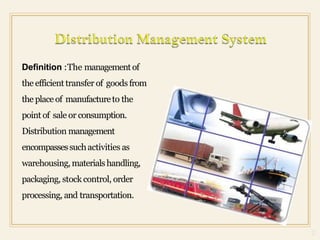
Definition :The managementof
the efficienttransfer of goodsfrom
the place of manufactureto the
point of sale or consumption.
Distribution management
encompassessuchactivities as
warehousing,materials handling,
packaging, stock control, order
processing, and transportation.
2
Distribution
Channels Defined•Are sets of interdependent organizationsinvolved
in the process of making aproduct orservice
available for useor consumption
oWhether selling products or services, marketing
channel decisions play arole of strategic importancein
the overall presence and successacompany enjoys in
the market place.
Distribution
Channels•Are intermediaries or middlemen
oExist becauseproducers cannot reach alltheir
consumers
oMultiply reach and provide efficiency tothe marketing
process
oFacilitate smooth flow and create time,place and
possession utilities
oHave the core competence andreach
oProvide contact, experience, specialization and scalesof
operation
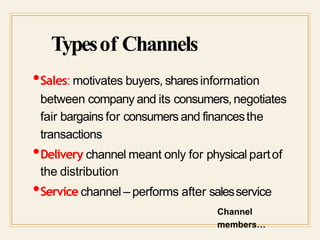
Typesof Channels
•Sales: motivates buyers, sharesinformation
between company and its consumers,negotiates
fair bargains for consumers and financesthe
transactions
•Delivery channel meant only for physical partof
the distribution
•Service channel – performs after salesservice
Channel
members…
Listing of Channel
Members•Companyown salesteam
•C&FAs and CSAs
•Distributors, dealers, stockists, value-addedre-sellers
•Agents and brokers
•Franchisees
•Electronic channels
•Wholesalers
•Retailers
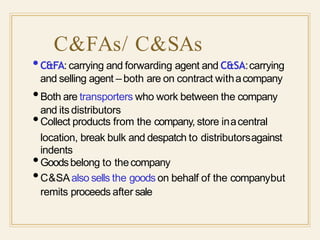
C&FAs/ C&SAs
•C&FA: carrying and forwarding agent and C&SA:carrying
and selling agent – both are on contract withacompany
and its distributors
•Both are transporters who work between the company
•Collect products from the company, store inacentral
location, break bulk and despatch to distributorsagainst
indents
•Goodsbelong to thecompany
•C&SAalso sells the goods on behalf of the companybut
remits proceeds after sale
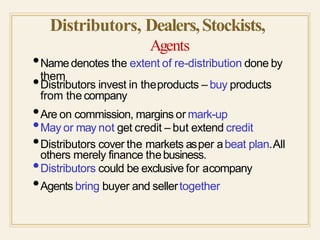
Distributors, Dealers,Stockists,
Agents
them
•Namedenotes the extent of re-distribution done by
•Distributors invest in theproducts – buy products
from the company
•Are on commission, margins or mark-up
•May or may not get credit – but extend credit
•Distributors cover the markets asper abeat plan.All
others merely finance thebusiness.
•Distributors could be exclusive for acompany
•Agents bring buyer and sellertogether
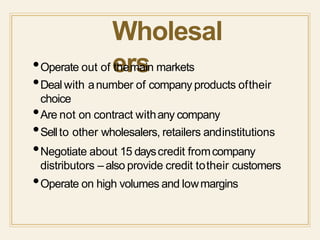
Wholesal
ers•Operate out of themain markets
•Deal with anumber of company products oftheir
choice
•Are not on contract withany company
•Sellto other wholesalers, retailers andinstitutions
•Negotiate about 15 dayscredit fromcompany
distributors – also provide credit totheir customers
•Operate on high volumes and lowmargins
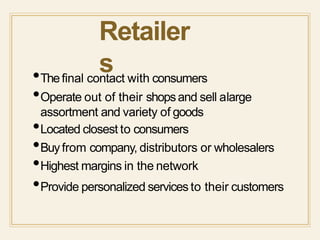
Retailer
s•Thefinal contact with consumers
•Operate out of their shopsand sell alarge
assortment and variety of goods
•Located closest to consumers
•Buyfrom company, distributors or wholesalers
•Highest margins in the network
•Provide personalized services to their customers
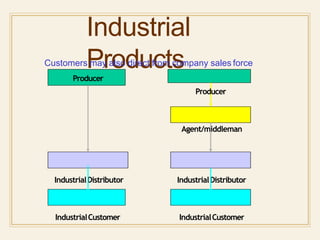
Industrial
Products
IndustrialDistributor
IndustrialCustomer
IndustrialDistributor
IndustrialCustomer
Agent/middleman
Customers may also direct from company sales force
Producer
Producer
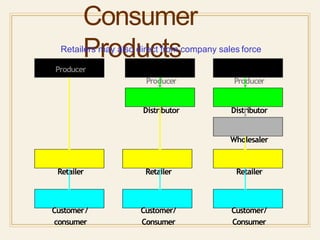
Consumer
Products
ProducerProducer
Customer/
consumer
Retailer
DistributorDistributor
Retailer
Customer/
Consumer
Wholesaler
Customer/
Consumer
Retailer
Retailers may also direct from company sales force
Producer
The prime object of productionis its consumption.The movementof product
fromproducer to consumeris animportantfunction of marketing.It is the
obligation of the producerto makegoods availableat right place,at right time
right price andin right quantity.The processof making goods available to
the consumer.Needseffectivechannelof distribution.Therefore, the path
takenby the goods inits movementis termedaschannelof distribution.The
goodsmaybesent to the consumerdirectly or indirectly through middlemen.
The channelof distribution maybeclassifiedas:
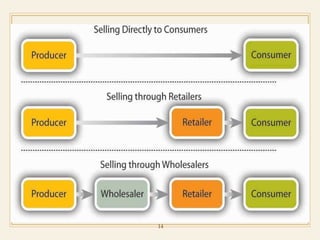
A) Selling through direct channels
B)Selling through indirect channels
13
14
A) Selling through direct channels
This is the oldest, shorter andthe simple channel ofdistribution. The producer sells theproduct
directly without involvement ofany middle man.The sale canbemadedoor to door through
salesman,retail stores anddirect mail.Certain industrial andconsumergoods suchasclothes,
shoes,books,hosiery goods, cosmetics, householdappliances,electronic goods etc., maybesold
through direct contact. Perishable goods suchasvegetable andfruits canalso besold directly.
Advantage of selling through direct channels
It is simpleandfast.
It is economical.
Disadvantages of selling through direct channels
Non-availability ofexpert services ofmiddleman.
Large investment is required.
15
B)Selling through indirect channel
According to this method of indirect selling,product is passedonto the customers through
intermediaries,knownaswholesalers,retailers andagents.These channelsmaybeas under:
1. Producers -> Wholesalers -> Retailers -> Customer Two level Channel: It is commonlyused
channelof distribution.It is alsoknownastraditional or normal channelof distribution.This channelis
usefulfor smallproducers forsmallmeans.The channelis usedfor consumergoods. The common practice
is that the manufacturer sells goods inlarge quantity to wholesalers,whosell goods to retailers insmall
quantity.Finally goods aresoldto customers in pieces.
2. Producer -> Agent -> Retailer -> Consumeror Two level Channel: The commonpracticeinthis
two level channelis that the goods aresoldto the agent inbulk.The agent sells goods to retailer,who sells
goods to customers inpieces.This channelis suitablewhere the retailers arefew andgeographically
centered.This channelis commonlyusedintextile, machinery,equipmentandagricultural products.
16
3.Producer -> Agent -> Wholesaler -> Retailer -> Customer or Three level Channel: The
commonpractice in this three level channel is that goods are sold by the producer to the agent,
who sells it to the wholesaler, who sells to the retailers who finally sells goods to customers. This
is the longest channel ofdistribution. This practice is useful, when the producer wants to the
relieved ofthe problemofdistribution. This channel is popularly used in textile.
4)Producer -> Retailer -> Customer or onelevel Channel:Under this channel the producer
sells goods to retailers, who sell the goods to customers. This channel is popularwith the
departmental stores, chainstores andsupermarkets etc., because these are large scale retailers.
Generally readymade garments, shoeshomeappliances andautomobiles are sold through this
channel.
17
Patterns of Distribution decides the intensity of the distribution & also
decides the service level provided.
Types of Distribution intensities:
1) Intensive
2) Selective
3) Exclusive
18
Intensive Distribution : is done through every reasonable outlet available – FMCG
Strategy is to make sure that, the product is available in as many outlets as possible.
Preferred for Consumer,Pharmaceuticals & automobile spare.
Selective Distribution: Multiple but not all outlets in the market Only
afew selected outlets are allowed to keepthe product
Outlets selected in line with the image of the companywants to project. Preferred
for High Value items like Jewelers
Exclusive Distribution: Highly selectivechoice of outlets, maybeonly onein the whole market.
Could include outlets set upbythe companyitself (Bata)
19
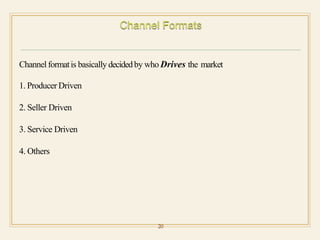
Channelformatis basically decidedby who Drives the market
20
1. Producer Driven
2. Seller Driven
3. Service Driven
4. Others
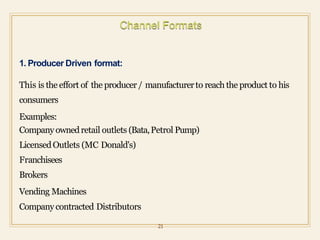
1. Producer Driven format:
This is the effort of the producer/ manufacturerto reach the product to his
consumers
Examples:
Companyownedretail outlets (Bata,Petrol Pump)
LicensedOutlets (MC Donald's)
Franchisees
Brokers
Vending Machines
Companycontracted Distributors
21
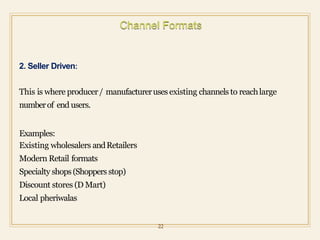
2. Seller Driven:
This is where producer/ manufactureruses existing channels to reachlarge
numberof end users.
Examples:
Existing wholesalers andRetailers
Modern Retail formats
Specialty shops(Shoppers stop)
Discount stores (D Mart)
Local pheriwalas
22
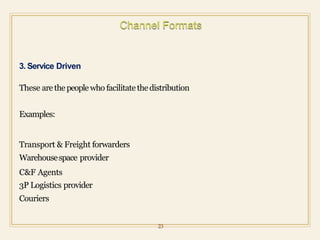
3. Service Driven
These arethepeople who facilitate thedistribution
Examples:
Transport & Freight forwarders
Warehousespace provider
C&F Agents
3P Logistics provider
Couriers
23
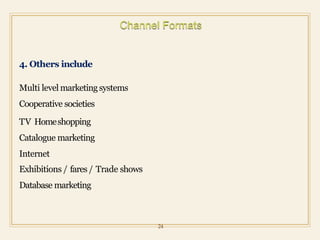
4. Others include
Multi level marketing systems
Cooperative societies
TV Homeshopping
Catalogue marketing
Internet
Exhibitions / fares / Trade shows
Database marketing
24
VERTICALMARKETINGSYSTEM
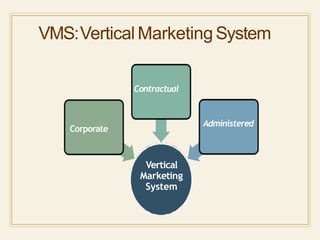
VMS:Vertical Marketing System
Vertical
Marketing
System
Corporate
Contractual
Administered
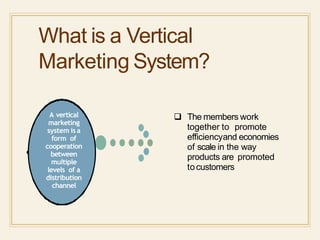
What is a Vertical
Marketing System?
A vertical
marketing
system is a
form of
cooperation
between
multiple
levels of a
distribution
channel
 The members work
together to promote
efficiencyand economies
of scale in the way
products are promoted
tocustomers
What are Distribution Channels?
A distribution
channelis the
network of
individuals and
organizations
involved in getting
a product orservice
from the producer
to the customer
 Distributionchannels are
also known asmarketing
channels or marketing
distribution channels
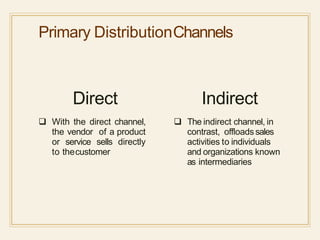
Primary DistributionChannels
Direct
 With the direct channel,
the vendor of a product
or service sells directly
to thecustomer
Indirect
 The indirect channel, in
contrast, offloads sales
activities to individuals
and organizations known
as intermediaries
Conventional MarketingSystems:
In conventional marketingsystems:
• Producers
• Wholesalers
• Retailers
Tryto maximizetheir profitsIndividually
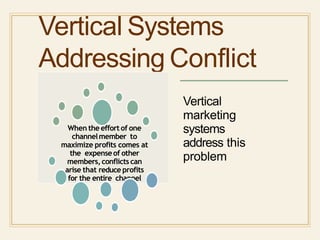
Vertical Systems
Addressing Conflict
When the effortof one
channelmember to
maximize profits comes at
the expenseof other
members,conflicts can
arise that reduce profits
for the entire channel
Vertical
marketing
systems
address this
problem
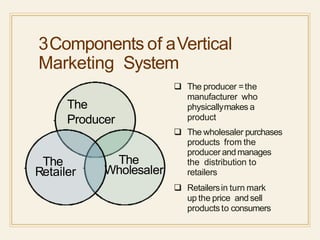
3Components of aVertical
Marketing System
The
Producer
The
Wholesaler
The
Retailer
 The producer =the
manufacturer who
physicallymakes a
product
 The wholesaler purchases
products from the
producerandmanages
the distribution to
retailers
 Retailersin turn mark
up the price and sell
products to consumers
Corporate
Vertical
System:
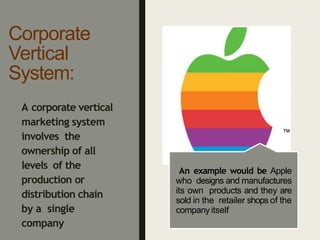
An example would be Apple
who designs and manufactures
its own products and they are
sold in the retailer shops of the
companyitself
A corporate vertical
marketing system
involves the
ownership of all
levels of the
production or
distribution chain
by a single
company
™
Contractual
Vertical
System:
 Franchising is acommon
form of a contractual
vertical marketing
system
A contractual
vertical marketing
systeminvolves a
formal agreement
between the
variouslevels of
the distribution or
production channel
to coordinate the
overall process
Arrangement where one party
(the franchiser) grants another
party (the franchisee) the right
to use its trademark or trade-
name as well as certain
business systems and
processes, to produce and
market a good or service
according to certain
specifications
Administered
Vertical
System:
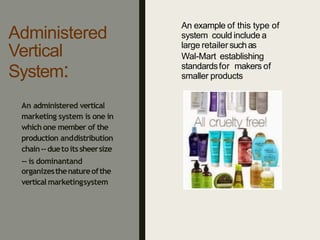
An example of this type of
system could include a
large retailer suchas
Wal-Mart establishing
standardsfor makers of
smaller products
An administered vertical
marketing system is one in
whichone member of the
production anddistribution
chain--duetoitssheersize
-- is dominantand
organizesthenatureofthe
vertical marketingsystem
• Horizontal marketing systems is a channel
arrangement in which two or more
companies at one level join together to
follow a new marketing opportunity.
• The major benefit is that companies
combine their capital, production
capabilities, marketing resources and
therefore accomplish more.
• E.g. Coca-Cola and Nestle formed a joint
venture to market ready-to-drink coffee
and tea worldwide.
Multi channel Distribution:
38
Used insituation where there are sameproducts but different marketsegments,
unrelated products insamemarkets,size ofbuyer varies & reach is difficult.
Company usesdifferent channels to reach same/ different marketsegment.
FMCG’s have separate network for retail markets & institutions
Pharmacy companiesmayusedifferent channels to reach Doctors, Chemists&
Hospitals
Indian distribution scenario at present
1. Direct Channel:
• It involves the distribution of products directly
by the producer himself without the use of the
middlemen. Some producers prefer to do this
by combining two distinct functions, pro-
duction and distribution. It cannot be strictly
called a ‘channel’.
Such direct distribution can be done in three ways:
• (a) By opening multiple shops. A producer of consumer goods of daily
necessity opens a number of retail shops with similar appearance at
different parts of a city or of the country as a whole.
• In India, the best example is the Bata Shoe Co. (India). Ltd. which
markets its products through more than 5,000 shops scattered all over
the country. There are many advantages of such multiple shops from the
sides of the producers and the consumers as well as some disadvantages.
• (b) By mail order business. The producer makes elaborate publicity for
his products through different media and by direct mailing of catalogues
to the potential buyers. The despatching of goods and payment of price
take place through post. This is practised for small and durable
consumer goods like books, toys etc.
• (c) By sending sales representatives to the prospective buyers with
samples. The sales representatives procure orders from the buyers which
are executed by the producer directly. Generally this procedure is
followed for marketing industrial goods like raw materials, machines,
machine parts, tools, machine oils, etc.
Indirect Channel:
• It means distribution of goods through middlemen or intermediaries.
Either, in the channel there is one middlemen like a Sole Selling Agent
who distributes the goods through a number of middlemen
subsequently or, there may be a number of middlemen when the
producer distributes the products through a number of agents or
wholesalers or even retailers.
• The whole process of indirect channel of distribution looks like a
chain:
• (a) At first the entire goods are supplied by the producer to a Sole Selling
Agent, part by part, at regular intervals. Appointment of sole selling
agent is common for industrial goods. The sole selling agent does the
function of a wholesaler. He gets a commission on the total sales.
• (b) A wholesaler buys the goods in bulk and then effects sales in smaller
parts to retailers. A wholesaler may procure the goods from the producer
directly without being a selling agent.
• A wholesaler may or may not have a showroom but he has a selling
counter and a godowns (or godowns) to store the goods. He gets a
commission on the total value of goods purchased by him from the
producer. He may get the supply from the sole selling agent of the
producer, if any.
• The wholesalers are of three types:
• (i) Traditional:
• These are the common types of wholesalers. Such a wholesaler may be of
general type when he deals in varieties of goods (in the same line, e.g.
textiles, cosmetics, medicines, etc.) as well as of different producers. A
traditional wholesaler may be of specialist type who deals in the
products of a very limited number of producers.
• (ii) Cooperative:
• With the development of cooperative system of distribution of consumer
goods, the Cooperative Wholesale Societies or Apex Societies buy the
goods and supply than to the different stores.
(iii) State:
• The Government may take the responsibility of supplying some essential
commodities directly from its warehouse to retailers (ration shops). This
is also known as public distribution. The Government generally does it
through some Government Agencies, e.g. the Food Corporation of India,
the State Trading Corporation of India, etc. Some wholesalers do mail
order business eliminating the retailers.
• (c) From the wholesalers the goods reach the retailers who ultimately sell
the goods to the consumers in smallest possible units. They buy the
goods at a discounted price from the wholesalers or selling agents of the
producers. Actually a part of the commission enjoyed by a wholesaler is
given to the retailers. There are many types of retailers. Firstly, retailers
can be classified into big and small.
• The department stores and chain stores are the examples of big retailers.
Other retailers are small retailers including consumers’ cooperative
stores and tied shops. Through consumer cooperative stores middlemen
may be eliminated to sate extent. Generally every retailer has a shop, big
or small. Multiple shops are retail shops.
• A department stores has different departments for different types of
goods (textiles, leather goods, stationery, furniture, books, etc.) from
where wide varieties of goods produced by different producers are sold.
Presented by – Mohammed Farooq Azam
Presented to – Prof Basavaraj S M

Distribution management by farooq azam

  • 1.
    SHARNBASVA UNIVERSITY KALABURAGI FacultyOF Business Studies APPAIET MBA CO-Edu Presentation on – Distribution management Presented by – Mohammed Farooq Azam Presented to - Prof. Basavaraj S M
  • 2.
    Definition :The managementof theefficienttransfer of goodsfrom the place of manufactureto the point of sale or consumption. Distribution management encompassessuchactivities as warehousing,materials handling, packaging, stock control, order processing, and transportation. 2
  • 3.
    Distribution Channels Defined•Are setsof interdependent organizationsinvolved in the process of making aproduct orservice available for useor consumption oWhether selling products or services, marketing channel decisions play arole of strategic importancein the overall presence and successacompany enjoys in the market place.
  • 4.
    Distribution Channels•Are intermediaries ormiddlemen oExist becauseproducers cannot reach alltheir consumers oMultiply reach and provide efficiency tothe marketing process oFacilitate smooth flow and create time,place and possession utilities oHave the core competence andreach oProvide contact, experience, specialization and scalesof operation
  • 5.
    Typesof Channels •Sales: motivatesbuyers, sharesinformation between company and its consumers,negotiates fair bargains for consumers and financesthe transactions •Delivery channel meant only for physical partof the distribution •Service channel – performs after salesservice Channel members…
  • 6.
    Listing of Channel Members•Companyownsalesteam •C&FAs and CSAs •Distributors, dealers, stockists, value-addedre-sellers •Agents and brokers •Franchisees •Electronic channels •Wholesalers •Retailers
  • 7.
    C&FAs/ C&SAs •C&FA: carryingand forwarding agent and C&SA:carrying and selling agent – both are on contract withacompany and its distributors •Both are transporters who work between the company •Collect products from the company, store inacentral location, break bulk and despatch to distributorsagainst indents •Goodsbelong to thecompany •C&SAalso sells the goods on behalf of the companybut remits proceeds after sale
  • 8.
    Distributors, Dealers,Stockists, Agents them •Namedenotes theextent of re-distribution done by •Distributors invest in theproducts – buy products from the company •Are on commission, margins or mark-up •May or may not get credit – but extend credit •Distributors cover the markets asper abeat plan.All others merely finance thebusiness. •Distributors could be exclusive for acompany •Agents bring buyer and sellertogether
  • 9.
    Wholesal ers•Operate out ofthemain markets •Deal with anumber of company products oftheir choice •Are not on contract withany company •Sellto other wholesalers, retailers andinstitutions •Negotiate about 15 dayscredit fromcompany distributors – also provide credit totheir customers •Operate on high volumes and lowmargins
  • 10.
    Retailer s•Thefinal contact withconsumers •Operate out of their shopsand sell alarge assortment and variety of goods •Located closest to consumers •Buyfrom company, distributors or wholesalers •Highest margins in the network •Provide personalized services to their customers
  • 11.
  • 12.
  • 13.
    The prime objectof productionis its consumption.The movementof product fromproducer to consumeris animportantfunction of marketing.It is the obligation of the producerto makegoods availableat right place,at right time right price andin right quantity.The processof making goods available to the consumer.Needseffectivechannelof distribution.Therefore, the path takenby the goods inits movementis termedaschannelof distribution.The goodsmaybesent to the consumerdirectly or indirectly through middlemen. The channelof distribution maybeclassifiedas: A) Selling through direct channels B)Selling through indirect channels 13
  • 14.
  • 15.
    A) Selling throughdirect channels This is the oldest, shorter andthe simple channel ofdistribution. The producer sells theproduct directly without involvement ofany middle man.The sale canbemadedoor to door through salesman,retail stores anddirect mail.Certain industrial andconsumergoods suchasclothes, shoes,books,hosiery goods, cosmetics, householdappliances,electronic goods etc., maybesold through direct contact. Perishable goods suchasvegetable andfruits canalso besold directly. Advantage of selling through direct channels It is simpleandfast. It is economical. Disadvantages of selling through direct channels Non-availability ofexpert services ofmiddleman. Large investment is required. 15
  • 16.
    B)Selling through indirectchannel According to this method of indirect selling,product is passedonto the customers through intermediaries,knownaswholesalers,retailers andagents.These channelsmaybeas under: 1. Producers -> Wholesalers -> Retailers -> Customer Two level Channel: It is commonlyused channelof distribution.It is alsoknownastraditional or normal channelof distribution.This channelis usefulfor smallproducers forsmallmeans.The channelis usedfor consumergoods. The common practice is that the manufacturer sells goods inlarge quantity to wholesalers,whosell goods to retailers insmall quantity.Finally goods aresoldto customers in pieces. 2. Producer -> Agent -> Retailer -> Consumeror Two level Channel: The commonpracticeinthis two level channelis that the goods aresoldto the agent inbulk.The agent sells goods to retailer,who sells goods to customers inpieces.This channelis suitablewhere the retailers arefew andgeographically centered.This channelis commonlyusedintextile, machinery,equipmentandagricultural products. 16
  • 17.
    3.Producer -> Agent-> Wholesaler -> Retailer -> Customer or Three level Channel: The commonpractice in this three level channel is that goods are sold by the producer to the agent, who sells it to the wholesaler, who sells to the retailers who finally sells goods to customers. This is the longest channel ofdistribution. This practice is useful, when the producer wants to the relieved ofthe problemofdistribution. This channel is popularly used in textile. 4)Producer -> Retailer -> Customer or onelevel Channel:Under this channel the producer sells goods to retailers, who sell the goods to customers. This channel is popularwith the departmental stores, chainstores andsupermarkets etc., because these are large scale retailers. Generally readymade garments, shoeshomeappliances andautomobiles are sold through this channel. 17
  • 18.
    Patterns of Distributiondecides the intensity of the distribution & also decides the service level provided. Types of Distribution intensities: 1) Intensive 2) Selective 3) Exclusive 18
  • 19.
    Intensive Distribution :is done through every reasonable outlet available – FMCG Strategy is to make sure that, the product is available in as many outlets as possible. Preferred for Consumer,Pharmaceuticals & automobile spare. Selective Distribution: Multiple but not all outlets in the market Only afew selected outlets are allowed to keepthe product Outlets selected in line with the image of the companywants to project. Preferred for High Value items like Jewelers Exclusive Distribution: Highly selectivechoice of outlets, maybeonly onein the whole market. Could include outlets set upbythe companyitself (Bata) 19
  • 20.
    Channelformatis basically decidedbywho Drives the market 20 1. Producer Driven 2. Seller Driven 3. Service Driven 4. Others
  • 21.
    1. Producer Drivenformat: This is the effort of the producer/ manufacturerto reach the product to his consumers Examples: Companyownedretail outlets (Bata,Petrol Pump) LicensedOutlets (MC Donald's) Franchisees Brokers Vending Machines Companycontracted Distributors 21
  • 22.
    2. Seller Driven: Thisis where producer/ manufactureruses existing channels to reachlarge numberof end users. Examples: Existing wholesalers andRetailers Modern Retail formats Specialty shops(Shoppers stop) Discount stores (D Mart) Local pheriwalas 22
  • 23.
    3. Service Driven Thesearethepeople who facilitate thedistribution Examples: Transport & Freight forwarders Warehousespace provider C&F Agents 3P Logistics provider Couriers 23
  • 24.
    4. Others include Multilevel marketing systems Cooperative societies TV Homeshopping Catalogue marketing Internet Exhibitions / fares / Trade shows Database marketing 24
  • 25.
  • 26.
  • 27.
    What is aVertical Marketing System? A vertical marketing system is a form of cooperation between multiple levels of a distribution channel  The members work together to promote efficiencyand economies of scale in the way products are promoted tocustomers
  • 28.
    What are DistributionChannels? A distribution channelis the network of individuals and organizations involved in getting a product orservice from the producer to the customer  Distributionchannels are also known asmarketing channels or marketing distribution channels
  • 29.
    Primary DistributionChannels Direct  Withthe direct channel, the vendor of a product or service sells directly to thecustomer Indirect  The indirect channel, in contrast, offloads sales activities to individuals and organizations known as intermediaries
  • 30.
    Conventional MarketingSystems: In conventionalmarketingsystems: • Producers • Wholesalers • Retailers Tryto maximizetheir profitsIndividually
  • 31.
    Vertical Systems Addressing Conflict Whenthe effortof one channelmember to maximize profits comes at the expenseof other members,conflicts can arise that reduce profits for the entire channel Vertical marketing systems address this problem
  • 32.
    3Components of aVertical MarketingSystem The Producer The Wholesaler The Retailer  The producer =the manufacturer who physicallymakes a product  The wholesaler purchases products from the producerandmanages the distribution to retailers  Retailersin turn mark up the price and sell products to consumers
  • 33.
    Corporate Vertical System: An example wouldbe Apple who designs and manufactures its own products and they are sold in the retailer shops of the companyitself A corporate vertical marketing system involves the ownership of all levels of the production or distribution chain by a single company ™
  • 34.
    Contractual Vertical System:  Franchising isacommon form of a contractual vertical marketing system A contractual vertical marketing systeminvolves a formal agreement between the variouslevels of the distribution or production channel to coordinate the overall process Arrangement where one party (the franchiser) grants another party (the franchisee) the right to use its trademark or trade- name as well as certain business systems and processes, to produce and market a good or service according to certain specifications
  • 35.
    Administered Vertical System: An example ofthis type of system could include a large retailer suchas Wal-Mart establishing standardsfor makers of smaller products An administered vertical marketing system is one in whichone member of the production anddistribution chain--duetoitssheersize -- is dominantand organizesthenatureofthe vertical marketingsystem
  • 36.
    • Horizontal marketingsystems is a channel arrangement in which two or more companies at one level join together to follow a new marketing opportunity. • The major benefit is that companies combine their capital, production capabilities, marketing resources and therefore accomplish more.
  • 37.
    • E.g. Coca-Colaand Nestle formed a joint venture to market ready-to-drink coffee and tea worldwide.
  • 38.
    Multi channel Distribution: 38 Usedinsituation where there are sameproducts but different marketsegments, unrelated products insamemarkets,size ofbuyer varies & reach is difficult. Company usesdifferent channels to reach same/ different marketsegment. FMCG’s have separate network for retail markets & institutions Pharmacy companiesmayusedifferent channels to reach Doctors, Chemists& Hospitals
  • 39.
    Indian distribution scenarioat present 1. Direct Channel: • It involves the distribution of products directly by the producer himself without the use of the middlemen. Some producers prefer to do this by combining two distinct functions, pro- duction and distribution. It cannot be strictly called a ‘channel’.
  • 40.
    Such direct distributioncan be done in three ways: • (a) By opening multiple shops. A producer of consumer goods of daily necessity opens a number of retail shops with similar appearance at different parts of a city or of the country as a whole. • In India, the best example is the Bata Shoe Co. (India). Ltd. which markets its products through more than 5,000 shops scattered all over the country. There are many advantages of such multiple shops from the sides of the producers and the consumers as well as some disadvantages. • (b) By mail order business. The producer makes elaborate publicity for his products through different media and by direct mailing of catalogues to the potential buyers. The despatching of goods and payment of price take place through post. This is practised for small and durable consumer goods like books, toys etc. • (c) By sending sales representatives to the prospective buyers with samples. The sales representatives procure orders from the buyers which are executed by the producer directly. Generally this procedure is followed for marketing industrial goods like raw materials, machines, machine parts, tools, machine oils, etc.
  • 41.
    Indirect Channel: • Itmeans distribution of goods through middlemen or intermediaries. Either, in the channel there is one middlemen like a Sole Selling Agent who distributes the goods through a number of middlemen subsequently or, there may be a number of middlemen when the producer distributes the products through a number of agents or wholesalers or even retailers. • The whole process of indirect channel of distribution looks like a chain: • (a) At first the entire goods are supplied by the producer to a Sole Selling Agent, part by part, at regular intervals. Appointment of sole selling agent is common for industrial goods. The sole selling agent does the function of a wholesaler. He gets a commission on the total sales. • (b) A wholesaler buys the goods in bulk and then effects sales in smaller parts to retailers. A wholesaler may procure the goods from the producer directly without being a selling agent.
  • 42.
    • A wholesalermay or may not have a showroom but he has a selling counter and a godowns (or godowns) to store the goods. He gets a commission on the total value of goods purchased by him from the producer. He may get the supply from the sole selling agent of the producer, if any. • The wholesalers are of three types: • (i) Traditional: • These are the common types of wholesalers. Such a wholesaler may be of general type when he deals in varieties of goods (in the same line, e.g. textiles, cosmetics, medicines, etc.) as well as of different producers. A traditional wholesaler may be of specialist type who deals in the products of a very limited number of producers. • (ii) Cooperative: • With the development of cooperative system of distribution of consumer goods, the Cooperative Wholesale Societies or Apex Societies buy the goods and supply than to the different stores.
  • 43.
    (iii) State: • TheGovernment may take the responsibility of supplying some essential commodities directly from its warehouse to retailers (ration shops). This is also known as public distribution. The Government generally does it through some Government Agencies, e.g. the Food Corporation of India, the State Trading Corporation of India, etc. Some wholesalers do mail order business eliminating the retailers. • (c) From the wholesalers the goods reach the retailers who ultimately sell the goods to the consumers in smallest possible units. They buy the goods at a discounted price from the wholesalers or selling agents of the producers. Actually a part of the commission enjoyed by a wholesaler is given to the retailers. There are many types of retailers. Firstly, retailers can be classified into big and small. • The department stores and chain stores are the examples of big retailers. Other retailers are small retailers including consumers’ cooperative stores and tied shops. Through consumer cooperative stores middlemen may be eliminated to sate extent. Generally every retailer has a shop, big or small. Multiple shops are retail shops. • A department stores has different departments for different types of goods (textiles, leather goods, stationery, furniture, books, etc.) from where wide varieties of goods produced by different producers are sold.
  • 44.
    Presented by –Mohammed Farooq Azam Presented to – Prof Basavaraj S M