

INDUSTRIAL TRAINING PRESENTATION
ON
INDIAN OIL CORPORATION LTD
‘GUWAHATI REFINERY’
SUBMITTED BY
ARINDAM KUMAR DEKA
ET13BT0125
MECHANICAL ENGINEERING
contents
Introduction
Major Products of Guwahati Refinery
Mechanical Equipment's
Maintenance
Various Units of Guwahati Refinery
Environmental Protections
Learning's
Conclusion
INTRODUCTION
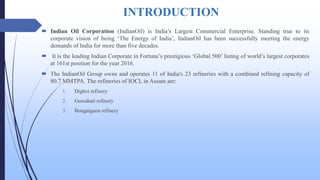
 Indian Oil Corporation (IndianOil) is India’s Largest Commercial Enterprise. Standing true to its
corporate vision of being ‘The Energy of India’, IndianOil has been successfully meeting the energy
demands of India for more than five decades.
 It is the leading Indian Corporate in Fortune’s prestigious ‘Global 500’ listing of world’s largest corporates
at 161st position for the year 2016.
 The IndianOil Group owns and operates 11 of India's 23 refineries with a combined refining capacity of
80.7 MMTPA. The refineries of IOCL in Assam are:
1. Digboi refinery
2. Guwahati refinery
3. Bongaigaon refinery
GUWAHATI REFINERY
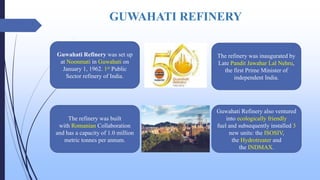
Guwahati Refinery was set up
at Noonmati in Guwahati on
January 1, 1962. 1st Public
Sector refinery of India.
The refinery was inaugurated by
Late Pandit Jawahar Lal Nehru,
the first Prime Minister of
independent India.
The refinery was built
with Romanian Collaboration
and has a capacity of 1.0 million
metric tonnes per annum.
Guwahati Refinery also ventured
into ecologically friendly
fuel and subsequently installed 3
new units: the ISOSIV,
the Hydrotreater and
the INDMAX.
MAJOR PRODUCTS
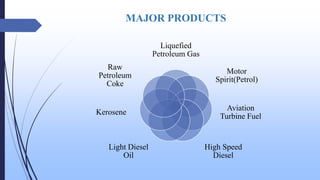
Liquefied
Petroleum Gas
Motor
Spirit(Petrol)
Aviation
Turbine Fuel
High Speed
Diesel
Light Diesel
Oil
Kerosene
Raw
Petroleum
Coke
MECHANICAL EQUIPMENTS
PUMP
COMPRESSOR
VALVES
BEARINGS
AIR
PREHEATER
HEAT
EXCHANGER
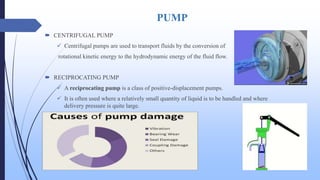
PUMP
 CENTRIFUGAL PUMP
 Centrifugal pumps are used to transport fluids by the conversion of
rotational kinetic energy to the hydrodynamic energy of the fluid flow.
 RECIPROCATING PUMP
 A reciprocating pump is a class of positive-displacement pumps.
 It is often used where a relatively small quantity of liquid is to be handled and where
delivery pressure is quite large.
AIR COMPRESSOR
 Mechanical device that increases the pressure of a gas by reducing its volume.
 In refinery compressor are used to pump out product like LPG, steam and other gases.
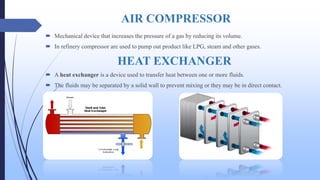
HEAT EXCHANGER
 A heat exchanger is a device used to transfer heat between one or more fluids.
 The fluids may be separated by a solid wall to prevent mixing or they may be in direct contact.
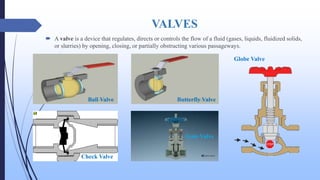
VALVES
 A valve is a device that regulates, directs or controls the flow of a fluid (gases, liquids, fluidized solids,
or slurries) by opening, closing, or partially obstructing various passageways.
Ball Valve Butterfly Valve
Globe Valve
Gate Valve
Check Valve
AIR PREHEATER
 Air preheater are heat exchanger to preheat or airheating of the combustion air by means of flue
gas, steam, water or thermal oil.
 Air preheaters are used when exhaust temperatures of combustion systems are particularly high.
BEARINGS
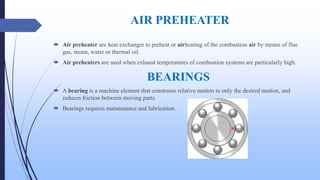
 A bearing is a machine element that constrains relative motion to only the desired motion, and
reduces friction between moving parts.
 Bearings requires maintenance and lubrication.
MAINTENANCE
 Maintenance is a sum of activities which keep the machines in condition that enable uninterrupted
implementations of plans involving its use and while in doing so optimize the maintenance cost.
 Different maintenance practice has been practiced by different maintenance personnel. However all
these maintenance practices can be classified into two main types:
 Breakdown Maintenance Practice
 Preventive Maintenance Practice
DEMINERALIZED WATER PLANT
 Demineralization is the process of removing mineral salts from water by using the ion exchange
process.
 Demineralised water is water completely free (or almost) of dissolved minerals as a result of one of
the following processes :
 Distillation
 Deionization
 Membrane filtration (reverse osmosis or nanofiltration)
 Electrodialysis
THERMAL POWER STATION
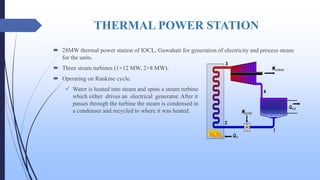
 28MW thermal power station of IOCL, Guwahati for generation of electricity and process steam
for the units.
 Three steam turbines (1×12 MW, 2×8 MW).
 Operating on Rankine cycle.
 Water is heated into steam and spins a steam turbine
which either drives an electrical generator. After it
passes through the turbine the steam is condensed in
a condenser and recycled to where it was heated.
CRUDE DISTILLATION UNIT (CDU)
 Primary unit of the Refinery : The Crude Distillation Unit (CDU), desalted crude from the desalter is
heated up through a series of heat exchangers and is fed into a pre fractionator column.
 The outputs from CDU are gasoline, Kero-I, Kero-II and Straight Run Gas Oil. Reduced Coke Oil
(RCO) which is the bottom product from the main fractionating column, forms the main raw
material for Coking unit and Indmax.
DELAYED COKING UNIT
 Main secondary unit : The Delayed Coking Unit (DCU), the Refinery produces middle distillates
from heavy ends.
 Main feedstock to DCU is RCO, which is heated to high temperatures of about 500oC in a
furnace. Due to high temperatures, RCO is thermally cracked and yields various hydrocarbon
fractions like:
 LPG,
 Coker gasoline,
 Coker kerosene,
 Coker gas oil,
 Coker fuel oil,
 Residual fuel oil and
 Coke.
INDMAX UNIT
 The Refinery has progressively improved its operations in terms of energy efficient state-of-the-art
technologies and production of clean fuels meeting emerging quality requirements. The Indane
Maximisation (INDMAX) technology is an in-house technology developed by R&D Centre of
IndianOil. The INDMAX technology was first commissioned at Guwahati Refinery.
 The technology is being globally licensed by M/s Lummus Technology Inc., USA (a CB&I
Company). INDMAX unit is designed by Lummus employing proprietary efficient hardware
components with basic process design from IndianOil.
 Advantages
 Higher Octane of Gasoline (RON >96)
 Lower Catalyst Consumption.
OIL MOVEMENT AND STORAGE DIVISION
 Functions of OM &S
 Receipt, storage, accounting, preparation and supply of crude oil to DCU.
 Receipt and storage of intermediate and finished products from production units.
 Blending of products and chemical dozing.
 Dispatch of finished products.
 Measurement of petroleum products – gauging and sampling.
 Filling and dispatch of LPG in bulk dispatches in bullets mounted on trucks.
PLANNING SECTION
 Budgetary Control
 Optimum Utilization
 Planning & Execution of different types of activities
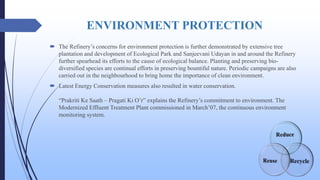
ENVIRONMENT PROTECTION
 The Refinery’s concerns for environment protection is further demonstrated by extensive tree
plantation and development of Ecological Park and Sanjeevani Udayan in and around the Refinery
further spearhead its efforts to the cause of ecological balance. Planting and preserving bio-
diversified species are continual efforts in preserving bountiful nature. Periodic campaigns are also
carried out in the neighbourhood to bring home the importance of clean environment.
 Latest Energy Conservation measures also resulted in water conservation.
“Prakriti Ke Saath – Pragati Ki O’r” explains the Refinery’s commitment to environment. The
Modernized Effluent Treatment Plant commissioned in March’07, the continuous environment
monitoring system.
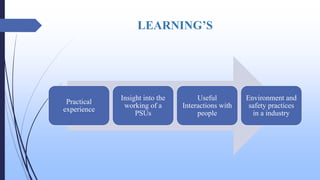
LEARNING’S
Practical
experience
Insight into the
working of a
PSUs
Useful
Interactions with
people
Environment and
safety practices
in a industry
CONCLUSION
 In line with Indian Oil’s responsibility towards the society, Guwahati Refinery has contributed
towards developing the community, which exists around it. The CSR agenda of the Refinery focuses
on three broad areas of education, health care and providing water supply. Initiatives taken under
these heads are participative in nature with community participation in a partnership model for
ensuring sustainable development of the community.
I THANK YOU ALL

Internship presentation (iocl)

  • 1.
    INDUSTRIAL TRAINING PRESENTATION ON INDIANOIL CORPORATION LTD ‘GUWAHATI REFINERY’ SUBMITTED BY ARINDAM KUMAR DEKA ET13BT0125 MECHANICAL ENGINEERING
  • 2.
    contents Introduction Major Products ofGuwahati Refinery Mechanical Equipment's Maintenance Various Units of Guwahati Refinery Environmental Protections Learning's Conclusion
  • 3.
    INTRODUCTION  Indian OilCorporation (IndianOil) is India’s Largest Commercial Enterprise. Standing true to its corporate vision of being ‘The Energy of India’, IndianOil has been successfully meeting the energy demands of India for more than five decades.  It is the leading Indian Corporate in Fortune’s prestigious ‘Global 500’ listing of world’s largest corporates at 161st position for the year 2016.  The IndianOil Group owns and operates 11 of India's 23 refineries with a combined refining capacity of 80.7 MMTPA. The refineries of IOCL in Assam are: 1. Digboi refinery 2. Guwahati refinery 3. Bongaigaon refinery
  • 4.
    GUWAHATI REFINERY Guwahati Refinerywas set up at Noonmati in Guwahati on January 1, 1962. 1st Public Sector refinery of India. The refinery was inaugurated by Late Pandit Jawahar Lal Nehru, the first Prime Minister of independent India. The refinery was built with Romanian Collaboration and has a capacity of 1.0 million metric tonnes per annum. Guwahati Refinery also ventured into ecologically friendly fuel and subsequently installed 3 new units: the ISOSIV, the Hydrotreater and the INDMAX.
  • 5.
    MAJOR PRODUCTS Liquefied Petroleum Gas Motor Spirit(Petrol) Aviation TurbineFuel High Speed Diesel Light Diesel Oil Kerosene Raw Petroleum Coke
  • 6.
  • 7.
    PUMP  CENTRIFUGAL PUMP Centrifugal pumps are used to transport fluids by the conversion of rotational kinetic energy to the hydrodynamic energy of the fluid flow.  RECIPROCATING PUMP  A reciprocating pump is a class of positive-displacement pumps.  It is often used where a relatively small quantity of liquid is to be handled and where delivery pressure is quite large.
  • 8.
    AIR COMPRESSOR  Mechanicaldevice that increases the pressure of a gas by reducing its volume.  In refinery compressor are used to pump out product like LPG, steam and other gases. HEAT EXCHANGER  A heat exchanger is a device used to transfer heat between one or more fluids.  The fluids may be separated by a solid wall to prevent mixing or they may be in direct contact.
  • 9.
    VALVES  A valveis a device that regulates, directs or controls the flow of a fluid (gases, liquids, fluidized solids, or slurries) by opening, closing, or partially obstructing various passageways. Ball Valve Butterfly Valve Globe Valve Gate Valve Check Valve
  • 10.
    AIR PREHEATER  Airpreheater are heat exchanger to preheat or airheating of the combustion air by means of flue gas, steam, water or thermal oil.  Air preheaters are used when exhaust temperatures of combustion systems are particularly high. BEARINGS  A bearing is a machine element that constrains relative motion to only the desired motion, and reduces friction between moving parts.  Bearings requires maintenance and lubrication.
  • 11.
    MAINTENANCE  Maintenance isa sum of activities which keep the machines in condition that enable uninterrupted implementations of plans involving its use and while in doing so optimize the maintenance cost.  Different maintenance practice has been practiced by different maintenance personnel. However all these maintenance practices can be classified into two main types:  Breakdown Maintenance Practice  Preventive Maintenance Practice
  • 12.
    DEMINERALIZED WATER PLANT Demineralization is the process of removing mineral salts from water by using the ion exchange process.  Demineralised water is water completely free (or almost) of dissolved minerals as a result of one of the following processes :  Distillation  Deionization  Membrane filtration (reverse osmosis or nanofiltration)  Electrodialysis
  • 13.
    THERMAL POWER STATION 28MW thermal power station of IOCL, Guwahati for generation of electricity and process steam for the units.  Three steam turbines (1×12 MW, 2×8 MW).  Operating on Rankine cycle.  Water is heated into steam and spins a steam turbine which either drives an electrical generator. After it passes through the turbine the steam is condensed in a condenser and recycled to where it was heated.
  • 14.
    CRUDE DISTILLATION UNIT(CDU)  Primary unit of the Refinery : The Crude Distillation Unit (CDU), desalted crude from the desalter is heated up through a series of heat exchangers and is fed into a pre fractionator column.  The outputs from CDU are gasoline, Kero-I, Kero-II and Straight Run Gas Oil. Reduced Coke Oil (RCO) which is the bottom product from the main fractionating column, forms the main raw material for Coking unit and Indmax.
  • 15.
    DELAYED COKING UNIT Main secondary unit : The Delayed Coking Unit (DCU), the Refinery produces middle distillates from heavy ends.  Main feedstock to DCU is RCO, which is heated to high temperatures of about 500oC in a furnace. Due to high temperatures, RCO is thermally cracked and yields various hydrocarbon fractions like:  LPG,  Coker gasoline,  Coker kerosene,  Coker gas oil,  Coker fuel oil,  Residual fuel oil and  Coke.
  • 16.
    INDMAX UNIT  TheRefinery has progressively improved its operations in terms of energy efficient state-of-the-art technologies and production of clean fuels meeting emerging quality requirements. The Indane Maximisation (INDMAX) technology is an in-house technology developed by R&D Centre of IndianOil. The INDMAX technology was first commissioned at Guwahati Refinery.  The technology is being globally licensed by M/s Lummus Technology Inc., USA (a CB&I Company). INDMAX unit is designed by Lummus employing proprietary efficient hardware components with basic process design from IndianOil.  Advantages  Higher Octane of Gasoline (RON >96)  Lower Catalyst Consumption.
  • 17.
    OIL MOVEMENT ANDSTORAGE DIVISION  Functions of OM &S  Receipt, storage, accounting, preparation and supply of crude oil to DCU.  Receipt and storage of intermediate and finished products from production units.  Blending of products and chemical dozing.  Dispatch of finished products.  Measurement of petroleum products – gauging and sampling.  Filling and dispatch of LPG in bulk dispatches in bullets mounted on trucks.
  • 18.
    PLANNING SECTION  BudgetaryControl  Optimum Utilization  Planning & Execution of different types of activities
  • 19.
    ENVIRONMENT PROTECTION  TheRefinery’s concerns for environment protection is further demonstrated by extensive tree plantation and development of Ecological Park and Sanjeevani Udayan in and around the Refinery further spearhead its efforts to the cause of ecological balance. Planting and preserving bio- diversified species are continual efforts in preserving bountiful nature. Periodic campaigns are also carried out in the neighbourhood to bring home the importance of clean environment.  Latest Energy Conservation measures also resulted in water conservation. “Prakriti Ke Saath – Pragati Ki O’r” explains the Refinery’s commitment to environment. The Modernized Effluent Treatment Plant commissioned in March’07, the continuous environment monitoring system.
  • 20.
    LEARNING’S Practical experience Insight into the workingof a PSUs Useful Interactions with people Environment and safety practices in a industry
  • 21.
    CONCLUSION  In linewith Indian Oil’s responsibility towards the society, Guwahati Refinery has contributed towards developing the community, which exists around it. The CSR agenda of the Refinery focuses on three broad areas of education, health care and providing water supply. Initiatives taken under these heads are participative in nature with community participation in a partnership model for ensuring sustainable development of the community.
  • 22.