Classifying Plants
Some plants are vascular.  That means they have tubes that carry water & nutrients throughout the plant
Some plants are nonvascular.  That means they do not have tubes.  They need to be small and close to the ground.
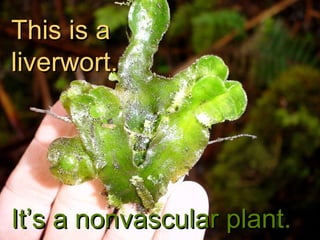
This is a liverwort. It’s a nonvascular plant.
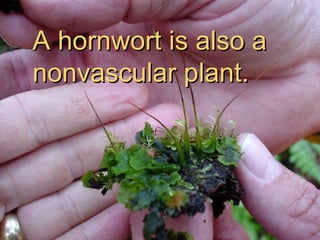
A hornwort is also a  nonvascular plant.
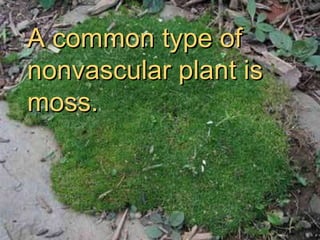
A common type of  nonvascular plant is moss.
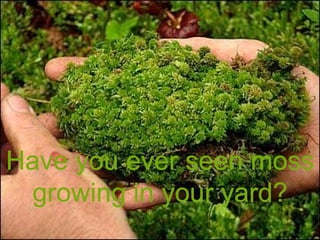
Have you ever seen moss growing in your yard?
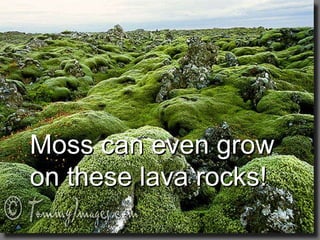
Moss can even grow on these lava rocks!
Remember that plants with tubes are called vascular? Some vascular plants reproduce by making seeds and some don’t!
Horse tails and ferns are vascular plants that have spores instead of seeds.
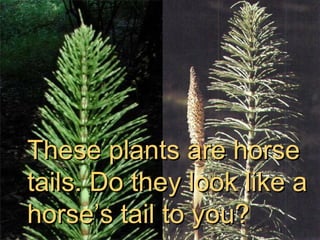
These plants are horse tails. Do they look like a horse’s tail to you?
Maybe you’ve seen a  fern before.  They can grow in a  forest or in your home.
Some vascular plants  do  have seeds.  Plants that make seeds can be classified even further!
Some plants make seeds in their flowers.
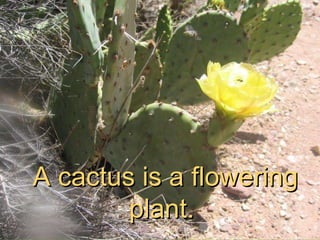
A cactus is a flowering plant.
The job of a flower is to make seeds.
But some plants make seeds without flowers!
Conifers make seeds in their cones.  They don’t have flowers!
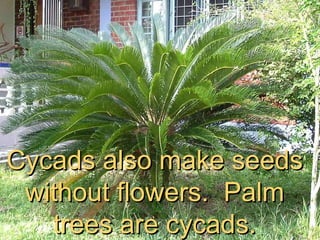
Cycads also make seeds without flowers.  Palm trees are cycads.
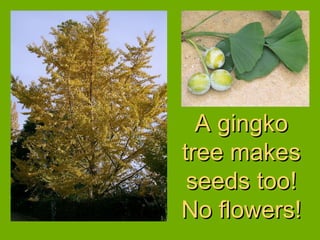
A gingko tree makes seeds too! No flowers!
Plants can be classified by using many characteristics.  Scientists want to know…
Whether or not the plant has tubes. (Vascular/nonvascular plants)
If the plant makes seeds or not. (seeded/seedless plants)
Are the seeds made in a flower? Or a cone? (flowering/nonflowering)
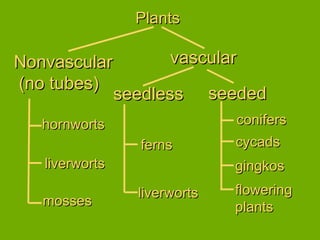
Plants Nonvascular  (no tubes) vascular seedless seeded hornworts liverworts mosses ferns liverworts conifers cycads gingkos flowering  plants
Sometimes, as we learn more about plants, we change the way they are classified.
What are some other characteristics that you could use to classify plants?

Classifying plants