Renewable energy technologies in
power generation
By
Sekar.k viknesh.k
Contents
• Introduction
• Wind energy
• Solar energy
Introduction
Introduction
• Renewable Energy – “any sustainable energy source that comes from natural
environment.”
• Some Aspects of Renewable Energy
– It exists perpetually and in abundant in the environment
– Ready to be harnessed, inexhaustible
– It is a clean alternative to fossil fuels
– “energy that is derived from natural process that are replenished
constantly” -- defined by the RENEWABLE ENERGY WORKING
Introduction
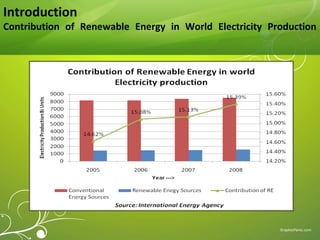
Contribution of Renewable Energy in World Electricity Production
Introduction
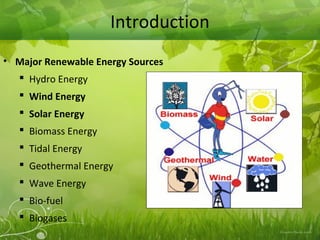
• Major Renewable Energy Sources
 Hydro Energy
 Wind Energy
 Solar Energy
 Biomass Energy
 Tidal Energy
 Geothermal Energy
 Wave Energy
 Bio-fuel
 Biogases
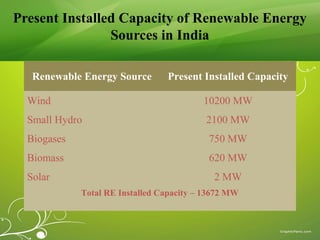
Present Installed Capacity of Renewable Energy
Sources in India
Renewable Energy Source Present Installed Capacity
Wind 10200 MW
Small Hydro 2100 MW
Biogases 750 MW
Biomass 620 MW
Solar 2 MW
Total RE Installed Capacity – 13672 MW
INTRODUCTION
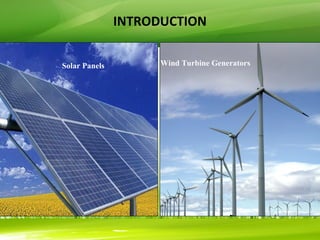
Solar Panels Wind Turbine Generators
Wind Energy
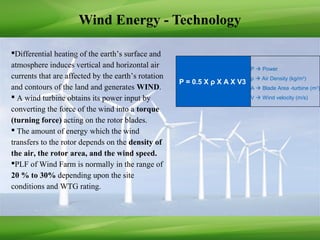
Wind Energy - Technology
Differential heating of the earth’s surface and
atmosphere induces vertical and horizontal air
currents that are affected by the earth’s rotation
and contours of the land and generates WIND.
 A wind turbine obtains its power input by
converting the force of the wind into a torque
(turning force) acting on the rotor blades.
 The amount of energy which the wind
transfers to the rotor depends on the density of
the air, the rotor area, and the wind speed.
PLF of Wind Farm is normally in the range of
20 % to 30% depending upon the site
conditions and WTG rating.
P  Power
ρ  Air Density (kg/m3
)
A  Blade Area -turbine (m2
)
V  Wind velocity (m/s)
P = 0.5 X ρ X A X V3
Wind Energy – Present Scenario
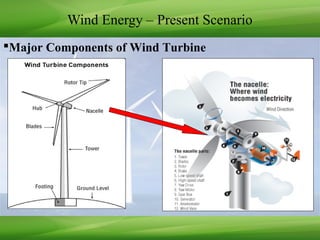
Major Components of Wind Turbine
Wind Energy – Present Scenario
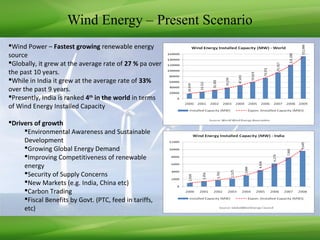
Wind Power – Fastest growing renewable energy
source
Globally, it grew at the average rate of 27 % pa over
the past 10 years.
While in India it grew at the average rate of 33%
over the past 9 years.
Presently, India is ranked 4th
in the world in terms
of Wind Energy Installed Capacity
Drivers of growth
Environmental Awareness and Sustainable
Development
Growing Global Energy Demand
Improving Competitiveness of renewable
energy
Security of Supply Concerns
New Markets (e.g. India, China etc)
Carbon Trading
Fiscal Benefits by Govt. (PTC, feed in tariffs,
etc)
Solar Energy
Solar Energy - Technology
Solar power is by far the Earth's most available energy source, easily capable of
providing many times the total current energy demand.
Solar power is the conversion of sunlight into electricity.
Two main commercial ways of conversion of sunlight into electricity.
Concentrating Solar Thermal Plant (CSP)
Photovoltaic Plants (PV)
CSP and PV both have their markets. PV is very successful in decentralized
applications, whereas CSP offers advantages for central and large-scale
applications. CSP power plants are the most cost-efficient way to generate and
to store dispatch able CO2
-free electricity. However, there is no competition
between both. Rather, they have to be seen as complementary technologies.
PLF of CSP – In the range of 20 % to 30 %
 PLF of PV – In the range of 15 % to 20 %
Solar Energy - Technology
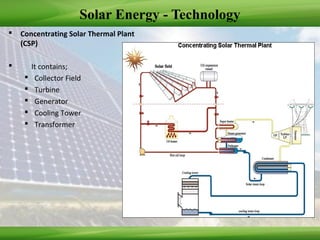
 Concentrating Solar Thermal Plant
(CSP)
 It contains;
 Collector Field
 Turbine
 Generator
 Cooling Tower
 Transformer
Solar Energy - Technology
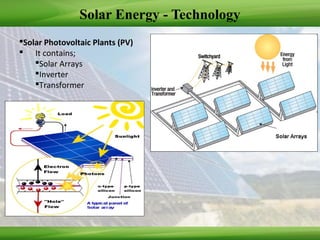
Solar Photovoltaic Plants (PV)
 It contains;
Solar Arrays
Inverter
Transformer
Solar Energy - Technology
 In both CSP and PV technologies, solar resources plays major role.
 Maps are available to calculate solar resource of a particular region. However, for both
CSP and PV technologies different solar radiations are taken into account.
 Basically two types of solar radiations are there;
 Global Horizontal irradiations (GHI)
 Direct Normal Irradiation (DNI)
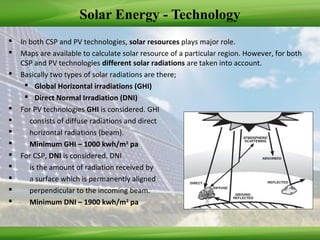
 For PV technologies GHI is considered. GHI
 consists of diffuse radiations and direct
 horizontal radiations (beam).
 Minimum GHI – 1000 kwh/m2
pa
 For CSP, DNI is considered. DNI
 is the amount of radiation received by
 a surface which is permanently aligned
 perpendicular to the incoming beam.
 Minimum DNI – 1900 kwh/m2
pa
Solar Energy - Technology
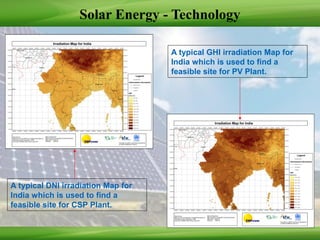
A typical DNI irradiation Map for
India which is used to find a
feasible site for CSP Plant.
A typical GHI irradiation Map for
India which is used to find a
feasible site for PV Plant.
Solar Energy - Technology
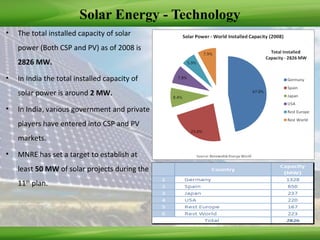
• The total installed capacity of solar
power (Both CSP and PV) as of 2008 is
2826 MW.
• In India the total installed capacity of
solar power is around 2 MW.
• In India, various government and private
players have entered into CSP and PV
markets.
• MNRE has set a target to establish at
least 50 MW of solar projects during the
11th
plan.
Thank you

RSEMZ

  • 1.
    Renewable energy technologiesin power generation By Sekar.k viknesh.k
  • 2.
    Contents • Introduction • Windenergy • Solar energy
  • 3.
  • 4.
    Introduction • Renewable Energy– “any sustainable energy source that comes from natural environment.” • Some Aspects of Renewable Energy – It exists perpetually and in abundant in the environment – Ready to be harnessed, inexhaustible – It is a clean alternative to fossil fuels – “energy that is derived from natural process that are replenished constantly” -- defined by the RENEWABLE ENERGY WORKING
  • 5.
    Introduction Contribution of RenewableEnergy in World Electricity Production
  • 6.
    Introduction • Major RenewableEnergy Sources  Hydro Energy  Wind Energy  Solar Energy  Biomass Energy  Tidal Energy  Geothermal Energy  Wave Energy  Bio-fuel  Biogases
  • 7.
    Present Installed Capacityof Renewable Energy Sources in India Renewable Energy Source Present Installed Capacity Wind 10200 MW Small Hydro 2100 MW Biogases 750 MW Biomass 620 MW Solar 2 MW Total RE Installed Capacity – 13672 MW
  • 8.
  • 9.
  • 10.
    Wind Energy -Technology Differential heating of the earth’s surface and atmosphere induces vertical and horizontal air currents that are affected by the earth’s rotation and contours of the land and generates WIND.  A wind turbine obtains its power input by converting the force of the wind into a torque (turning force) acting on the rotor blades.  The amount of energy which the wind transfers to the rotor depends on the density of the air, the rotor area, and the wind speed. PLF of Wind Farm is normally in the range of 20 % to 30% depending upon the site conditions and WTG rating. P  Power ρ  Air Density (kg/m3 ) A  Blade Area -turbine (m2 ) V  Wind velocity (m/s) P = 0.5 X ρ X A X V3
  • 11.
    Wind Energy –Present Scenario Major Components of Wind Turbine
  • 12.
    Wind Energy –Present Scenario Wind Power – Fastest growing renewable energy source Globally, it grew at the average rate of 27 % pa over the past 10 years. While in India it grew at the average rate of 33% over the past 9 years. Presently, India is ranked 4th in the world in terms of Wind Energy Installed Capacity Drivers of growth Environmental Awareness and Sustainable Development Growing Global Energy Demand Improving Competitiveness of renewable energy Security of Supply Concerns New Markets (e.g. India, China etc) Carbon Trading Fiscal Benefits by Govt. (PTC, feed in tariffs, etc)
  • 13.
  • 14.
    Solar Energy -Technology Solar power is by far the Earth's most available energy source, easily capable of providing many times the total current energy demand. Solar power is the conversion of sunlight into electricity. Two main commercial ways of conversion of sunlight into electricity. Concentrating Solar Thermal Plant (CSP) Photovoltaic Plants (PV) CSP and PV both have their markets. PV is very successful in decentralized applications, whereas CSP offers advantages for central and large-scale applications. CSP power plants are the most cost-efficient way to generate and to store dispatch able CO2 -free electricity. However, there is no competition between both. Rather, they have to be seen as complementary technologies. PLF of CSP – In the range of 20 % to 30 %  PLF of PV – In the range of 15 % to 20 %
  • 15.
    Solar Energy -Technology  Concentrating Solar Thermal Plant (CSP)  It contains;  Collector Field  Turbine  Generator  Cooling Tower  Transformer
  • 16.
    Solar Energy -Technology Solar Photovoltaic Plants (PV)  It contains; Solar Arrays Inverter Transformer
  • 17.
    Solar Energy -Technology  In both CSP and PV technologies, solar resources plays major role.  Maps are available to calculate solar resource of a particular region. However, for both CSP and PV technologies different solar radiations are taken into account.  Basically two types of solar radiations are there;  Global Horizontal irradiations (GHI)  Direct Normal Irradiation (DNI)  For PV technologies GHI is considered. GHI  consists of diffuse radiations and direct  horizontal radiations (beam).  Minimum GHI – 1000 kwh/m2 pa  For CSP, DNI is considered. DNI  is the amount of radiation received by  a surface which is permanently aligned  perpendicular to the incoming beam.  Minimum DNI – 1900 kwh/m2 pa
  • 18.
    Solar Energy -Technology A typical DNI irradiation Map for India which is used to find a feasible site for CSP Plant. A typical GHI irradiation Map for India which is used to find a feasible site for PV Plant.
  • 19.
    Solar Energy -Technology • The total installed capacity of solar power (Both CSP and PV) as of 2008 is 2826 MW. • In India the total installed capacity of solar power is around 2 MW. • In India, various government and private players have entered into CSP and PV markets. • MNRE has set a target to establish at least 50 MW of solar projects during the 11th plan.
  • 20.