16MEE43
SOLAR AND WIND ENERGY
Online Lecture-1
Dept of Mechanical Engineering 16MEE43 - SOLAR AND WIND ENERGY 1
BHARATHIRAJA R
ASSISTANT PROFESSOR [MECH]
Dr.Mahalingam College of Engineering & Technology -
Pollachi
Dept of Mechanical Engineering 16MEE43 - SOLAR AND WIND ENERGY 2
Course Type : Elective Course Categories : Mastery Courses
Total Hours-45
IIIrd Year Mechanical Engineering
[2018-2022 Batch]
Text Books
1. Solar Energy, S.P.Sukhatme and J.K.Nayak, McGraw Hill, Fourth Edition, 2017.
2. Solar Photovoltaics – Fundamentals, Technologies and Applications, Solanki C.S. PHI Publications, 2015.
3. Non-Conventional Energy Sources, G.D.Rai, Khanna Publishers, 2004.
References
1. Wind Energy Engineering, Pramod Jain, McGraw Hill Education, New York, 2nd Edition, 2010Heinrich
2. H.W. “Industrial Accident Prevention” McGraw-Hill Company, New York, 1980
3. Wind Energy Explained-Theory, Design and Application, James F.Manwell, Jon G.Mc Gowan, Anthony L.Rogers, 2nd Edition, 2010.
4. Solar Energy Utilization, G.D.Rai, Khanna Publishers, 2004.
Web References
• http://www.icebookshop.com
• http://nptel.ac.in/courses/112107143/40
Dept of Mechanical Engineering 16MEE43 - SOLAR AND WIND ENERGY 3
About the Course
• As climate change continues to affect our planet and fossil
fuels become less profitable, renewable energy has emerged
as the obvious answer to ecological sustainability. Despite its
importance, solar power generation technologies are new to
us.
• This Course is designed with the objective of developing the
skills of the students in tapping various sources of Renewable
Energy including solar, wind etc.
Dept of Mechanical Engineering 16MEE43 - SOLAR AND WIND ENERGY 4
UNIT I
SOLAR RADIATION
Dept of Mechanical Engineering 16MEE43 - SOLAR AND WIND ENERGY 5
Syllabus
• Availability – Measurement and Estimation – Introduction to
solar collectors – flat plate collectors and Concentrating
collectors – Types, working principle and Performance – Solar
Thermal storage – Sensible and latent heat storage systems.
Dept of Mechanical Engineering 16MEE43 - SOLAR AND WIND ENERGY 6
Learning Outcome 1
Explain the importance of Solar Energy for Economic
Development
• Explain about the Energy Source and Scenario
Dept of Mechanical Engineering 16MEE43 - SOLAR AND WIND ENERGY 7
Course Outcome
Identify the availability of solar radiation in different places.
INTRODUCTION
• Energy is one of the major inputs for the economic
development of any country .
• In developing countries, the energy sector
assumes a critical importance in view of the ever-
increasing energy needs requiring huge
investments to meet them .
Dept of Mechanical Engineering 16MEE43 - SOLAR AND WIND ENERGY 8
CLASSIFICATION
• Primary and Secondary energy.
• Commercial and Non commercial énergies.
• Renewable and Non-Renewable energy.
Dept of Mechanical Engineering 16MEE43 - SOLAR AND WIND ENERGY 9
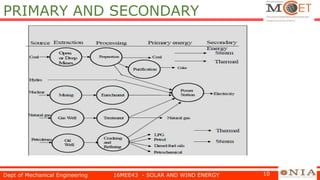
PRIMARY AND SECONDARY
Dept of Mechanical Engineering 16MEE43 - SOLAR AND WIND ENERGY 10
COMMERCIAL AND NON COMMERCIAL ENERGY
• COMMERCIAL ENERGY :
– Energy source that are available in market for definite
prices are known as Commercial energy.
– They forms the basis of industrial, agricultural, transport
and commercial development in the modern world .
– Eg : Electricity, lignite, coal, oil, natural gas
Dept of Mechanical Engineering 16MEE43 - SOLAR AND WIND ENERGY 11
• NON COMMERCIAL ENERGY:
– The energy sources that are not available in the commercial
market for a price are classified as non-commercial energy.
– Eg: Firewood, agro waste in rural areas; solar energy for
water heating, electricity generation, for drying grain, fish
and fruits; animal power for transport, threshing, lifting
water for irrigation, crushing sugarcane.
Dept of Mechanical Engineering 16MEE43 - SOLAR AND WIND ENERGY 12
COMMERCIAL AND NON COMMERCIAL ENERGY
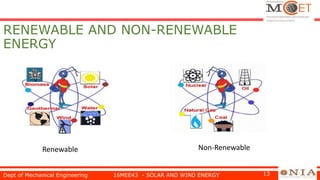
RENEWABLE AND NON-RENEWABLE
ENERGY
Dept of Mechanical Engineering 16MEE43 - SOLAR AND WIND ENERGY 13
Renewable Non-Renewable
GLOBAL ENERGY RESERVES
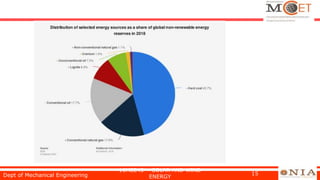
Coal :
– Global coal reserve was estimated to be 1.1 trillion tonnes of
proven coal reserves worldwide.
– The USA had the largest share of the global reserve (25.4%)
followed by Russia (15.9%), China (11.6%) ,India (8.6%).
Oil :
– British oil company (BP) estimated that the world had 1.73
trillion barrels of oil reserves as of 2018, which would be
sufficient to meet 50 years of global production at 2018 levels.
– Saudi Arabia had the largest share of the reserve with almost
23%.
Gas :
– As of January 1, 2019, there were an estimated 7,177 trillion
cubic feet (Tcf) of total world proved reserves of gross natural
gas.
– The Russian Federation had the largest share of the reserve with
almost 27%.
Dept of Mechanical Engineering 16MEE43 - SOLAR AND WIND ENERGY 14
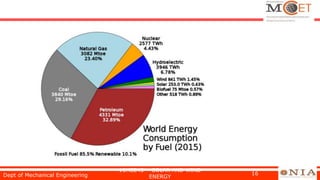
Dept of Mechanical Engineering
16MEE43 - SOLAR AND WIND
ENERGY
15
Dept of Mechanical Engineering
16MEE43 - SOLAR AND WIND
ENERGY
16
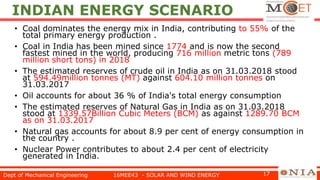
INDIAN ENERGY SCENARIO
• Coal dominates the energy mix in India, contributing to 55% of the
total primary energy production .
• Coal in India has been mined since 1774 and is now the second
fastest mined in the world, producing 716 million metric tons (789
million short tons) in 2018
• The estimated reserves of crude oil in India as on 31.03.2018 stood
at 594.49million tonnes (MT) against 604.10 million tonnes on
31.03.2017
• Oil accounts for about 36 % of India's total energy consumption
• The estimated reserves of Natural Gas in India as on 31.03.2018
stood at 1339.57Billion Cubic Meters (BCM) as against 1289.70 BCM
as on 31.03.2017
• Natural gas accounts for about 8.9 per cent of energy consumption in
the country .
• Nuclear Power contributes to about 2.4 per cent of electricity
generated in India.
Dept of Mechanical Engineering 16MEE43 - SOLAR AND WIND ENERGY 17
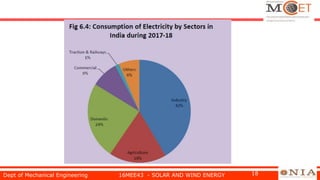
Dept of Mechanical Engineering 16MEE43 - SOLAR AND WIND ENERGY 18
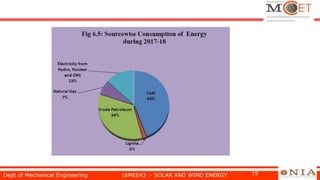
Dept of Mechanical Engineering 16MEE43 - SOLAR AND WIND ENERGY 19
ENERGY NEEDS OF GROWING ECONOMY
• Economic growth is desirable for developing countries, and
energy is essential for economic growth.
• For example, under present conditions, 6% increase in India's
Gross Domestic Product (GDP) would impose an increased
demand of 9 % on its energy sector.
• The ratio of energy demand to GDP is a useful indicator
• A high ratio reflects energy dependence and a strong influence
of energy on GDP growth.
• Energy intensity is energy consumption per unit of GDP. Energy
intensity indicates the development stage of the country.
• India’s energy intensity is 3.7 times of Japan, 1.55 times of
USA, 1.47 times of Asia and 1.5 times of World average.
Dept of Mechanical Engineering 16MEE43 - SOLAR AND WIND ENERGY 20
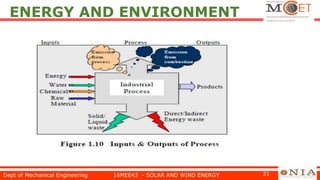
ENERGY AND ENVIRONMENT
Dept of Mechanical Engineering 16MEE43 - SOLAR AND WIND ENERGY 21
• The usage of energy resources in industry leads to
environmental damages by polluting the atmosphere.
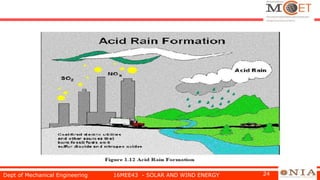
• Few of examples of air pollution are sulphur dioxide (SO2),
nitrous oxide (NOX) and carbon monoxide (CO) emissions
from boilers and furnaces
• Chloro-fluro carbons (CFC) emissions from refrigerants use.
• In chemical and fertilizers industries, toxic gases are
released.
• Cement plants and power plants spew out particulate
matter.
Dept of Mechanical Engineering 16MEE43 - SOLAR AND WIND ENERGY 22
Various Pollutant
• Sulphur dioxide
• Nitrogen oxides
• Carbon monoxide (CO)
• Ground-level ozone (O3)
• Hydrocarbons
• Benzene
• Heavy Metals and Lead
Dept of Mechanical Engineering 16MEE43 - SOLAR AND WIND ENERGY 23
Dept of Mechanical Engineering 16MEE43 - SOLAR AND WIND ENERGY 24
ENERGY SECURITY
• The basic aim of energy security for a nation is to reduce its
dependency on the imported energy sources for its economic
growth.
• India will continue to experience an energy supply shortfall
throughout the forecast period. This gap has widened since
1985, when the country became a net importer of coal.
• Rising oil demand of close to 10 percent per year has led to
sizable oil import bills.
Dept of Mechanical Engineering 16MEE43 - SOLAR AND WIND ENERGY 25
• Some of the strategies that can be used to meet future
challenges to their energy security are
 Diversification of energy supply sources
 Increased capacity of fuel switching
 Development of renewable energy sources.
 Energy efficiency
 Sustainable development
Dept of Mechanical Engineering 16MEE43 - SOLAR AND WIND ENERGY 26

SWE_L1_S1 New.ppt

  • 1.
    16MEE43 SOLAR AND WINDENERGY Online Lecture-1 Dept of Mechanical Engineering 16MEE43 - SOLAR AND WIND ENERGY 1 BHARATHIRAJA R ASSISTANT PROFESSOR [MECH] Dr.Mahalingam College of Engineering & Technology - Pollachi
  • 2.
    Dept of MechanicalEngineering 16MEE43 - SOLAR AND WIND ENERGY 2 Course Type : Elective Course Categories : Mastery Courses Total Hours-45 IIIrd Year Mechanical Engineering [2018-2022 Batch]
  • 3.
    Text Books 1. SolarEnergy, S.P.Sukhatme and J.K.Nayak, McGraw Hill, Fourth Edition, 2017. 2. Solar Photovoltaics – Fundamentals, Technologies and Applications, Solanki C.S. PHI Publications, 2015. 3. Non-Conventional Energy Sources, G.D.Rai, Khanna Publishers, 2004. References 1. Wind Energy Engineering, Pramod Jain, McGraw Hill Education, New York, 2nd Edition, 2010Heinrich 2. H.W. “Industrial Accident Prevention” McGraw-Hill Company, New York, 1980 3. Wind Energy Explained-Theory, Design and Application, James F.Manwell, Jon G.Mc Gowan, Anthony L.Rogers, 2nd Edition, 2010. 4. Solar Energy Utilization, G.D.Rai, Khanna Publishers, 2004. Web References • http://www.icebookshop.com • http://nptel.ac.in/courses/112107143/40 Dept of Mechanical Engineering 16MEE43 - SOLAR AND WIND ENERGY 3
  • 4.
    About the Course •As climate change continues to affect our planet and fossil fuels become less profitable, renewable energy has emerged as the obvious answer to ecological sustainability. Despite its importance, solar power generation technologies are new to us. • This Course is designed with the objective of developing the skills of the students in tapping various sources of Renewable Energy including solar, wind etc. Dept of Mechanical Engineering 16MEE43 - SOLAR AND WIND ENERGY 4
  • 5.
    UNIT I SOLAR RADIATION Deptof Mechanical Engineering 16MEE43 - SOLAR AND WIND ENERGY 5
  • 6.
    Syllabus • Availability –Measurement and Estimation – Introduction to solar collectors – flat plate collectors and Concentrating collectors – Types, working principle and Performance – Solar Thermal storage – Sensible and latent heat storage systems. Dept of Mechanical Engineering 16MEE43 - SOLAR AND WIND ENERGY 6
  • 7.
    Learning Outcome 1 Explainthe importance of Solar Energy for Economic Development • Explain about the Energy Source and Scenario Dept of Mechanical Engineering 16MEE43 - SOLAR AND WIND ENERGY 7 Course Outcome Identify the availability of solar radiation in different places.
  • 8.
    INTRODUCTION • Energy isone of the major inputs for the economic development of any country . • In developing countries, the energy sector assumes a critical importance in view of the ever- increasing energy needs requiring huge investments to meet them . Dept of Mechanical Engineering 16MEE43 - SOLAR AND WIND ENERGY 8
  • 9.
    CLASSIFICATION • Primary andSecondary energy. • Commercial and Non commercial énergies. • Renewable and Non-Renewable energy. Dept of Mechanical Engineering 16MEE43 - SOLAR AND WIND ENERGY 9
  • 10.
    PRIMARY AND SECONDARY Deptof Mechanical Engineering 16MEE43 - SOLAR AND WIND ENERGY 10
  • 11.
    COMMERCIAL AND NONCOMMERCIAL ENERGY • COMMERCIAL ENERGY : – Energy source that are available in market for definite prices are known as Commercial energy. – They forms the basis of industrial, agricultural, transport and commercial development in the modern world . – Eg : Electricity, lignite, coal, oil, natural gas Dept of Mechanical Engineering 16MEE43 - SOLAR AND WIND ENERGY 11
  • 12.
    • NON COMMERCIALENERGY: – The energy sources that are not available in the commercial market for a price are classified as non-commercial energy. – Eg: Firewood, agro waste in rural areas; solar energy for water heating, electricity generation, for drying grain, fish and fruits; animal power for transport, threshing, lifting water for irrigation, crushing sugarcane. Dept of Mechanical Engineering 16MEE43 - SOLAR AND WIND ENERGY 12 COMMERCIAL AND NON COMMERCIAL ENERGY
  • 13.
    RENEWABLE AND NON-RENEWABLE ENERGY Deptof Mechanical Engineering 16MEE43 - SOLAR AND WIND ENERGY 13 Renewable Non-Renewable
  • 14.
    GLOBAL ENERGY RESERVES Coal: – Global coal reserve was estimated to be 1.1 trillion tonnes of proven coal reserves worldwide. – The USA had the largest share of the global reserve (25.4%) followed by Russia (15.9%), China (11.6%) ,India (8.6%). Oil : – British oil company (BP) estimated that the world had 1.73 trillion barrels of oil reserves as of 2018, which would be sufficient to meet 50 years of global production at 2018 levels. – Saudi Arabia had the largest share of the reserve with almost 23%. Gas : – As of January 1, 2019, there were an estimated 7,177 trillion cubic feet (Tcf) of total world proved reserves of gross natural gas. – The Russian Federation had the largest share of the reserve with almost 27%. Dept of Mechanical Engineering 16MEE43 - SOLAR AND WIND ENERGY 14
  • 15.
    Dept of MechanicalEngineering 16MEE43 - SOLAR AND WIND ENERGY 15
  • 16.
    Dept of MechanicalEngineering 16MEE43 - SOLAR AND WIND ENERGY 16
  • 17.
    INDIAN ENERGY SCENARIO •Coal dominates the energy mix in India, contributing to 55% of the total primary energy production . • Coal in India has been mined since 1774 and is now the second fastest mined in the world, producing 716 million metric tons (789 million short tons) in 2018 • The estimated reserves of crude oil in India as on 31.03.2018 stood at 594.49million tonnes (MT) against 604.10 million tonnes on 31.03.2017 • Oil accounts for about 36 % of India's total energy consumption • The estimated reserves of Natural Gas in India as on 31.03.2018 stood at 1339.57Billion Cubic Meters (BCM) as against 1289.70 BCM as on 31.03.2017 • Natural gas accounts for about 8.9 per cent of energy consumption in the country . • Nuclear Power contributes to about 2.4 per cent of electricity generated in India. Dept of Mechanical Engineering 16MEE43 - SOLAR AND WIND ENERGY 17
  • 18.
    Dept of MechanicalEngineering 16MEE43 - SOLAR AND WIND ENERGY 18
  • 19.
    Dept of MechanicalEngineering 16MEE43 - SOLAR AND WIND ENERGY 19
  • 20.
    ENERGY NEEDS OFGROWING ECONOMY • Economic growth is desirable for developing countries, and energy is essential for economic growth. • For example, under present conditions, 6% increase in India's Gross Domestic Product (GDP) would impose an increased demand of 9 % on its energy sector. • The ratio of energy demand to GDP is a useful indicator • A high ratio reflects energy dependence and a strong influence of energy on GDP growth. • Energy intensity is energy consumption per unit of GDP. Energy intensity indicates the development stage of the country. • India’s energy intensity is 3.7 times of Japan, 1.55 times of USA, 1.47 times of Asia and 1.5 times of World average. Dept of Mechanical Engineering 16MEE43 - SOLAR AND WIND ENERGY 20
  • 21.
    ENERGY AND ENVIRONMENT Deptof Mechanical Engineering 16MEE43 - SOLAR AND WIND ENERGY 21
  • 22.
    • The usageof energy resources in industry leads to environmental damages by polluting the atmosphere. • Few of examples of air pollution are sulphur dioxide (SO2), nitrous oxide (NOX) and carbon monoxide (CO) emissions from boilers and furnaces • Chloro-fluro carbons (CFC) emissions from refrigerants use. • In chemical and fertilizers industries, toxic gases are released. • Cement plants and power plants spew out particulate matter. Dept of Mechanical Engineering 16MEE43 - SOLAR AND WIND ENERGY 22
  • 23.
    Various Pollutant • Sulphurdioxide • Nitrogen oxides • Carbon monoxide (CO) • Ground-level ozone (O3) • Hydrocarbons • Benzene • Heavy Metals and Lead Dept of Mechanical Engineering 16MEE43 - SOLAR AND WIND ENERGY 23
  • 24.
    Dept of MechanicalEngineering 16MEE43 - SOLAR AND WIND ENERGY 24
  • 25.
    ENERGY SECURITY • Thebasic aim of energy security for a nation is to reduce its dependency on the imported energy sources for its economic growth. • India will continue to experience an energy supply shortfall throughout the forecast period. This gap has widened since 1985, when the country became a net importer of coal. • Rising oil demand of close to 10 percent per year has led to sizable oil import bills. Dept of Mechanical Engineering 16MEE43 - SOLAR AND WIND ENERGY 25
  • 26.
    • Some ofthe strategies that can be used to meet future challenges to their energy security are  Diversification of energy supply sources  Increased capacity of fuel switching  Development of renewable energy sources.  Energy efficiency  Sustainable development Dept of Mechanical Engineering 16MEE43 - SOLAR AND WIND ENERGY 26