Seminar on
“Photo-voltaic cells”
By
Chetan hiwase
Roll Number: 173510
1
PHOTO-VOLTAIC CELLS
2
INTRODUCTION
3
 Photovoltaics (PV) or solar cells are semiconductor
devices that convert sunlight into direct current (DC)
electricity.
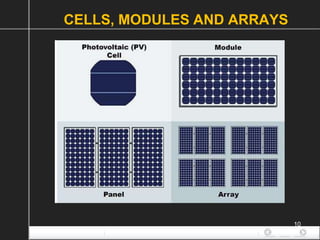
 Groups of PV cells are electrically configured into
modules and arrays, which can be used to charge
batteries, operate motors, and to power any number of
electrical loads.
 With the appropriate power conversion equipment, PV
systems can produce alternating current (AC)
compatible with any conventional appliances, and can
operate in parallel with, and interconnected to, the
utility grid
INTRODUCTION
4
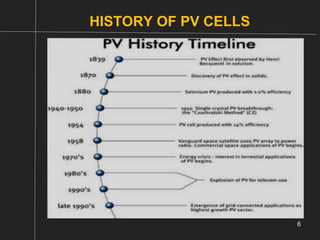
HISTORY OF PV CELLS
5
1960-1970:
Battery charging for navigational
aids
1950-1960:
Earth Orbiting Satellites
1980:
Consumer electronic devices
HISTORY OF PV CELLS
6
PV CELLS COST
7
8
Trend of growth in PV cells
Working of PV cells
9
CELLS, MODULES AND ARRAYS
10
TYPES OF PV CELLS
11
Made by using
crystalline solid solar
cells, developed from
micro electronics
technology industry
Mono crystalline PV
cells
Multi crystalline PV
cells
 Made by depositing one
or more thin photo
voltaic material on
substrate
 Amorphous silicon PV
cells
 Poly crystalline PV cells
12
Production of PV cells
from silicon-wafers
• Raw silicon wafer- pre-check - geometric
shape and thickness conformity and damages such as cracks,
breakages, scratches or other anomalities.
• Then the wafers are split and cleaned with industrial soaps to
remove any metal residues, liquids or other production
remains from the surface that would otherwise impact the
efficiency of that wafer.
13
Step 1: Pre-check and Pretreatment
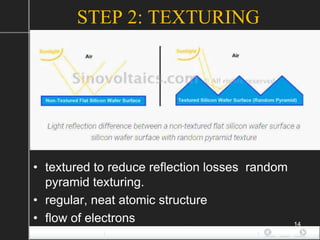
STEP 2: TEXTURING
• textured to reduce reflection losses random
pyramid texturing.
• regular, neat atomic structure
• flow of electrons 14
Step 3: Acid Cleaning
15
• acidic rinsing means remove the post texturing
particles which remains their.
• hydrogen flouride (HF) vapor
• hydrogen chloride (HCl)
Step 4: DIFFUSION
16
• Adding dopant so it is more electrically conductive.
• There are basically 2 methods of diffusion: solid state
Diffusion (p type, boron) and emitter diffusion.(Dopant
material-containing coating) by passing through
Diffusion coating furnace.
• The junction of electron deficiency in the p-type and
high electron concentration in the n-type allows for
excess electrons from the n-type to pass to the p-type,
a flow creating an electron field at the junction.
Step 5: Etching & Edge Isolation
17
• The n-type phosphorous diffuses not only into the
desired wafer surface but also around the edges of the
wafer as well as on the backside, creating an electrical
path between the front and back side and in this way also
preventing electrical isolation between the two sides.
•The objective of the etching and edge isolation process
is to remove this electrical path.
Step 6: Post-Etching Washing
18
• After the etching, particle residues potential remain on
the wafer and the wafer edges. Therefore the wafers
need to undergo a second washing to remove remains of
the previous etching process.
•After this second washing, the wafers can further be
processed for the deposition of anti-reflective (AR)
coating.
Step 7: Anti-Reflective Coating Deposition
19
• Anti-Reflective Coating reduce reflection and increase
the amount of light absorbed into the cell.
•Anti-Reflective Coating silicon nitride (Si3N4) or titanium
oxide (TiO2) is used.
•The colour of the solar cell can be changed by varying
the thickness of the anti reflection coating.
Step 8: Contact Printing and Drying
20
• metal inlines are printed on the wafer with the objective
to create ohmic contacts. These metal inlines are printed
on the rear side of the wafer, which is called backside
printing.
• The wafer undergoes a drying process.
•After all contacts have been printed on the rear and front
sides, the screen-printed wafers are passed through
a sintering furnace to solidify the dry metal pastes onto
the wafers. Then, the wafers are cooled.
Step 9: Testing and Cell Sorting
21
In this final process, the now ready-to-assemble solar
cells are tested under simulated sunlight conditions and
then classified and sorted according to their efficiencies.
This is handled by a solar cell testing device that
automatically tests and sorts the cells.
THANK YOU
22

Renewable

  • 1.
  • 2.
  • 3.
    INTRODUCTION 3  Photovoltaics (PV)or solar cells are semiconductor devices that convert sunlight into direct current (DC) electricity.  Groups of PV cells are electrically configured into modules and arrays, which can be used to charge batteries, operate motors, and to power any number of electrical loads.  With the appropriate power conversion equipment, PV systems can produce alternating current (AC) compatible with any conventional appliances, and can operate in parallel with, and interconnected to, the utility grid
  • 4.
  • 5.
    HISTORY OF PVCELLS 5 1960-1970: Battery charging for navigational aids 1950-1960: Earth Orbiting Satellites 1980: Consumer electronic devices
  • 6.
  • 7.
  • 8.
    8 Trend of growthin PV cells
  • 9.
  • 10.
  • 11.
    TYPES OF PVCELLS 11 Made by using crystalline solid solar cells, developed from micro electronics technology industry Mono crystalline PV cells Multi crystalline PV cells  Made by depositing one or more thin photo voltaic material on substrate  Amorphous silicon PV cells  Poly crystalline PV cells
  • 12.
    12 Production of PVcells from silicon-wafers
  • 13.
    • Raw siliconwafer- pre-check - geometric shape and thickness conformity and damages such as cracks, breakages, scratches or other anomalities. • Then the wafers are split and cleaned with industrial soaps to remove any metal residues, liquids or other production remains from the surface that would otherwise impact the efficiency of that wafer. 13 Step 1: Pre-check and Pretreatment
  • 14.
    STEP 2: TEXTURING •textured to reduce reflection losses random pyramid texturing. • regular, neat atomic structure • flow of electrons 14
  • 15.
    Step 3: AcidCleaning 15 • acidic rinsing means remove the post texturing particles which remains their. • hydrogen flouride (HF) vapor • hydrogen chloride (HCl)
  • 16.
    Step 4: DIFFUSION 16 •Adding dopant so it is more electrically conductive. • There are basically 2 methods of diffusion: solid state Diffusion (p type, boron) and emitter diffusion.(Dopant material-containing coating) by passing through Diffusion coating furnace. • The junction of electron deficiency in the p-type and high electron concentration in the n-type allows for excess electrons from the n-type to pass to the p-type, a flow creating an electron field at the junction.
  • 17.
    Step 5: Etching& Edge Isolation 17 • The n-type phosphorous diffuses not only into the desired wafer surface but also around the edges of the wafer as well as on the backside, creating an electrical path between the front and back side and in this way also preventing electrical isolation between the two sides. •The objective of the etching and edge isolation process is to remove this electrical path.
  • 18.
    Step 6: Post-EtchingWashing 18 • After the etching, particle residues potential remain on the wafer and the wafer edges. Therefore the wafers need to undergo a second washing to remove remains of the previous etching process. •After this second washing, the wafers can further be processed for the deposition of anti-reflective (AR) coating.
  • 19.
    Step 7: Anti-ReflectiveCoating Deposition 19 • Anti-Reflective Coating reduce reflection and increase the amount of light absorbed into the cell. •Anti-Reflective Coating silicon nitride (Si3N4) or titanium oxide (TiO2) is used. •The colour of the solar cell can be changed by varying the thickness of the anti reflection coating.
  • 20.
    Step 8: ContactPrinting and Drying 20 • metal inlines are printed on the wafer with the objective to create ohmic contacts. These metal inlines are printed on the rear side of the wafer, which is called backside printing. • The wafer undergoes a drying process. •After all contacts have been printed on the rear and front sides, the screen-printed wafers are passed through a sintering furnace to solidify the dry metal pastes onto the wafers. Then, the wafers are cooled.
  • 21.
    Step 9: Testingand Cell Sorting 21 In this final process, the now ready-to-assemble solar cells are tested under simulated sunlight conditions and then classified and sorted according to their efficiencies. This is handled by a solar cell testing device that automatically tests and sorts the cells.
  • 22.

Editor's Notes

  • #15  S-EMS produces a stirring force that pushes the liquid steel horizontally along the cast product width and generates a butterfly type flow pattern in the liquid steel. When S-EMS can be placed behind the support rollers (Fig. 2 ) then it is not dependent on a minimum support roller diameter and hence in this case can be optimally placed along the strand from the metallurgical point of view. S – EMS when built into the support rollers requires a minimum roller diameter to include the iron core and windings. In this case the stirrer is placed at a distance from the meniscus and hence is less effective. S -EMS operates at low frequency to ensure good penetration of the stirrer force through the strand. As a result the liquid steel has transverse stirring as shown in Fig 2. S –EMS is usually used in combination with M – EMS. S – EMS can be of either linear or rotary type stirrer. Most common is the linear stirrer, which is easy to install and protect against heat radiation and possible breakouts. S-EMS promotes the formation of equiaxed structure. It promotes grain refinement in the cast product and reduces the shrinkage cavity, centre segregation and internal cracks. It also removes superheat effectively.