Renal involvement with
infective endocarditis
Riyad Abusrewil
Supervisor John Nel
Department of nephrology
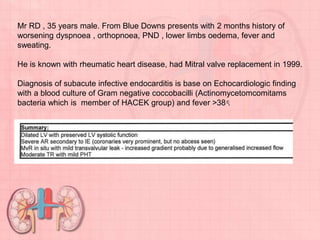
Mr RD , 35 years male. From Blue Downs presents with 2 months history of
worsening dyspnoea , orthopnoea, PND , lower limbs oedema, fever and
sweating.
He is known with rheumatic heart disease, had Mitral valve replacement in 1999.
Diagnosis of subacute infective endocarditis is base on Echocardiologic finding
with a blood culture of Gram negative coccobacilli (Actinomycetomcomitams
bacteria which is member of HACEK group) and fever >38 ͨ.
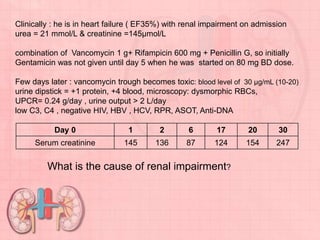
Clinically : he is in heart failure ( EF35%) with renal impairment on admission
urea = 21 mmol/L & creatinine =145μmol/L
combination of Vancomycin 1 g+ Rifampicin 600 mg + Penicillin G, so initially
Gentamicin was not given until day 5 when he was started on 80 mg BD dose.
Few days later : vancomycin trough becomes toxic: blood level of 30 μg/mL (10-20)
urine dipstick = +1 protein, +4 blood, microscopy: dysmorphic RBCs,
UPCR= 0.24 g/day , urine output > 2 L/day
low C3, C4 , negative HIV, HBV , HCV, RPR, ASOT, Anti-DNA
What is the cause of renal impairment?
Day 0 1 2 6 17 20 30
Serum creatinine 145 136 87 124 154 247
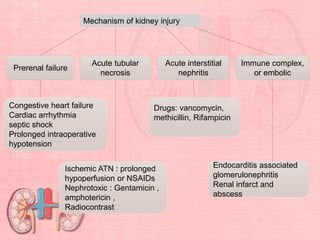
Prerenal failure
Acute tubular
necrosis
Acute interstitial
nephritis
Immune complex,
or embolic
Congestive heart failure
Cardiac arrhythmia
septic shock
Prolonged intraoperative
hypotension
Ischemic ATN : prolonged
hypoperfusion or NSAIDs
Nephrotoxic : Gentamicin ,
amphotericin ,
Radiocontrast
Mechanism of kidney injury
Drugs: vancomycin,
methicillin, Rifampicin
Endocarditis associated
glomerulonephritis
Renal infarct and
abscess
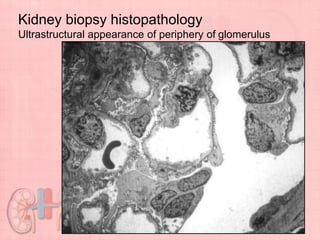
Kidney biopsy histopathology
Ultrastructural appearance of periphery of glomerulus
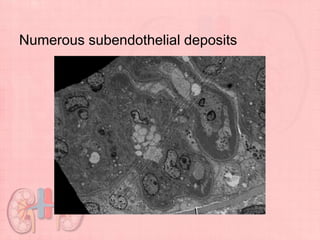
Numerous subendothelial deposits
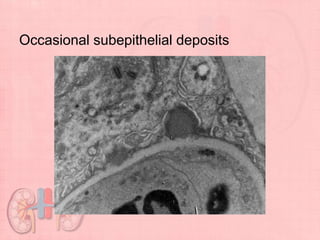
Occasional subepithelial deposits
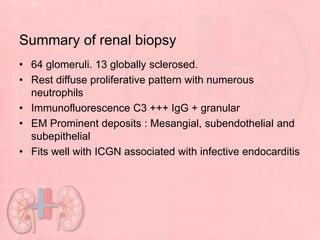
Summary of renal biopsy
• 64 glomeruli. 13 globally sclerosed.
• Rest diffuse proliferative pattern with numerous
neutrophils
• Immunofluorescence C3 +++ IgG + granular
• EM Prominent deposits : Mesangial, subendothelial and
subepithelial
• Fits well with ICGN associated with infective endocarditis
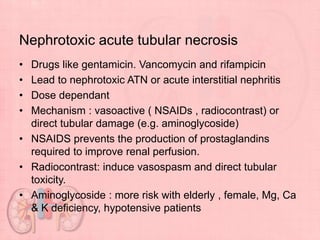
Nephrotoxic acute tubular necrosis
• Drugs like gentamicin. Vancomycin and rifampicin
• Lead to nephrotoxic ATN or acute interstitial nephritis
• Dose dependant
• Mechanism : vasoactive ( NSAIDs , radiocontrast) or
direct tubular damage (e.g. aminoglycoside)
• NSAIDS prevents the production of prostaglandins
required to improve renal perfusion.
• Radiocontrast: induce vasospasm and direct tubular
toxicity.
• Aminoglycoside : more risk with elderly , female, Mg, Ca
& K deficiency, hypotensive patients
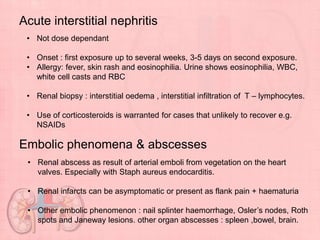
Acute interstitial nephritis
• Not dose dependant
• Onset : first exposure up to several weeks, 3-5 days on second exposure.
• Allergy: fever, skin rash and eosinophilia. Urine shows eosinophilia, WBC,
white cell casts and RBC
• Renal biopsy : interstitial oedema , interstitial infiltration of T – lymphocytes.
• Use of corticosteroids is warranted for cases that unlikely to recover e.g.
NSAIDs
Embolic phenomena & abscesses
• Renal abscess as result of arterial emboli from vegetation on the heart
valves. Especially with Staph aureus endocarditis.
• Renal infarcts can be asymptomatic or present as flank pain + haematuria
• Other embolic phenomenon : nail splinter haemorrhage, Osler’s nodes, Roth
spots and Janeway lesions. other organ abscesses : spleen ,bowel, brain.
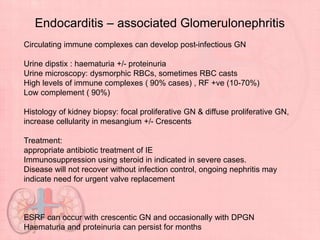
Endocarditis – associated Glomerulonephritis
Circulating immune complexes can develop post-infectious GN
Urine dipstix : haematuria +/- proteinuria
Urine microscopy: dysmorphic RBCs, sometimes RBC casts
High levels of immune complexes ( 90% cases) , RF +ve (10-70%)
Low complement ( 90%)
Histology of kidney biopsy: focal proliferative GN & diffuse proliferative GN,
increase cellularity in mesangium +/- Crescents
Treatment:
appropriate antibiotic treatment of IE
Immunosuppression using steroid in indicated in severe cases.
Disease will not recover without infection control, ongoing nephritis may
indicate need for urgent valve replacement
ESRF can occur with crescentic GN and occasionally with DPGN
Haematuria and proteinuria can persist for months
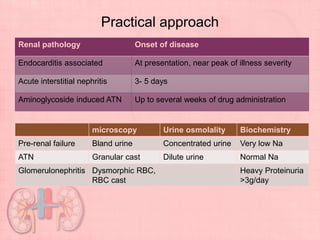
Practical approach
Renal pathology Onset of disease
Endocarditis associated At presentation, near peak of illness severity
Acute interstitial nephritis 3- 5 days
Aminoglycoside induced ATN Up to several weeks of drug administration
microscopy Urine osmolality Biochemistry
Pre-renal failure Bland urine Concentrated urine Very low Na
ATN Granular cast Dilute urine Normal Na
Glomerulonephritis Dysmorphic RBC,
RBC cast
Heavy Proteinuria
>3g/day
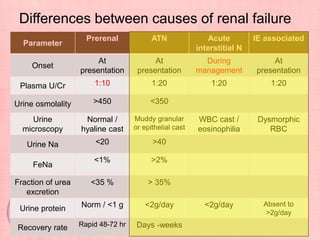
Parameter
Prerenal ATN Acute
interstitial N
IE associated
Onset
At
presentation
At
presentation
During
management
At
presentation
Plasma U/Cr 1:10 1:20 1:20 1:20
Urine osmolality >450 <350
Urine
microscopy
Normal /
hyaline cast
Muddy granular
or epithelial cast
WBC cast /
eosinophilia
Dysmorphic
RBC
Urine Na <20 >40
FeNa
<1% >2%
Fraction of urea
excretion
<35 % > 35%
Urine protein Norm / <1 g <2g/day <2g/day Absent to
>2g/day
Recovery rate Rapid 48-72 hr Days -weeks
Differences between causes of renal failure
Thank you
Reference
1. An insight into renal disease associated with infective
endocarditis; A.B Adeniyi, J.D.Nel. SA heart journal.
vol.4.3.2007
2. Davidson’s principles and practice of medicine , 22nd edition.
3. SAMF 11th edition

Renal involvement with infective endocarditis

  • 1.
    Renal involvement with infectiveendocarditis Riyad Abusrewil Supervisor John Nel Department of nephrology
  • 2.
    Mr RD ,35 years male. From Blue Downs presents with 2 months history of worsening dyspnoea , orthopnoea, PND , lower limbs oedema, fever and sweating. He is known with rheumatic heart disease, had Mitral valve replacement in 1999. Diagnosis of subacute infective endocarditis is base on Echocardiologic finding with a blood culture of Gram negative coccobacilli (Actinomycetomcomitams bacteria which is member of HACEK group) and fever >38 ͨ.
  • 3.
    Clinically : heis in heart failure ( EF35%) with renal impairment on admission urea = 21 mmol/L & creatinine =145μmol/L combination of Vancomycin 1 g+ Rifampicin 600 mg + Penicillin G, so initially Gentamicin was not given until day 5 when he was started on 80 mg BD dose. Few days later : vancomycin trough becomes toxic: blood level of 30 μg/mL (10-20) urine dipstick = +1 protein, +4 blood, microscopy: dysmorphic RBCs, UPCR= 0.24 g/day , urine output > 2 L/day low C3, C4 , negative HIV, HBV , HCV, RPR, ASOT, Anti-DNA What is the cause of renal impairment? Day 0 1 2 6 17 20 30 Serum creatinine 145 136 87 124 154 247
  • 4.
    Prerenal failure Acute tubular necrosis Acuteinterstitial nephritis Immune complex, or embolic Congestive heart failure Cardiac arrhythmia septic shock Prolonged intraoperative hypotension Ischemic ATN : prolonged hypoperfusion or NSAIDs Nephrotoxic : Gentamicin , amphotericin , Radiocontrast Mechanism of kidney injury Drugs: vancomycin, methicillin, Rifampicin Endocarditis associated glomerulonephritis Renal infarct and abscess
  • 5.
    Kidney biopsy histopathology Ultrastructuralappearance of periphery of glomerulus
  • 6.
  • 7.
  • 8.
    Summary of renalbiopsy • 64 glomeruli. 13 globally sclerosed. • Rest diffuse proliferative pattern with numerous neutrophils • Immunofluorescence C3 +++ IgG + granular • EM Prominent deposits : Mesangial, subendothelial and subepithelial • Fits well with ICGN associated with infective endocarditis
  • 9.
    Nephrotoxic acute tubularnecrosis • Drugs like gentamicin. Vancomycin and rifampicin • Lead to nephrotoxic ATN or acute interstitial nephritis • Dose dependant • Mechanism : vasoactive ( NSAIDs , radiocontrast) or direct tubular damage (e.g. aminoglycoside) • NSAIDS prevents the production of prostaglandins required to improve renal perfusion. • Radiocontrast: induce vasospasm and direct tubular toxicity. • Aminoglycoside : more risk with elderly , female, Mg, Ca & K deficiency, hypotensive patients
  • 10.
    Acute interstitial nephritis •Not dose dependant • Onset : first exposure up to several weeks, 3-5 days on second exposure. • Allergy: fever, skin rash and eosinophilia. Urine shows eosinophilia, WBC, white cell casts and RBC • Renal biopsy : interstitial oedema , interstitial infiltration of T – lymphocytes. • Use of corticosteroids is warranted for cases that unlikely to recover e.g. NSAIDs Embolic phenomena & abscesses • Renal abscess as result of arterial emboli from vegetation on the heart valves. Especially with Staph aureus endocarditis. • Renal infarcts can be asymptomatic or present as flank pain + haematuria • Other embolic phenomenon : nail splinter haemorrhage, Osler’s nodes, Roth spots and Janeway lesions. other organ abscesses : spleen ,bowel, brain.
  • 11.
    Endocarditis – associatedGlomerulonephritis Circulating immune complexes can develop post-infectious GN Urine dipstix : haematuria +/- proteinuria Urine microscopy: dysmorphic RBCs, sometimes RBC casts High levels of immune complexes ( 90% cases) , RF +ve (10-70%) Low complement ( 90%) Histology of kidney biopsy: focal proliferative GN & diffuse proliferative GN, increase cellularity in mesangium +/- Crescents Treatment: appropriate antibiotic treatment of IE Immunosuppression using steroid in indicated in severe cases. Disease will not recover without infection control, ongoing nephritis may indicate need for urgent valve replacement ESRF can occur with crescentic GN and occasionally with DPGN Haematuria and proteinuria can persist for months
  • 12.
    Practical approach Renal pathologyOnset of disease Endocarditis associated At presentation, near peak of illness severity Acute interstitial nephritis 3- 5 days Aminoglycoside induced ATN Up to several weeks of drug administration microscopy Urine osmolality Biochemistry Pre-renal failure Bland urine Concentrated urine Very low Na ATN Granular cast Dilute urine Normal Na Glomerulonephritis Dysmorphic RBC, RBC cast Heavy Proteinuria >3g/day
  • 13.
    Parameter Prerenal ATN Acute interstitialN IE associated Onset At presentation At presentation During management At presentation Plasma U/Cr 1:10 1:20 1:20 1:20 Urine osmolality >450 <350 Urine microscopy Normal / hyaline cast Muddy granular or epithelial cast WBC cast / eosinophilia Dysmorphic RBC Urine Na <20 >40 FeNa <1% >2% Fraction of urea excretion <35 % > 35% Urine protein Norm / <1 g <2g/day <2g/day Absent to >2g/day Recovery rate Rapid 48-72 hr Days -weeks Differences between causes of renal failure
  • 14.
    Thank you Reference 1. Aninsight into renal disease associated with infective endocarditis; A.B Adeniyi, J.D.Nel. SA heart journal. vol.4.3.2007 2. Davidson’s principles and practice of medicine , 22nd edition. 3. SAMF 11th edition