Noon Conference
Di Yan
08/16/2018
© 2016 Virginia Mason Medical Center 2
Objectives
Glomerular causes of hematuria
• Definitions and initial approach
• Further workup and differential diagnosis
• ANCA associated GN
• Review illness script
• Discuss treatment
© 2016 Virginia Mason Medical Center
Definition of hematuria
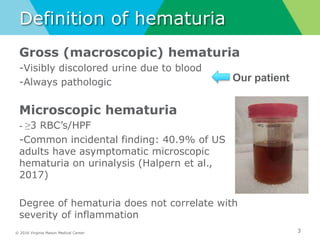
Gross (macroscopic) hematuria
-Visibly discolored urine due to blood
-Always pathologic
Microscopic hematuria
- ≥3 RBC’s/HPF
-Common incidental finding: 40.9% of US
adults have asymptomatic microscopic
hematuria on urinalysis (Halpern et al.,
2017)
Degree of hematuria does not correlate with
severity of inflammation
3
Our patient
© 2016 Virginia Mason Medical Center
-Vigorous exercise
-Viral illness
-Trauma
-Sexual activity
Causes of hematuria
4
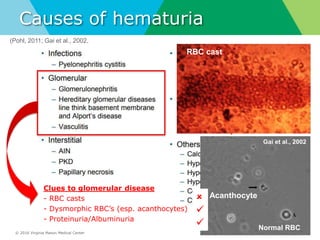
Clues to glomerular disease
- RBC casts
- Dysmorphic RBC’s (esp. acanthocytes)
- Proteinuria/Albuminuria
RBC cast
Acanthocyte

 Normal RBC
Gai et al., 2002
(Pohl, 2011; Gai et al., 2002,
© 2016 Virginia Mason Medical Center
Sensitivity and specificity for
glomerular disease
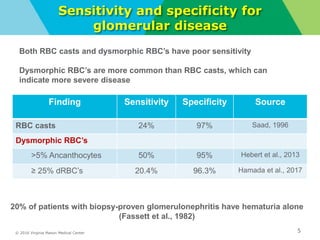
Finding Sensitivity Specificity Source
RBC casts 24% 97% Saad, 1996
Dysmorphic RBC’s
>5% Ancanthocytes 50% 95% Hebert et al., 2013
≥ 25% dRBC’s 20.4% 96.3% Hamada et al., 2017
5
20% of patients with biopsy-proven glomerulonephritis have hematuria alone
(Fassett et al., 1982)
Both RBC casts and dysmorphic RBC’s have poor sensitivity
Dysmorphic RBC’s are more common than RBC casts, which can
indicate more severe disease
© 2016 Virginia Mason Medical Center
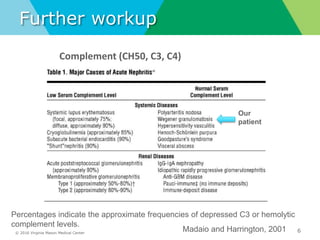
Further workup
6
Complement (CH50, C3, C4)
ANCA
Our
patient
Madaio and Harrington, 2001
Percentages indicate the approximate frequencies of depressed C3 or hemolytic
complement levels.
© 2016 Virginia Mason Medical Center
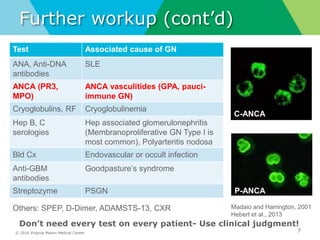
Further workup (cont’d)
7
Test Associated cause of GN
ANA, Anti-DNA
antibodies
SLE
ANCA (PR3,
MPO)
ANCA vasculitides (GPA, pauci-
immune GN)
Cryoglobulins, RF Cryoglobulinemia
Hep B, C
serologies
Hep associated glomerulonephritis
(Membranoproliferative GN Type I is
most common), Polyarteritis nodosa
Bld Cx Endovascular or occult infection
Anti-GBM
antibodies
Goodpasture’s syndrome
Streptozyme PSGN
Don’t need every test on every patient- Use clinical judgment!
C-ANCA
P-ANCA
Madaio and Harrington, 2001
Hebert et al., 2013
Others: SPEP, D-Dimer, ADAMSTS-13, CXR
© 2016 Virginia Mason Medical Center
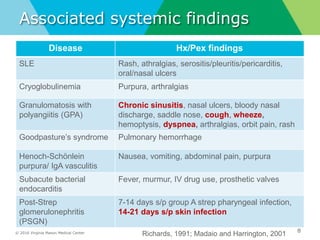
Associated systemic findings
8
Disease Hx/Pex findings
SLE Rash, athralgias, serositis/pleuritis/pericarditis,
oral/nasal ulcers
Cryoglobulinemia Purpura, arthralgias
Granulomatosis with
polyangiitis (GPA)
Chronic sinusitis, nasal ulcers, bloody nasal
discharge, saddle nose, cough, wheeze,
hemoptysis, dyspnea, arthralgias, orbit pain, rash
Goodpasture’s syndrome Pulmonary hemorrhage
Henoch-Schönlein
purpura/ IgA vasculitis
Nausea, vomiting, abdominal pain, purpura
Subacute bacterial
endocarditis
Fever, murmur, IV drug use, prosthetic valves
Post-Strep
glomerulonephritis
(PSGN)
7-14 days s/p group A strep pharyngeal infection,
14-21 days s/p skin infection
Richards, 1991; Madaio and Harrington, 2001
© 2016 Virginia Mason Medical Center
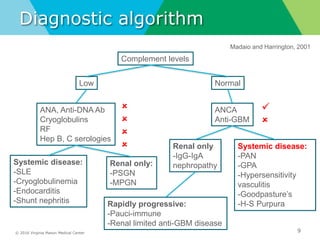
Diagnostic algorithm
9
Madaio and Harrington, 2001
Complement levels
NormalLow
ANA, Anti-DNA Ab
Cryoglobulins
RF
Hep B, C serologies
ANCA
Anti-GBM
Renal only:
-PSGN
-MPGN
Renal only
-IgG-IgA
nephropathySystemic disease:
-SLE
-Cryoglobulinemia
-Endocarditis
-Shunt nephritis
Systemic disease:
-PAN
-GPA
-Hypersensitivity
vasculitis
-Goodpasture’s
-H-S PurpuraRapidly progressive:
-Pauci-immune
-Renal limited anti-GBM disease






© 2016 Virginia Mason Medical Center
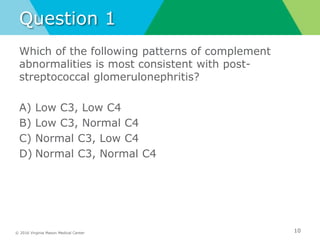
Question 1
Which of the following patterns of complement
abnormalities is most consistent with post-
streptococcal glomerulonephritis?
A) Low C3, Low C4
B) Low C3, Normal C4
C) Normal C3, Low C4
D) Normal C3, Normal C4
10
© 2016 Virginia Mason Medical Center
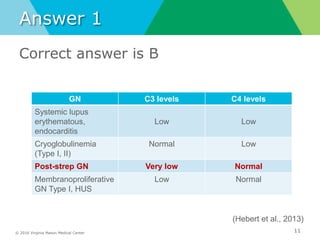
Answer 1
Correct answer is B
11
GN C3 levels C4 levels
Systemic lupus
erythematous,
endocarditis
Low Low
Cryoglobulinemia
(Type I, II)
Normal Low
Post-strep GN Very low Normal
Membranoproliferative
GN Type I, HUS
Low Normal
(Hebert et al., 2013)
© 2016 Virginia Mason Medical Center
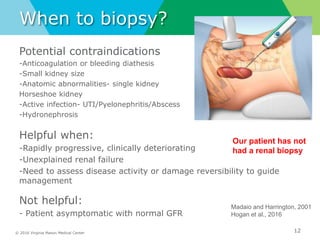
When to biopsy?
Potential contraindications
-Anticoagulation or bleeding diathesis
-Small kidney size
-Anatomic abnormalities- single kidney
Horseshoe kidney
-Active infection- UTI/Pyelonephritis/Abscess
-Hydronephrosis
Helpful when:
-Rapidly progressive, clinically deteriorating
-Unexplained renal failure
-Need to assess disease activity or damage reversibility to guide
management
Not helpful:
- Patient asymptomatic with normal GFR
12
Madaio and Harrington, 2001
Hogan et al., 2016
Our patient has not
had a renal biopsy
© 2016 Virginia Mason Medical Center
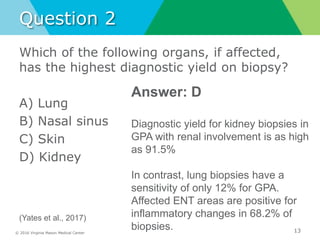
Question 2
Which of the following organs, if affected,
has the highest diagnostic yield on biopsy?
A) Lung
B) Nasal sinus
C) Skin
D) Kidney
13
Answer: D
Diagnostic yield for kidney biopsies in
GPA with renal involvement is as high
as 91.5%
In contrast, lung biopsies have a
sensitivity of only 12% for GPA.
Affected ENT areas are positive for
inflammatory changes in 68.2% of
biopsies.
(Yates et al., 2017)
© 2016 Virginia Mason Medical Center
ANCA associated GN
14
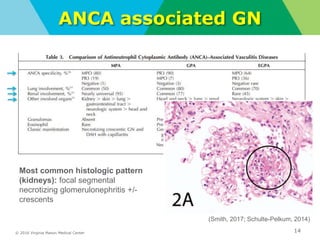
Most common histologic pattern
(kidneys): focal segmental
necrotizing glomerulonephritis +/-
crescents
(Smith, 2017; Schulte-Pelkum, 2014)
© 2016 Virginia Mason Medical Center
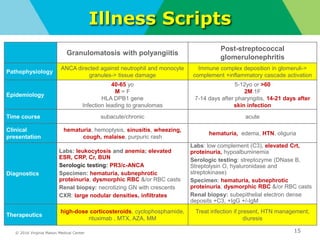
Illness Scripts
15
Granulomatosis with polyangiitis
Post-streptococcal
glomerulonephritis
Pathophysiology
ANCA directed against neutrophil and monocyte
granules-> tissue damage
Immune complex deposition in glomeruli->
complement +inflammatory cascade activation
Epidemiology
40-65 yo
M = F
HLA DPB1 gene
Infection leading to granulomas
5-12yo or >60
2M:1F
7-14 days after pharyngitis, 14-21 days after
skin infection
Time course subacute/chronic acute
Clinical
presentation
hematuria, hemoptysis, sinusitis, wheezing,
cough, malaise, purpuric rash
hematuria, edema, HTN, oliguria
Diagnostics
Labs: leukocytosis and anemia; elevated
ESR, CRP, Cr, BUN
Serologic testing: PR3/c-ANCA
Specimen: hematuria, subnephrotic
proteinuria, dysmorphic RBC &/or RBC casts
Renal biopsy: necrotizing GN with crescents
CXR: large nodular densities, infiltrates
Labs: low complement (C3), elevated Crt,
proteinuria, hypoalbuminemia
Serologic testing: streptozyme (DNase B,
Streptolysin O, hyaluronidase and
streptokinase)
Specimen: hematuria, subnephrotic
proteinuria, dysmorphic RBC &/or RBC casts
Renal biopsy: subepithelial electron dense
deposits +C3, +IgG +/-IgM
Therapeutics
high-dose corticosteroids, cyclophosphamide,
rituximab , MTX, AZA, MM
Treat infection if present, HTN management,
diuresis
© 2016 Virginia Mason Medical Center
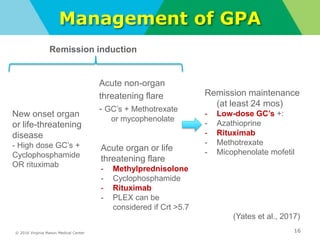
Management of GPA
Acute non-organ
threatening flare
- GC’s + Methotrexate
or mycophenolate
16
(Yates et al., 2017)
Remission maintenance
(at least 24 mos)
- Low-dose GC’s +:
- Azathioprine
- Rituximab
- Methotrexate
- Micophenolate mofetilAcute organ or life
threatening flare
- Methylprednisolone
- Cyclophosphamide
- Rituximab
- PLEX can be
considered if Crt >5.7
New onset organ
or life-threatening
disease
- High dose GC’s +
Cyclophosphamide
OR rituximab
Remission induction
© 2016 Virginia Mason Medical Center
Acknowledgements
Thank you Dr. Cyrus Cryst!
17
© 2016 Virginia Mason Medical Center
Literature cited
1. Fassett RG, Horgan BA, Mathew TH. Detection of glomerular bleeding by phase-contrast microscopy. Lancet (London,
England). 1982;1(8287):1432-1434.
2. Gai M, Piccoli GB, Jeantet A, Segoloni GP, Lanfranco G. About urinary erythrocyte dysmorphism. Nephrology, dialysis,
transplantation : official publication of the European Dialysis and Transplant Association - European Renal Association.
2002;17(8):1533.
3. Halpern JA, Chughtai B, Ghomrawi H. Cost-effectiveness of Common Diagnostic Approaches for Evaluation of
Asymptomatic Microscopic Hematuria. JAMA internal medicine. 2017;177(6):800-807.
4. Hamadah AM, Gharaibeh K, Mara KC, et al. Urinalysis for the diagnosis of glomerulonephritis: role of dysmorphic red
blood cells. Nephrology, dialysis, transplantation : official publication of the European Dialysis and Transplant Association -
European Renal Association. 2017.
5. Hebert LA, Parikh S, Prosek J, Nadasdy T, Rovin BH. Differential diagnosis of glomerular disease: a systematic and
inclusive approach. American journal of nephrology. 2013;38(3):253-266.
6. Hogan JJ, Mocanu M, Berns JS. The Native Kidney Biopsy: Update and Evidence for Best Practice. Clinical journal of
the American Society of Nephrology : CJASN. 2016;11(2):354-362.
7. Madaio MP, Harrington JT. The diagnosis of glomerular diseases: acute glomerulonephritis and the nephrotic
syndrome. Archives of internal medicine. 2001;161(1):25-34.
8. Pohl MA. Clinical Approach to the Clinical Approach to the Patient with Kidney Disease- Hematuria, Proteinuria,
Elevated Serum Creatinine and Diabetic Nephropathy. The Cleveland Clinic Foundation; 2011.
9. Richards J. Acute post-streptococcal glomerulonephritis. The West Virginia medical journal. 1991;87(2):61-65.
10. Saad TF. Images in clinical medicine. Dysmorphic urinary erythrocytes. The New England journal of medicine.
1996;334(22):1440.
11. Schulte-Pelkum J, Radice A, Norman GL, et al. Novel clinical and diagnostic aspects of antineutrophil cytoplasmic
antibodies. Journal of immunology research. 2014;2014:185416.
12. Smith ML. Pathology of Antineutrophil Cytoplasmic Antibody-Associated Pulmonary and Renal Disease. Archives of
pathology & laboratory medicine. 2017;141(2):223-231.
13. Tesser Poloni JA, Bosan IB, Garigali G, Fogazzi GB. Urinary red blood cells: not only glomerular or nonglomerular.
Nephron Clinical practice. 2012;120(1):c36-41; discussion c41.
14. van der Molen AJ, Hovius MC. Hematuria: a problem-based imaging algorithm illustrating the recent Dutch guidelines
on hematuria. AJR American journal of roentgenology. 2012;198(6):1256-1265.
15. Yates M, Watts R, Bajema I, et al. Validation of the EULAR/ERA-EDTA recommendations for the management of
ANCA-associated vasculitis by disease content experts. RMD open. 2017;3(1):e000449.
18
© 2016 Virginia Mason Medical Center 19

Noon conference 8-16

  • 1.
  • 2.
    © 2016 VirginiaMason Medical Center 2 Objectives Glomerular causes of hematuria • Definitions and initial approach • Further workup and differential diagnosis • ANCA associated GN • Review illness script • Discuss treatment
  • 3.
    © 2016 VirginiaMason Medical Center Definition of hematuria Gross (macroscopic) hematuria -Visibly discolored urine due to blood -Always pathologic Microscopic hematuria - ≥3 RBC’s/HPF -Common incidental finding: 40.9% of US adults have asymptomatic microscopic hematuria on urinalysis (Halpern et al., 2017) Degree of hematuria does not correlate with severity of inflammation 3 Our patient
  • 4.
    © 2016 VirginiaMason Medical Center -Vigorous exercise -Viral illness -Trauma -Sexual activity Causes of hematuria 4 Clues to glomerular disease - RBC casts - Dysmorphic RBC’s (esp. acanthocytes) - Proteinuria/Albuminuria RBC cast Acanthocyte   Normal RBC Gai et al., 2002 (Pohl, 2011; Gai et al., 2002,
  • 5.
    © 2016 VirginiaMason Medical Center Sensitivity and specificity for glomerular disease Finding Sensitivity Specificity Source RBC casts 24% 97% Saad, 1996 Dysmorphic RBC’s >5% Ancanthocytes 50% 95% Hebert et al., 2013 ≥ 25% dRBC’s 20.4% 96.3% Hamada et al., 2017 5 20% of patients with biopsy-proven glomerulonephritis have hematuria alone (Fassett et al., 1982) Both RBC casts and dysmorphic RBC’s have poor sensitivity Dysmorphic RBC’s are more common than RBC casts, which can indicate more severe disease
  • 6.
    © 2016 VirginiaMason Medical Center Further workup 6 Complement (CH50, C3, C4) ANCA Our patient Madaio and Harrington, 2001 Percentages indicate the approximate frequencies of depressed C3 or hemolytic complement levels.
  • 7.
    © 2016 VirginiaMason Medical Center Further workup (cont’d) 7 Test Associated cause of GN ANA, Anti-DNA antibodies SLE ANCA (PR3, MPO) ANCA vasculitides (GPA, pauci- immune GN) Cryoglobulins, RF Cryoglobulinemia Hep B, C serologies Hep associated glomerulonephritis (Membranoproliferative GN Type I is most common), Polyarteritis nodosa Bld Cx Endovascular or occult infection Anti-GBM antibodies Goodpasture’s syndrome Streptozyme PSGN Don’t need every test on every patient- Use clinical judgment! C-ANCA P-ANCA Madaio and Harrington, 2001 Hebert et al., 2013 Others: SPEP, D-Dimer, ADAMSTS-13, CXR
  • 8.
    © 2016 VirginiaMason Medical Center Associated systemic findings 8 Disease Hx/Pex findings SLE Rash, athralgias, serositis/pleuritis/pericarditis, oral/nasal ulcers Cryoglobulinemia Purpura, arthralgias Granulomatosis with polyangiitis (GPA) Chronic sinusitis, nasal ulcers, bloody nasal discharge, saddle nose, cough, wheeze, hemoptysis, dyspnea, arthralgias, orbit pain, rash Goodpasture’s syndrome Pulmonary hemorrhage Henoch-Schönlein purpura/ IgA vasculitis Nausea, vomiting, abdominal pain, purpura Subacute bacterial endocarditis Fever, murmur, IV drug use, prosthetic valves Post-Strep glomerulonephritis (PSGN) 7-14 days s/p group A strep pharyngeal infection, 14-21 days s/p skin infection Richards, 1991; Madaio and Harrington, 2001
  • 9.
    © 2016 VirginiaMason Medical Center Diagnostic algorithm 9 Madaio and Harrington, 2001 Complement levels NormalLow ANA, Anti-DNA Ab Cryoglobulins RF Hep B, C serologies ANCA Anti-GBM Renal only: -PSGN -MPGN Renal only -IgG-IgA nephropathySystemic disease: -SLE -Cryoglobulinemia -Endocarditis -Shunt nephritis Systemic disease: -PAN -GPA -Hypersensitivity vasculitis -Goodpasture’s -H-S PurpuraRapidly progressive: -Pauci-immune -Renal limited anti-GBM disease      
  • 10.
    © 2016 VirginiaMason Medical Center Question 1 Which of the following patterns of complement abnormalities is most consistent with post- streptococcal glomerulonephritis? A) Low C3, Low C4 B) Low C3, Normal C4 C) Normal C3, Low C4 D) Normal C3, Normal C4 10
  • 11.
    © 2016 VirginiaMason Medical Center Answer 1 Correct answer is B 11 GN C3 levels C4 levels Systemic lupus erythematous, endocarditis Low Low Cryoglobulinemia (Type I, II) Normal Low Post-strep GN Very low Normal Membranoproliferative GN Type I, HUS Low Normal (Hebert et al., 2013)
  • 12.
    © 2016 VirginiaMason Medical Center When to biopsy? Potential contraindications -Anticoagulation or bleeding diathesis -Small kidney size -Anatomic abnormalities- single kidney Horseshoe kidney -Active infection- UTI/Pyelonephritis/Abscess -Hydronephrosis Helpful when: -Rapidly progressive, clinically deteriorating -Unexplained renal failure -Need to assess disease activity or damage reversibility to guide management Not helpful: - Patient asymptomatic with normal GFR 12 Madaio and Harrington, 2001 Hogan et al., 2016 Our patient has not had a renal biopsy
  • 13.
    © 2016 VirginiaMason Medical Center Question 2 Which of the following organs, if affected, has the highest diagnostic yield on biopsy? A) Lung B) Nasal sinus C) Skin D) Kidney 13 Answer: D Diagnostic yield for kidney biopsies in GPA with renal involvement is as high as 91.5% In contrast, lung biopsies have a sensitivity of only 12% for GPA. Affected ENT areas are positive for inflammatory changes in 68.2% of biopsies. (Yates et al., 2017)
  • 14.
    © 2016 VirginiaMason Medical Center ANCA associated GN 14 Most common histologic pattern (kidneys): focal segmental necrotizing glomerulonephritis +/- crescents (Smith, 2017; Schulte-Pelkum, 2014)
  • 15.
    © 2016 VirginiaMason Medical Center Illness Scripts 15 Granulomatosis with polyangiitis Post-streptococcal glomerulonephritis Pathophysiology ANCA directed against neutrophil and monocyte granules-> tissue damage Immune complex deposition in glomeruli-> complement +inflammatory cascade activation Epidemiology 40-65 yo M = F HLA DPB1 gene Infection leading to granulomas 5-12yo or >60 2M:1F 7-14 days after pharyngitis, 14-21 days after skin infection Time course subacute/chronic acute Clinical presentation hematuria, hemoptysis, sinusitis, wheezing, cough, malaise, purpuric rash hematuria, edema, HTN, oliguria Diagnostics Labs: leukocytosis and anemia; elevated ESR, CRP, Cr, BUN Serologic testing: PR3/c-ANCA Specimen: hematuria, subnephrotic proteinuria, dysmorphic RBC &/or RBC casts Renal biopsy: necrotizing GN with crescents CXR: large nodular densities, infiltrates Labs: low complement (C3), elevated Crt, proteinuria, hypoalbuminemia Serologic testing: streptozyme (DNase B, Streptolysin O, hyaluronidase and streptokinase) Specimen: hematuria, subnephrotic proteinuria, dysmorphic RBC &/or RBC casts Renal biopsy: subepithelial electron dense deposits +C3, +IgG +/-IgM Therapeutics high-dose corticosteroids, cyclophosphamide, rituximab , MTX, AZA, MM Treat infection if present, HTN management, diuresis
  • 16.
    © 2016 VirginiaMason Medical Center Management of GPA Acute non-organ threatening flare - GC’s + Methotrexate or mycophenolate 16 (Yates et al., 2017) Remission maintenance (at least 24 mos) - Low-dose GC’s +: - Azathioprine - Rituximab - Methotrexate - Micophenolate mofetilAcute organ or life threatening flare - Methylprednisolone - Cyclophosphamide - Rituximab - PLEX can be considered if Crt >5.7 New onset organ or life-threatening disease - High dose GC’s + Cyclophosphamide OR rituximab Remission induction
  • 17.
    © 2016 VirginiaMason Medical Center Acknowledgements Thank you Dr. Cyrus Cryst! 17
  • 18.
    © 2016 VirginiaMason Medical Center Literature cited 1. Fassett RG, Horgan BA, Mathew TH. Detection of glomerular bleeding by phase-contrast microscopy. Lancet (London, England). 1982;1(8287):1432-1434. 2. Gai M, Piccoli GB, Jeantet A, Segoloni GP, Lanfranco G. About urinary erythrocyte dysmorphism. Nephrology, dialysis, transplantation : official publication of the European Dialysis and Transplant Association - European Renal Association. 2002;17(8):1533. 3. Halpern JA, Chughtai B, Ghomrawi H. Cost-effectiveness of Common Diagnostic Approaches for Evaluation of Asymptomatic Microscopic Hematuria. JAMA internal medicine. 2017;177(6):800-807. 4. Hamadah AM, Gharaibeh K, Mara KC, et al. Urinalysis for the diagnosis of glomerulonephritis: role of dysmorphic red blood cells. Nephrology, dialysis, transplantation : official publication of the European Dialysis and Transplant Association - European Renal Association. 2017. 5. Hebert LA, Parikh S, Prosek J, Nadasdy T, Rovin BH. Differential diagnosis of glomerular disease: a systematic and inclusive approach. American journal of nephrology. 2013;38(3):253-266. 6. Hogan JJ, Mocanu M, Berns JS. The Native Kidney Biopsy: Update and Evidence for Best Practice. Clinical journal of the American Society of Nephrology : CJASN. 2016;11(2):354-362. 7. Madaio MP, Harrington JT. The diagnosis of glomerular diseases: acute glomerulonephritis and the nephrotic syndrome. Archives of internal medicine. 2001;161(1):25-34. 8. Pohl MA. Clinical Approach to the Clinical Approach to the Patient with Kidney Disease- Hematuria, Proteinuria, Elevated Serum Creatinine and Diabetic Nephropathy. The Cleveland Clinic Foundation; 2011. 9. Richards J. Acute post-streptococcal glomerulonephritis. The West Virginia medical journal. 1991;87(2):61-65. 10. Saad TF. Images in clinical medicine. Dysmorphic urinary erythrocytes. The New England journal of medicine. 1996;334(22):1440. 11. Schulte-Pelkum J, Radice A, Norman GL, et al. Novel clinical and diagnostic aspects of antineutrophil cytoplasmic antibodies. Journal of immunology research. 2014;2014:185416. 12. Smith ML. Pathology of Antineutrophil Cytoplasmic Antibody-Associated Pulmonary and Renal Disease. Archives of pathology & laboratory medicine. 2017;141(2):223-231. 13. Tesser Poloni JA, Bosan IB, Garigali G, Fogazzi GB. Urinary red blood cells: not only glomerular or nonglomerular. Nephron Clinical practice. 2012;120(1):c36-41; discussion c41. 14. van der Molen AJ, Hovius MC. Hematuria: a problem-based imaging algorithm illustrating the recent Dutch guidelines on hematuria. AJR American journal of roentgenology. 2012;198(6):1256-1265. 15. Yates M, Watts R, Bajema I, et al. Validation of the EULAR/ERA-EDTA recommendations for the management of ANCA-associated vasculitis by disease content experts. RMD open. 2017;3(1):e000449. 18
  • 19.
    © 2016 VirginiaMason Medical Center 19

Editor's Notes

  • #2 Title your presentation “Noon Conference” Prevents inadvertently giving away the case.
  • #4 Microscopic hematuria- depending on setting (are there obvious causes like menstruation, UTI, stones) and risk factors (age >40, toxic exposure, prior malignancy or urologic disease, pelvic irradiation, analgesic abuse) can warrant workup or at least follow up
  • #5 Proteinuria: (usu. 500mg-3 g/d, but may be nephrotic range) What are the tests you would order initially? Things to order on initial evaluation: -Metabolic panel UA Microscopic urine evaluation (urine sediment) Urine chemistry Renal U/S- r/o obstruction - 24hr urine prot What findings would suggest glomerular disease? Ancanthocyte- RBC in the shape of a ring from which one or more blebs of different shapes and sizes protrude
  • #6 A positive ANCA in a patient with surrogate markers for GPA allowed a diagnosis of GPA without a biopsy. resulted in fewer unclassified patients than either the ACR criteria or CHCC definitions  Serology – autoimmune tests Cardiolipin IgG <1.6 GPL Cardiolipin IgM 0.5 MPL Cardiolipin IgA <0.5 APL c-ANCA positive 1:128 p-ANCA negative Myeloperoxidase antibody (MPO) <0.2 Proteinase 3 antibody (PR3) 3.7 (H) B2GP IgG <1.4 B2GP IgM 0.4 B2GP IgA 0.9 Autoimmune-mediated, necrotizing, granulomatous, small vessel vasculitis Swelling called granulomatous inflammation. This often affects the lung, sinuses, nose, eyes or ears.
  • #7 CH50- measures total complement levels, tests ability of serum to lyse sheep erythrocytes
  • #8 C-ANCA has a coarse granular cytoplasmic staining pattern and is directed against proteinase 3 (PR3). P-ANCA stains the area around the nuclei (perinuclear) and is directed against myeloperoxidase (MPO)
  • #13 Small kidney size (<9cm for 70kg patient)- Incr. risk of bleeding, Decr. diagnostic yield (Madaio and Harrington, 2001)
  • #14 82% of untreated GPA patients die w/in 1 yr
  • #15 Systemic vasculitis - prodome Diagnostic tests A blood test to check for ANCA Chest x-rays or CT scan to check for lung problems Blood and urine tests to check to see if vasculitis is affecting the kidneys Endoscopic exam by an ENT to check the ears, nose, and throat A small tissue sample, called a biopsy, may be taken from an affected area for a lab to look at more closely
  • #16 purpuric rash may suggest so-called “double-positive” patients who have concurrent ANCA-associated vasculitis (granulomatosis with polyangiitis).
  • #17 Cyclophosphamide reserved for life or organ threatening flares due to concern for toxicity with cumulative dose