■ The composition of the blood ( internal
environment ) is determined not by what the
mouth ingest but by what the kidney keep.
------- SMITH.
KIDNEY: BLOOD SUPPLY AND
ITS CIRCULATION?
Renal Circulation
• Arterial supply:- RenalA. (br ofAbdominal
aorta)
• Venous drainage:- Renal vein into IVC.
• Both the kidneys weight around 0.4% of body
weight, but the combined blood flow accounts
for 20-25% of total cardiac output (CO).
• 80% of renal blood flow goes to cortical nephrons.
10-15% goes to juxtamedullary nephrons.
• Autoregulation of renal blood flow occurs
between MAPof 80 and 180 mm Hg.
Neural regulation
• Renal efferent nerve from brain to kidney
• Renal sympathetic nerve
• Renal afferent nerve from kidney to brain
• Renal afferent nerve fiber can be stimulated
mechanical and chemical factors.
• RENORENAL REFLEX:
• One side renal efferent nerve activity can effect other
side renal nerve activity.
• Activity of sympathetic nerves is low, but can
increase during hemorrhage, stress and exercise
Hormonal regulation
Vasoconstriction
• Angiotensin II
• Epinephrine
• Norepinephrinei
ne
Vasodilation
• Prostaglandin
• nitrous oxide
• Bradykinin
RBF
RBF
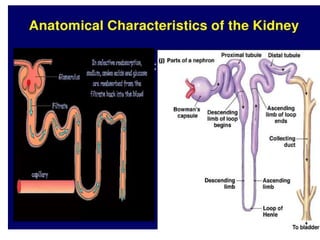
Two Types of Nephron
• Cortical nephrons
• ~85% of all nephrons
• Located in the cortex
• Juxtamedullary
nephrons
• Closer to renal
medulla
• Loops of Henle extend
deep into renal pyramids
Cortical & Juxtamedullay nephrons
■ Juxtamedullary
nephrons have long
LOH, dipping deep into
the medulla.
■ They are important in
formation of
concentrated urine.
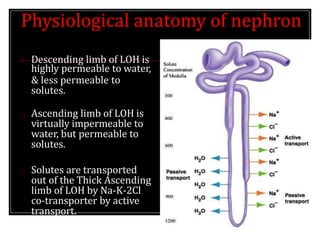
Physiological anatomy of nephron
Descending limb of LOH is
highly permeable to water,
& less permeable to
solutes.
Ascending limb of LOH is
virtually impermeable to
water, but permeable to
solutes.
Solutes are transported
out of the Thick Ascending
limb of LOH by Na-K-2Cl
co-transporter by active
transport.
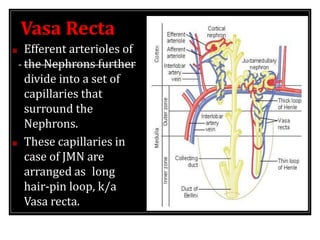
Vasa Recta
■ Efferent arterioles of
the Nephrons further
divide into a set of
capillaries that
surround the
Nephrons.
■ These capillaries in
case of JMN are
arranged as long
hair-pin loop, k/a
Vasa recta.
Vasa Recta
Osmosis■ Movement of solvent
from lower concentration
of solution to higher
concentration.
■ Movement of water from
tubules to interstitium to
peritubular capillaries
occurs by osmosis.
■ Solute particles move by
various other transport
processes.
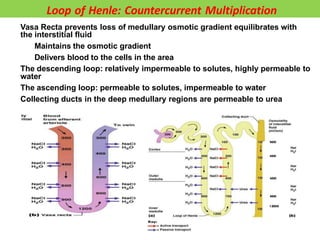
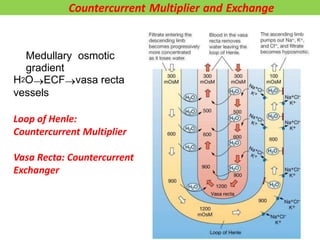
Loop of Henle: Countercurrent Multiplication
• Vasa Recta prevents loss of medullary osmotic gradient equilibrates with
the interstitial fluid
• Maintains the osmotic gradient
• Delivers blood to the cells in the area
• The descending loop: relatively impermeable to solutes, highly permeable to
water
• The ascending loop: permeable to solutes, impermeable to water
• Collecting ducts in the deep medullary regions are permeable to urea
• Medullary osmotic
gradient
H2OECFvasa recta
vessels
Loop of Henle:
Countercurrent Multiplier
Vasa Recta: Countercurrent
Exchanger
• Medullary osmotic
gradient
Countercurrent Multiplier and Exchange
Hyperosmotic Medullary Interstitium
■ There is a progressively
increasing osmolar gradient
in medulla.
■ This gradient is due to:
LOH acting as Countercurrent
Multiplier
Vasa Recta acting as
Countercurrent Exchanger
Urea cycling also contributes
to the medullary osmolarity.
Countercurrent Multiplier
■ LOH act as countercurrent
multiplier to produce the
medullary osmotic gradient.
AL pumps out NaCl into the
interstitium & is capable of
producing an osmotic gradient of
200 mosmol/l b/w any part of
tubule & interstitium.
The countercurrent flow in LOH,
with differing permeability of DL &
AL is capable of multiplying this
effect to produce an osmotic
gradient.
Countercurrent Exchanger
■ Vasa recta prevents the wash
down of medullary
concentration gradient while
absorbing excess solutes &
water from interstitium.
It does not contribute to the
production of medullary
concentration gradient but
helps to preserve it.
Low blood flow (5-10% of
total) to the medulla also helps
in this.
Contribution of Urea to the hyperosmotic renal
medulla
urea contributes about 40 –
50% of the osmolarity of the
renal medullary interstitium.
Unlike sodium chloride, urea is
passively reabsorbed from the
tubule.
When there is water deficit
and blood concentrations of
ADH are high, large amounts of
urea are passively reabsorbed
from the inner medullary
collecting ducts into the
interstitium
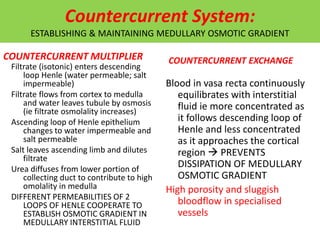
Countercurrent System:
ESTABLISHING & MAINTAINING MEDULLARY OSMOTIC GRADIENT
COUNTERCURRENT MULTIPLIER COUNTERCURRENT EXCHANGE
Filtrate (isotonic) enters descending
loop Henle (water permeable; salt
impermeable)
Filtrate flows from cortex to medulla
and water leaves tubule by osmosis
(ie filtrate osmolality increases)
Ascending loop of Henle epithelium
changes to water impermeable and
salt permeable
Salt leaves ascending limb and dilutes
filtrate
Urea diffuses from lower portion of
collecting duct to contribute to high
omolality in medulla
DIFFERENT PERMEABILITIES OF 2
LOOPS OF HENLE COOPERATE TO
ESTABLISH OSMOTIC GRADIENT IN
MEDULLARY INTERSTITIAL FLUID
Blood in vasa recta continuously
equilibrates with interstitial
fluid ie more concentrated as
it follows descending loop of
Henle and less concentrated
as it approaches the cortical
region  PREVENTS
DISSIPATION OF MEDULLARY
OSMOTIC GRADIENT
High porosity and sluggish
bloodflow in specialised
vessels
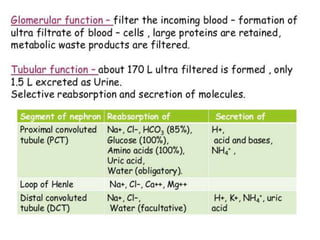
Glomerular Filtration
Only water and small solutes can be filtrated----selective.
RIFLE criteria
COLLOIDS IN RENAL DISEASE
• Albumin gives renoprotection which may be
explained by maintaining renal perfusion,
promoting proximal tubular integrity and
function, binding of endogenous toxins and
nephrotoxic drugs, and preventing oxidative
damage.
• Carbohydrate-based artificial colloids
hydroxyethyl starch (HES) and dextran were
frequently associated with acute kidney injury
Pharmacological Considerations In Renal
Disease
• INTRAVENOUS AGENTS
– Induction Agents
– Muscle Relaxants
– Reversal Agents
– Benzodiazepines
– Opioids
• INHALATION AGENTS
– Volatile Agents
– Nitrous Oxide
• OTHER
COLLOIDS IN RENAL DISEASE
• The degradation products of HES and
Dextran cause direct tubular injury and
plugging of tubules.
• Renal failure following HES and dextran
use is more often reported when renal
perfusion is reduced or when pre-existing
renal damage is present.
NSAIDS AND RENAL FUNCTIONS
• Renal synthesis of vasodilating prostaglandins
(PGD2, PGE2 and PGI2) is an important
protective mechanism during periods of
systemic hypotension and renal ischemia.
• Inhibition of prostaglandin synthesis by
NSAIDs impairs the renal autoregulation (the
purpose of which was to maintain renal blood
flow during systemic vasoconstriction eg In
hypovolaemics).
• NSAIDs also cause acute interstitial nephritis.
ACE INHIBITORS AND ITS RENAL EFFECTS
• Angiotensin II causes generalized arterial
vasoconstriction and secondarily reduces RBF.
• Both afferent and efferent glomerular arterioles are
constricted, but because the efferent arteriole is
smaller, its resistance becomes greater than that of
afferent arteriole; GFR tends to be relatively
preserved.
• ACE inhibitors block the protective effects of
Angiotensin II and may result in reduction of GFR
during anaesthesia.
• These prevent the local action of bradykinins,
responsible for constriction of the efferent arteriole
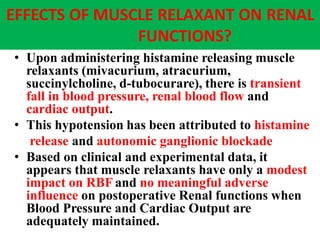
EFFECTS OF MUSCLE RELAXANT ON RENAL
FUNCTIONS?
• Upon administering histamine releasing muscle
relaxants (mivacurium, atracurium,
succinylcholine, d-tubocurare), there is transient
fall in blood pressure, renal blood flow and
cardiac output.
• This hypotension has been attributed to histamine
release and autonomic ganglionic blockade
• Based on clinical and experimental data, it
appears that muscle relaxants have only a modest
impact on RBF and no meaningful adverse
influence on postoperative Renal functions when
Blood Pressure and Cardiac Output are
adequately maintained.
Muscle Relaxants
SUCCINYLCHOLINE Safe if HYPERKALAEMIA absent
CISATRACURIUM &
ATRACURIUM
DRUG OF CHOICE; plasma ester hydrolysis, non enzymatic
Hoffman elimination
VECURONIUM Primary hepatic metabolism, 20% eliminated by kidneys. If
use >0,1mg/kg dose prolonged effect
ROCURONIUM Hepatic elimination but prolonged action in kidney disease
reported. Can be used if appropriate NM monitoring available
PANCURONIUM 60 – 90% dependant on renal excretion
NEOSTIGMINE Renal excretion. Half life prolonged. Inadequate reversal
often related to other effects (“recurarizaton’)
ATROPINE &
GLYCOPYROLLATE
Safe for use.
Repeated doses potential for accumulation (50% drug
excreted in urine)
Reversal Agents
INTRAVENOUSAGENTSAND RENAL
FUNCTIONS
• These exhibit minor effect on kidney when used
alone.
• Ketamine minimally effects and preserves renal
functions during haemorrhagic hypovolaemia. It is
associated with tachycardia, increased blood
pressure, and increased cardiac output; useful in
the shocked, unwell patient.
• Propofol can be safely used. Its long term
infusion use – ‘Propofol Infusion Syndrome’is
associated with renal failure.
• Life-threatening condition characterised by
acute refractory bradycardia progressing to
asystole and one or more of:-
(1) metabolic acidosis.
(2) rhabdomyolysis or myoglobinuria.
(3) hyperlipidaemia.
(4) enlarged or fatty liver.
• Risk Factors:-
- >4mg/kg/hr (> 75µg/kg/min)for 48 hours; but
can occur at lower doses
- younger age.
- acute neurological injury.
- low carbohydrate intake.
- catecholamine/corticosteroids infusion.
• Management:-
- Discontinue propofol immediately
- Haemodynamic maintainance:-
crystalloid/colloids, vasopressors/inotropes.
- Adequate carbohydrate intake (6-8mg/kg/min)
- Hemodialysis & continuous renal replacement
therapy (CRRT)
- Transvenous pacing.
- ECMO.
Induction Agents
PROPOFOL &
ETOMIDATE
Pharmacokinetics minimally affected and pharmaco dynamics
unchanged
Changes in volume distribution and mental state
Decreased induction dose required
BARBITURATES Pharmacokinetics unchanged but
Increased sensitivity d/t increased free circulating barbiturates
(decreased protein binding) and acidosis increases entry into
brain by increasing non ionised fraction
KETAMINE Pharmacokinetics minimally changed
Hepatic metabolites may depend on renal excretion and can
potentially accumulate
OPIOIDSAND RENAL
FUNCTIONS
• Opioid are commonly used safely in anesthesia
and pain control in the perioperative period.
• They decrease renal blood flow, GFR and
urine output which is minimal and transient.
• Ramifentanyl pharmacokinetics are unaffected
by renal functions due to rapid ester hydrolysis.
• With the exception of morphine and
meperidine, significant accumulation of active
metabolites do not occur.
OPIOIDSAND RENALFUNCTIONS
• The renal toxicity appears in the context of
inappropriate use:- either higher than needed
doses, in the presence of other toxins, chronic use
of opioids (accumulation of metabolites), deranged
renal functions or with pre-existing dehydration.
• The accumulation of morphine (morphine-6-
glucuronide) and meperidine (normeperidine) has
been reported to prolong respiratory depression in
patients with kidney failure.
• Increased level of normeperidine has been
associated with seizures.
Opioids
MORPHINE Active metabolites (morphine-6-glucoronide) may have
greater activity than parent drug and may accumulate
Start at lower suggested dosage and titrate dosage upwards
slowly and increase dose intervals
FENTANYL
REMIFENTANYL
ALFENTANYL
Inactivated by liver and excreted by urine
Significant accumulation does not occur
No active metabolites
MIDAZOLAM &
DIAZEPAM
Hepatic metabolism with urine elimination
Active metabolites accumulate
Protein bound ; increased sensitivity in hypo albuminaemic
patients
Dose reduction 30 – 50%
Benzodiazepines
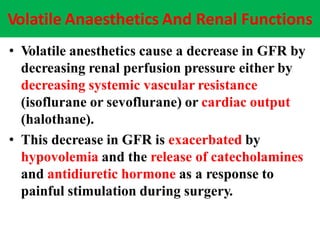
Volatile Anaesthetics And Renal Functions
• Volatile anesthetics cause a decrease in GFR by
decreasing renal perfusion pressure either by
decreasing systemic vascular resistance
(isoflurane or sevoflurane) or cardiac output
(halothane).
• This decrease in GFR is exacerbated by
hypovolemia and the release of catecholamines
and antidiuretic hormone as a response to
painful stimulation during surgery.
Inhalational Agents
AGENT PROPERTY EFFECT
Halothane Inorganic fluoride levels are less No Neprotoxicity
Isoflurane Inorganic fluoride levels are less No Neprotoxicity
Sevoflurane Inorganic fluoride levels are less but not stable
, degraded by soda-lime to compound A &
undergoes liver metabolism
Compound A is
Neprotoxic
Desflurane Inorganic fluoride levels are very less, highly
stable & resists degradation by soda-lime &
liver
No Neprotoxicity
SEVOFLURANEAND ITS RENAL
EFFECTS?
• Sevoflurane is degraded in basic carbon dioxide
absorbents (Barium Hydroxide and Soda lime)
into a vinyl ether called compoundA.
• CompoundAhas been implicated to cause renal
injury through fluoride toxicity (animal studies).
• High intra-renal fluoride concentrations impair
the concentrating ability of the kidney and may
theoretically lead to non-oliguric renal failure
However, studies have failed to show a
relevant effect in clinical practice.
• It is considered safe even in patients
with renal impairment as long as
prolonged low-flow anesthesia is
avoided. (Minimum flow ≥ 2L/min)
METHOXYFLURANEAND ITS
EFFECTS ON KIDNEYS?
• Methoxyflurane caused dose-
dependent abnormalities post-surgery.
• It causes vasopressin-resistant polyuria, serum
hyperosmolality, hypernatremia, increased
concentrations of serum urea nitrogen and
inorganic fluoride, and decreased urinary
potassium, sodium, osmolality, and urea nitrogen
concentrations.
• Therefore, clinically it is no longer used
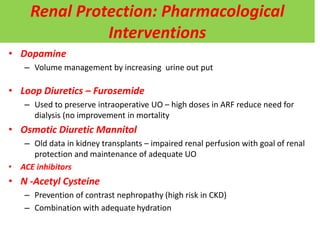
Renal Protection: Pharmacological
Interventions
• Dopamine
– Volume management by increasing urine out put
• Loop Diuretics – Furosemide
– Used to preserve intraoperative UO – high doses in ARF reduce need for
dialysis (no improvement in mortality
• Osmotic Diuretic Mannitol
– Old data in kidney transplants – impaired renal perfusion with goal of renal
protection and maintenance of adequate UO
• ACE inhibitors
• N -Acetyl Cysteine
– Prevention of contrast nephropathy (high risk in CKD)
– Combination with adequate hydration
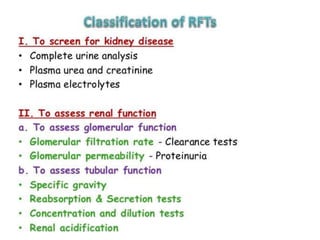
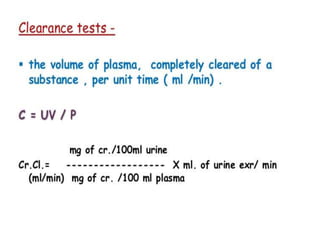
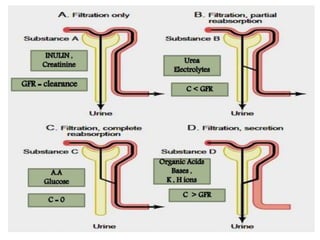
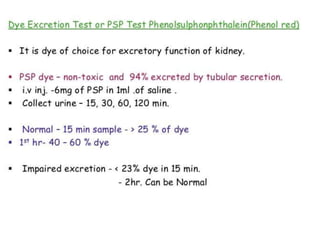
Renal function test
Renal function test

Renal function test

  • 2.
    ■ The compositionof the blood ( internal environment ) is determined not by what the mouth ingest but by what the kidney keep. ------- SMITH.
  • 3.
    KIDNEY: BLOOD SUPPLYAND ITS CIRCULATION?
  • 4.
    Renal Circulation • Arterialsupply:- RenalA. (br ofAbdominal aorta) • Venous drainage:- Renal vein into IVC. • Both the kidneys weight around 0.4% of body weight, but the combined blood flow accounts for 20-25% of total cardiac output (CO). • 80% of renal blood flow goes to cortical nephrons. 10-15% goes to juxtamedullary nephrons. • Autoregulation of renal blood flow occurs between MAPof 80 and 180 mm Hg.
  • 5.
    Neural regulation • Renalefferent nerve from brain to kidney • Renal sympathetic nerve • Renal afferent nerve from kidney to brain • Renal afferent nerve fiber can be stimulated mechanical and chemical factors. • RENORENAL REFLEX: • One side renal efferent nerve activity can effect other side renal nerve activity. • Activity of sympathetic nerves is low, but can increase during hemorrhage, stress and exercise
  • 6.
    Hormonal regulation Vasoconstriction • AngiotensinII • Epinephrine • Norepinephrinei ne Vasodilation • Prostaglandin • nitrous oxide • Bradykinin RBF RBF
  • 8.
    Two Types ofNephron • Cortical nephrons • ~85% of all nephrons • Located in the cortex • Juxtamedullary nephrons • Closer to renal medulla • Loops of Henle extend deep into renal pyramids
  • 9.
    Cortical & Juxtamedullaynephrons ■ Juxtamedullary nephrons have long LOH, dipping deep into the medulla. ■ They are important in formation of concentrated urine.
  • 10.
    Physiological anatomy ofnephron Descending limb of LOH is highly permeable to water, & less permeable to solutes. Ascending limb of LOH is virtually impermeable to water, but permeable to solutes. Solutes are transported out of the Thick Ascending limb of LOH by Na-K-2Cl co-transporter by active transport.
  • 11.
    Vasa Recta ■ Efferentarterioles of the Nephrons further divide into a set of capillaries that surround the Nephrons. ■ These capillaries in case of JMN are arranged as long hair-pin loop, k/a Vasa recta.
  • 12.
  • 13.
    Osmosis■ Movement ofsolvent from lower concentration of solution to higher concentration. ■ Movement of water from tubules to interstitium to peritubular capillaries occurs by osmosis. ■ Solute particles move by various other transport processes.
  • 14.
    Loop of Henle:Countercurrent Multiplication • Vasa Recta prevents loss of medullary osmotic gradient equilibrates with the interstitial fluid • Maintains the osmotic gradient • Delivers blood to the cells in the area • The descending loop: relatively impermeable to solutes, highly permeable to water • The ascending loop: permeable to solutes, impermeable to water • Collecting ducts in the deep medullary regions are permeable to urea
  • 15.
    • Medullary osmotic gradient H2OECFvasarecta vessels Loop of Henle: Countercurrent Multiplier Vasa Recta: Countercurrent Exchanger • Medullary osmotic gradient Countercurrent Multiplier and Exchange
  • 16.
    Hyperosmotic Medullary Interstitium ■There is a progressively increasing osmolar gradient in medulla. ■ This gradient is due to: LOH acting as Countercurrent Multiplier Vasa Recta acting as Countercurrent Exchanger Urea cycling also contributes to the medullary osmolarity.
  • 17.
    Countercurrent Multiplier ■ LOHact as countercurrent multiplier to produce the medullary osmotic gradient. AL pumps out NaCl into the interstitium & is capable of producing an osmotic gradient of 200 mosmol/l b/w any part of tubule & interstitium. The countercurrent flow in LOH, with differing permeability of DL & AL is capable of multiplying this effect to produce an osmotic gradient.
  • 18.
    Countercurrent Exchanger ■ Vasarecta prevents the wash down of medullary concentration gradient while absorbing excess solutes & water from interstitium. It does not contribute to the production of medullary concentration gradient but helps to preserve it. Low blood flow (5-10% of total) to the medulla also helps in this.
  • 19.
    Contribution of Ureato the hyperosmotic renal medulla urea contributes about 40 – 50% of the osmolarity of the renal medullary interstitium. Unlike sodium chloride, urea is passively reabsorbed from the tubule. When there is water deficit and blood concentrations of ADH are high, large amounts of urea are passively reabsorbed from the inner medullary collecting ducts into the interstitium
  • 20.
    Countercurrent System: ESTABLISHING &MAINTAINING MEDULLARY OSMOTIC GRADIENT COUNTERCURRENT MULTIPLIER COUNTERCURRENT EXCHANGE Filtrate (isotonic) enters descending loop Henle (water permeable; salt impermeable) Filtrate flows from cortex to medulla and water leaves tubule by osmosis (ie filtrate osmolality increases) Ascending loop of Henle epithelium changes to water impermeable and salt permeable Salt leaves ascending limb and dilutes filtrate Urea diffuses from lower portion of collecting duct to contribute to high omolality in medulla DIFFERENT PERMEABILITIES OF 2 LOOPS OF HENLE COOPERATE TO ESTABLISH OSMOTIC GRADIENT IN MEDULLARY INTERSTITIAL FLUID Blood in vasa recta continuously equilibrates with interstitial fluid ie more concentrated as it follows descending loop of Henle and less concentrated as it approaches the cortical region  PREVENTS DISSIPATION OF MEDULLARY OSMOTIC GRADIENT High porosity and sluggish bloodflow in specialised vessels
  • 28.
    Glomerular Filtration Only waterand small solutes can be filtrated----selective.
  • 65.
  • 69.
    COLLOIDS IN RENALDISEASE • Albumin gives renoprotection which may be explained by maintaining renal perfusion, promoting proximal tubular integrity and function, binding of endogenous toxins and nephrotoxic drugs, and preventing oxidative damage. • Carbohydrate-based artificial colloids hydroxyethyl starch (HES) and dextran were frequently associated with acute kidney injury
  • 70.
    Pharmacological Considerations InRenal Disease • INTRAVENOUS AGENTS – Induction Agents – Muscle Relaxants – Reversal Agents – Benzodiazepines – Opioids • INHALATION AGENTS – Volatile Agents – Nitrous Oxide • OTHER
  • 71.
    COLLOIDS IN RENALDISEASE • The degradation products of HES and Dextran cause direct tubular injury and plugging of tubules. • Renal failure following HES and dextran use is more often reported when renal perfusion is reduced or when pre-existing renal damage is present.
  • 72.
    NSAIDS AND RENALFUNCTIONS • Renal synthesis of vasodilating prostaglandins (PGD2, PGE2 and PGI2) is an important protective mechanism during periods of systemic hypotension and renal ischemia. • Inhibition of prostaglandin synthesis by NSAIDs impairs the renal autoregulation (the purpose of which was to maintain renal blood flow during systemic vasoconstriction eg In hypovolaemics). • NSAIDs also cause acute interstitial nephritis.
  • 73.
    ACE INHIBITORS ANDITS RENAL EFFECTS • Angiotensin II causes generalized arterial vasoconstriction and secondarily reduces RBF. • Both afferent and efferent glomerular arterioles are constricted, but because the efferent arteriole is smaller, its resistance becomes greater than that of afferent arteriole; GFR tends to be relatively preserved. • ACE inhibitors block the protective effects of Angiotensin II and may result in reduction of GFR during anaesthesia. • These prevent the local action of bradykinins, responsible for constriction of the efferent arteriole
  • 74.
    EFFECTS OF MUSCLERELAXANT ON RENAL FUNCTIONS? • Upon administering histamine releasing muscle relaxants (mivacurium, atracurium, succinylcholine, d-tubocurare), there is transient fall in blood pressure, renal blood flow and cardiac output. • This hypotension has been attributed to histamine release and autonomic ganglionic blockade • Based on clinical and experimental data, it appears that muscle relaxants have only a modest impact on RBF and no meaningful adverse influence on postoperative Renal functions when Blood Pressure and Cardiac Output are adequately maintained.
  • 75.
    Muscle Relaxants SUCCINYLCHOLINE Safeif HYPERKALAEMIA absent CISATRACURIUM & ATRACURIUM DRUG OF CHOICE; plasma ester hydrolysis, non enzymatic Hoffman elimination VECURONIUM Primary hepatic metabolism, 20% eliminated by kidneys. If use >0,1mg/kg dose prolonged effect ROCURONIUM Hepatic elimination but prolonged action in kidney disease reported. Can be used if appropriate NM monitoring available PANCURONIUM 60 – 90% dependant on renal excretion NEOSTIGMINE Renal excretion. Half life prolonged. Inadequate reversal often related to other effects (“recurarizaton’) ATROPINE & GLYCOPYROLLATE Safe for use. Repeated doses potential for accumulation (50% drug excreted in urine) Reversal Agents
  • 76.
    INTRAVENOUSAGENTSAND RENAL FUNCTIONS • Theseexhibit minor effect on kidney when used alone. • Ketamine minimally effects and preserves renal functions during haemorrhagic hypovolaemia. It is associated with tachycardia, increased blood pressure, and increased cardiac output; useful in the shocked, unwell patient. • Propofol can be safely used. Its long term infusion use – ‘Propofol Infusion Syndrome’is associated with renal failure.
  • 77.
    • Life-threatening conditioncharacterised by acute refractory bradycardia progressing to asystole and one or more of:- (1) metabolic acidosis. (2) rhabdomyolysis or myoglobinuria. (3) hyperlipidaemia. (4) enlarged or fatty liver. • Risk Factors:- - >4mg/kg/hr (> 75µg/kg/min)for 48 hours; but can occur at lower doses - younger age. - acute neurological injury.
  • 78.
    - low carbohydrateintake. - catecholamine/corticosteroids infusion. • Management:- - Discontinue propofol immediately - Haemodynamic maintainance:- crystalloid/colloids, vasopressors/inotropes. - Adequate carbohydrate intake (6-8mg/kg/min) - Hemodialysis & continuous renal replacement therapy (CRRT) - Transvenous pacing. - ECMO.
  • 79.
    Induction Agents PROPOFOL & ETOMIDATE Pharmacokineticsminimally affected and pharmaco dynamics unchanged Changes in volume distribution and mental state Decreased induction dose required BARBITURATES Pharmacokinetics unchanged but Increased sensitivity d/t increased free circulating barbiturates (decreased protein binding) and acidosis increases entry into brain by increasing non ionised fraction KETAMINE Pharmacokinetics minimally changed Hepatic metabolites may depend on renal excretion and can potentially accumulate
  • 80.
    OPIOIDSAND RENAL FUNCTIONS • Opioidare commonly used safely in anesthesia and pain control in the perioperative period. • They decrease renal blood flow, GFR and urine output which is minimal and transient. • Ramifentanyl pharmacokinetics are unaffected by renal functions due to rapid ester hydrolysis. • With the exception of morphine and meperidine, significant accumulation of active metabolites do not occur.
  • 81.
    OPIOIDSAND RENALFUNCTIONS • Therenal toxicity appears in the context of inappropriate use:- either higher than needed doses, in the presence of other toxins, chronic use of opioids (accumulation of metabolites), deranged renal functions or with pre-existing dehydration. • The accumulation of morphine (morphine-6- glucuronide) and meperidine (normeperidine) has been reported to prolong respiratory depression in patients with kidney failure. • Increased level of normeperidine has been associated with seizures.
  • 82.
    Opioids MORPHINE Active metabolites(morphine-6-glucoronide) may have greater activity than parent drug and may accumulate Start at lower suggested dosage and titrate dosage upwards slowly and increase dose intervals FENTANYL REMIFENTANYL ALFENTANYL Inactivated by liver and excreted by urine Significant accumulation does not occur No active metabolites MIDAZOLAM & DIAZEPAM Hepatic metabolism with urine elimination Active metabolites accumulate Protein bound ; increased sensitivity in hypo albuminaemic patients Dose reduction 30 – 50% Benzodiazepines
  • 83.
    Volatile Anaesthetics AndRenal Functions • Volatile anesthetics cause a decrease in GFR by decreasing renal perfusion pressure either by decreasing systemic vascular resistance (isoflurane or sevoflurane) or cardiac output (halothane). • This decrease in GFR is exacerbated by hypovolemia and the release of catecholamines and antidiuretic hormone as a response to painful stimulation during surgery.
  • 84.
    Inhalational Agents AGENT PROPERTYEFFECT Halothane Inorganic fluoride levels are less No Neprotoxicity Isoflurane Inorganic fluoride levels are less No Neprotoxicity Sevoflurane Inorganic fluoride levels are less but not stable , degraded by soda-lime to compound A & undergoes liver metabolism Compound A is Neprotoxic Desflurane Inorganic fluoride levels are very less, highly stable & resists degradation by soda-lime & liver No Neprotoxicity
  • 85.
    SEVOFLURANEAND ITS RENAL EFFECTS? •Sevoflurane is degraded in basic carbon dioxide absorbents (Barium Hydroxide and Soda lime) into a vinyl ether called compoundA. • CompoundAhas been implicated to cause renal injury through fluoride toxicity (animal studies). • High intra-renal fluoride concentrations impair the concentrating ability of the kidney and may theoretically lead to non-oliguric renal failure
  • 86.
    However, studies havefailed to show a relevant effect in clinical practice. • It is considered safe even in patients with renal impairment as long as prolonged low-flow anesthesia is avoided. (Minimum flow ≥ 2L/min)
  • 87.
    METHOXYFLURANEAND ITS EFFECTS ONKIDNEYS? • Methoxyflurane caused dose- dependent abnormalities post-surgery. • It causes vasopressin-resistant polyuria, serum hyperosmolality, hypernatremia, increased concentrations of serum urea nitrogen and inorganic fluoride, and decreased urinary potassium, sodium, osmolality, and urea nitrogen concentrations. • Therefore, clinically it is no longer used
  • 88.
    Renal Protection: Pharmacological Interventions •Dopamine – Volume management by increasing urine out put • Loop Diuretics – Furosemide – Used to preserve intraoperative UO – high doses in ARF reduce need for dialysis (no improvement in mortality • Osmotic Diuretic Mannitol – Old data in kidney transplants – impaired renal perfusion with goal of renal protection and maintenance of adequate UO • ACE inhibitors • N -Acetyl Cysteine – Prevention of contrast nephropathy (high risk in CKD) – Combination with adequate hydration