USG ASSESMENT OF
NATIVE RENAL VESSELS
DR NITIN WADHWANI
HOD &PROF
DEPT OF RADIODIAGNOSIS
DYPATIL HOSPITAL KOLHAPUR
Anatomy
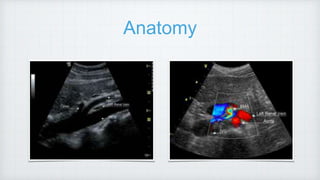
Right RA is retrocaval in location.
The left renal vein lies between the superior mesenteric artery and the aorta.
Circumaortic left renal vein
Renal arteries arise from proximal aorta just below origin of SMA.
Anatomy
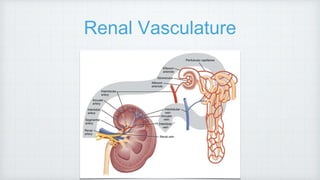
Renal Vasculature
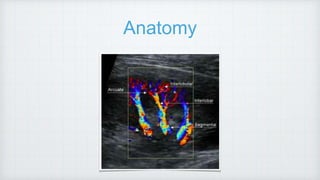
Anatomy
Technique
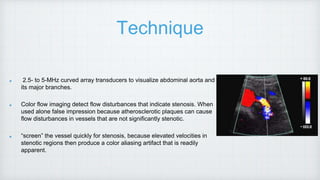
2.5- to 5-MHz curved array transducers to visualize abdominal aorta and
its major branches.
Color flow imaging detect flow disturbances that indicate stenosis. When
used alone false impression because atherosclerotic plaques can cause
flow disturbances in vessels that are not significantly stenotic.
“screen” the vessel quickly for stenosis, because elevated velocities in
stenotic regions then produce a color aliasing artifact that is readily
apparent.
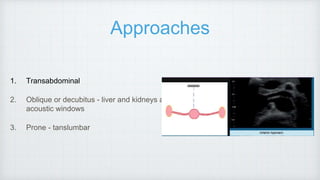
Approaches
1. Transabdominal
2. Oblique or decubitus - liver and kidneys as
acoustic windows
3. Prone - tanslumbar
Approaches
1. Transabdominal
2. Oblique or decubitus - liver and kidneys as
acoustic windows
3. Prone - tanslumbar
Approaches
1. Transabdominal
2. Oblique or decubitus - liver and kidneys as
acoustic windows
3. Prone - tanslumbar
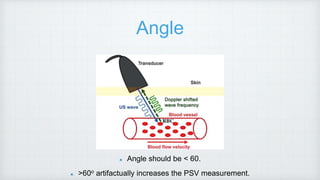
Angle
Angle should be < 60.
>60o artifactually increases the PSV measurement.
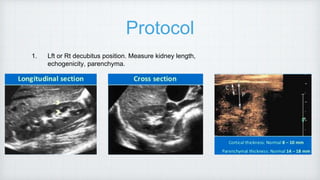
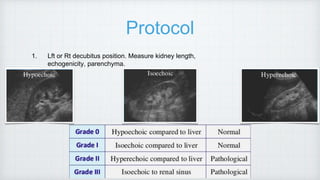
Protocol
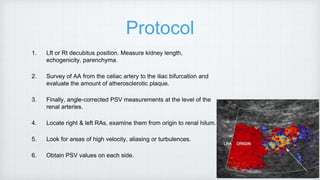
1. Lft or Rt decubitus position. Measure kidney length,
echogenicity, parenchyma.
Protocol
1. Lft or Rt decubitus position. Measure kidney length,
echogenicity, parenchyma.
Protocol
1. Lft or Rt decubitus position. Measure kidney length,
echogenicity, parenchyma.
2. Survey of AA from the celiac artery to the iliac bifurcation and
evaluate the amount of atherosclerotic plaque.
3. Finally, angle-corrected PSV measurements at the level of the
renal arteries.
4. Locate right & left RAs, examine them from origin to renal hilum.
5. Look for areas of high velocity, aliasing or turbulences.
6. Obtain PSV values on each side.
Protocol
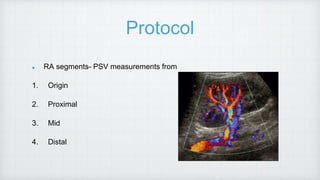
RA segments- PSV measurements from
1. Origin
2. Proximal
3. Mid
4. Distal
Vessel sampling
On each side
1. AA @ level of RAs.
2. RA at origin
3. RA at Proximal
4. RA at Mid
5. RA at Distal
6. Segmental RA at upper pole
7. Segmental RA Mid pole.
8. Segmental RA Lower pole
At least seven waveforms are
captured from each side.
Normal PSV range in adult renal arteries is 60 to 100 cm/sec.
Doppler Waveform
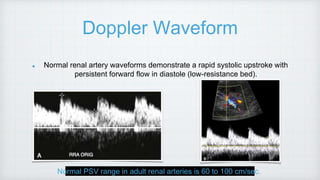
Normal renal artery waveforms demonstrate a rapid systolic upstroke with
persistent forward flow in diastole (low-resistance bed).
Normal PSV range in adult renal arteries is 60 to 100 cm/sec.
VASCULAR DISORDERS
Normal PSV range in adult renal arteries is 60 to 100 cm/sec.
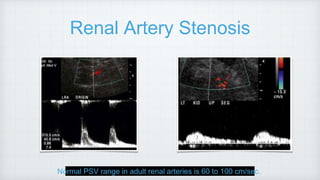
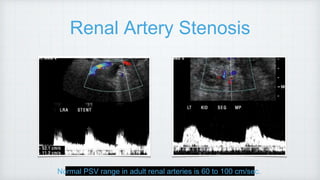
Renal Artery Stenosis
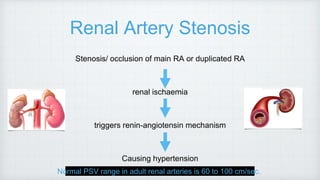
Stenosis/ occlusion of main RA or duplicated RA
renal ischaemia
triggers renin-angiotensin mechanism
Causing hypertension
Normal PSV range in adult renal arteries is 60 to 100 cm/sec.
Renal Artery Stenosis
(1) young patients with severe HTN
(2) patients with rapidly accelerating or malignant HTN
(3) patients with HTN that is difficult to control despite a suitable treatment program
(4) patients with concomitant HTN & deteriorating renal function
(5) patients with renal insufficiency and discrepant kidney size
Normal PSV range in adult renal arteries is 60 to 100 cm/sec.
Renal Artery Stenosis
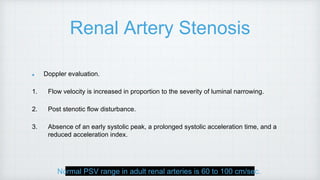
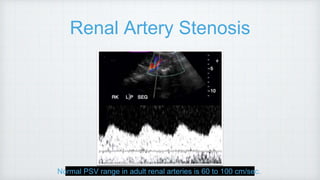
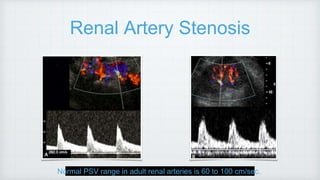
Doppler evaluation.
1. Flow velocity is increased in proportion to the severity of luminal narrowing.
2. Post stenotic flow disturbance.
3. Absence of an early systolic peak, a prolonged systolic acceleration time, and a
reduced acceleration index.
Normal PSV range in adult renal arteries is 60 to 100 cm/sec.
Renal Artery Stenosis
Diagnostic doppler criteria :
(1) PSV in the stenosis of 180 to 200 cm/sec or greater.
(2) a renal artery to aortic ratio (RAR) exceeding 3.3 0r 3.5
RAR = PSV of stenotic region of RA.
Normal PSV range in adult renal arteries is 60 to 100 cm/sec.
PSV of AA @ level of RA
Renal Artery Stenosis
Normal PSV range in adult renal arteries is 60 to 100 cm/sec.
Renal Artery Stenosis
Normal PSV range in adult renal arteries is 60 to 100 cm/sec.
Renal Artery Stenosis
Normal PSV range in adult renal arteries is 60 to 100 cm/sec.
Renal Artery Stenosis
Normal PSV range in adult renal arteries is 60 to 100 cm/sec.
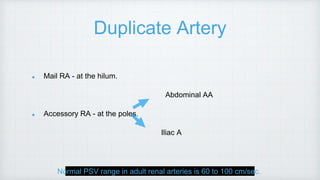
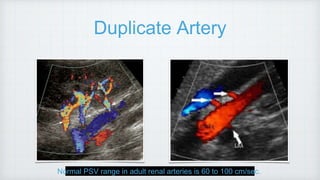
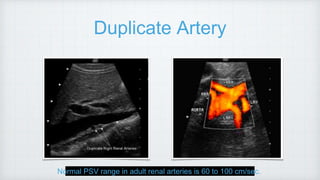
Duplicate Artery
Mail RA - at the hilum.
Abdominal AA
Accessory RA - at the poles.
Iliac A
Normal PSV range in adult renal arteries is 60 to 100 cm/sec.
Duplicate Artery
Normal PSV range in adult renal arteries is 60 to 100 cm/sec.
Duplicate Artery
Normal PSV range in adult renal arteries is 60 to 100 cm/sec.
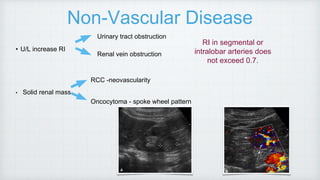
• U/L increase RI
• Solid renal mass
Urinary tract obstruction
Renal vein obstruction
RCC -neovascularity
Oncocytoma - spoke wheel pattern
RI in segmental or
intralobar arteries does
not exceed 0.7.
Non-Vascular Disease
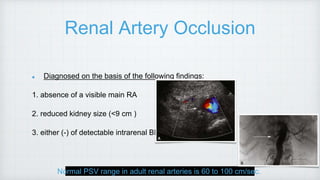
Renal Artery Occlusion
Diagnosed on the basis of the following findings:
1. absence of a visible main RA
2. reduced kidney size (<9 cm )
3. either (-) of detectable intrarenal BF
Normal PSV range in adult renal arteries is 60 to 100 cm/sec.
Renal Artery Occlusion
False-positive - a) visualization of the main renal artery is poor or
b) the kidney is small.
False-negative - collateralization
Normal PSV range in adult renal arteries is 60 to 100 cm/sec.
Renal Vein Thrombosis
Presents with pain and hematuria.
Chronic RV thrombosis - asymp / nephrotic synd, hematuria or renal failure.
Renal vein blocked by either -
Normal PSV range in adult renal arteries is 60 to 100 cm/sec.
Intraluminal
Tumor
Thrombus
Extrinsic compression
Acute pancreatitis
LN enlargement
Retroperitoneal fibrosis
Renal Vein Thrombosis
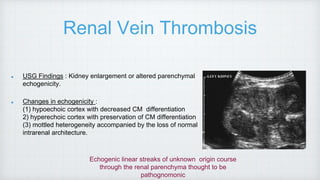
USG Findings : Kidney enlargement or altered parenchymal
echogenicity.
Changes in echogenicity :
(1) hypoechoic cortex with decreased CM differentiation
2) hyperechoic cortex with preservation of CM differentiation
(3) mottled heterogeneity accompanied by the loss of normal
intrarenal architecture.
Echogenic linear streaks of unknown origin course
through the renal parenchyma thought to be
pathognomonic
Renal Vein Thrombosis
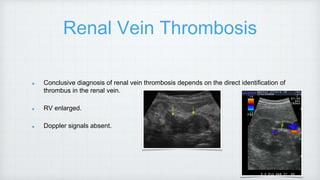
Conclusive diagnosis of renal vein thrombosis depends on the direct identification of
thrombus in the renal vein.
RV enlarged.
Doppler signals absent.
Renal Vein Thrombosis
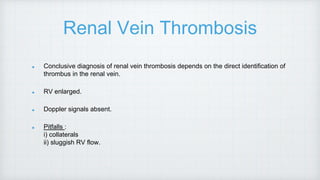
Conclusive diagnosis of renal vein thrombosis depends on the direct identification of
thrombus in the renal vein.
RV enlarged.
Doppler signals absent.

Pitfalls :
i) collaterals
ii) sluggish RV flow.
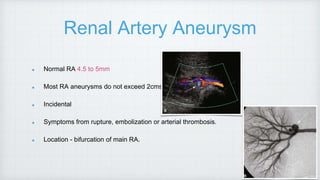
Renal Artery Aneurysm
Normal RA 4.5 to 5mm
Most RA aneurysms do not exceed 2cms.
Incidental
Symptoms from rupture, embolization or arterial thrombosis.
Location - bifurcation of main RA.
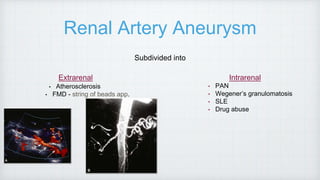
Renal Artery Aneurysm
Subdivided into
Extrarenal Intrarenal
• Atherosclerosis
• FMD - string of beads app.
• PAN
• Wegener’s granulomatosis
• SLE
• Drug abuse
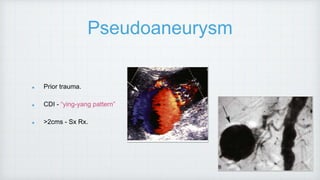
Pseudoaneurysm
Prior trauma.
CDI - “ying-yang pattern”
Pseudoaneurysm
Prior trauma.
CDI - “ying-yang pattern”
>2cms - Sx Rx.
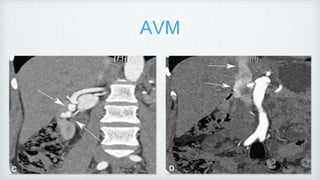
AVM
abnormal communications between the intra- renal arterial and venous vessels.
Types : i) Congenital [1/3rd] ii) Acquired [2/3rd]. -
iatrogenic
Cirsoid [MC] Cavernous AVM
Dilated corkscrew app Single dilated vessel
aka renal AV fistulas
US -Turbulent flow within renal parenchyma
AVM
abnormal communications between the intra- renal arterial and venous vessels.
Types : i) Congenital [1/3rd] ii) Acquired [2/3rd]. -
iatrogenic
Cirsoid [MC] Cavernous AVM
Dilated corkscrew app Single dilated vessel
aka renal AV fistulas
US -Turbulent flow within renal parenchyma
AVM
Stents
Gray-scale images provide optimal visualization of the stent as color flow may
obscure the stent.
Pitfalls & limitations :
overlying bowel gas
Obesity
Renal doppler HOD.pptx

Renal doppler HOD.pptx

  • 1.
    USG ASSESMENT OF NATIVERENAL VESSELS DR NITIN WADHWANI HOD &PROF DEPT OF RADIODIAGNOSIS DYPATIL HOSPITAL KOLHAPUR
  • 2.
    Anatomy Right RA isretrocaval in location. The left renal vein lies between the superior mesenteric artery and the aorta. Circumaortic left renal vein Renal arteries arise from proximal aorta just below origin of SMA.
  • 3.
  • 4.
  • 6.
  • 7.
    Technique 2.5- to 5-MHzcurved array transducers to visualize abdominal aorta and its major branches. Color flow imaging detect flow disturbances that indicate stenosis. When used alone false impression because atherosclerotic plaques can cause flow disturbances in vessels that are not significantly stenotic. “screen” the vessel quickly for stenosis, because elevated velocities in stenotic regions then produce a color aliasing artifact that is readily apparent.
  • 8.
    Approaches 1. Transabdominal 2. Obliqueor decubitus - liver and kidneys as acoustic windows 3. Prone - tanslumbar
  • 9.
    Approaches 1. Transabdominal 2. Obliqueor decubitus - liver and kidneys as acoustic windows 3. Prone - tanslumbar
  • 10.
    Approaches 1. Transabdominal 2. Obliqueor decubitus - liver and kidneys as acoustic windows 3. Prone - tanslumbar
  • 11.
    Angle Angle should be< 60. >60o artifactually increases the PSV measurement.
  • 12.
    Protocol 1. Lft orRt decubitus position. Measure kidney length, echogenicity, parenchyma.
  • 13.
    Protocol 1. Lft orRt decubitus position. Measure kidney length, echogenicity, parenchyma.
  • 14.
    Protocol 1. Lft orRt decubitus position. Measure kidney length, echogenicity, parenchyma. 2. Survey of AA from the celiac artery to the iliac bifurcation and evaluate the amount of atherosclerotic plaque. 3. Finally, angle-corrected PSV measurements at the level of the renal arteries. 4. Locate right & left RAs, examine them from origin to renal hilum. 5. Look for areas of high velocity, aliasing or turbulences. 6. Obtain PSV values on each side.
  • 15.
    Protocol RA segments- PSVmeasurements from 1. Origin 2. Proximal 3. Mid 4. Distal
  • 16.
    Vessel sampling On eachside 1. AA @ level of RAs. 2. RA at origin 3. RA at Proximal 4. RA at Mid 5. RA at Distal 6. Segmental RA at upper pole 7. Segmental RA Mid pole. 8. Segmental RA Lower pole At least seven waveforms are captured from each side. Normal PSV range in adult renal arteries is 60 to 100 cm/sec.
  • 17.
    Doppler Waveform Normal renalartery waveforms demonstrate a rapid systolic upstroke with persistent forward flow in diastole (low-resistance bed). Normal PSV range in adult renal arteries is 60 to 100 cm/sec.
  • 18.
    VASCULAR DISORDERS Normal PSVrange in adult renal arteries is 60 to 100 cm/sec.
  • 19.
    Renal Artery Stenosis Stenosis/occlusion of main RA or duplicated RA renal ischaemia triggers renin-angiotensin mechanism Causing hypertension Normal PSV range in adult renal arteries is 60 to 100 cm/sec.
  • 20.
    Renal Artery Stenosis (1)young patients with severe HTN (2) patients with rapidly accelerating or malignant HTN (3) patients with HTN that is difficult to control despite a suitable treatment program (4) patients with concomitant HTN & deteriorating renal function (5) patients with renal insufficiency and discrepant kidney size Normal PSV range in adult renal arteries is 60 to 100 cm/sec.
  • 21.
    Renal Artery Stenosis Dopplerevaluation. 1. Flow velocity is increased in proportion to the severity of luminal narrowing. 2. Post stenotic flow disturbance. 3. Absence of an early systolic peak, a prolonged systolic acceleration time, and a reduced acceleration index. Normal PSV range in adult renal arteries is 60 to 100 cm/sec.
  • 22.
    Renal Artery Stenosis Diagnosticdoppler criteria : (1) PSV in the stenosis of 180 to 200 cm/sec or greater. (2) a renal artery to aortic ratio (RAR) exceeding 3.3 0r 3.5 RAR = PSV of stenotic region of RA. Normal PSV range in adult renal arteries is 60 to 100 cm/sec. PSV of AA @ level of RA
  • 23.
    Renal Artery Stenosis NormalPSV range in adult renal arteries is 60 to 100 cm/sec.
  • 24.
    Renal Artery Stenosis NormalPSV range in adult renal arteries is 60 to 100 cm/sec.
  • 25.
    Renal Artery Stenosis NormalPSV range in adult renal arteries is 60 to 100 cm/sec.
  • 26.
    Renal Artery Stenosis NormalPSV range in adult renal arteries is 60 to 100 cm/sec.
  • 27.
    Duplicate Artery Mail RA- at the hilum. Abdominal AA Accessory RA - at the poles. Iliac A Normal PSV range in adult renal arteries is 60 to 100 cm/sec.
  • 28.
    Duplicate Artery Normal PSVrange in adult renal arteries is 60 to 100 cm/sec.
  • 29.
    Duplicate Artery Normal PSVrange in adult renal arteries is 60 to 100 cm/sec.
  • 30.
    • U/L increaseRI • Solid renal mass Urinary tract obstruction Renal vein obstruction RCC -neovascularity Oncocytoma - spoke wheel pattern RI in segmental or intralobar arteries does not exceed 0.7. Non-Vascular Disease
  • 31.
    Renal Artery Occlusion Diagnosedon the basis of the following findings: 1. absence of a visible main RA 2. reduced kidney size (<9 cm ) 3. either (-) of detectable intrarenal BF Normal PSV range in adult renal arteries is 60 to 100 cm/sec.
  • 32.
    Renal Artery Occlusion False-positive- a) visualization of the main renal artery is poor or b) the kidney is small. False-negative - collateralization Normal PSV range in adult renal arteries is 60 to 100 cm/sec.
  • 33.
    Renal Vein Thrombosis Presentswith pain and hematuria. Chronic RV thrombosis - asymp / nephrotic synd, hematuria or renal failure. Renal vein blocked by either - Normal PSV range in adult renal arteries is 60 to 100 cm/sec. Intraluminal Tumor Thrombus Extrinsic compression Acute pancreatitis LN enlargement Retroperitoneal fibrosis
  • 34.
    Renal Vein Thrombosis USGFindings : Kidney enlargement or altered parenchymal echogenicity. Changes in echogenicity : (1) hypoechoic cortex with decreased CM differentiation 2) hyperechoic cortex with preservation of CM differentiation (3) mottled heterogeneity accompanied by the loss of normal intrarenal architecture. Echogenic linear streaks of unknown origin course through the renal parenchyma thought to be pathognomonic
  • 35.
    Renal Vein Thrombosis Conclusivediagnosis of renal vein thrombosis depends on the direct identification of thrombus in the renal vein. RV enlarged. Doppler signals absent.
  • 36.
    Renal Vein Thrombosis Conclusivediagnosis of renal vein thrombosis depends on the direct identification of thrombus in the renal vein. RV enlarged. Doppler signals absent. Pitfalls : i) collaterals ii) sluggish RV flow.
  • 37.
    Renal Artery Aneurysm NormalRA 4.5 to 5mm Most RA aneurysms do not exceed 2cms. Incidental Symptoms from rupture, embolization or arterial thrombosis. Location - bifurcation of main RA.
  • 38.
    Renal Artery Aneurysm Subdividedinto Extrarenal Intrarenal • Atherosclerosis • FMD - string of beads app. • PAN • Wegener’s granulomatosis • SLE • Drug abuse
  • 39.
    Pseudoaneurysm Prior trauma. CDI -“ying-yang pattern”
  • 40.
    Pseudoaneurysm Prior trauma. CDI -“ying-yang pattern” >2cms - Sx Rx.
  • 41.
    AVM abnormal communications betweenthe intra- renal arterial and venous vessels. Types : i) Congenital [1/3rd] ii) Acquired [2/3rd]. - iatrogenic Cirsoid [MC] Cavernous AVM Dilated corkscrew app Single dilated vessel aka renal AV fistulas US -Turbulent flow within renal parenchyma
  • 42.
    AVM abnormal communications betweenthe intra- renal arterial and venous vessels. Types : i) Congenital [1/3rd] ii) Acquired [2/3rd]. - iatrogenic Cirsoid [MC] Cavernous AVM Dilated corkscrew app Single dilated vessel aka renal AV fistulas US -Turbulent flow within renal parenchyma
  • 43.
  • 44.
    Stents Gray-scale images provideoptimal visualization of the stent as color flow may obscure the stent. Pitfalls & limitations : overlying bowel gas Obesity

Editor's Notes

  • #3 3. One of the most common anatomic variants of the renal venous system is a circumaortic left renal vein, in which one of the limbs of the left renal vein courses anterior to the aorta and another one runs posterior to it. 4. RK is relatively inferior in its position, which explains a downward course of the rt RA, lt RA,, arises below the right renal artery from the aorta and is more horizontally.
  • #4  ultrasound image is a sagittal view of the abdominal aorta. The left renal vein can be seen in its short axis between the SMA and aorta. The bottom right ultrasound image is a transverse color Doppler view showing the anatomical relationship between the SMA, celiac trunk, aorta, IVC and left renal vein
  • #5 The main renal artery divides into 5 segmental arteries@level of the renal hilum: the posterior, apical, upper, middle, and lower segmental renal arteries. The segmental arteries then course through the renal sinus and divide into the interlobar arteries, which are within the renal parenchyma. The interlobar arteries divide into the arcuate arteries, which course around the medullary pyramids and lead to the interlobular arteries. The inter- lobular arteries give rise to the afferent arterioles, which feed each glomerulus. Blood flows from the glomerulus to the efferent arteries, which lead to the vasarecta, which, in turn, provides the network for venous drainage of the kidney.
  • #6 The venous drainage follows the same branch- ing pattern as the arteries. However, unlike the arterial system, multiple communications exist between the renal segments within the venous system.
  • #7 Color Doppler image demonstrating normal intrarenal vasculature. Both arteries and veins are color encoded. The arteries are encoded red, as the flow is coursing toward the probe to the periphery of the kidney.
  • #8 recommend a 12-hour fast before examination. We prefer to schedule our renal Doppler studies in the morn- ing, before patients have breakfast, to improve visualization of the vascular structures. The study is performed using 2.5- to 5-MHz curved array transducers for adequate depth of penetration to visualize the abdominal aorta and its major branches: celiac, mesenteric, and renal arteries. However, when used alone, this modality may give a false impression of renal artery stenosis, because atherosclerotic plaques can cause flow disturbances in vessels that are not
  • #9 In some patients, the anterior abdominal approach may not be feasible due to artifacts and attenua- tion from bowel gas or obesity. decubitus or oblique positions because they can use the liver and kidneys as acoustic windows to visualize the renal arteries. posterior (trans- lumbar) approach through the patient’s back.
  • #10 Color Doppler shows the origin of both renal arteries from the abdominal aorta. The right renal artery courses toward the probe and the left courses away from the probe (B). The Doppler sample volume is placed within the proximal right renal artery.
  • #11 In some patients, the anterior abdominal approach may not be feasible due to artifacts and attenua- tion from bowel gas or obesity. decubitus or oblique positions because they can use the liver and kidneys as acoustic windows to visualize the renal arteries. posterior (trans- lumbar) approach through the patient’s back.
  • #12 Doppler sampling is performed with angles of 60 degrees or less. We never use angles of greater than 60 degrees, because this artifactually increases the PSV measurement.
  • #13 3. We also assess the kidneys for atrophy, scarring, hydronephrosis, calculi, or masses. We identify occult renal cell carcinomas each year during renal Doppler examinations.
  • #14  5.begin @ celiac axis or SMA, bCZ these are easily located, and move slightly caudal along the aorta until the origin of each renal artery is seen. The right RA is often easier to spot than LA. left renal artery may be better seen by positioning the patient in a right lateral decubitus position and scanning from a left pos- terolateral transducer approach,18 using the left kidney as an acoustic window
  • #15 3. We also assess the kidneys for atrophy, scarring, hydronephrosis, calculi, or masses. We identify occult renal cell carcinomas each year during renal Doppler examinations. 4. longitudinal survey of the abdominal aorta from the celiac artery to the iliac bifurcation and evaluate the amount of athero- sclerotic plaque. Doppler. Gray-scale evaluation is important to assess for irregular plaque and ostial lesions (i.e., at the origin of the aortic branches) 5.begin @ celiac axis or SMA, bCZ these are easily located, and move slightly caudal along the aorta until the origin of each renal artery is seen. The right RA is often easier to spot than LA. left renal artery may be better seen by positioning the patient in a right lateral decubitus position and scanning from a left pos- terolateral transducer approach,18 using the left kidney as an acoustic window
  • #16 Pic- olor Doppler scan through the left kid- ney, obtained in the right lateral decubitus position, allows complete visualization of the left renal artery
  • #18 demonstrates a low-resistance flow pattern with a rapid systolic upstroke and early systolic compliance peak. B, Wave- forms obtained from a segmental artery branch, at the renal hilum, demonstrate normal waveform shape and acceleration.
  • #19 MC VASCULAR CONDITIONS renal arteries are renal artery stenosis (due to atherosclerosis or fibromuscular dysplasia [FMD]), renal artery occlusion, and renal artery aneurysm. Renal vein thrombosis can be seen with hypercoagulable states, malignancy (tumor thrombus), or propagation of clot from the IVC. Other renal vascular pathologies include arteriovenous fis- tula (AVF), vasculitis, and pseudoaneurysm.
  • #20 renal artery obstruction is considered hemo- dynamically significant (or flow reducing) when the lumen diameter is narrowed by 50% to 60%.
  • #21 that renal artery stenosis should be sought in the following groups of patients: (1) young patients with severe hypertension; (2) patients with rapidly acceler- ating hypertension or malignant hypertension; (3) patients with hypertension that is difficult to control despite a suitable treatment program; (4) patients with concomitant hypertension and
  • #22 1. therefore, spectral Doppler measurements can be used to approximate stenosis severity. 4. The most important downstream findings are the absence of an early systolic peak, a prolonged systolic acceleration time, and a reduced acceleration index
  • #23 Img- A, Renal artery stenosis. Pulsed Doppler interrogation of the right renal artery, at the site of color aliasing, reveals elevated peak systolic velocities (PSVs; 382.3cm/sec.) B, Pulsed Doppler sampling of the aorta, at the level of the renal arteries, reveals a PSV of 88.6cm/ sec. The renal-aortic ratio is 4.3, consistent with signifi- cant renal artery stenosis.
  • #24 C, Renal hilar sampling reveals characteristic damping (tardus-parvus) of the segmental artery waveform. Note the absence of the early systolic peak, rounded contour, and prolonged systolic accelera- tion time
  • #25 Patient with generalized arterial stiffness and/or high resistance in the microvasculature from parenchymal renal disease (e.g., diabees-related nephropa- thy), the damping effects of a main renal artery stenosis may be obliterated Inntrarenal waveform findings are more accurate for high-grade renal artery stenoses exceeding 70% diameter reduction.
  • #26 Elevated psv ec) are identified in the left renal artery consistent with significant stenosis, confirmed with magnetic resonance angiography. B, Hilar waveforms obtained from the left kidney are normal in appearance. This is a false-negative finding obtained by indirect arterial sampling-
  • #27 A, Elevated velocities (peak systolic velocity [PSV]=315.5cm/sec) are detected at the origin of the left renal artery (LRA ORIG) consistent with significant stenosis in this patient with hypertension. B, Typical tardus wave- forms (delayed upstroke and rounded contour) are obtained from the left upper pole segmental artery in the left kid- ney (LT KID UP SEG).
  • #28 C, Following renal artery stent placement, PSVs in the left renal artery (LRA) return to the normal range (PSV = 52.1 cm/sec.). D, Pulsed Doppler waveforms obtained from the left midpole segmental artery demonstrate a return to normal appearance with normal upstroke (acceleration) and waveform shape. LT KID, left kidney; MP, midpole; SEG, segmental artery.
  • #29 accessory arteries (usually at the poles of the kidney). Accessory arteries usually arise from the aorta but may also arise from the iliac arteries.
  • #30  Multiple duplicate renal arteries (arrows) are identified on this longitudinal color Doppler image obtained through the left kidney
  • #32 Flow resistance within the renal parenchyma mayBE Increased in variety of pathological processes, uncluding urinary tract obstruction & host of acute & chr parenchyamal disord, including gloerulosclerosis , ATN &pyelonephritis. RI in segmental or intralobar arteries does not exceed 0.7. Solid masses such as renal cell carcinoma or oncocy- tomas may demonstrate significant neovascular- ity that is distinct from vascular disorders such as pseudoaneurysm or arteriovenous malformation Img- Renal oncocytoma. A, Gray-scale image demonstrates well-defined uniformly echogenic solid mass (cursors) eccentrically located in the right kidney. B, Color Doppler images reveal a spoke-wheel pattern of flow (arrows) within the mass highly suggestive of oncocytoma.
  • #33  Occluded right renal artery. A, Transverse color flow image through the juxtarenal aorta demon- strates absence of flow in the expected location of the right renal artery with a small focal area of color at the level of the renal artery stump (arrow) as seen on the cor- related conventional angiography (B).
  • #34 collateralization, which may occur via capsular or adrenal branches, and dupli- cate renal arteries. In the collateralized kidney, flow signals may well be present in the kidney parenchyma or in the renal hilum despite renal artery occlusion
  • #35 Complications - PE Associated or predisposing conditions include preexisting renal disease, renal cell carcinoma, hypercoagulable state, venacaval or ovarian vein thrombus (with extension tothe renal veins), abdominal surgery, trauma, and dehydration.
  • #36 Img- he left kidney is echogenic on these longitudinal ultrasound images with poor corticomedullary differentiation (Figs. 86A and 86B). Within some of the medullary pyramids, linear areas of increased echogenicity are present, probably representing abnormal interlobar veins. Overall, the left kidney is enlarged. Venous signals from the left kidney were difficult to achieve on Doppler examination. The right kidney is normal.
  • #37 Kidney enlargement and altered parenchymal echogenicity are nonspecific findings, and the conclusive diagnosis of renal vein thrombosis depends on the direct identification of thrombus in the renal vein. Pic 1 - Tumor thrombus in the right renal vein transverse Pic 2 - Duplex ultrasonography of the right renal vein)
  • #38 First, venous flow may be present within the kidney itself, even though the renal vein is occluded, because large hilar collaterals may develop quickly. Second, very sluggish renal vein flow (as a result of more proximal obstruction or congestion) may mimic thrombosis, because the Doppler signal may be difficult to detect at very slow flow rates.
  • #39 4. embolization of peripheral vascular bed or arterial thrombosis causing infarction or ischaemia. Pic - A, Color Doppler image of the right renal artery reveals a focal saccular dilatation of the distal renal artery at the renal hilum that fills in with color (arrow). B, Conventional angiogra- phy of the same patient reveals contrast enhancement of the aneurysm (arrow).
  • #40 Pic A, Color Doppler image of the right renal artery demonstrates a long segment of narrowing (arrows) of the proximal and mid portions of the renal artery. B,. Magnetic resonance angiography demonstrates a “string of beads” appearance (arrows) of the proximal and mid right renal artery characteristic of FMD. Intra- renal aneurysms are seen in patients suffering from polyarteritis nodosa, a rare necrotizing vas- culitis that affects the small and medium-sized. Intrarenal microaneurysms can also be seen in patients with Wegener’s.
  • #41 are usually related to prior trauma (i.e., biopsy or arterial puncture) or infection that causes disruption of the arterial wall. The blood that escapes is confined by surrounding soft tissue and hematoma. A saccular outpouching or cavity is seen extending from the damaged vessel. ColorDoppler demonstrates swirling blood flow in the cavity during real-time evaluation (“yin-yang”pattern)
  • #42  A, Color flow examination shows a pseudoaneurysm sac (arrows) in the right kidney demonstrating characteristic yin-yang flow pattern. B, Conventional angiogram in the same patient reveals a large vascular mass (arrow) extend- ing from the renal hilum that fills in with intravenous contrast.
  • #44 diagnosis can be made by detection of high-velocity flow within the feeding artery and pulsatile flow within the affected vein. Renal arteriovenous malformation (AVM). A, Gray-scale image of the right kidney reveals multiple ser- pentine anechoic tubular structures (arrows). B, Color Doppler image of the right kidney demonstrates color aliasing in the dilated feeding artery and draining vein of the AVM (arrow).
  • #45 C, Computed tomographic (CT) angiography in this patient reveals multiple dilated enhancing vessels in the right renal cortex (arrows). D, CT angiography reveals early fill-in of the suprarenal inferior vena cava (arrows).
  • #46 MRA is not suitable for renal artery stent eval- uation due to the appearance of metallic artifacts that preclude adequate evaluation of the stent lumen. MRA also utilizes gadolinium as a contrast agent to opacify the renal arteries. Gadolinium agents carry the risk for nephrogenic systemic fibrosis, a potentially fatal disease, in patients withseverely impaired renal function.
  • #47 MRA is not suitable for renal artery stent eval- uation due to the appearance of metallic artifacts that preclude adequate evaluation of the stent lumen. MRA also utilizes gadolinium as a contrast agent to opacify the renal arteries. Gadolinium agents carry the risk for nephrogenic systemic fibrosis, a potentially fatal disease, in patients withseverely impaired renal function.
  • #48  Renal in-stent restenosis. A, Color Dop- pler image through the transverse abdominal aorta demonstrates aliasing artifacts in both renal arteries treated with stents (arrows). B, Spectral analysis of the left renal artery obtained at the level of the renal stent shows markedly elevated peak systolic velocity of 312 cm/ sec, consistent with a hemodynamically significant in- stent restenosis. C, Angiography demonstrates severe in- stent stenoses within both renal arteries (arrows).