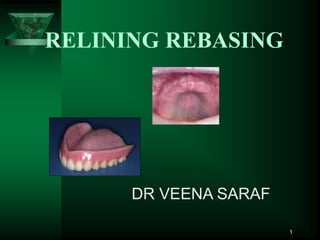
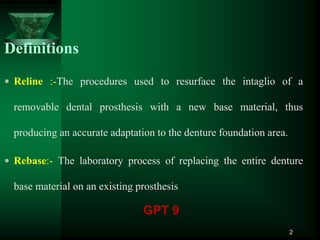
RELINING REBASING
1
DR VEENA SARAF
Definitions
 Reline :-The procedures used to resurface the intaglio of a
removable dental prosthesis with a new base material, thus
producing an accurate adaptation to the denture foundation area.
 Rebase:- The laboratory process of replacing the entire denture
base material on an existing prosthesis
2
GPT 9
Definitions…
 Relining: it is the process of adding some material to
the tissue side of denture to fill the space between the
tissue and the denture base.
 Rebasing: it is the process of replacing all the base
material of a denture.
3
Sheldon Winkler, Essentials Of Complete denture Prosthodontics ,Third Edition , 341-354
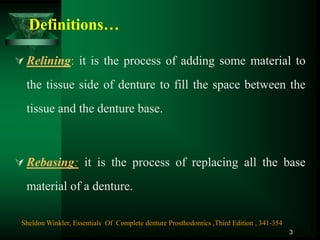
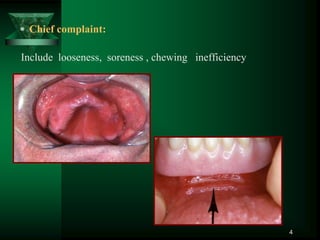
 Chief complaint:
Include looseness, soreness , chewing inefficiency
4
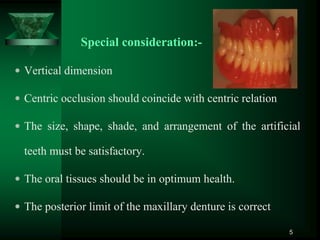
Special consideration:-
 Vertical dimension
 Centric occlusion should coincide with centric relation
 The size, shape, shade, and arrangement of the artificial
teeth must be satisfactory.
 The oral tissues should be in optimum health.
 The posterior limit of the maxillary denture is correct
5
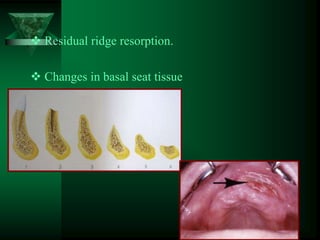
 Residual ridge resorption.
 Changes in basal seat tissue
6
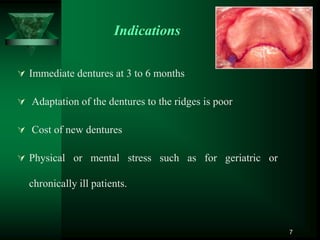
Indications
 Immediate dentures at 3 to 6 months
 Adaptation of the dentures to the ridges is poor
 Cost of new dentures
 Physical or mental stress such as for geriatric or
chronically ill patients.
7
Contraindications
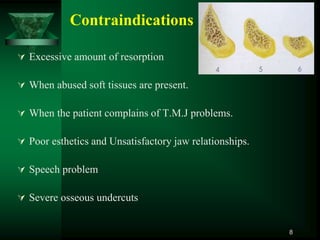
 Excessive amount of resorption
 When abused soft tissues are present.
 When the patient complains of T.M.J problems.
 Poor esthetics and Unsatisfactory jaw relationships.
 Speech problem
 Severe osseous undercuts
8
Advantages
 Eliminates frequency of patient visits.
 Economical for the patient.
 Improves fit of the denture.
 A soft liner incorporated restores the health of soft tissues.
9
Disadvantages
 Likelihood of altering the jaw relationship during the process.
 Cannot correct aesthetics or jaw relations.
 Cannot correct occlusal problems
 Cannot be used when excessive resorption has occurred.
 Hence it cannot be a substitute for a New denture.
10
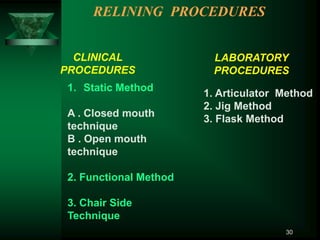
RELINING PROCEDURES
11
CLINICAL
PROCEDURES
LABORATORY
PROCEDURES
1. Static Method
A . Closed mouth
technique
B . Open mouth
technique
2. Functional Method
3. Chair Side
Technique
1. Articulator Method
2. Jig Method
3. Flask Method
12
13
14
15
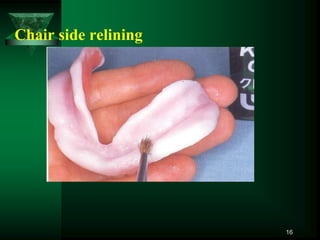
Chair side relining
16
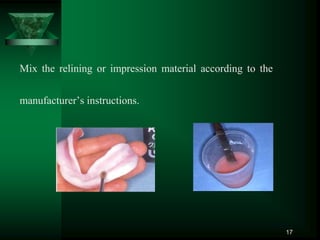
Mix the relining or impression material according to the
manufacturer’s instructions.
17
18
Laboratory procedures
 Flask method
 Articulator method
 Jig method
19
Flask method
20
21
22
23
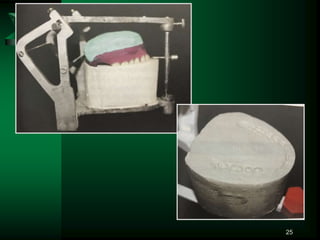
Articulator method
24
25
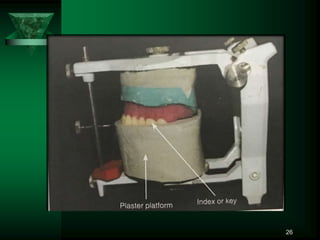
26
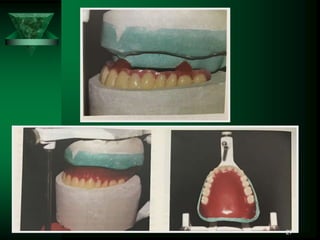
27
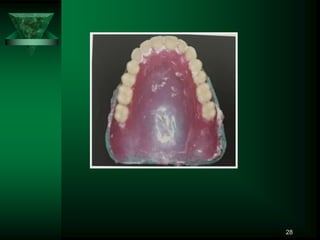
28
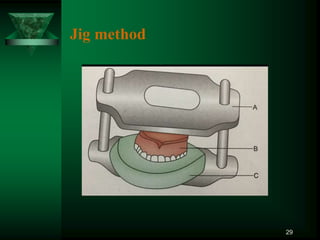
Jig method
29
RELINING PROCEDURES
30
CLINICAL
PROCEDURES
LABORATORY
PROCEDURES
1. Static Method
A . Closed mouth
technique
B . Open mouth
technique
2. Functional Method
3. Chair Side
Technique
1. Articulator Method
2. Jig Method
3. Flask Method
31
“Our country requires heroes; be heroes;
your duty is to go on working, and then
everything will follow of itself”

RELINING REBASING.ppt

Editor's Notes

  • #8 after their original construction When residual alveolar ridges have resorbed and When the patient cannot afford When the construction of new dentures with accompanying series of appointments can cause
  • #9 Relining is not indicated until the tissue recovers.(2nd point ) problems until accurate diagnosis and treatment of the problem has been accomplished.(tmj) When severe osseous undercuts exist until surgical removal and healing occurs
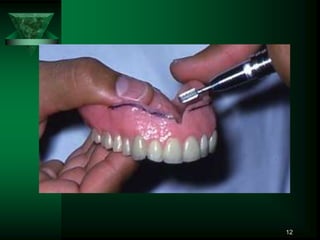
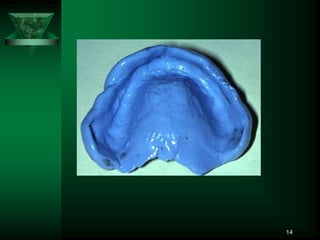
  • #14 A large part of the middle of the palatal portion of the maxillary denture is removed for visibility in positioning the maxillary denture during the impression making.
  • #17 If extensive ridge resorption & loss of vertical dimensions have occurred, 3 compound stops may be required on the impression surface of the denture to reestablish a proper occlusal relationship. A treatment liner is next placed inside the denture. The lining material should flow evenly to cover the whole impression surface and the borders of the dentures with a thin layer.
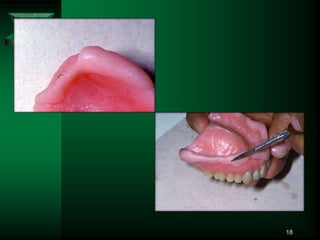
  • #18 Excessive material is not desirable and should be avoided.
  • #19 If voids are evident they should be filled with a fresh mix of liner material Unsupported parts of the liners may occur on the borders of the denture and this indicates that localized border molding with stick compound may be needed before the placement of a fresh mix of liner. The patient’s mandible is guided into a retruded position, to help stabilized the denture while lining the material is settling. Excess material is trimmed away with a hot sharp scalpel
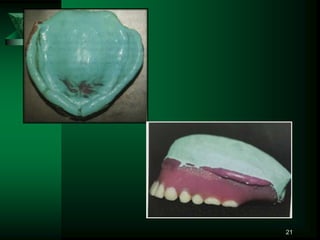
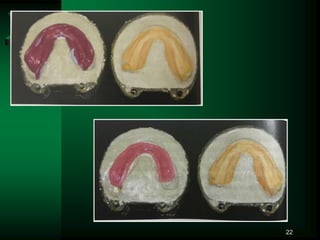
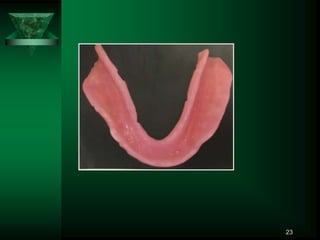
  • #22 The relined impression is poured with the dental stone.(1) The master cast is poured around the impression made by beading and boxing.(2) This cast provides the surface against which the denture is relined by embedding it in a processing flask.(3) The flask is warmed to soften the impression compound before opening it to remove the impression material.(4) Separating medium is applied on the plaster and stone moulds, and heat polymerized denture base resin is packed into the mould. The flask is then closed and clamped to ensure maintenance of occlusal vertical dimension. The acrylic is then processed. After processing the flask is cooled slowly and the denture is retrieved from stone mould, finished and polished.
  • #26 As the plaster is setting, the cast with the relined impression is placed on the wet plaster platform such that the teeth penetrate the plaster surface to a depth of 2mm and the occlusal plane is parallel to the floor. This forms an index or key of the teeth on the plaster platform which allows repositioning of the teeth maintaining the distance and the relation with the cast. Once the plaster platform sets additional plaster is placed on the base of the cast and it is mounted on the upper member of articulator.
  • #28 When mounting sets, denture with the impression can be separated from the cast. At this point one may elect to rebase or reline the denture. It differs only in amount of trimming of denture. The denture base is waxed, cast, and the denture are removed from the mounting, flasked, and processed with heat-cure denture base acrylic resin.