SWK1048 Faith and Community
Rev. Fr Tim Curtis 1
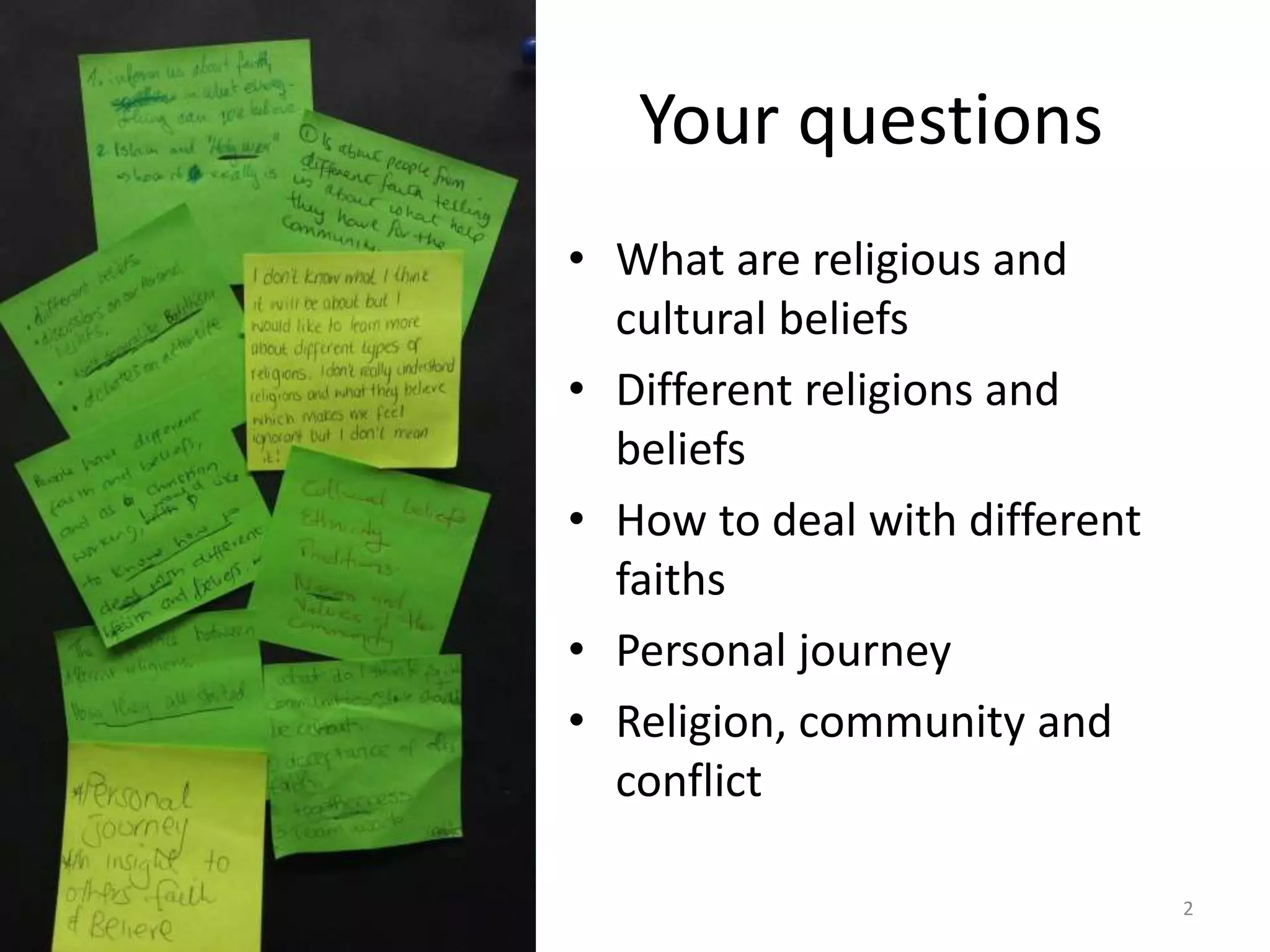
Your questions
• What are religious and
cultural beliefs
• Different religions and
beliefs
• How to deal with different
faiths
• Personal journey
• Religion, community and
conflict
2
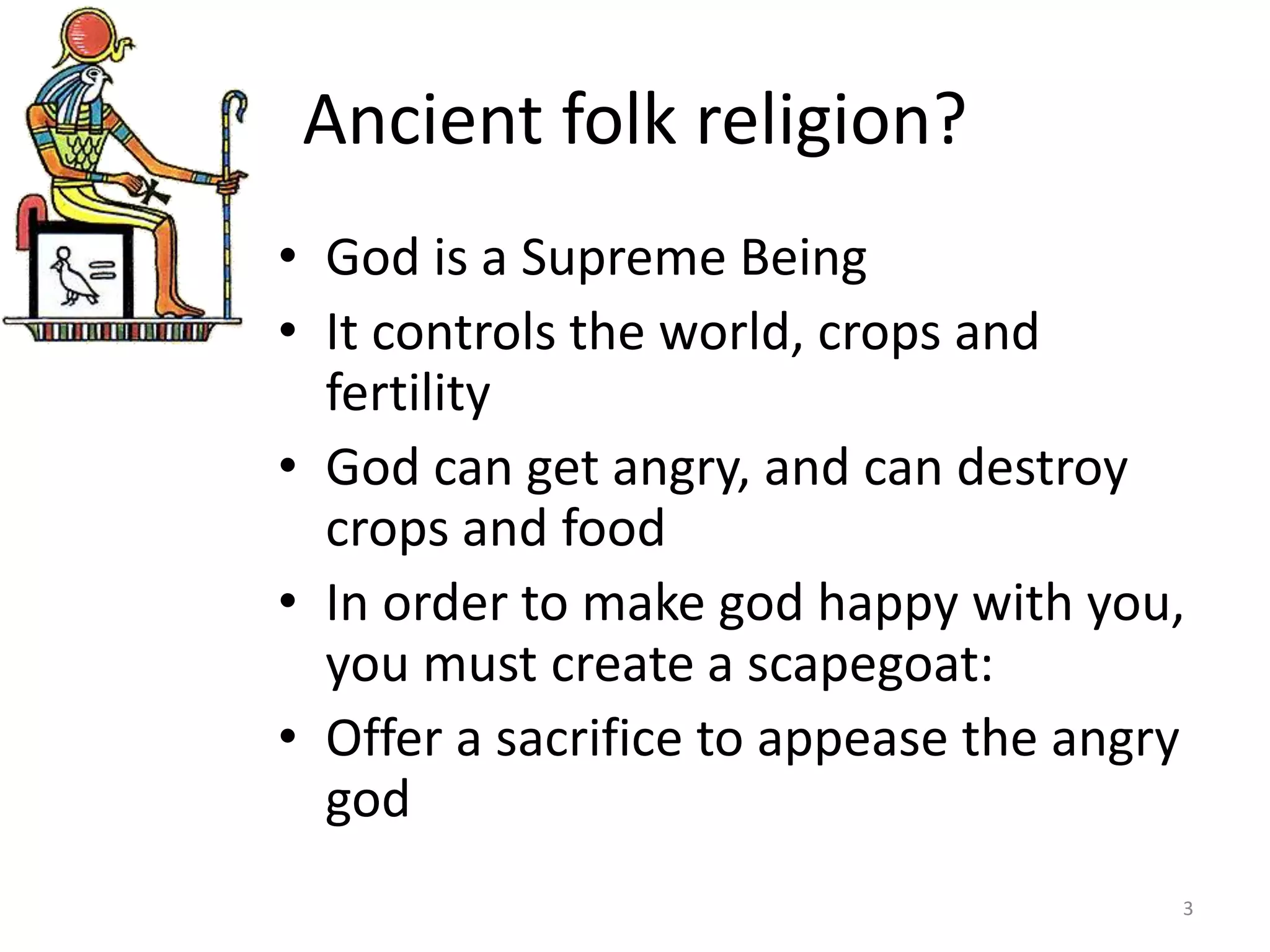
Ancient folk religion?
• God is a Supreme Being
• It controls the world, crops and
fertility
• God can get angry, and can destroy
crops and food
• In order to make god happy with you,
you must create a scapegoat:
• Offer a sacrifice to appease the angry
god
3
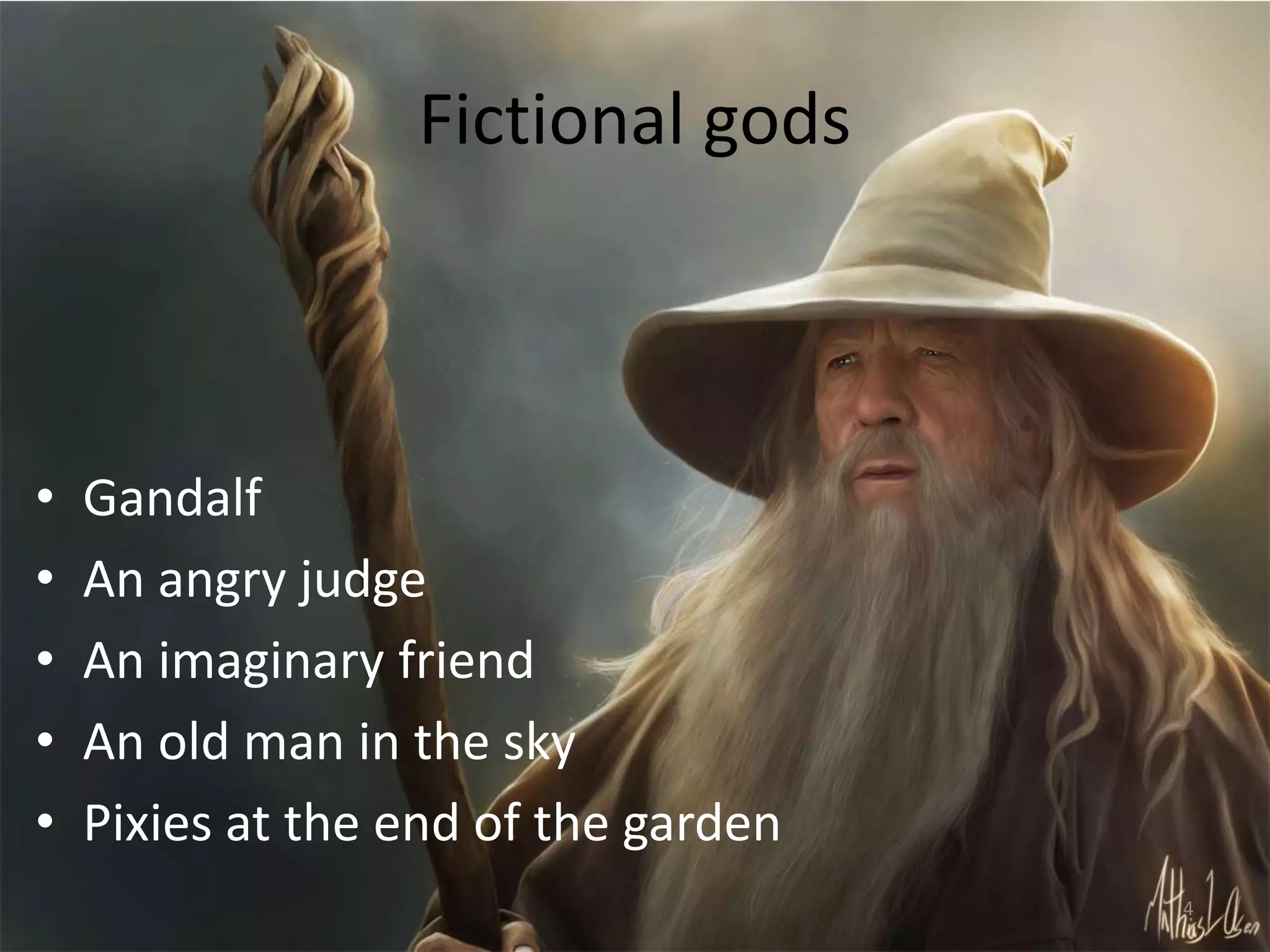
Fictional gods
• Gandalf
• An angry judge
• An imaginary friend
• An old man in the sky
• Pixies at the end of the garden
4
Modern folk religion (MTD)
• A god exists who created and ordered the
world and watches over (but doesn’t interfere
in) human life on earth.
• God wants people to be good, nice, and fair to
each other, as taught in the Bible and by most
world religions.
• The central goal of life is to be happy and to
feel good about oneself.
• God does not need to be particularly involved
in one's life except when God is needed to
resolve a problem.
• Good people go to heaven when they die.
Smith, Christian; Lundquist Denton, Melina (2005). Soul Searching : The Religious and Spiritual Lives of American
Teenagers: The Religious and Spiritual Lives of American Teenagers. Oxford University Press.
5
God and Faith
• God is not a thing, in this universe
• God created space and time
• God is unknowable in space and time
• We cannot think outside space and time
• God sustains its creation, all the time
• God is intimately involved in creation – and in
particular through Jesus (for Christians)
• God is Love, and does not need a scapegoat
6
Belief, faith, spirituality or religion?
• Belief- we all believe in something, but it
doesn’t always have to be a God (atheist).
– We might believe in science or randomness, as an
explanation of why we are here- but it is still a
belief
• We might not be sure, or need more proof, of
haven’t thought of it (agnostic)
• We believe that there is a God (a theist)
7
Spirituality
• animating or vital principle in man and animals
• Essentially a personal experience, as opposed to
a group
• Natural: deriving from nature and the beauty of
human experience
• Esoteric: peak experiences, methods of getting ‘in
touch with’ God
• Observances: Judaism knows a variety of religious
observances: ethical rules, prayers, religious
clothing, holidays, shabbat, pilgrimages, Torah
reading, dietary laws
8
Belief
• a point of view or ‘une conviction’ must ‘attain a
certain level of cogency, seriousness, cohesion
and importance, be worthy of respect in a
democratic society and … not incompatible with
human dignity’.
• Equality Act 2006
– cogent
– serious
– cohesive
– compatible with human dignity.
9
Religion
• A group experience. Emile Durkheim -"something
eminently social"
• A collection of individual spiritual experiences
• Marked by symbols of the common experience: texts,
practices, places, rituals, histories, festivals, ‘special’ or
holy people, like clergy, shamans etc
• Ritual = Repetition of common experiences over time-
ritual
• Holy = things set apart
• A group narrative, requires ‘insiders’ and ‘outsiders’
Durkheim, E. (1915) The Elementary Forms of the Religious Life. London: George Allen & Unwin,
p.10.
10
Supreme Court case: Hodkin v
Registrar 2013
• Lord Toulson’s description of religion has four
elements:
• religion is a spiritual or non-secular belief system
• adherents to the belief system form a group
• the belief system claims to explain mankind’s
place in the universe and relationship with the
infinite
• there is a code of behaviour consistent with the
belief system
11
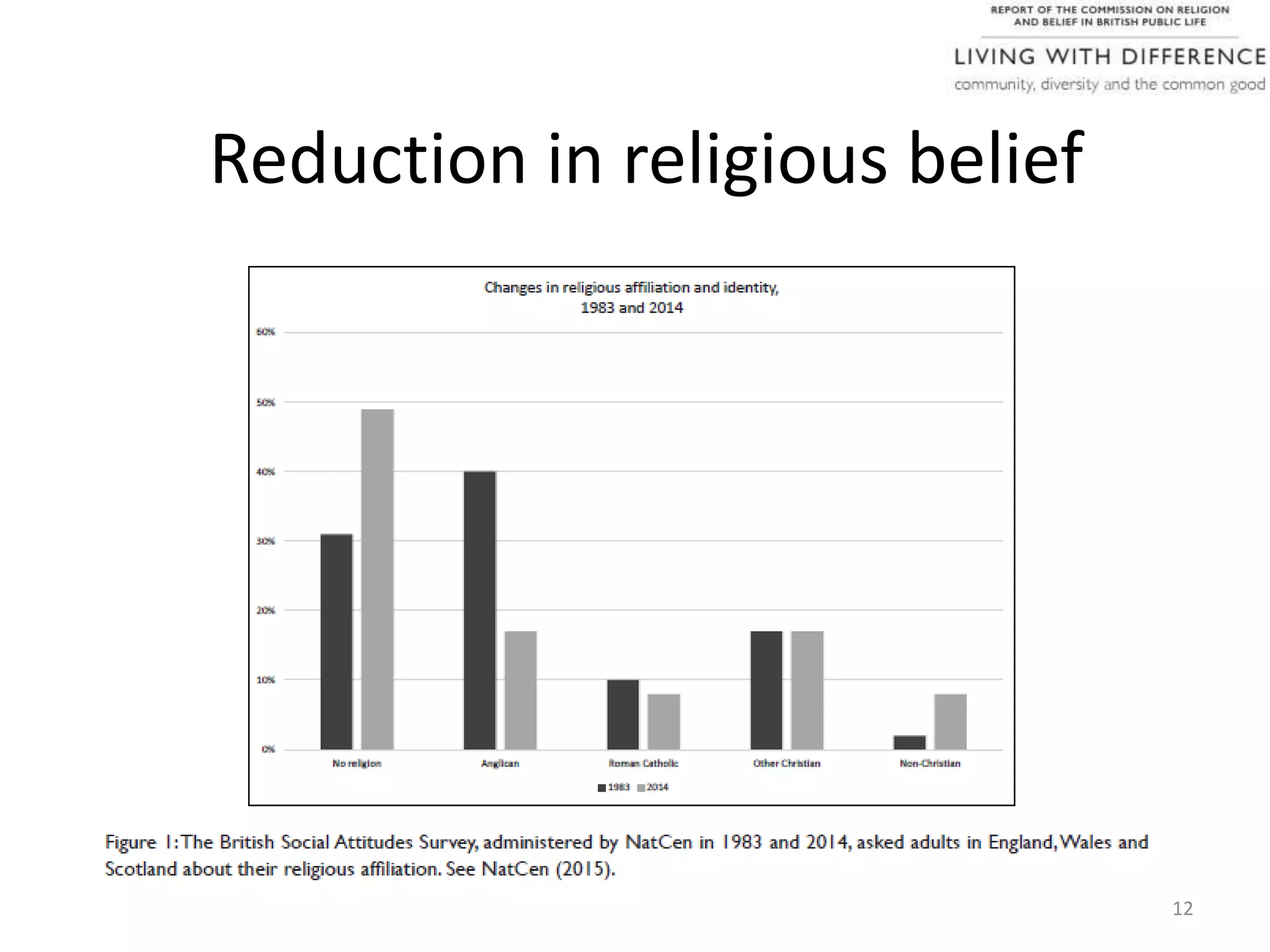
Reduction in religious belief
12
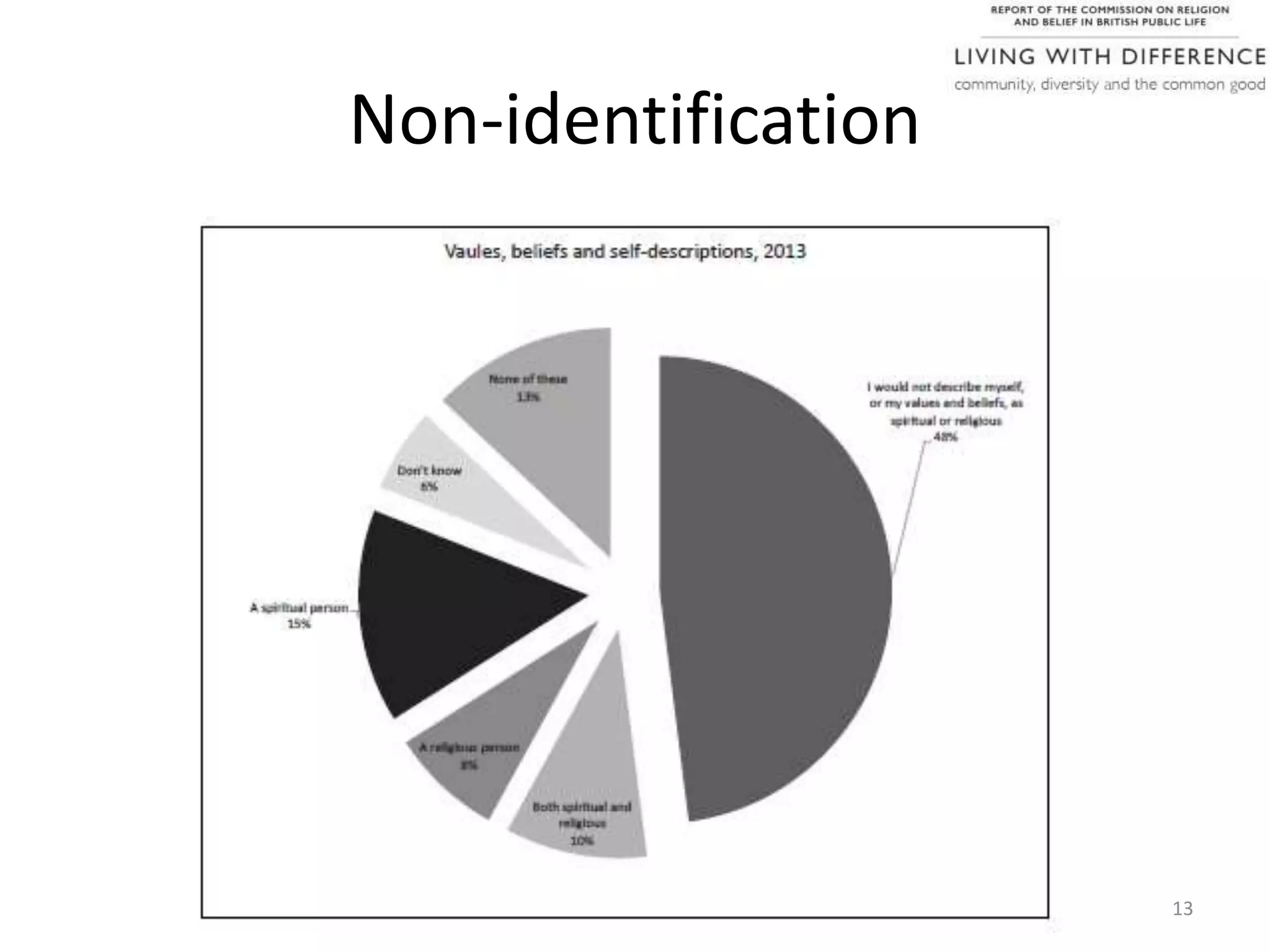
Non-identification
13
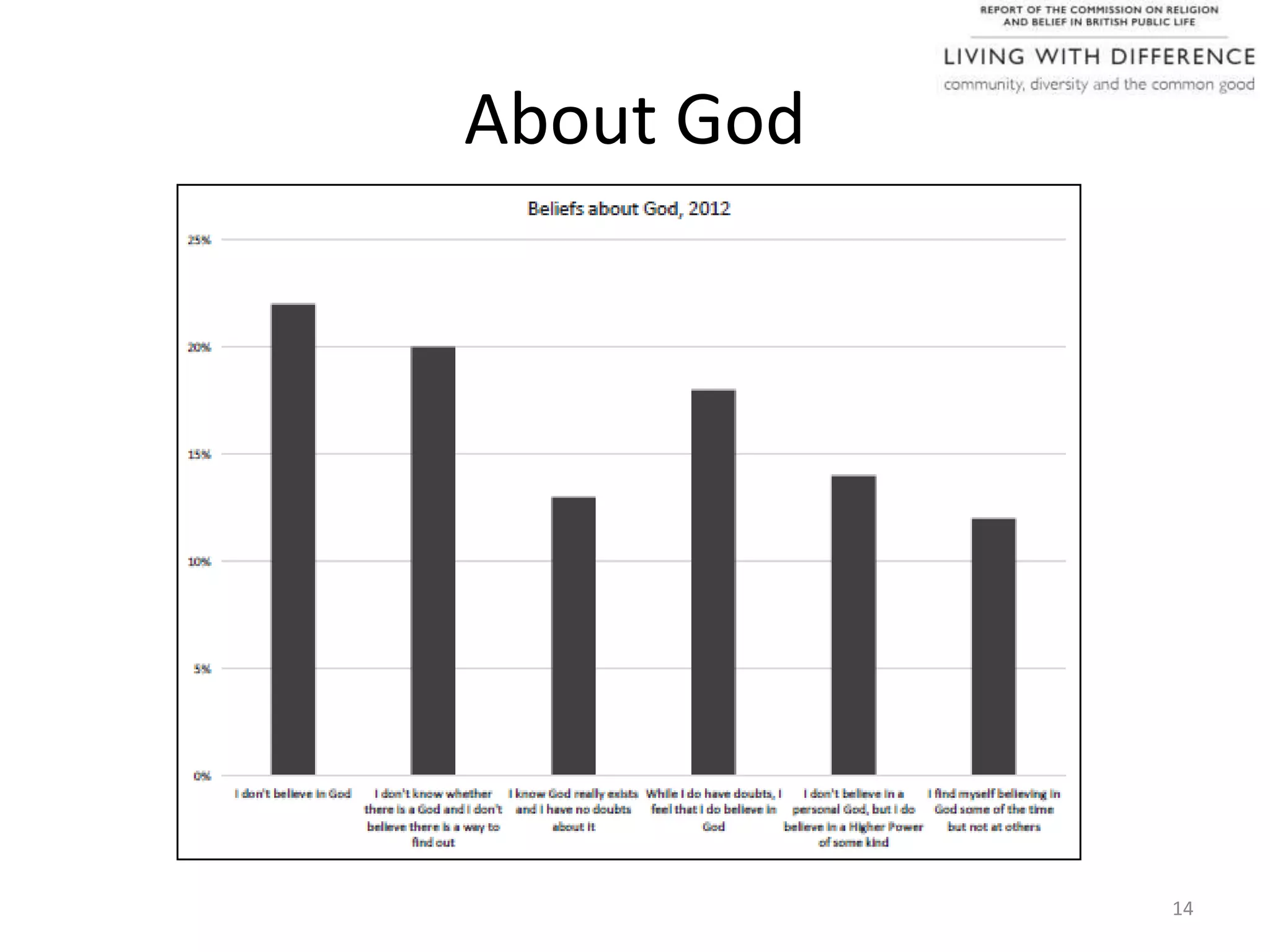
About God
14
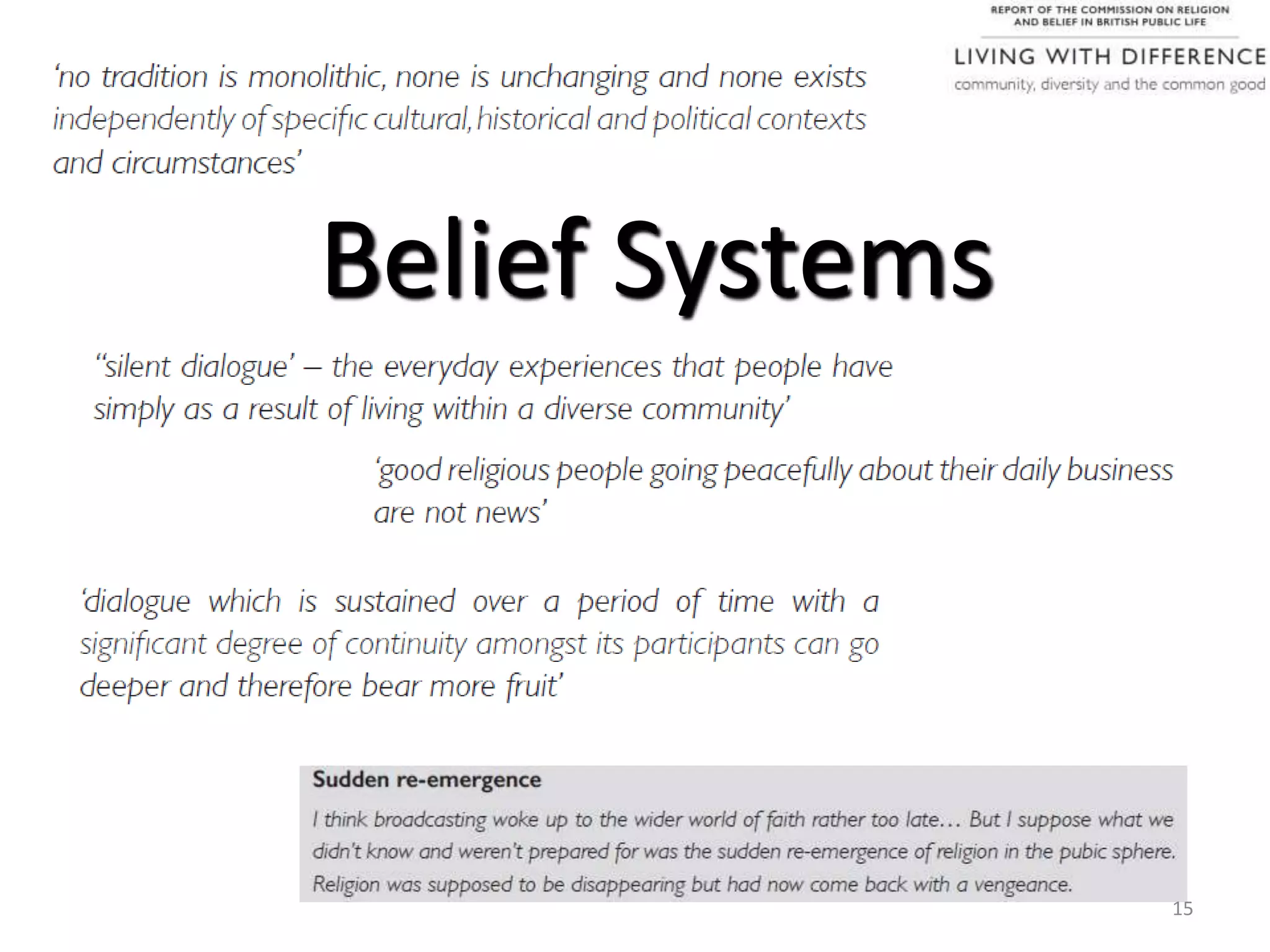
Belief Systems
15
Animism
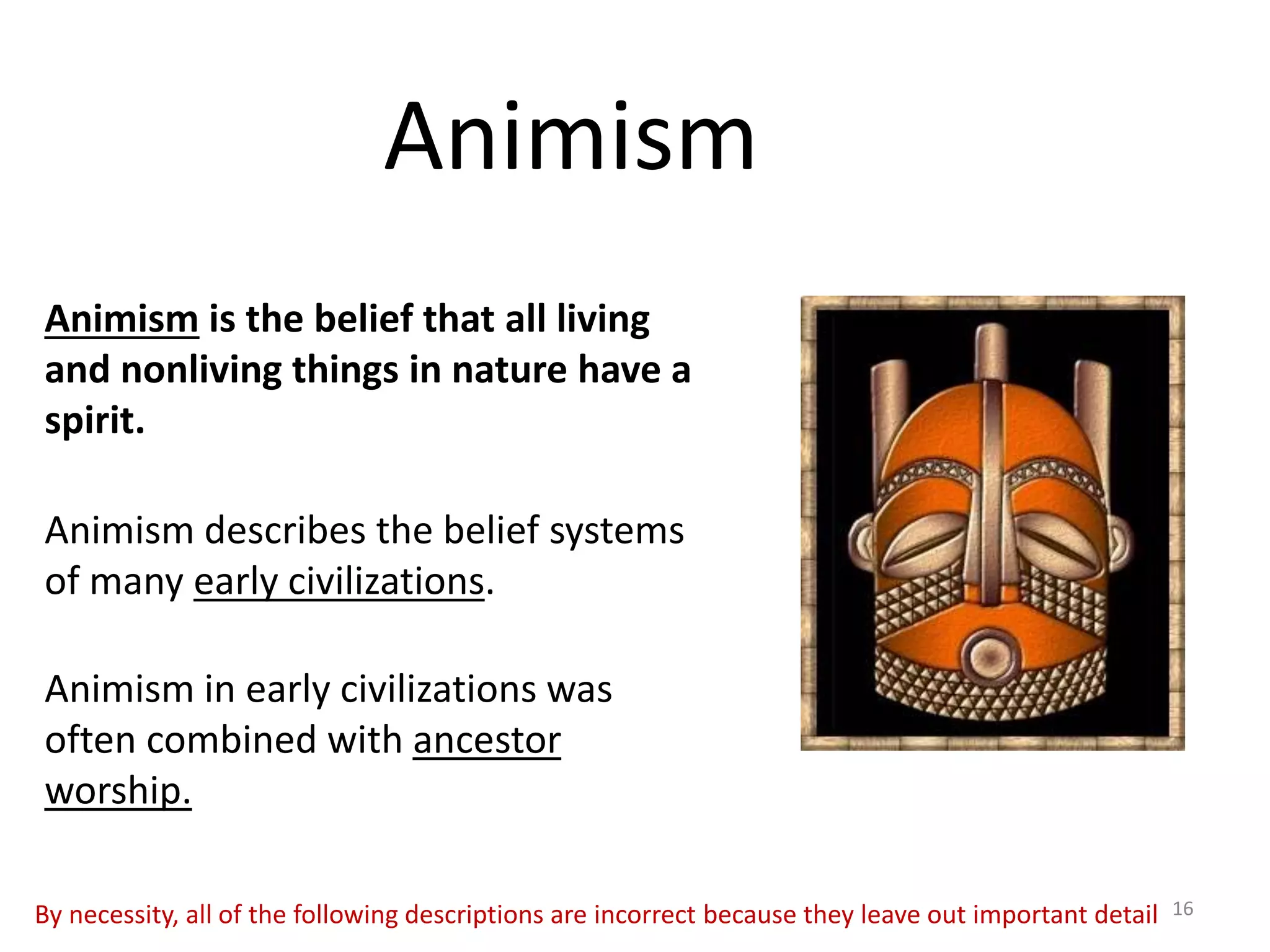
Animism is the belief that all living
and nonliving things in nature have a
spirit.
Animism describes the belief systems
of many early civilizations.
Animism in early civilizations was
often combined with ancestor
worship.
16By necessity, all of the following descriptions are incorrect because they leave out important detail
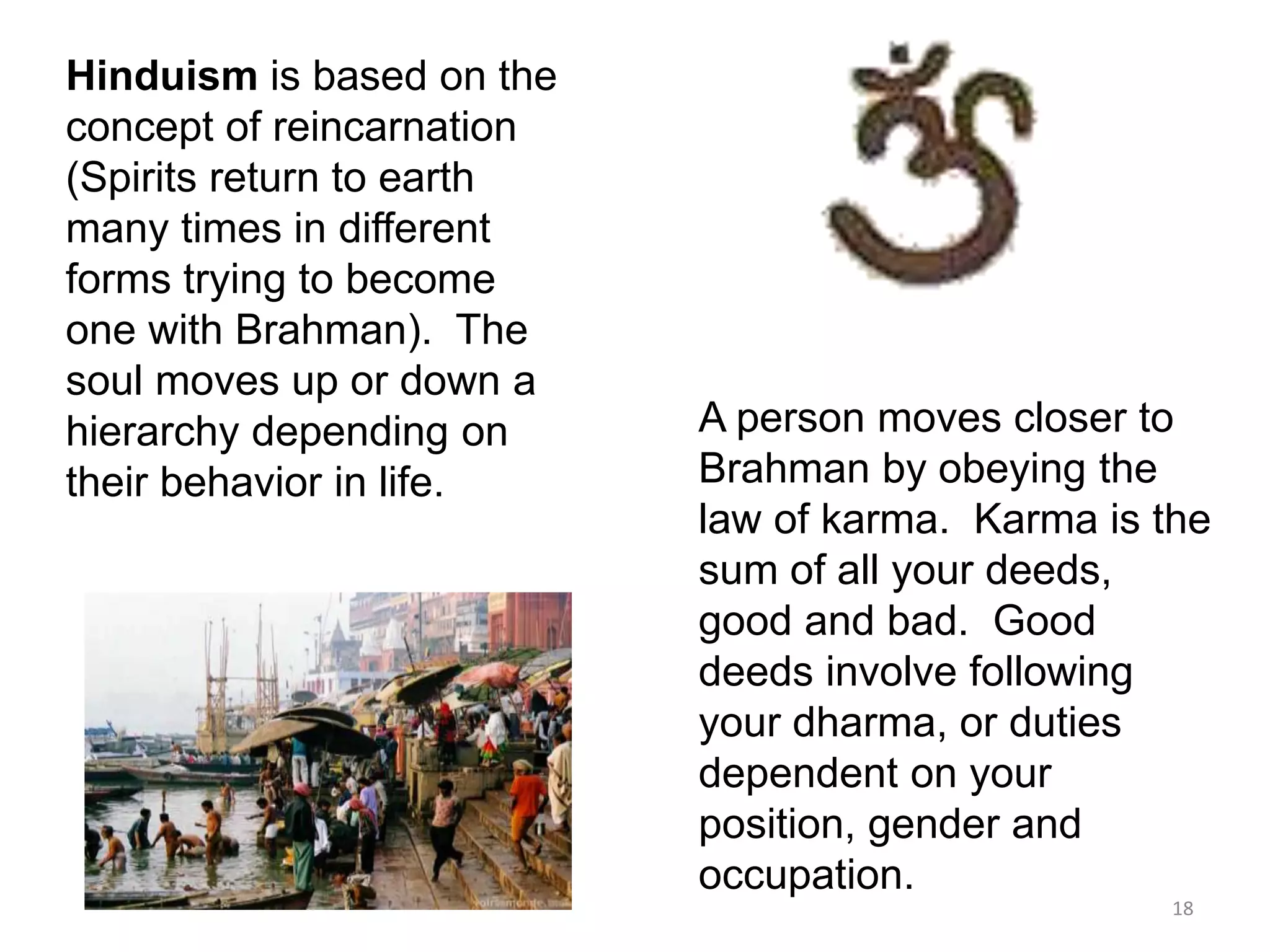
Hinduism has no single
founder, but originated from
the mixing of Harappan and
Aryan cultures in ancient
India around 1500 BCE.
Hindus believe in one
unifying spirit, Brahman.
Brahman can manifest in
many, polytheistic, forms
or in one, monotheistic.
17
Hinduism is based on the
concept of reincarnation
(Spirits return to earth
many times in different
forms trying to become
one with Brahman). The
soul moves up or down a
hierarchy depending on
their behavior in life.
A person moves closer to
Brahman by obeying the
law of karma. Karma is the
sum of all your deeds,
good and bad. Good
deeds involve following
your dharma, or duties
dependent on your
position, gender and
occupation.
18
The caste system separated Indian society into
distinct social classes in which everyone knew
their place and believed that if they followed the
dharma of their caste, they would be reincarnated
into a better caste.
Brahmin
Kshatriya
Vaisya
Sudra
Untouchables
19
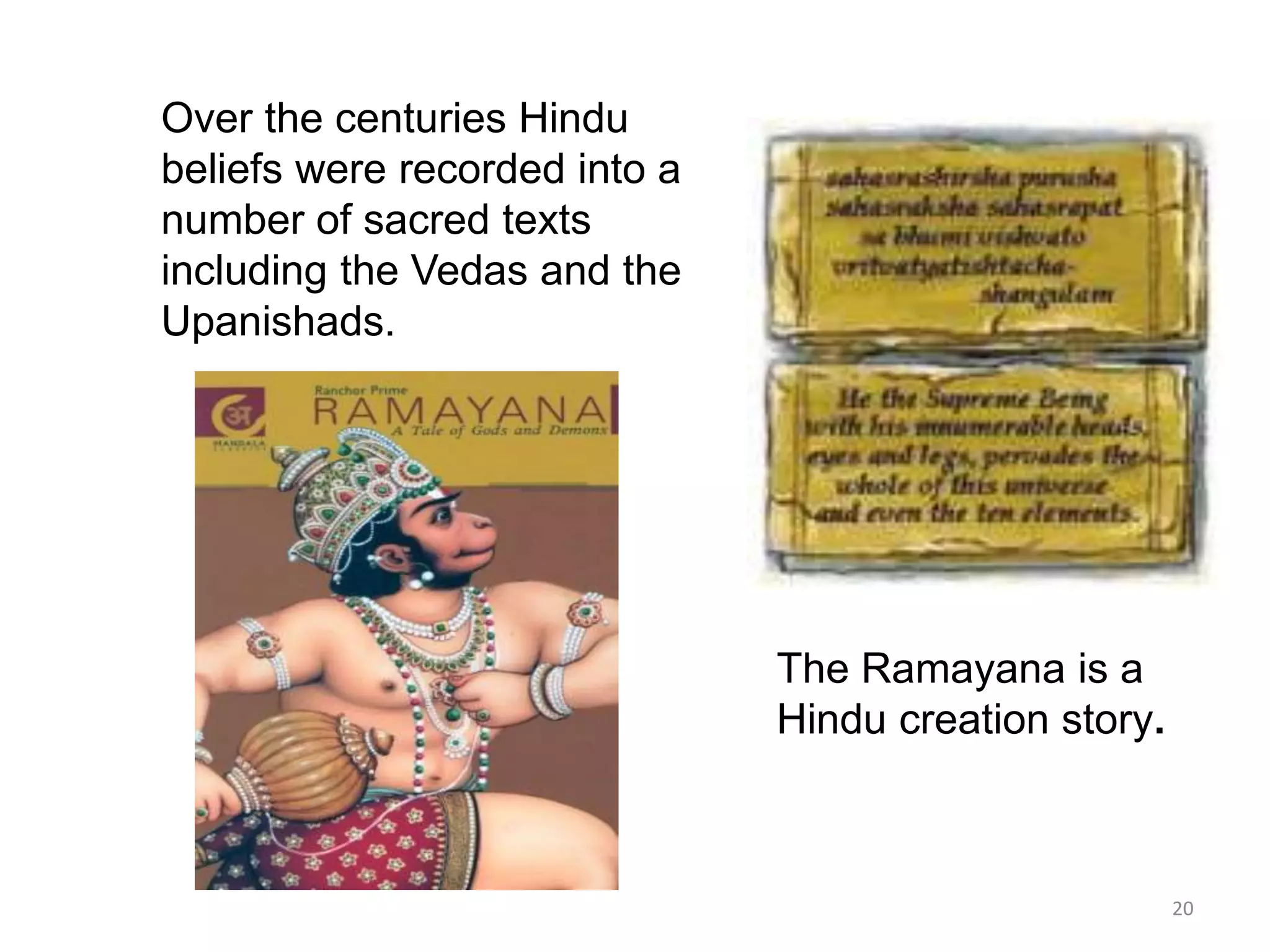
Over the centuries Hindu
beliefs were recorded into a
number of sacred texts
including the Vedas and the
Upanishads.
The Ramayana is a
Hindu creation story.
20
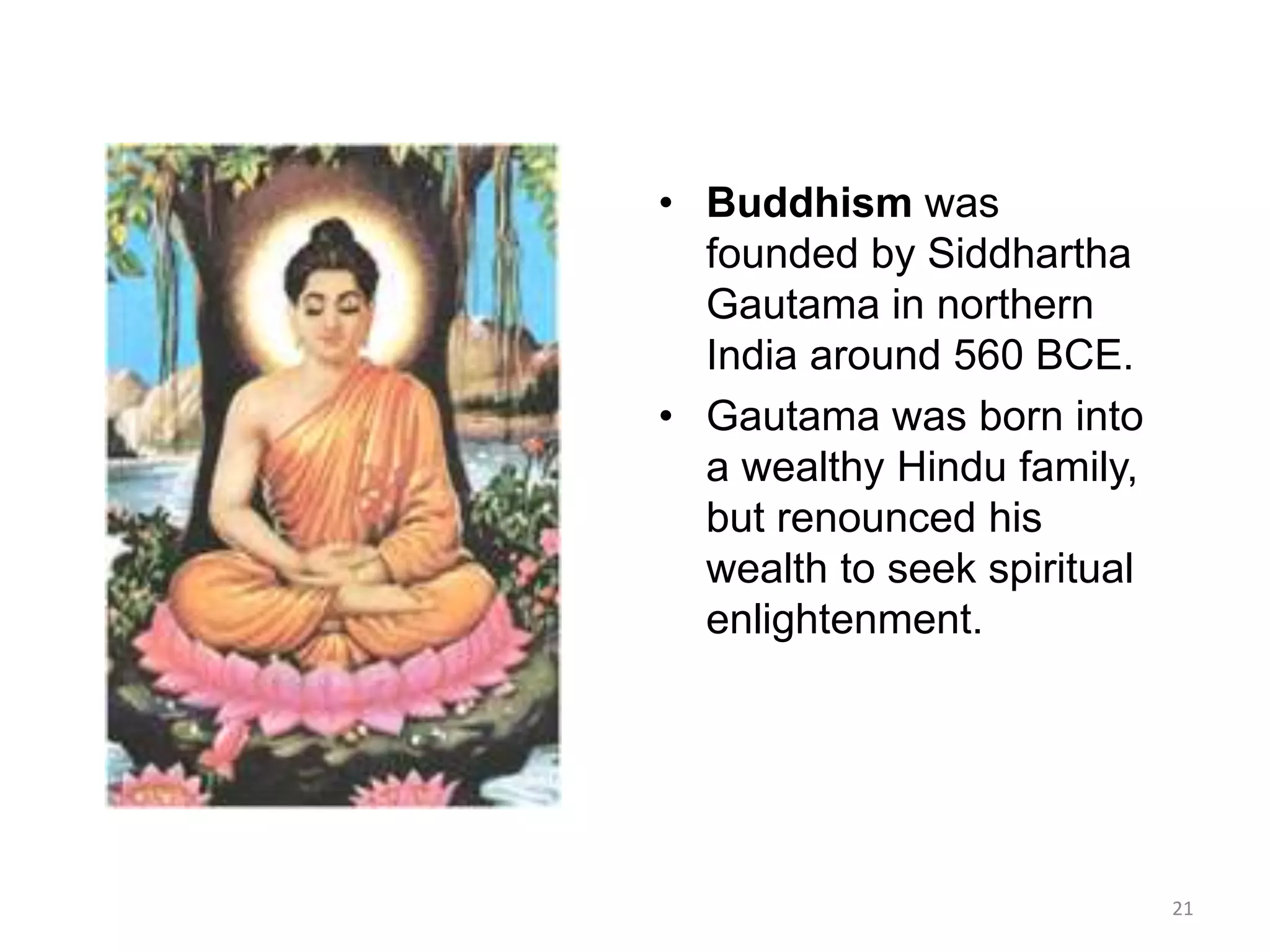
• Buddhism was
founded by Siddhartha
Gautama in northern
India around 560 BCE.
• Gautama was born into
a wealthy Hindu family,
but renounced his
wealth to seek spiritual
enlightenment.
21
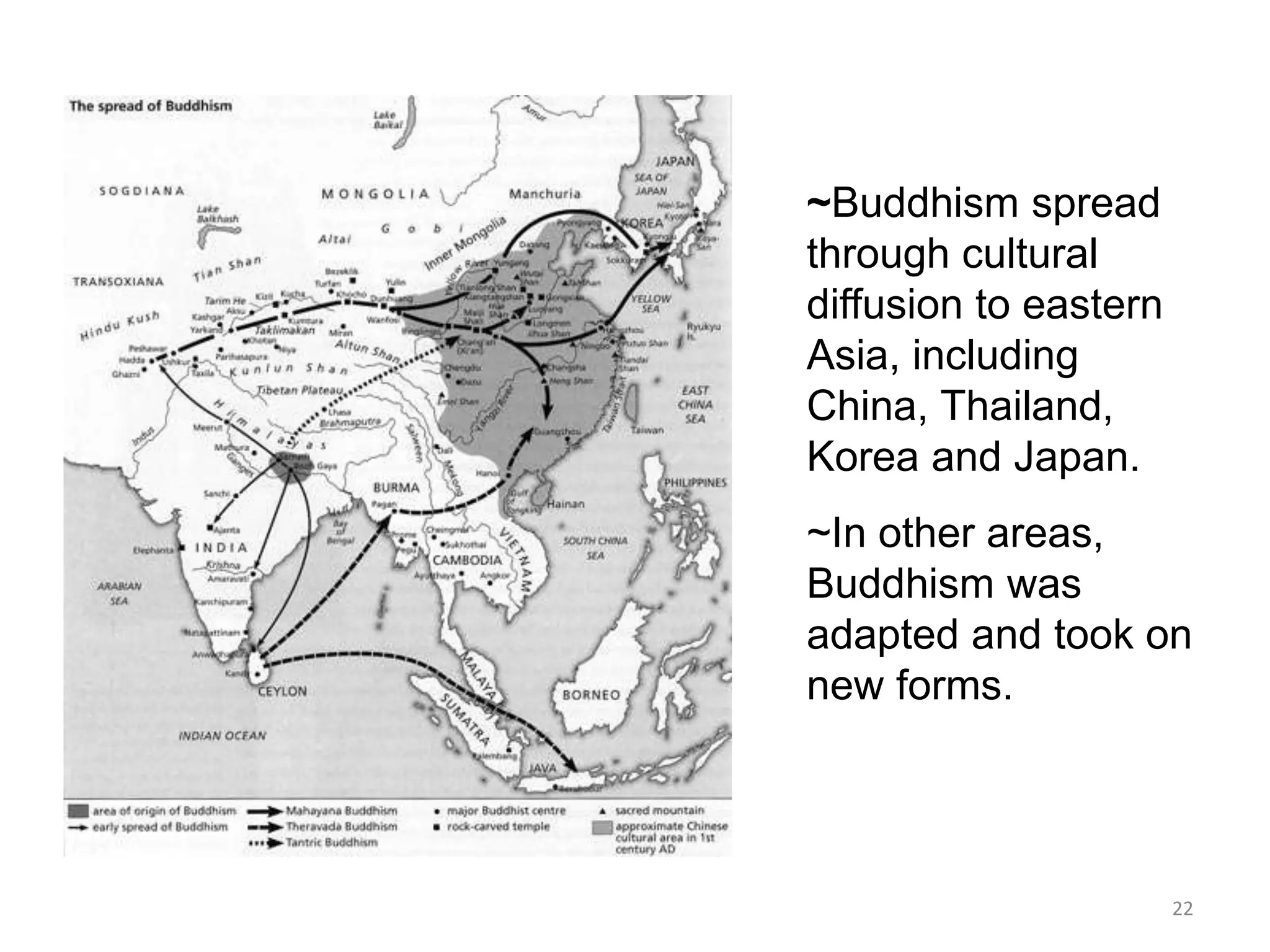
~Buddhism spread
through cultural
diffusion to eastern
Asia, including
China, Thailand,
Korea and Japan.
~In other areas,
Buddhism was
adapted and took on
new forms.
22
Buddhism is based on the Four Noble Truths.
1. All life is
suffering.
2. Suffering is
caused by desire for
things that are
illusions.
3. The way to
eliminate suffering
is to eliminate
desire.
4. Following the
Eightfold path will
help people to
overcome desire.
23
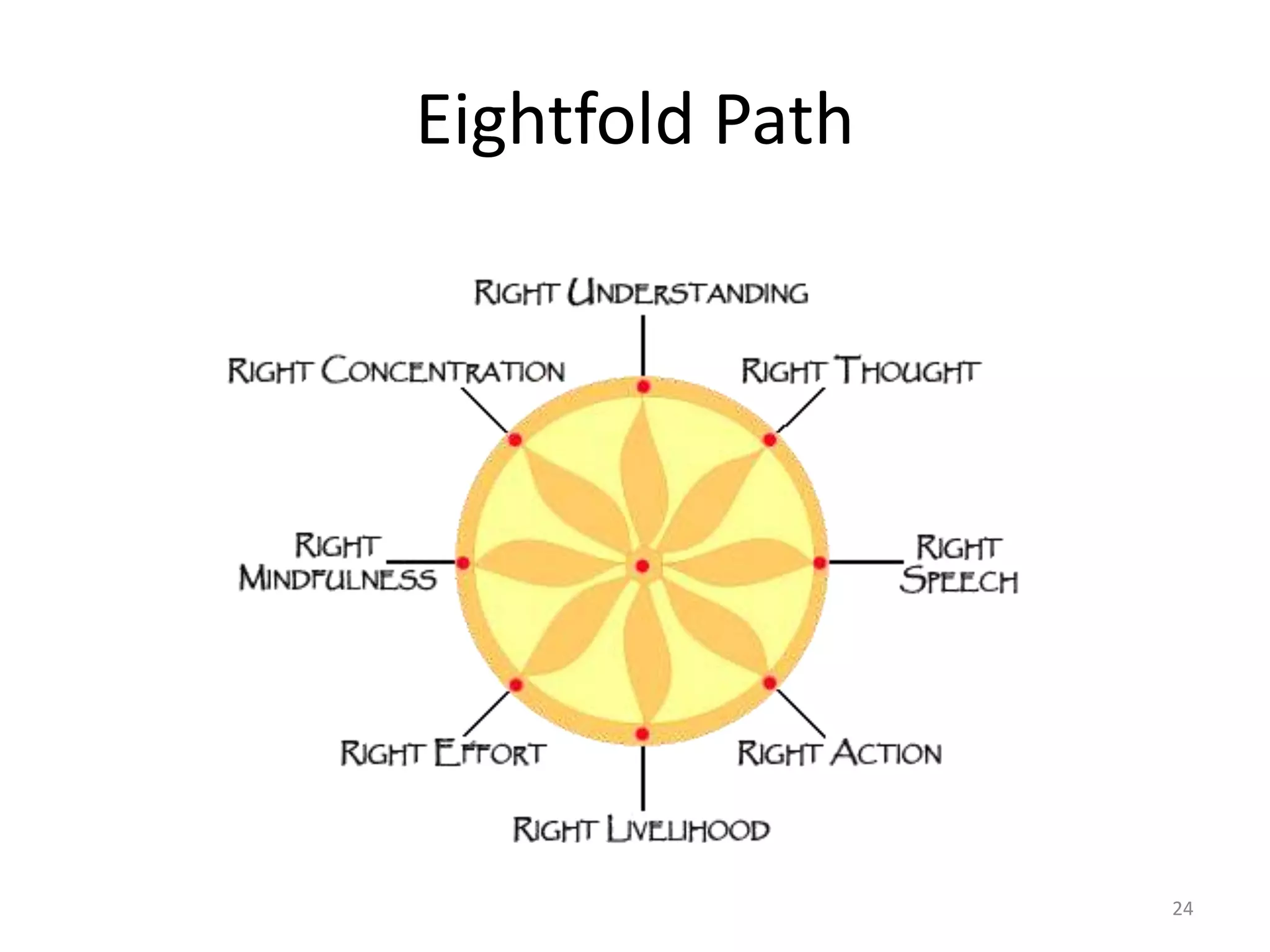
Eightfold Path
24
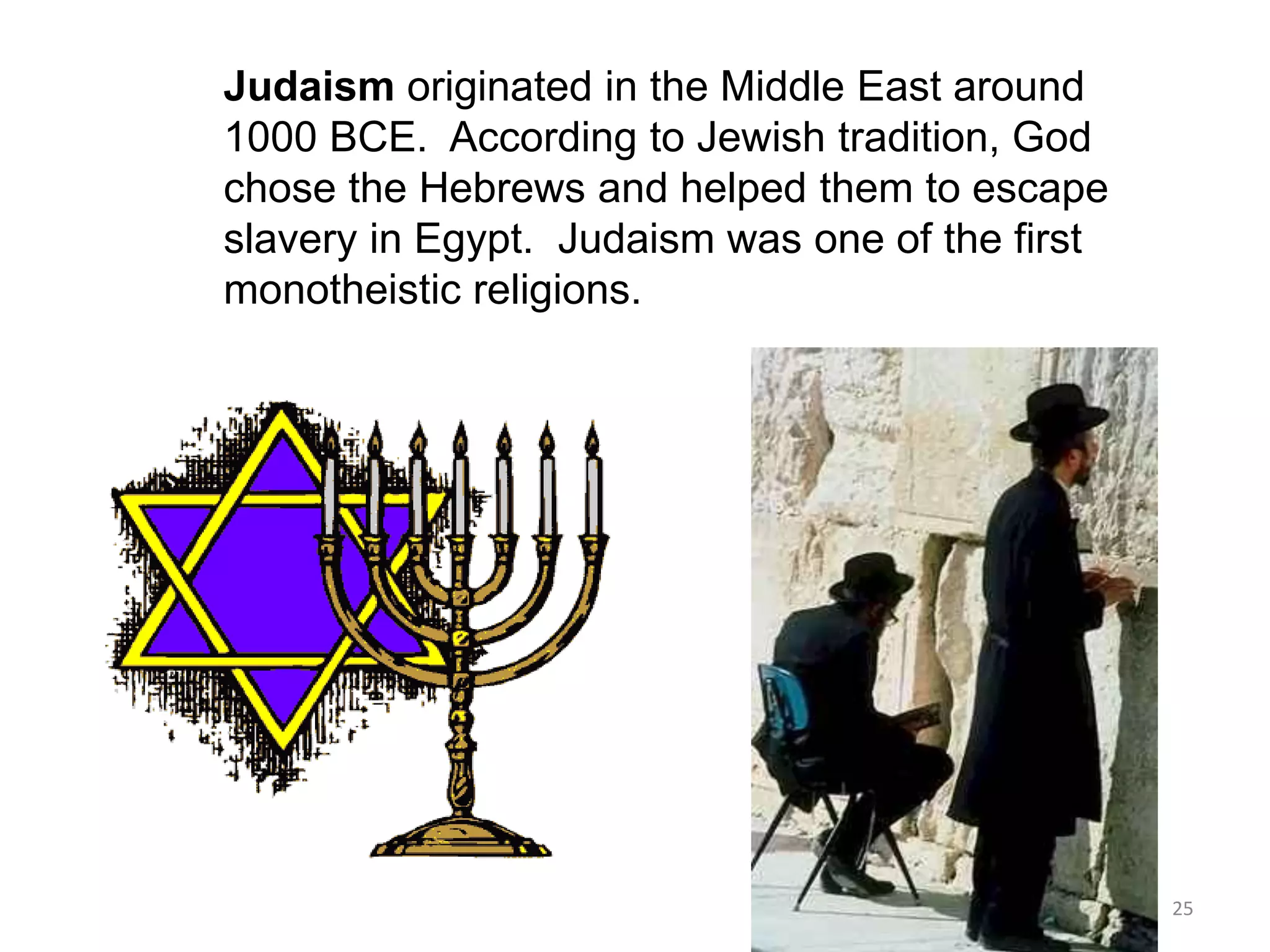
Judaism originated in the Middle East around
1000 BCE. According to Jewish tradition, God
chose the Hebrews and helped them to escape
slavery in Egypt. Judaism was one of the first
monotheistic religions.
25
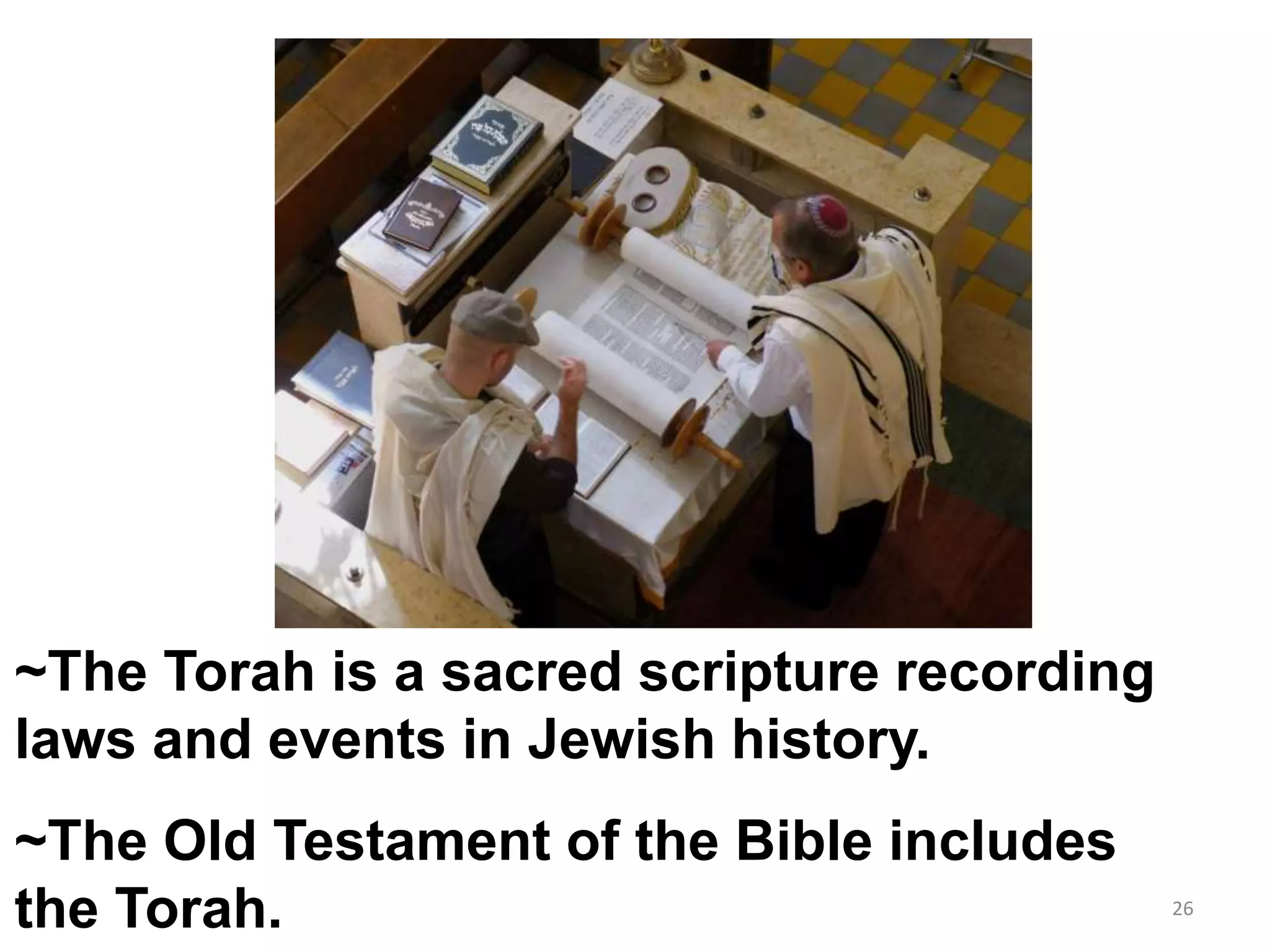
~The Torah is a sacred scripture recording
laws and events in Jewish history.
~The Old Testament of the Bible includes
the Torah. 26
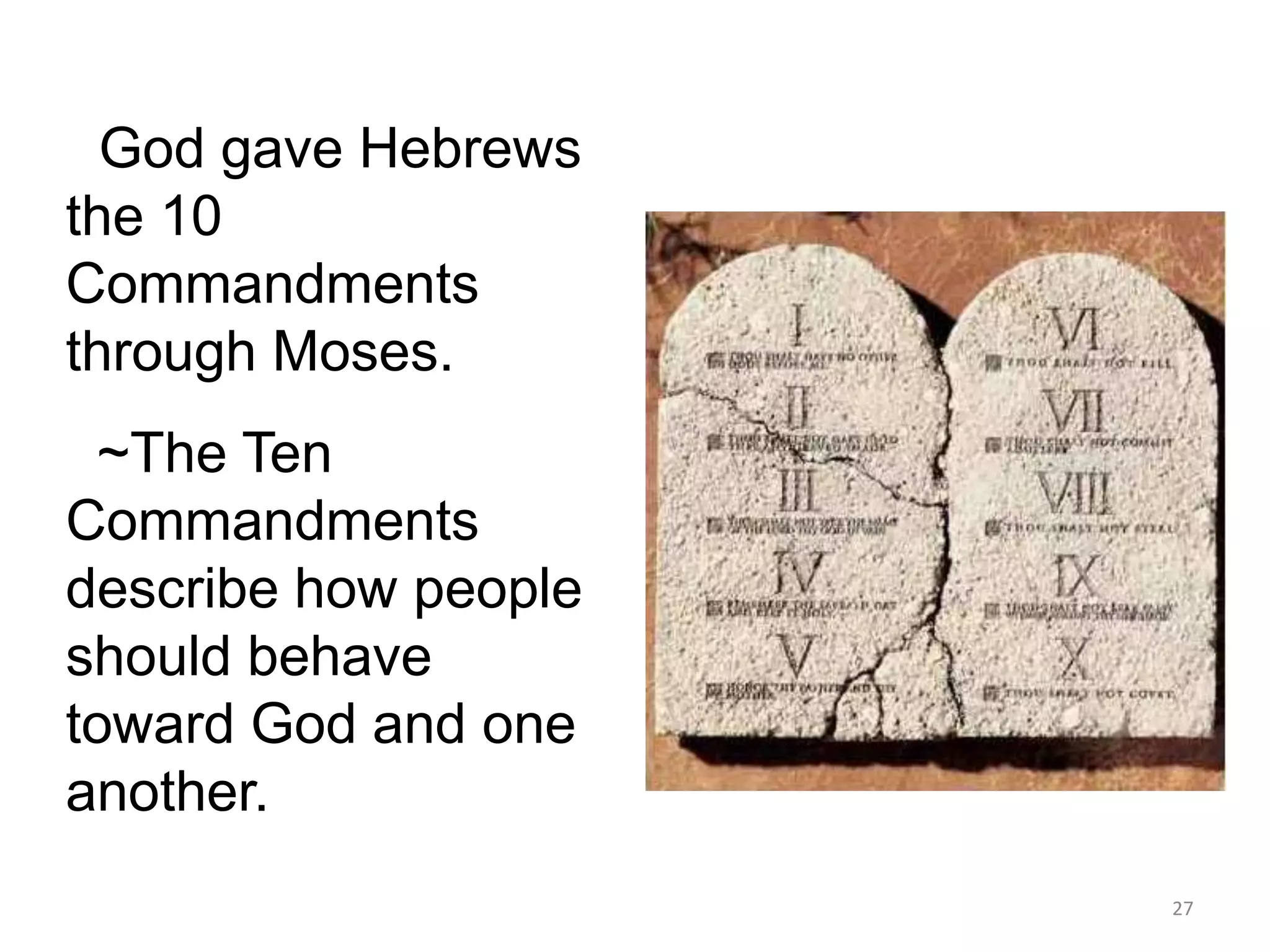
~God gave Hebrews
the 10
Commandments
through Moses.
~The Ten
Commandments
describe how people
should behave
toward God and one
another.
27
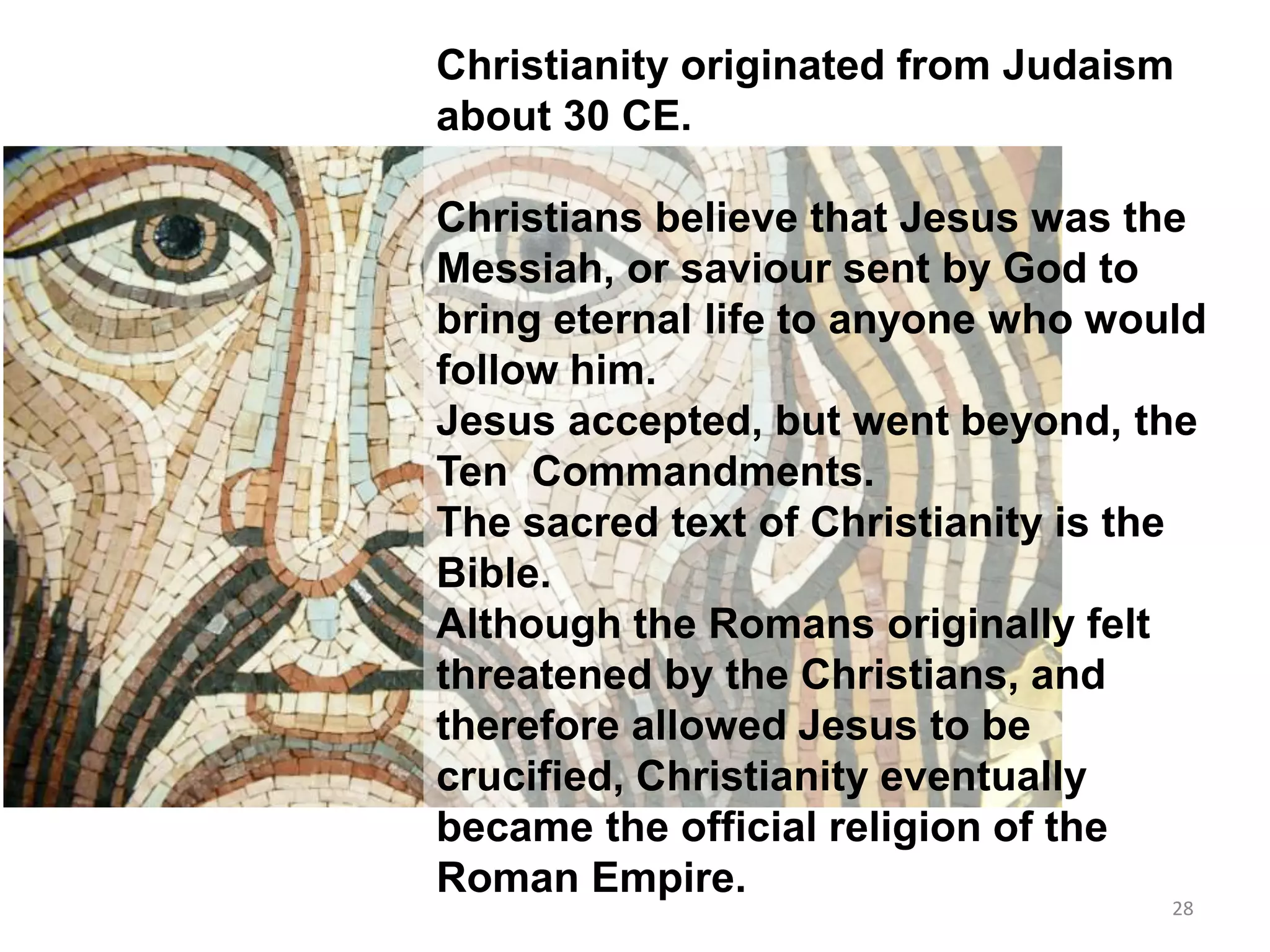
Christianity originated from Judaism
about 30 CE.
Christians believe that Jesus was the
Messiah, or saviour sent by God to
bring eternal life to anyone who would
follow him.
Jesus accepted, but went beyond, the
Ten Commandments.
The sacred text of Christianity is the
Bible.
Although the Romans originally felt
threatened by the Christians, and
therefore allowed Jesus to be
crucified, Christianity eventually
became the official religion of the
Roman Empire.
28
Islam originated in
the Middle East
around 622 CE with
the Prophet,
Muhammad.
Muhammad was
born in Mecca and
traveled to Medina
in a journey called
the hijra, that
became the
founding of Islam.
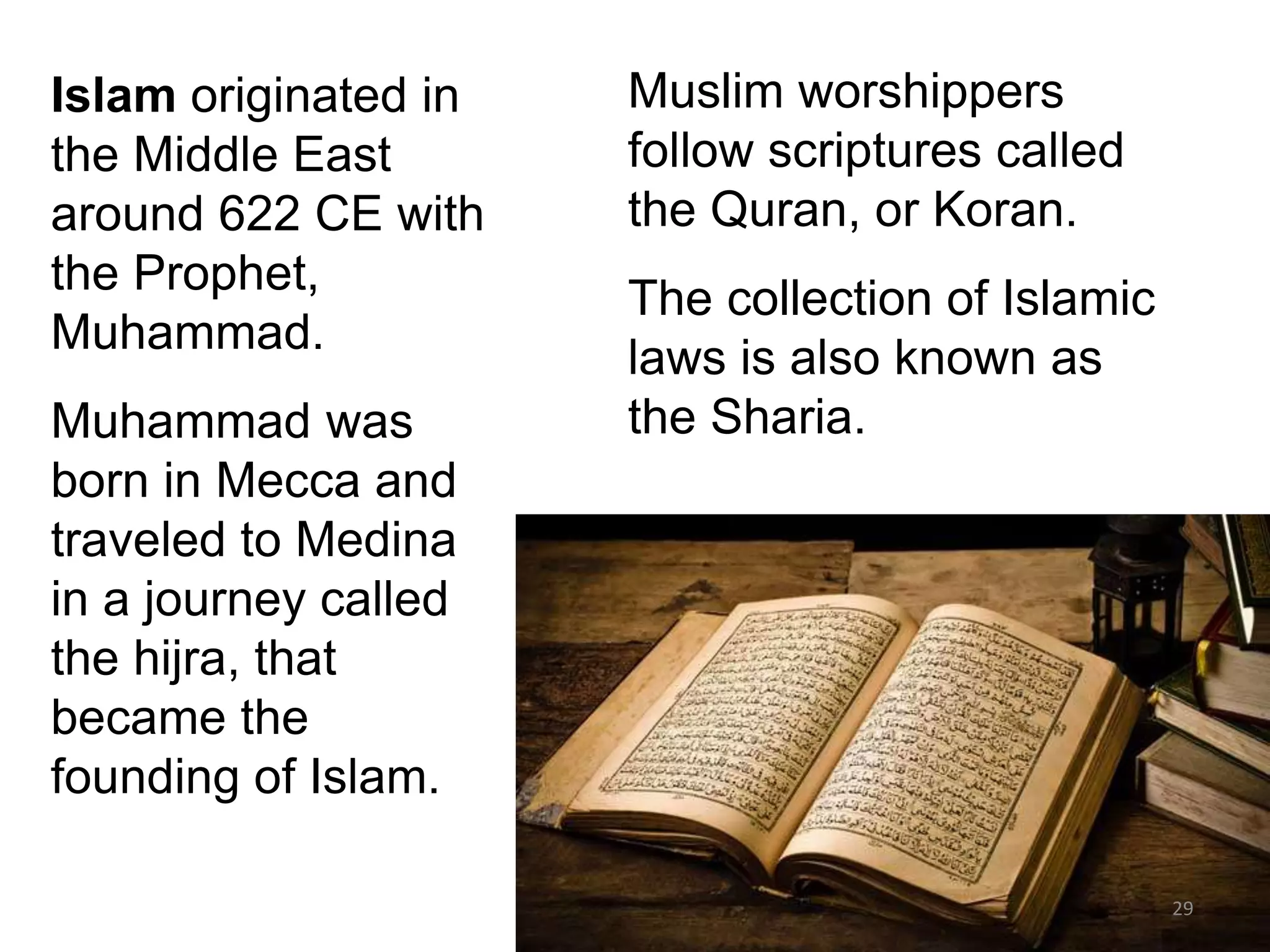
Muslim worshippers
follow scriptures called
the Quran, or Koran.
The collection of Islamic
laws is also known as
the Sharia.
29
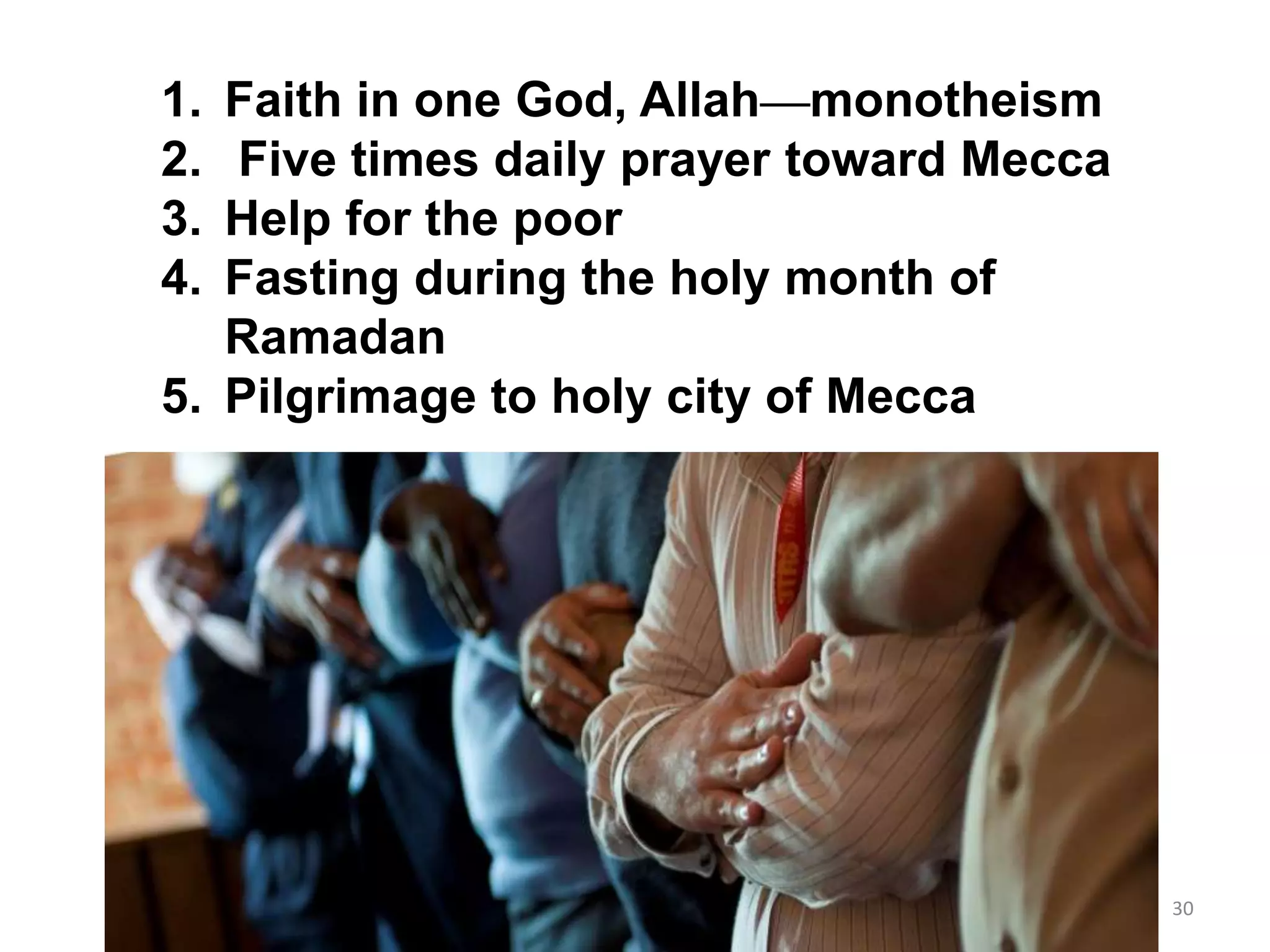
Five Pillars of Islam1. Faith in one God, Allah—monotheism
2. Five times daily prayer toward Mecca
3. Help for the poor
4. Fasting during the holy month of
Ramadan
5. Pilgrimage to holy city of Mecca
30
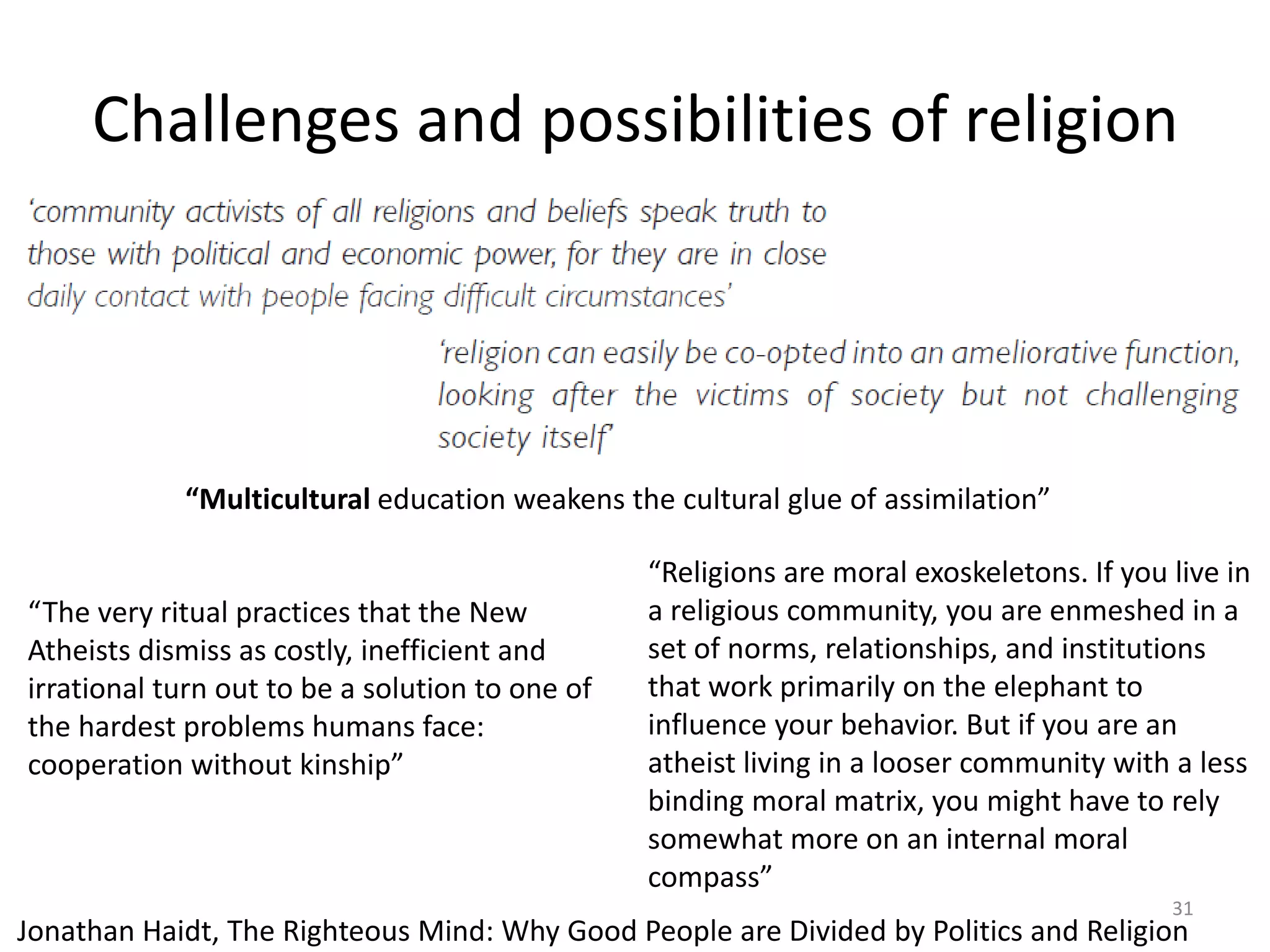
Challenges and possibilities of religion
31
“The very ritual practices that the New
Atheists dismiss as costly, inefficient and
irrational turn out to be a solution to one of
the hardest problems humans face:
cooperation without kinship”
“Religions are moral exoskeletons. If you live in
a religious community, you are enmeshed in a
set of norms, relationships, and institutions
that work primarily on the elephant to
influence your behavior. But if you are an
atheist living in a looser community with a less
binding moral matrix, you might have to rely
somewhat more on an internal moral
compass”
“Multicultural education weakens the cultural glue of assimilation”
Jonathan Haidt, The Righteous Mind: Why Good People are Divided by Politics and Religion

Swk1046 introduction to faith and community

  • 1.
    SWK1048 Faith andCommunity Rev. Fr Tim Curtis 1
  • 2.
    Your questions • Whatare religious and cultural beliefs • Different religions and beliefs • How to deal with different faiths • Personal journey • Religion, community and conflict 2
  • 3.
    Ancient folk religion? •God is a Supreme Being • It controls the world, crops and fertility • God can get angry, and can destroy crops and food • In order to make god happy with you, you must create a scapegoat: • Offer a sacrifice to appease the angry god 3
  • 4.
    Fictional gods • Gandalf •An angry judge • An imaginary friend • An old man in the sky • Pixies at the end of the garden 4
  • 5.
    Modern folk religion(MTD) • A god exists who created and ordered the world and watches over (but doesn’t interfere in) human life on earth. • God wants people to be good, nice, and fair to each other, as taught in the Bible and by most world religions. • The central goal of life is to be happy and to feel good about oneself. • God does not need to be particularly involved in one's life except when God is needed to resolve a problem. • Good people go to heaven when they die. Smith, Christian; Lundquist Denton, Melina (2005). Soul Searching : The Religious and Spiritual Lives of American Teenagers: The Religious and Spiritual Lives of American Teenagers. Oxford University Press. 5
  • 6.
    God and Faith •God is not a thing, in this universe • God created space and time • God is unknowable in space and time • We cannot think outside space and time • God sustains its creation, all the time • God is intimately involved in creation – and in particular through Jesus (for Christians) • God is Love, and does not need a scapegoat 6
  • 7.
    Belief, faith, spiritualityor religion? • Belief- we all believe in something, but it doesn’t always have to be a God (atheist). – We might believe in science or randomness, as an explanation of why we are here- but it is still a belief • We might not be sure, or need more proof, of haven’t thought of it (agnostic) • We believe that there is a God (a theist) 7
  • 8.
    Spirituality • animating orvital principle in man and animals • Essentially a personal experience, as opposed to a group • Natural: deriving from nature and the beauty of human experience • Esoteric: peak experiences, methods of getting ‘in touch with’ God • Observances: Judaism knows a variety of religious observances: ethical rules, prayers, religious clothing, holidays, shabbat, pilgrimages, Torah reading, dietary laws 8
  • 9.
    Belief • a pointof view or ‘une conviction’ must ‘attain a certain level of cogency, seriousness, cohesion and importance, be worthy of respect in a democratic society and … not incompatible with human dignity’. • Equality Act 2006 – cogent – serious – cohesive – compatible with human dignity. 9
  • 10.
    Religion • A groupexperience. Emile Durkheim -"something eminently social" • A collection of individual spiritual experiences • Marked by symbols of the common experience: texts, practices, places, rituals, histories, festivals, ‘special’ or holy people, like clergy, shamans etc • Ritual = Repetition of common experiences over time- ritual • Holy = things set apart • A group narrative, requires ‘insiders’ and ‘outsiders’ Durkheim, E. (1915) The Elementary Forms of the Religious Life. London: George Allen & Unwin, p.10. 10
  • 11.
    Supreme Court case:Hodkin v Registrar 2013 • Lord Toulson’s description of religion has four elements: • religion is a spiritual or non-secular belief system • adherents to the belief system form a group • the belief system claims to explain mankind’s place in the universe and relationship with the infinite • there is a code of behaviour consistent with the belief system 11
  • 12.
  • 13.
  • 14.
  • 15.
  • 16.
    Animism Animism is thebelief that all living and nonliving things in nature have a spirit. Animism describes the belief systems of many early civilizations. Animism in early civilizations was often combined with ancestor worship. 16By necessity, all of the following descriptions are incorrect because they leave out important detail
  • 17.
    Hinduism has nosingle founder, but originated from the mixing of Harappan and Aryan cultures in ancient India around 1500 BCE. Hindus believe in one unifying spirit, Brahman. Brahman can manifest in many, polytheistic, forms or in one, monotheistic. 17
  • 18.
    Hinduism is basedon the concept of reincarnation (Spirits return to earth many times in different forms trying to become one with Brahman). The soul moves up or down a hierarchy depending on their behavior in life. A person moves closer to Brahman by obeying the law of karma. Karma is the sum of all your deeds, good and bad. Good deeds involve following your dharma, or duties dependent on your position, gender and occupation. 18
  • 19.
    The caste systemseparated Indian society into distinct social classes in which everyone knew their place and believed that if they followed the dharma of their caste, they would be reincarnated into a better caste. Brahmin Kshatriya Vaisya Sudra Untouchables 19
  • 20.
    Over the centuriesHindu beliefs were recorded into a number of sacred texts including the Vedas and the Upanishads. The Ramayana is a Hindu creation story. 20
  • 21.
    • Buddhism was foundedby Siddhartha Gautama in northern India around 560 BCE. • Gautama was born into a wealthy Hindu family, but renounced his wealth to seek spiritual enlightenment. 21
  • 22.
    ~Buddhism spread through cultural diffusionto eastern Asia, including China, Thailand, Korea and Japan. ~In other areas, Buddhism was adapted and took on new forms. 22
  • 23.
    Buddhism is basedon the Four Noble Truths. 1. All life is suffering. 2. Suffering is caused by desire for things that are illusions. 3. The way to eliminate suffering is to eliminate desire. 4. Following the Eightfold path will help people to overcome desire. 23
  • 24.
  • 25.
    Judaism originated inthe Middle East around 1000 BCE. According to Jewish tradition, God chose the Hebrews and helped them to escape slavery in Egypt. Judaism was one of the first monotheistic religions. 25
  • 26.
    ~The Torah isa sacred scripture recording laws and events in Jewish history. ~The Old Testament of the Bible includes the Torah. 26
  • 27.
    ~God gave Hebrews the10 Commandments through Moses. ~The Ten Commandments describe how people should behave toward God and one another. 27
  • 28.
    Christianity originated fromJudaism about 30 CE. Christians believe that Jesus was the Messiah, or saviour sent by God to bring eternal life to anyone who would follow him. Jesus accepted, but went beyond, the Ten Commandments. The sacred text of Christianity is the Bible. Although the Romans originally felt threatened by the Christians, and therefore allowed Jesus to be crucified, Christianity eventually became the official religion of the Roman Empire. 28
  • 29.
    Islam originated in theMiddle East around 622 CE with the Prophet, Muhammad. Muhammad was born in Mecca and traveled to Medina in a journey called the hijra, that became the founding of Islam. Muslim worshippers follow scriptures called the Quran, or Koran. The collection of Islamic laws is also known as the Sharia. 29
  • 30.
    Five Pillars ofIslam1. Faith in one God, Allah—monotheism 2. Five times daily prayer toward Mecca 3. Help for the poor 4. Fasting during the holy month of Ramadan 5. Pilgrimage to holy city of Mecca 30
  • 31.
    Challenges and possibilitiesof religion 31 “The very ritual practices that the New Atheists dismiss as costly, inefficient and irrational turn out to be a solution to one of the hardest problems humans face: cooperation without kinship” “Religions are moral exoskeletons. If you live in a religious community, you are enmeshed in a set of norms, relationships, and institutions that work primarily on the elephant to influence your behavior. But if you are an atheist living in a looser community with a less binding moral matrix, you might have to rely somewhat more on an internal moral compass” “Multicultural education weakens the cultural glue of assimilation” Jonathan Haidt, The Righteous Mind: Why Good People are Divided by Politics and Religion