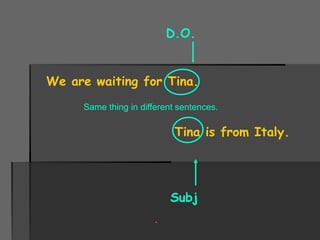
We are waiting for Tina.
Tina is from Italy.
Same thing in different sentences.
D.O.
Subj
.
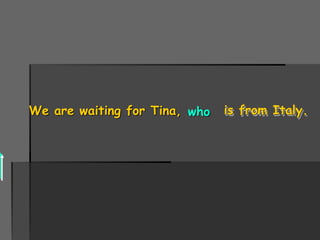
We are waiting for Tina, is from Italy.who
We are waiting for Tina , is from Italy.who
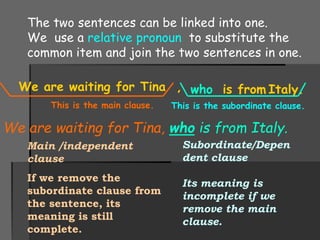
We are waiting for Tina, who is from Italy.
This is the main clause. This is the subordinate clause.
Subordinate/Depen
dent clause
Its meaning is
incomplete if we
remove the main
clause.
Main /independent
clause
If we remove the
subordinate clause from
the sentence, its
meaning is still
complete.
The two sentences can be linked into one.
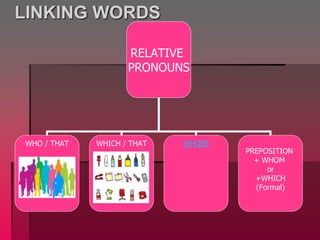
We use a relative pronoun to substitute the
common item and join the two sentences in one.
LINKING WORDS
RELATIVE
PRONOUNS
WHO / THAT WHICH / THAT WHOSE
PREPOSITION
+ WHOM
or
+WHICH
(Formal)
LINKING WORDS
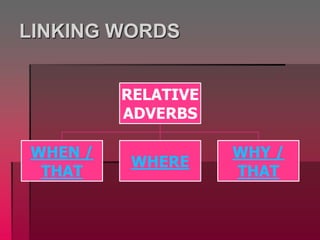
RELATIVE
ADVERBS
WHEN /
THAT
WHERE
WHY /
THAT
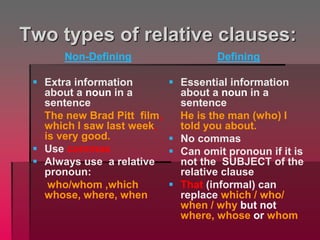
Two types of relative clauses:
Non-Defining
 Extra information
about a noun in a
sentence
The new Brad Pitt film,
which I saw last week,
is very good.
 Use commas
 Always use a relative
pronoun:
who/whom ,which
whose, where, when
Defining
 Essential information
about a noun in a
sentence
He is the man (who) I
told you about.
 No commas
 Can omit pronoun if it is
not the SUBJECT of the
relative clause
 That (informal) can
replace which / who/
when / why but not
where, whose or whom
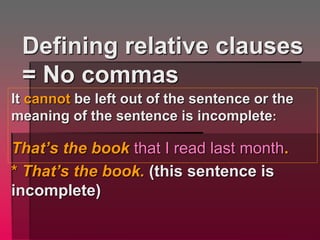
Defining relative clauses
= No commas
It cannot be left out of the sentence or the
meaning of the sentence is incomplete:
That’s the book that I read last month.
* That’s the book. (this sentence is
incomplete)
Defining relative clauses
= No commas
 You can omit the pronoun if it is the
OBJECT of the relative clause (if there is
a SUBJECT and a VERB after the
relative pronoun )
It’ That’s the book I read yesterday.
The boy who lives next door is Canadian.
 We can never omit WHOSE and WHERE
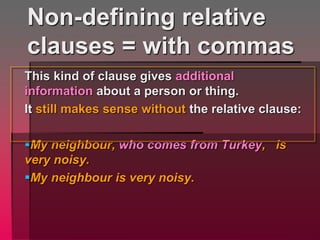
Non-defining relative
clauses = with commas
This kind of clause gives additional
information about a person or thing.
It still makes sense without the relative clause:
My neighbour, who comes from Turkey, is
very noisy.
My neighbour is very noisy.
Formal / Informal
Non-Defining relative clauses (with
commas) are more common in written
English because they are quite formal.
In spoken English we would probably use
two sentences.
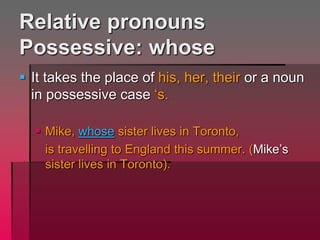
Relative pronouns
Possessive: whose
 It takes the place of his, her, their or a noun
in possessive case ‘s.
 Mike, whose sister lives in Toronto,
is travelling to England this summer. (Mike’s
sister lives in Toronto).

Relative Sentences

  • 2.
    We are waitingfor Tina. Tina is from Italy. Same thing in different sentences. D.O. Subj .
  • 3.
    We are waitingfor Tina, is from Italy.who
  • 4.
    We are waitingfor Tina , is from Italy.who We are waiting for Tina, who is from Italy. This is the main clause. This is the subordinate clause. Subordinate/Depen dent clause Its meaning is incomplete if we remove the main clause. Main /independent clause If we remove the subordinate clause from the sentence, its meaning is still complete. The two sentences can be linked into one. We use a relative pronoun to substitute the common item and join the two sentences in one.
  • 5.
    LINKING WORDS RELATIVE PRONOUNS WHO /THAT WHICH / THAT WHOSE PREPOSITION + WHOM or +WHICH (Formal)
  • 6.
  • 7.
    Two types ofrelative clauses: Non-Defining  Extra information about a noun in a sentence The new Brad Pitt film, which I saw last week, is very good.  Use commas  Always use a relative pronoun: who/whom ,which whose, where, when Defining  Essential information about a noun in a sentence He is the man (who) I told you about.  No commas  Can omit pronoun if it is not the SUBJECT of the relative clause  That (informal) can replace which / who/ when / why but not where, whose or whom
  • 8.
    Defining relative clauses =No commas It cannot be left out of the sentence or the meaning of the sentence is incomplete: That’s the book that I read last month. * That’s the book. (this sentence is incomplete)
  • 9.
    Defining relative clauses =No commas  You can omit the pronoun if it is the OBJECT of the relative clause (if there is a SUBJECT and a VERB after the relative pronoun ) It’ That’s the book I read yesterday. The boy who lives next door is Canadian.  We can never omit WHOSE and WHERE
  • 10.
    Non-defining relative clauses =with commas This kind of clause gives additional information about a person or thing. It still makes sense without the relative clause: My neighbour, who comes from Turkey, is very noisy. My neighbour is very noisy.
  • 11.
    Formal / Informal Non-Definingrelative clauses (with commas) are more common in written English because they are quite formal. In spoken English we would probably use two sentences.
  • 12.
    Relative pronouns Possessive: whose It takes the place of his, her, their or a noun in possessive case ‘s.  Mike, whose sister lives in Toronto, is travelling to England this summer. (Mike’s sister lives in Toronto).