THE PASSIVE VOICE UNIT 5
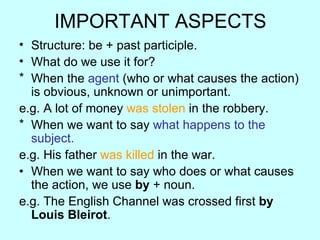
IMPORTANT ASPECTS Structure: be + past participle. What do we use it for? When the  agent  (who or what causes the action) is obvious, unknown or unimportant. e.g. A lot of money  was stolen  in the robbery. When we want to say  what happens to the subject. e.g. His father  was killed  in the war. When we want to say who does or what causes the action, we use  by  + noun.  e.g. The English Channel was crossed first  by Louis Bleirot .
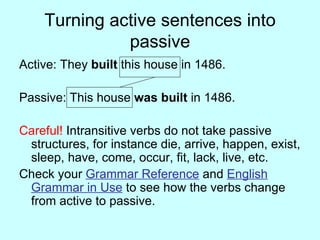
Turning active sentences into passive Active: They  built  this house in 1486. Passive: This house  was built  in 1486. Careful!  Intransitive verbs do not take passive structures, for instance die, arrive, happen, exist, sleep, have, come, occur, fit, lack, live, etc. Check your  Grammar Reference  and  English   Grammar in Use  to see how the verbs change from active to passive.
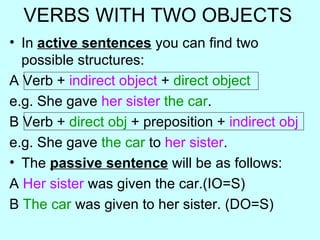
VERBS WITH TWO OBJECTS In  active sentences  you can find two possible structures: A Verb +  indirect object  +  direct object e.g. She gave  her sister   the car . B Verb +  direct obj  + preposition +  indirect obj e.g. She gave  the car  to  her sister . The  passive sentence  will be as follows: A  Her sister  was given the car.(IO=S) B  The car  was given to her sister. (DO=S)

Passive Voice

  • 1.
  • 2.
    IMPORTANT ASPECTS Structure:be + past participle. What do we use it for? When the agent (who or what causes the action) is obvious, unknown or unimportant. e.g. A lot of money was stolen in the robbery. When we want to say what happens to the subject. e.g. His father was killed in the war. When we want to say who does or what causes the action, we use by + noun. e.g. The English Channel was crossed first by Louis Bleirot .
  • 3.
    Turning active sentencesinto passive Active: They built this house in 1486. Passive: This house was built in 1486. Careful! Intransitive verbs do not take passive structures, for instance die, arrive, happen, exist, sleep, have, come, occur, fit, lack, live, etc. Check your Grammar Reference and English Grammar in Use to see how the verbs change from active to passive.
  • 4.
    VERBS WITH TWOOBJECTS In active sentences you can find two possible structures: A Verb + indirect object + direct object e.g. She gave her sister the car . B Verb + direct obj + preposition + indirect obj e.g. She gave the car to her sister . The passive sentence will be as follows: A Her sister was given the car.(IO=S) B The car was given to her sister. (DO=S)