Independent Clauses
Adverb Clauses
Adjective Clauses
Noun Clauses
What is a clause?
A sentence with a subject and a
verb that is part of a longer
sentence
An independent clauses in a
compound sentence.
A compound sentence combines
two complete sentences using a
conjunction (FANBOYS: for, and,
nor, but, or, yet, so).
There is a comma before the
conjunction:
I didn’t want to be late again, so I set
my alarm clock half an hour earlier.
I want to take a music class, but I don’t
have time this semester.
Adverb Clauses = Subordinate
Clauses
An adverb clause
1) gives more information about
the main clause
2) It can be the first half or the
second half of a complex sentence
3) It begins with a subordinator =
and adverbial expression
She went to Canada before she
came to the U.S.
Before she came to the U.S., she
went to Canada
I came to the United States
because I wanted to join my
parents here.
If she saves enough money, she
will travel to Europe.
An adverb clause can go before or
after the main clause, but pay
attention to the punctuation:
There is no comma when the main
clause comes first in the sentence.
When the adverb clause comes first,
you must use a comma after the
adverb clause and before the main
clause.
Adjective Clauses
Adjective Clauses
1) modify a noun
2) usually go after the noun they
modify
3) usually begin with a relative
pronoun
Examples of sentences with
adjective clauses:
A have a friend who is a computer
programmer.
Bill Gates, who is a rich person,
created Microsoft.
Noun Clauses:
1) Replaces a noun in the sentence.
2) Can be anywhere in the sentence
because a noun clause can replace the
subject, the object, or the object of a
preposition.
3) Usually begins with “that” or a
question word (“what,” “when,”
“where,” “why,” “who,” etc.)
There are two kinds of adjective
clauses:
An essential adjective clause gives
essential information about the noun it
modifies. The sentence changes
meaning or doesn’t make sense if you
omit the essential adjective clause:
This information about clauses is
familiar for students who have
taken Advanced Grammar.
There is no comma before an
essential adjective clause.
A non-essential adjective clause
just gives some more information
about the noun it modifies. The
sentence still makes sense if you
leave it out.
Students in ESL 52 should have
taken ESL 217, where this
information about clauses is
taught.
There is a comma before a non-
essential adjective clause.
A non-essential
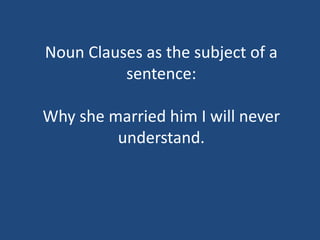
Noun Clauses as the subject of a
sentence:
Why she married him I will never
understand.
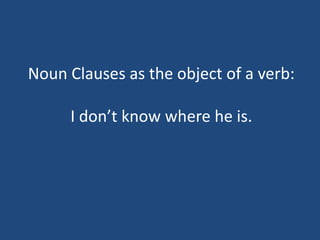
Noun Clauses as the object of a verb:
I don’t know where he is.
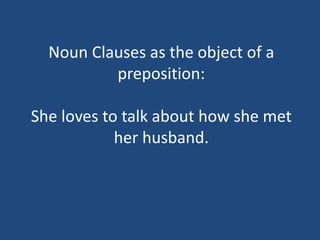
Noun Clauses as the object of a
preposition:
She loves to talk about how she met
her husband.
Some words can be used in more
than one kind of clause!
For example, “when”:
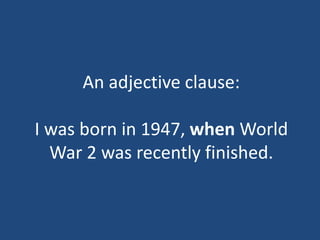
An adjective clause:
I was born in 1947, when World
War 2 was recently finished.
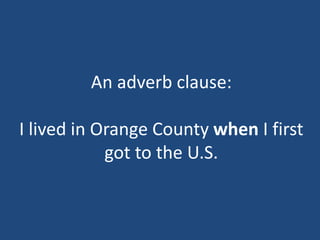
An adverb clause:
I lived in Orange County when I first
got to the U.S.
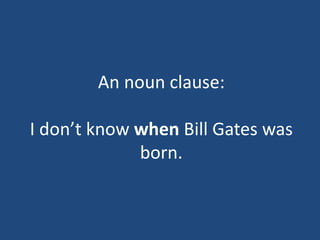
An noun clause:
I don’t know when Bill Gates was
born.

Four kinds of clauses revised

  • 1.
  • 2.
    What is aclause? A sentence with a subject and a verb that is part of a longer sentence
  • 3.
    An independent clausesin a compound sentence.
  • 4.
    A compound sentencecombines two complete sentences using a conjunction (FANBOYS: for, and, nor, but, or, yet, so).
  • 5.
    There is acomma before the conjunction:
  • 6.
    I didn’t wantto be late again, so I set my alarm clock half an hour earlier.
  • 7.
    I want totake a music class, but I don’t have time this semester.
  • 8.
    Adverb Clauses =Subordinate Clauses
  • 9.
    An adverb clause 1)gives more information about the main clause 2) It can be the first half or the second half of a complex sentence 3) It begins with a subordinator = and adverbial expression
  • 10.
    She went toCanada before she came to the U.S. Before she came to the U.S., she went to Canada
  • 11.
    I came tothe United States because I wanted to join my parents here.
  • 12.
    If she savesenough money, she will travel to Europe.
  • 13.
    An adverb clausecan go before or after the main clause, but pay attention to the punctuation:
  • 14.
    There is nocomma when the main clause comes first in the sentence. When the adverb clause comes first, you must use a comma after the adverb clause and before the main clause.
  • 15.
  • 16.
    Adjective Clauses 1) modifya noun 2) usually go after the noun they modify 3) usually begin with a relative pronoun
  • 17.
    Examples of sentenceswith adjective clauses:
  • 18.
    A have afriend who is a computer programmer.
  • 19.
    Bill Gates, whois a rich person, created Microsoft.
  • 20.
    Noun Clauses: 1) Replacesa noun in the sentence. 2) Can be anywhere in the sentence because a noun clause can replace the subject, the object, or the object of a preposition. 3) Usually begins with “that” or a question word (“what,” “when,” “where,” “why,” “who,” etc.)
  • 21.
    There are twokinds of adjective clauses:
  • 22.
    An essential adjectiveclause gives essential information about the noun it modifies. The sentence changes meaning or doesn’t make sense if you omit the essential adjective clause:
  • 23.
    This information aboutclauses is familiar for students who have taken Advanced Grammar.
  • 24.
    There is nocomma before an essential adjective clause.
  • 25.
    A non-essential adjectiveclause just gives some more information about the noun it modifies. The sentence still makes sense if you leave it out.
  • 26.
    Students in ESL52 should have taken ESL 217, where this information about clauses is taught.
  • 27.
    There is acomma before a non- essential adjective clause.
  • 28.
  • 29.
    Noun Clauses asthe subject of a sentence: Why she married him I will never understand.
  • 30.
    Noun Clauses asthe object of a verb: I don’t know where he is.
  • 31.
    Noun Clauses asthe object of a preposition: She loves to talk about how she met her husband.
  • 32.
    Some words canbe used in more than one kind of clause! For example, “when”:
  • 33.
    An adjective clause: Iwas born in 1947, when World War 2 was recently finished.
  • 34.
    An adverb clause: Ilived in Orange County when I first got to the U.S.
  • 35.
    An noun clause: Idon’t know when Bill Gates was born.