Downloaded 54 times
![Find the velocity of Train A 80 km/hr [E] Train B 110 km/hr [W] Train A relative to Train B (assume B is not moving) Train B relative to Train A](https://image.slidesharecdn.com/relativemotion-091014101548-phpapp01/85/Relative-Motion-2-320.jpg)
![Find the relative velocity of each train Train A 80 km/hr [W] Train B 130 km/hr [W] 40 km apart How long for B to catch A?](https://image.slidesharecdn.com/relativemotion-091014101548-phpapp01/85/Relative-Motion-3-320.jpg)
![What if the motions are at right angles? Wind 60 km/hr [S] Plane 120 km/hr [E] What is the velocity of the plane RELATIVE TO the ground?](https://image.slidesharecdn.com/relativemotion-091014101548-phpapp01/85/Relative-Motion-4-320.jpg)
![Compensating for wind and current Wind 60 km/hr [S] Plane 120 km/hr At what angle should you head so that your plane heads “due east”? What will the “ground speed” be?](https://image.slidesharecdn.com/relativemotion-091014101548-phpapp01/85/Relative-Motion-5-320.jpg)
![What if the vectors do not form a right triangle? Plane 120 km/hr [70 o ] Wind 60 km/hr [140 o ] How can we find the resulting velocity (both speed and direction) if the triangle is OBLIQUE?](https://image.slidesharecdn.com/relativemotion-091014101548-phpapp01/85/Relative-Motion-6-320.jpg)
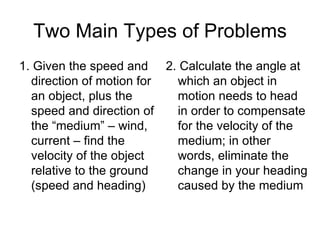

The document discusses using vectors to determine relative motion and velocities between objects. It contains examples of calculating the relative velocity between two trains moving in opposite directions, an airplane's velocity relative to the ground when factoring in wind speed and direction, and determining the angle an airplane needs to fly to compensate for wind and travel due east relative to the ground. The document outlines two main types of relative motion problems - finding an object's velocity relative to the ground given its motion and a medium's motion, and calculating the angle an object needs to travel to compensate for a medium's velocity.


