PASSIVE
VOICE
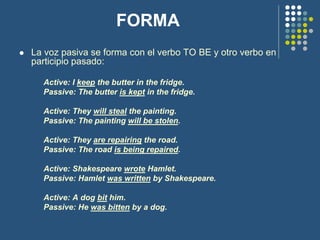
FORMA
 La voz pasiva se forma con el verbo TO BE y otro verbo en
participio pasado:
Active: I keep the butter in the fridge.
Passive: The butter is kept in the fridge.
Active: They will steal the painting.
Passive: The painting will be stolen.
Active: They are repairing the road.
Passive: The road is being repaired.
Active: Shakespeare wrote Hamlet.
Passive: Hamlet was written by Shakespeare.
Active: A dog bit him.
Passive: He was bitten by a dog.
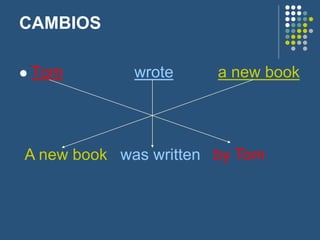
CAMBIOS
 Tom wrote a new book
A new book was written by Tom
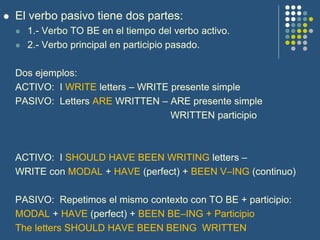
 El verbo pasivo tiene dos partes:
 1.- Verbo TO BE en el tiempo del verbo activo.
 2.- Verbo principal en participio pasado.
Dos ejemplos:
ACTIVO: I WRITE letters – WRITE presente simple
PASIVO: Letters ARE WRITTEN – ARE presente simple
WRITTEN participio
ACTIVO: I SHOULD HAVE BEEN WRITING letters –
WRITE con MODAL + HAVE (perfect) + BEEN V–ING (continuo)
PASIVO: Repetimos el mismo contexto con TO BE + participio:
MODAL + HAVE (perfect) + BEEN BE–ING + Participio
The letters SHOULD HAVE BEEN BEING WRITTEN
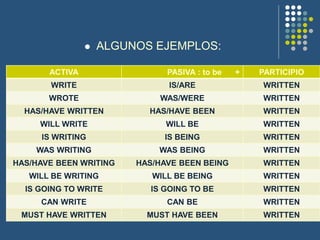
 ALGUNOS EJEMPLOS:
ACTIVA PASIVA : to be + PARTICIPIO
WRITE IS/ARE WRITTEN
WROTE WAS/WERE WRITTEN
HAS/HAVE WRITTEN HAS/HAVE BEEN WRITTEN
WILL WRITE WILL BE WRITTEN
IS WRITING IS BEING WRITTEN
WAS WRITING WAS BEING WRITTEN
HAS/HAVE BEEN WRITING HAS/HAVE BEEN BEING WRITTEN
WILL BE WRITING WILL BE BEING WRITTEN
IS GOING TO WRITE IS GOING TO BE WRITTEN
CAN WRITE CAN BE WRITTEN
MUST HAVE WRITTEN MUST HAVE BEEN WRITTEN
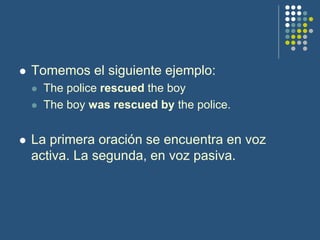
 Tomemos el siguiente ejemplo:
 The police rescued the boy
 The boy was rescued by the police.
 La primera oración se encuentra en voz
activa. La segunda, en voz pasiva.
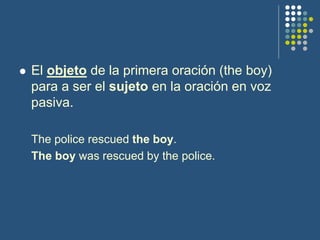
 El objeto de la primera oración (the boy)
para a ser el sujeto en la oración en voz
pasiva.
The police rescued the boy.
The boy was rescued by the police.
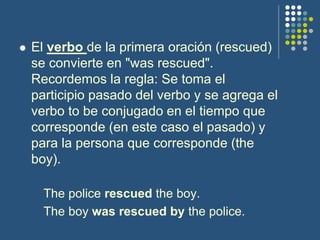
 El verbo de la primera oración (rescued)
se convierte en "was rescued".
Recordemos la regla: Se toma el
participio pasado del verbo y se agrega el
verbo to be conjugado en el tiempo que
corresponde (en este caso el pasado) y
para la persona que corresponde (the
boy).
The police rescued the boy.
The boy was rescued by the police.
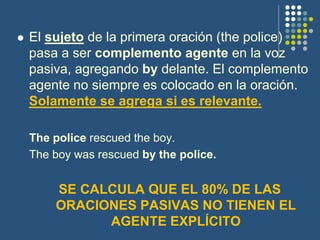
 El sujeto de la primera oración (the police)
pasa a ser complemento agente en la voz
pasiva, agregando by delante. El complemento
agente no siempre es colocado en la oración.
Solamente se agrega si es relevante.
The police rescued the boy.
The boy was rescued by the police.
SE CALCULA QUE EL 80% DE LAS
ORACIONES PASIVAS NO TIENEN EL
AGENTE EXPLÍCITO
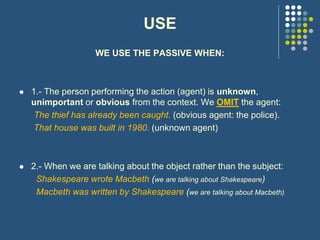
USE
WE USE THE PASSIVE WHEN:
 1.- The person performing the action (agent) is unknown,
unimportant or obvious from the context. We OMIT the agent:
The thief has already been caught. (obvious agent: the police).
That house was built in 1980. (unknown agent)
 2.- When we are talking about the object rather than the subject:
Shakespeare wrote Macbeth (we are talking about Shakespeare)
Macbeth was written by Shakespeare (we are talking about Macbeth)
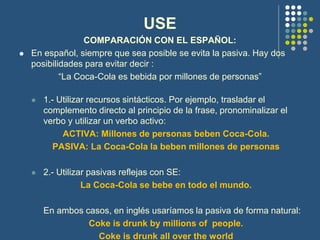
USE
COMPARACIÓN CON EL ESPAÑOL:
 En español, siempre que sea posible se evita la pasiva. Hay dos
posibilidades para evitar decir :
“La Coca-Cola es bebida por millones de personas”
 1.- Utilizar recursos sintácticos. Por ejemplo, trasladar el
complemento directo al principio de la frase, pronominalizar el
verbo y utilizar un verbo activo:
ACTIVA: Millones de personas beben Coca-Cola.
PASIVA: La Coca-Cola la beben millones de personas
 2.- Utilizar pasivas reflejas con SE:
La Coca-Cola se bebe en todo el mundo.
En ambos casos, en inglés usaríamos la pasiva de forma natural:
Coke is drunk by millions of people.
Coke is drunk all over the world
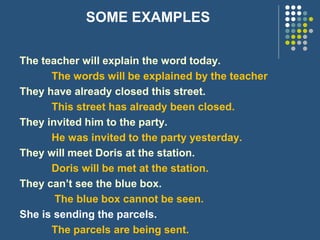
SOME EXAMPLES
The teacher will explain the word today.
The words will be explained by the teacher
They have already closed this street.
This street has already been closed.
They invited him to the party.
He was invited to the party yesterday.
They will meet Doris at the station.
Doris will be met at the station.
They can’t see the blue box.
The blue box cannot be seen.
She is sending the parcels.
The parcels are being sent.
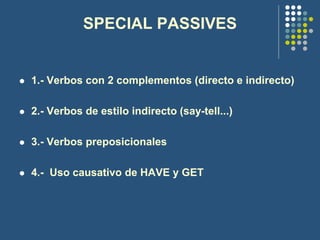
SPECIAL PASSIVES
 1.- Verbos con 2 complementos (directo e indirecto)
 2.- Verbos de estilo indirecto (say-tell...)
 3.- Verbos preposicionales
 4.- Uso causativo de HAVE y GET
SPECIAL PASSIVES
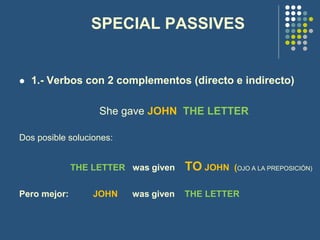
 1.- Verbos con 2 complementos (directo e indirecto)
She gave JOHN THE LETTER
Dos posible soluciones:
THE LETTER was given TO JOHN (OJO A LA PREPOSICIÓN)
Pero mejor: JOHN was given THE LETTER
SPECIAL PASSIVES
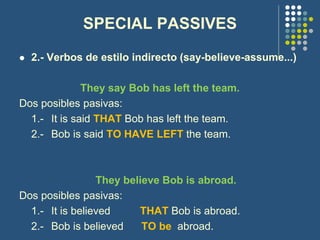
 2.- Verbos de estilo indirecto (say-believe-assume...)
They say Bob has left the team.
Dos posibles pasivas:
1.- It is said THAT Bob has left the team.
2.- Bob is said TO HAVE LEFT the team.
They believe Bob is abroad.
Dos posibles pasivas:
1.- It is believed THAT Bob is abroad.
2.- Bob is believed TO be abroad.
SPECIAL PASSIVES
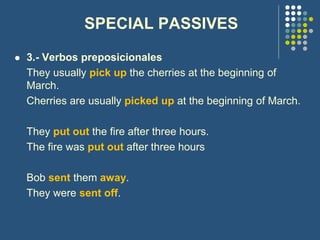
 3.- Verbos preposicionales
They usually pick up the cherries at the beginning of
March.
Cherries are usually picked up at the beginning of March.
They put out the fire after three hours.
The fire was put out after three hours
Bob sent them away.
They were sent off.
SOME MORE EXAMPLES
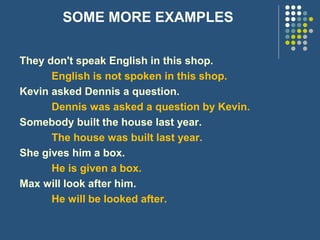
They don't speak English in this shop.
English is not spoken in this shop.
Kevin asked Dennis a question.
Dennis was asked a question by Kevin.
Somebody built the house last year.
The house was built last year.
She gives him a box.
He is given a box.
Max will look after him.
He will be looked after.
SOME MORE EXAMPLES
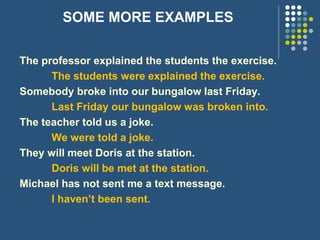
The professor explained the students the exercise.
The students were explained the exercise.
Somebody broke into our bungalow last Friday.
Last Friday our bungalow was broken into.
The teacher told us a joke.
We were told a joke.
They will meet Doris at the station.
Doris will be met at the station.
Michael has not sent me a text message.
I haven’t been sent.
SPECIAL PASSIVES
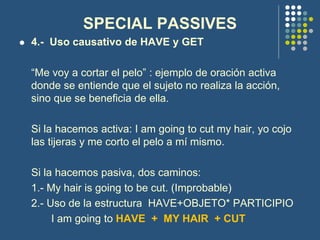
 4.- Uso causativo de HAVE y GET
“Me voy a cortar el pelo” : ejemplo de oración activa
donde se entiende que el sujeto no realiza la acción,
sino que se beneficia de ella.
Si la hacemos activa: I am going to cut my hair, yo cojo
las tijeras y me corto el pelo a mí mismo.
Si la hacemos pasiva, dos caminos:
1.- My hair is going to be cut. (Improbable)
2.- Uso de la estructura HAVE+OBJETO* PARTICIPIO
I am going to HAVE + MY HAIR + CUT
SPECIAL PASSIVES
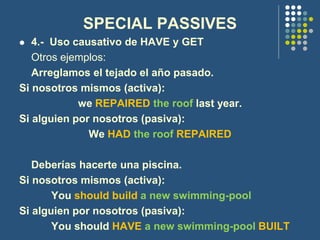
 4.- Uso causativo de HAVE y GET
Otros ejemplos:
Arreglamos el tejado el año pasado.
Si nosotros mismos (activa):
we REPAIRED the roof last year.
Si alguien por nosotros (pasiva):
We HAD the roof REPAIRED
Deberías hacerte una piscina.
Si nosotros mismos (activa):
You should build a new swimming-pool
Si alguien por nosotros (pasiva):
You should HAVE a new swimming-pool BUILT
SOME MORE EXAMPLES
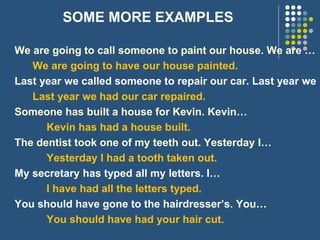
We are going to call someone to paint our house. We are …
We are going to have our house painted.
Last year we called someone to repair our car. Last year we
Last year we had our car repaired.
Someone has built a house for Kevin. Kevin…
Kevin has had a house built.
The dentist took one of my teeth out. Yesterday I…
Yesterday I had a tooth taken out.
My secretary has typed all my letters. I…
I have had all the letters typed.
You should have gone to the hairdresser’s. You…
You should have had your hair cut.
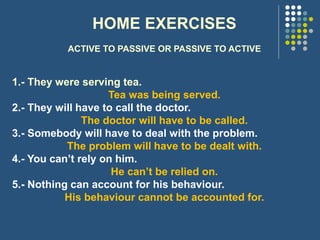
HOME EXERCISES
ACTIVE TO PASSIVE OR PASSIVE TO ACTIVE
1.- They were serving tea.
Tea was being served.
2.- They will have to call the doctor.
The doctor will have to be called.
3.- Somebody will have to deal with the problem.
The problem will have to be dealt with.
4.- You can’t rely on him.
He can’t be relied on.
5.- Nothing can account for his behaviour.
His behaviour cannot be accounted for.
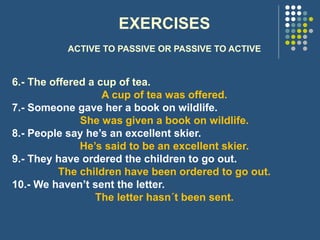
EXERCISES
ACTIVE TO PASSIVE OR PASSIVE TO ACTIVE
6.- The offered a cup of tea.
A cup of tea was offered.
7.- Someone gave her a book on wildlife.
She was given a book on wildlife.
8.- People say he’s an excellent skier.
He’s said to be an excellent skier.
9.- They have ordered the children to go out.
The children have been ordered to go out.
10.- We haven’t sent the letter.
The letter hasn´t been sent.
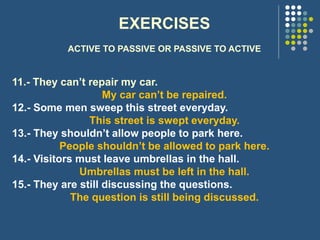
EXERCISES
ACTIVE TO PASSIVE OR PASSIVE TO ACTIVE
11.- They can’t repair my car.
My car can’t be repaired.
12.- Some men sweep this street everyday.
This street is swept everyday.
13.- They shouldn’t allow people to park here.
People shouldn’t be allowed to park here.
14.- Visitors must leave umbrellas in the hall.
Umbrellas must be left in the hall.
15.- They are still discussing the questions.
The question is still being discussed.
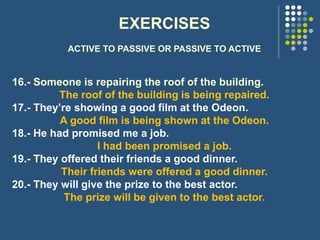
EXERCISES
ACTIVE TO PASSIVE OR PASSIVE TO ACTIVE
16.- Someone is repairing the roof of the building.
The roof of the building is being repaired.
17.- They’re showing a good film at the Odeon.
A good film is being shown at the Odeon.
18.- He had promised me a job.
I had been promised a job.
19.- They offered their friends a good dinner.
Their friends were offered a good dinner.
20.- They will give the prize to the best actor.
The prize will be given to the best actor.
EXERCISES
ACTIVE TO PASSIVE OR PASSIVE TO ACTIVE
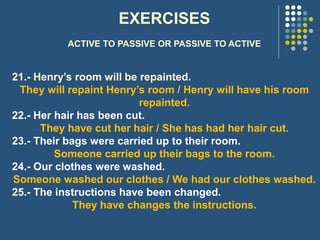
21.- Henry’s room will be repainted.
They will repaint Henry’s room / Henry will have his room
repainted.
22.- Her hair has been cut.
They have cut her hair / She has had her hair cut.
23.- Their bags were carried up to their room.
Someone carried up their bags to the room.
24.- Our clothes were washed.
Someone washed our clothes / We had our clothes washed.
25.- The instructions have been changed.
They have changes the instructions.
HOME EXERCISES
ACTIVE TO PASSIVE OR PASSIVE TO ACTIVE
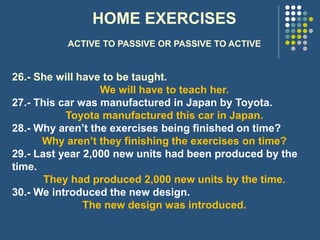
26.- She will have to be taught.
We will have to teach her.
27.- This car was manufactured in Japan by Toyota.
Toyota manufactured this car in Japan.
28.- Why aren’t the exercises being finished on time?
Why aren’t they finishing the exercises on time?
29.- Last year 2,000 new units had been produced by the
time.
They had produced 2,000 new units by the time.
30.- We introduced the new design.
The new design was introduced.
EXERCISES
ACTIVE TO PASSIVE OR PASSIVE TO ACTIVE
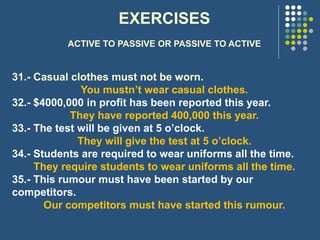
31.- Casual clothes must not be worn.
You mustn’t wear casual clothes.
32.- $4000,000 in profit has been reported this year.
They have reported 400,000 this year.
33.- The test will be given at 5 o’clock.
They will give the test at 5 o’clock.
34.- Students are required to wear uniforms all the time.
They require students to wear uniforms all the time.
35.- This rumour must have been started by our
competitors.
Our competitors must have started this rumour.
EXERCISES
ACTIVE TO PASSIVE OR PASSIVE TO ACTIVE
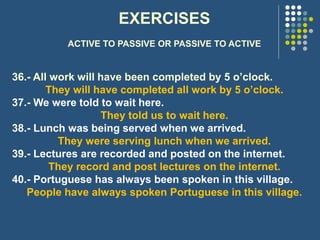
36.- All work will have been completed by 5 o’clock.
They will have completed all work by 5 o’clock.
37.- We were told to wait here.
They told us to wait here.
38.- Lunch was being served when we arrived.
They were serving lunch when we arrived.
39.- Lectures are recorded and posted on the internet.
They record and post lectures on the internet.
40.- Portuguese has always been spoken in this village.
People have always spoken Portuguese in this village.
EXERCISES
ACTIVE TO PASSIVE OR PASSIVE TO ACTIVE
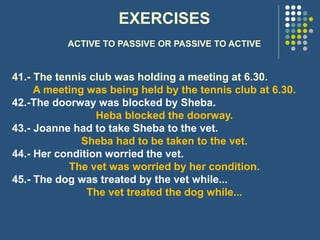
41.- The tennis club was holding a meeting at 6.30.
A meeting was being held by the tennis club at 6.30.
42.-The doorway was blocked by Sheba.
Heba blocked the doorway.
43.- Joanne had to take Sheba to the vet.
Sheba had to be taken to the vet.
44.- Her condition worried the vet.
The vet was worried by her condition.
45.- The dog was treated by the vet while...
The vet treated the dog while...
EXERCISES
ACTIVE TO PASSIVE OR PASSIVE TO ACTIVE
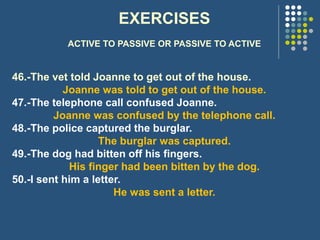
46.-The vet told Joanne to get out of the house.
Joanne was told to get out of the house.
47.-The telephone call confused Joanne.
Joanne was confused by the telephone call.
48.-The police captured the burglar.
The burglar was captured.
49.-The dog had bitten off his fingers.
His finger had been bitten by the dog.
50.-I sent him a letter.
He was sent a letter.
EXERCISES
ACTIVE TO PASSIVE OR PASSIVE TO ACTIVE
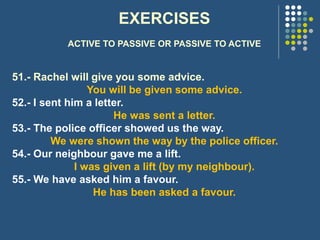
51.- Rachel will give you some advice.
You will be given some advice.
52.- I sent him a letter.
He was sent a letter.
53.- The police officer showed us the way.
We were shown the way by the police officer.
54.- Our neighbour gave me a lift.
I was given a lift (by my neighbour).
55.- We have asked him a favour.
He has been asked a favour.
EXERCISES
ACTIVE TO PASSIVE OR PASSIVE TO ACTIVE
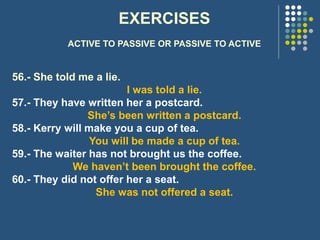
56.- She told me a lie.
I was told a lie.
57.- They have written her a postcard.
She’s been written a postcard.
58.- Kerry will make you a cup of tea.
You will be made a cup of tea.
59.- The waiter has not brought us the coffee.
We haven’t been brought the coffee.
60.- They did not offer her a seat.
She was not offered a seat.
EXERCISES
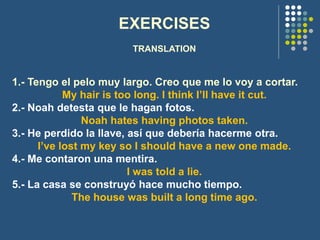
TRANSLATION
1.- Tengo el pelo muy largo. Creo que me lo voy a cortar.
My hair is too long. I think I’ll have it cut.
2.- Noah detesta que le hagan fotos.
Noah hates having photos taken.
3.- He perdido la llave, así que debería hacerme otra.
I’ve lost my key so I should have a new one made.
4.- Me contaron una mentira.
I was told a lie.
5.- La casa se construyó hace mucho tiempo.
The house was built a long time ago.
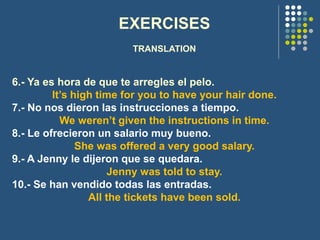
EXERCISES
TRANSLATION
6.- Ya es hora de que te arregles el pelo.
It’s high time for you to have your hair done.
7.- No nos dieron las instrucciones a tiempo.
We weren’t given the instructions in time.
8.- Le ofrecieron un salario muy bueno.
She was offered a very good salary.
9.- A Jenny le dijeron que se quedara.
Jenny was told to stay.
10.- Se han vendido todas las entradas.
All the tickets have been sold.
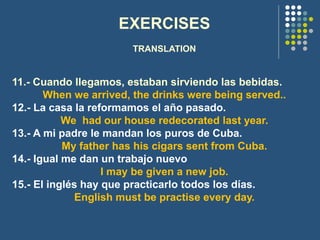
EXERCISES
TRANSLATION
11.- Cuando llegamos, estaban sirviendo las bebidas.
When we arrived, the drinks were being served..
12.- La casa la reformamos el año pasado.
We had our house redecorated last year.
13.- A mi padre le mandan los puros de Cuba.
My father has his cigars sent from Cuba.
14.- Igual me dan un trabajo nuevo
I may be given a new job.
15.- El inglés hay que practicarlo todos los días.
English must be practise every day.
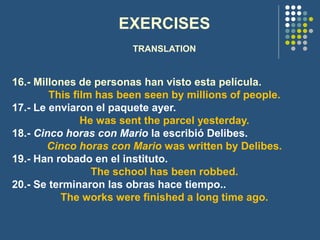
EXERCISES
TRANSLATION
16.- Millones de personas han visto esta película.
This film has been seen by millions of people.
17.- Le enviaron el paquete ayer.
He was sent the parcel yesterday.
18.- Cinco horas con Mario la escribió Delibes.
Cinco horas con Mario was written by Delibes.
19.- Han robado en el instituto.
The school has been robbed.
20.- Se terminaron las obras hace tiempo..
The works were finished a long time ago.

P

  • 1.
  • 2.
    FORMA  La vozpasiva se forma con el verbo TO BE y otro verbo en participio pasado: Active: I keep the butter in the fridge. Passive: The butter is kept in the fridge. Active: They will steal the painting. Passive: The painting will be stolen. Active: They are repairing the road. Passive: The road is being repaired. Active: Shakespeare wrote Hamlet. Passive: Hamlet was written by Shakespeare. Active: A dog bit him. Passive: He was bitten by a dog.
  • 3.
    CAMBIOS  Tom wrotea new book A new book was written by Tom
  • 4.
     El verbopasivo tiene dos partes:  1.- Verbo TO BE en el tiempo del verbo activo.  2.- Verbo principal en participio pasado. Dos ejemplos: ACTIVO: I WRITE letters – WRITE presente simple PASIVO: Letters ARE WRITTEN – ARE presente simple WRITTEN participio ACTIVO: I SHOULD HAVE BEEN WRITING letters – WRITE con MODAL + HAVE (perfect) + BEEN V–ING (continuo) PASIVO: Repetimos el mismo contexto con TO BE + participio: MODAL + HAVE (perfect) + BEEN BE–ING + Participio The letters SHOULD HAVE BEEN BEING WRITTEN
  • 5.
     ALGUNOS EJEMPLOS: ACTIVAPASIVA : to be + PARTICIPIO WRITE IS/ARE WRITTEN WROTE WAS/WERE WRITTEN HAS/HAVE WRITTEN HAS/HAVE BEEN WRITTEN WILL WRITE WILL BE WRITTEN IS WRITING IS BEING WRITTEN WAS WRITING WAS BEING WRITTEN HAS/HAVE BEEN WRITING HAS/HAVE BEEN BEING WRITTEN WILL BE WRITING WILL BE BEING WRITTEN IS GOING TO WRITE IS GOING TO BE WRITTEN CAN WRITE CAN BE WRITTEN MUST HAVE WRITTEN MUST HAVE BEEN WRITTEN
  • 6.
     Tomemos elsiguiente ejemplo:  The police rescued the boy  The boy was rescued by the police.  La primera oración se encuentra en voz activa. La segunda, en voz pasiva.
  • 7.
     El objetode la primera oración (the boy) para a ser el sujeto en la oración en voz pasiva. The police rescued the boy. The boy was rescued by the police.
  • 8.
     El verbode la primera oración (rescued) se convierte en "was rescued". Recordemos la regla: Se toma el participio pasado del verbo y se agrega el verbo to be conjugado en el tiempo que corresponde (en este caso el pasado) y para la persona que corresponde (the boy). The police rescued the boy. The boy was rescued by the police.
  • 9.
     El sujetode la primera oración (the police) pasa a ser complemento agente en la voz pasiva, agregando by delante. El complemento agente no siempre es colocado en la oración. Solamente se agrega si es relevante. The police rescued the boy. The boy was rescued by the police. SE CALCULA QUE EL 80% DE LAS ORACIONES PASIVAS NO TIENEN EL AGENTE EXPLÍCITO
  • 10.
    USE WE USE THEPASSIVE WHEN:  1.- The person performing the action (agent) is unknown, unimportant or obvious from the context. We OMIT the agent: The thief has already been caught. (obvious agent: the police). That house was built in 1980. (unknown agent)  2.- When we are talking about the object rather than the subject: Shakespeare wrote Macbeth (we are talking about Shakespeare) Macbeth was written by Shakespeare (we are talking about Macbeth)
  • 11.
    USE COMPARACIÓN CON ELESPAÑOL:  En español, siempre que sea posible se evita la pasiva. Hay dos posibilidades para evitar decir : “La Coca-Cola es bebida por millones de personas”  1.- Utilizar recursos sintácticos. Por ejemplo, trasladar el complemento directo al principio de la frase, pronominalizar el verbo y utilizar un verbo activo: ACTIVA: Millones de personas beben Coca-Cola. PASIVA: La Coca-Cola la beben millones de personas  2.- Utilizar pasivas reflejas con SE: La Coca-Cola se bebe en todo el mundo. En ambos casos, en inglés usaríamos la pasiva de forma natural: Coke is drunk by millions of people. Coke is drunk all over the world
  • 12.
    SOME EXAMPLES The teacherwill explain the word today. The words will be explained by the teacher They have already closed this street. This street has already been closed. They invited him to the party. He was invited to the party yesterday. They will meet Doris at the station. Doris will be met at the station. They can’t see the blue box. The blue box cannot be seen. She is sending the parcels. The parcels are being sent.
  • 13.
    SPECIAL PASSIVES  1.-Verbos con 2 complementos (directo e indirecto)  2.- Verbos de estilo indirecto (say-tell...)  3.- Verbos preposicionales  4.- Uso causativo de HAVE y GET
  • 14.
    SPECIAL PASSIVES  1.-Verbos con 2 complementos (directo e indirecto) She gave JOHN THE LETTER Dos posible soluciones: THE LETTER was given TO JOHN (OJO A LA PREPOSICIÓN) Pero mejor: JOHN was given THE LETTER
  • 15.
    SPECIAL PASSIVES  2.-Verbos de estilo indirecto (say-believe-assume...) They say Bob has left the team. Dos posibles pasivas: 1.- It is said THAT Bob has left the team. 2.- Bob is said TO HAVE LEFT the team. They believe Bob is abroad. Dos posibles pasivas: 1.- It is believed THAT Bob is abroad. 2.- Bob is believed TO be abroad.
  • 16.
    SPECIAL PASSIVES  3.-Verbos preposicionales They usually pick up the cherries at the beginning of March. Cherries are usually picked up at the beginning of March. They put out the fire after three hours. The fire was put out after three hours Bob sent them away. They were sent off.
  • 17.
    SOME MORE EXAMPLES Theydon't speak English in this shop. English is not spoken in this shop. Kevin asked Dennis a question. Dennis was asked a question by Kevin. Somebody built the house last year. The house was built last year. She gives him a box. He is given a box. Max will look after him. He will be looked after.
  • 18.
    SOME MORE EXAMPLES Theprofessor explained the students the exercise. The students were explained the exercise. Somebody broke into our bungalow last Friday. Last Friday our bungalow was broken into. The teacher told us a joke. We were told a joke. They will meet Doris at the station. Doris will be met at the station. Michael has not sent me a text message. I haven’t been sent.
  • 19.
    SPECIAL PASSIVES  4.-Uso causativo de HAVE y GET “Me voy a cortar el pelo” : ejemplo de oración activa donde se entiende que el sujeto no realiza la acción, sino que se beneficia de ella. Si la hacemos activa: I am going to cut my hair, yo cojo las tijeras y me corto el pelo a mí mismo. Si la hacemos pasiva, dos caminos: 1.- My hair is going to be cut. (Improbable) 2.- Uso de la estructura HAVE+OBJETO* PARTICIPIO I am going to HAVE + MY HAIR + CUT
  • 20.
    SPECIAL PASSIVES  4.-Uso causativo de HAVE y GET Otros ejemplos: Arreglamos el tejado el año pasado. Si nosotros mismos (activa): we REPAIRED the roof last year. Si alguien por nosotros (pasiva): We HAD the roof REPAIRED Deberías hacerte una piscina. Si nosotros mismos (activa): You should build a new swimming-pool Si alguien por nosotros (pasiva): You should HAVE a new swimming-pool BUILT
  • 21.
    SOME MORE EXAMPLES Weare going to call someone to paint our house. We are … We are going to have our house painted. Last year we called someone to repair our car. Last year we Last year we had our car repaired. Someone has built a house for Kevin. Kevin… Kevin has had a house built. The dentist took one of my teeth out. Yesterday I… Yesterday I had a tooth taken out. My secretary has typed all my letters. I… I have had all the letters typed. You should have gone to the hairdresser’s. You… You should have had your hair cut.
  • 22.
    HOME EXERCISES ACTIVE TOPASSIVE OR PASSIVE TO ACTIVE 1.- They were serving tea. Tea was being served. 2.- They will have to call the doctor. The doctor will have to be called. 3.- Somebody will have to deal with the problem. The problem will have to be dealt with. 4.- You can’t rely on him. He can’t be relied on. 5.- Nothing can account for his behaviour. His behaviour cannot be accounted for.
  • 23.
    EXERCISES ACTIVE TO PASSIVEOR PASSIVE TO ACTIVE 6.- The offered a cup of tea. A cup of tea was offered. 7.- Someone gave her a book on wildlife. She was given a book on wildlife. 8.- People say he’s an excellent skier. He’s said to be an excellent skier. 9.- They have ordered the children to go out. The children have been ordered to go out. 10.- We haven’t sent the letter. The letter hasn´t been sent.
  • 24.
    EXERCISES ACTIVE TO PASSIVEOR PASSIVE TO ACTIVE 11.- They can’t repair my car. My car can’t be repaired. 12.- Some men sweep this street everyday. This street is swept everyday. 13.- They shouldn’t allow people to park here. People shouldn’t be allowed to park here. 14.- Visitors must leave umbrellas in the hall. Umbrellas must be left in the hall. 15.- They are still discussing the questions. The question is still being discussed.
  • 25.
    EXERCISES ACTIVE TO PASSIVEOR PASSIVE TO ACTIVE 16.- Someone is repairing the roof of the building. The roof of the building is being repaired. 17.- They’re showing a good film at the Odeon. A good film is being shown at the Odeon. 18.- He had promised me a job. I had been promised a job. 19.- They offered their friends a good dinner. Their friends were offered a good dinner. 20.- They will give the prize to the best actor. The prize will be given to the best actor.
  • 26.
    EXERCISES ACTIVE TO PASSIVEOR PASSIVE TO ACTIVE 21.- Henry’s room will be repainted. They will repaint Henry’s room / Henry will have his room repainted. 22.- Her hair has been cut. They have cut her hair / She has had her hair cut. 23.- Their bags were carried up to their room. Someone carried up their bags to the room. 24.- Our clothes were washed. Someone washed our clothes / We had our clothes washed. 25.- The instructions have been changed. They have changes the instructions.
  • 27.
    HOME EXERCISES ACTIVE TOPASSIVE OR PASSIVE TO ACTIVE 26.- She will have to be taught. We will have to teach her. 27.- This car was manufactured in Japan by Toyota. Toyota manufactured this car in Japan. 28.- Why aren’t the exercises being finished on time? Why aren’t they finishing the exercises on time? 29.- Last year 2,000 new units had been produced by the time. They had produced 2,000 new units by the time. 30.- We introduced the new design. The new design was introduced.
  • 28.
    EXERCISES ACTIVE TO PASSIVEOR PASSIVE TO ACTIVE 31.- Casual clothes must not be worn. You mustn’t wear casual clothes. 32.- $4000,000 in profit has been reported this year. They have reported 400,000 this year. 33.- The test will be given at 5 o’clock. They will give the test at 5 o’clock. 34.- Students are required to wear uniforms all the time. They require students to wear uniforms all the time. 35.- This rumour must have been started by our competitors. Our competitors must have started this rumour.
  • 29.
    EXERCISES ACTIVE TO PASSIVEOR PASSIVE TO ACTIVE 36.- All work will have been completed by 5 o’clock. They will have completed all work by 5 o’clock. 37.- We were told to wait here. They told us to wait here. 38.- Lunch was being served when we arrived. They were serving lunch when we arrived. 39.- Lectures are recorded and posted on the internet. They record and post lectures on the internet. 40.- Portuguese has always been spoken in this village. People have always spoken Portuguese in this village.
  • 30.
    EXERCISES ACTIVE TO PASSIVEOR PASSIVE TO ACTIVE 41.- The tennis club was holding a meeting at 6.30. A meeting was being held by the tennis club at 6.30. 42.-The doorway was blocked by Sheba. Heba blocked the doorway. 43.- Joanne had to take Sheba to the vet. Sheba had to be taken to the vet. 44.- Her condition worried the vet. The vet was worried by her condition. 45.- The dog was treated by the vet while... The vet treated the dog while...
  • 31.
    EXERCISES ACTIVE TO PASSIVEOR PASSIVE TO ACTIVE 46.-The vet told Joanne to get out of the house. Joanne was told to get out of the house. 47.-The telephone call confused Joanne. Joanne was confused by the telephone call. 48.-The police captured the burglar. The burglar was captured. 49.-The dog had bitten off his fingers. His finger had been bitten by the dog. 50.-I sent him a letter. He was sent a letter.
  • 32.
    EXERCISES ACTIVE TO PASSIVEOR PASSIVE TO ACTIVE 51.- Rachel will give you some advice. You will be given some advice. 52.- I sent him a letter. He was sent a letter. 53.- The police officer showed us the way. We were shown the way by the police officer. 54.- Our neighbour gave me a lift. I was given a lift (by my neighbour). 55.- We have asked him a favour. He has been asked a favour.
  • 33.
    EXERCISES ACTIVE TO PASSIVEOR PASSIVE TO ACTIVE 56.- She told me a lie. I was told a lie. 57.- They have written her a postcard. She’s been written a postcard. 58.- Kerry will make you a cup of tea. You will be made a cup of tea. 59.- The waiter has not brought us the coffee. We haven’t been brought the coffee. 60.- They did not offer her a seat. She was not offered a seat.
  • 34.
    EXERCISES TRANSLATION 1.- Tengo elpelo muy largo. Creo que me lo voy a cortar. My hair is too long. I think I’ll have it cut. 2.- Noah detesta que le hagan fotos. Noah hates having photos taken. 3.- He perdido la llave, así que debería hacerme otra. I’ve lost my key so I should have a new one made. 4.- Me contaron una mentira. I was told a lie. 5.- La casa se construyó hace mucho tiempo. The house was built a long time ago.
  • 35.
    EXERCISES TRANSLATION 6.- Ya eshora de que te arregles el pelo. It’s high time for you to have your hair done. 7.- No nos dieron las instrucciones a tiempo. We weren’t given the instructions in time. 8.- Le ofrecieron un salario muy bueno. She was offered a very good salary. 9.- A Jenny le dijeron que se quedara. Jenny was told to stay. 10.- Se han vendido todas las entradas. All the tickets have been sold.
  • 36.
    EXERCISES TRANSLATION 11.- Cuando llegamos,estaban sirviendo las bebidas. When we arrived, the drinks were being served.. 12.- La casa la reformamos el año pasado. We had our house redecorated last year. 13.- A mi padre le mandan los puros de Cuba. My father has his cigars sent from Cuba. 14.- Igual me dan un trabajo nuevo I may be given a new job. 15.- El inglés hay que practicarlo todos los días. English must be practise every day.
  • 37.
    EXERCISES TRANSLATION 16.- Millones depersonas han visto esta película. This film has been seen by millions of people. 17.- Le enviaron el paquete ayer. He was sent the parcel yesterday. 18.- Cinco horas con Mario la escribió Delibes. Cinco horas con Mario was written by Delibes. 19.- Han robado en el instituto. The school has been robbed. 20.- Se terminaron las obras hace tiempo.. The works were finished a long time ago.