A report prepared by Ma. Cristina V. Santos
REFORMATION
Martin Luther
Ulrich Zwingli
Switzerland
Germany
France
HenryVIII
King of England
Martin Luther
1483 - 1546
• He entered the monastery at
the age of 22 and became an
Augustinian Monk, a devout
Roman Catholic priest and a
theologian
• His faith was soon struck by a
series of experiences.
• scandalized by the
corrupted lifestyle of some
clergy
• outraged by the practice of
selling of indulgences. NB1
Martin Luther
1483 - 1546
• He wrote his Ninety-five Theses and
posted on the door of Wittenberg
Church in Germany, on October 31,
1517. NB2
• When his Theses were forwarded to
Pope Leo X, the discussion lasted for
three years and the decision was
excommunication for Luther.
Martin Luther
1483 - 1546
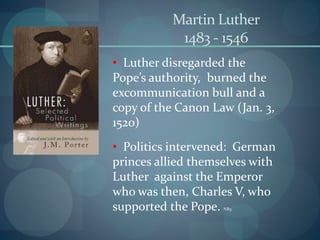
• Luther disregarded the
Pope’s authority, burned the
excommunication bull and a
copy of the Canon Law (Jan. 3,
1520)
• Politics intervened: German
princes allied themselves with
Luther against the Emperor
who was then, Charles V, who
supported the Pope. NB3
Martin Luther
1483 - 1546
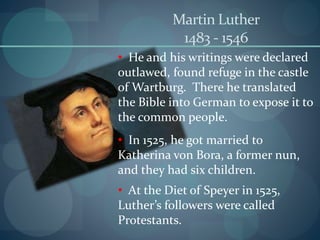
• He and his writings were declared
outlawed, found refuge in the castle
of Wartburg. There he translated
the Bible into German to expose it to
the common people.
• In 1525, he got married to
Katherina von Bora, a former nun,
and they had six children.
• At the Diet of Speyer in 1525,
Luther’s followers were called
Protestants.
Martin Luther
1483 - 1546
• The new Protestant theology was
officially formulated in Augsburg
Confession in 1530.
•It can be synthesized in 3 statements:
• Sola Fide (faith alone) NB4
• Sola Gratia (grace alone)
• Sola Scriptura (Scriptures alone)
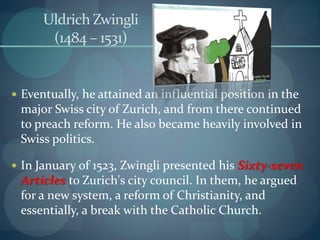
Uldrich Zwingli
(1484 – 1531)
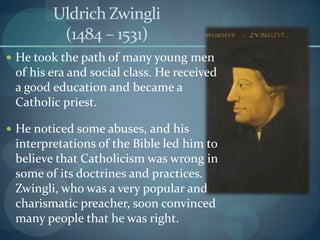
 He took the path of many young men
of his era and social class. He received
a good education and became a
Catholic priest.
 He noticed some abuses, and his
interpretations of the Bible led him to
believe that Catholicism was wrong in
some of its doctrines and practices.
Zwingli, who was a very popular and
charismatic preacher, soon convinced
many people that he was right.
Uldrich Zwingli
(1484 – 1531)
 Eventually, he attained an influential position in the
major Swiss city of Zurich, and from there continued
to preach reform. He also became heavily involved in
Swiss politics.
 In January of 1523, Zwingli presented his Sixty-seven
Articles to Zurich's city council. In them, he argued
for a new system, a reform of Christianity, and
essentially, a break with the Catholic Church.
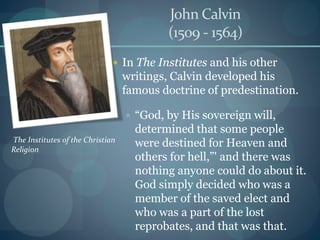
John Calvin
(1509 - 1564)
 In The Institutes and his other
writings, Calvin developed his
famous doctrine of predestination.
 “God, by His sovereign will,
determined that some people
were destined for Heaven and
others for hell,”' and there was
nothing anyone could do about it.
God simply decided who was a
member of the saved elect and
who was a part of the lost
reprobates, and that was that.
The Institutes of the Christian
Religion
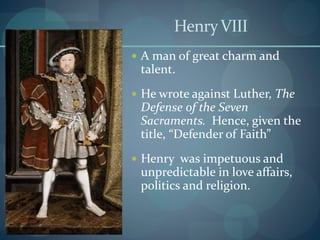
HenryVIII
 A man of great charm and
talent.
 He wrote against Luther, The
Defense of the Seven
Sacraments. Hence, given the
title, “Defender of Faith”
 Henry was impetuous and
unpredictable in love affairs,
politics and religion.
HenryVIII
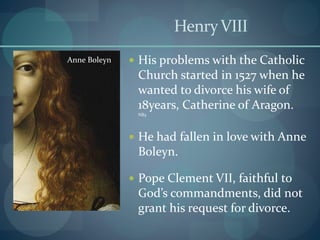
 His problems with the Catholic
Church started in 1527 when he
wanted to divorce his wife of
18years, Catherine of Aragon.
NB5
 He had fallen in love with Anne
Boleyn.
 Pope Clement VII, faithful to
God’s commandments, did not
grant his request for divorce.
Anne Boleyn
HenryVIII
 Henry being denied of his
request, separated from the
Catholic Church and founded
the Anglican Church through
Act of Supremacy (1534)
 Being the King and at the same
time head of the Anglican
Church, he ordered the exile or
public execution of those who
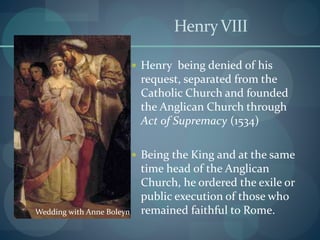
remained faithful to Rome.Wedding with Anne Boleyn
HenryVIII
 The martyrs of England, were
totured in the most barbarous
manner.
 Being the King and at the
same time head of the
Anglican Church, he ordered
the exile or public execution of
those who remained faithful to
Rome. NB6
Henry VIII married six times
HenryVIII
One among the martyrs during Henry
VIII reign:
 St. Thomas More, the Chancellor, a
devote Catholic and a prestigious
lawyer, devoted his life at the service
of the King of England. When he
refused to support the divorce of
Henry VIII, he was imprisoned in
London Tower and eventually
beheaded. His words: “I am the king’s
good servant, but God’s first.”
St. Thomas More
CONCLUSION
The Reformation is a hallmark in the journey
of the Church, the People of God. This era
may have broken the unity of the Church
but it definitely had opened the eyes of the
Catholic Church leaders to look into doing
reforms for the common good. Hence, their
answer was Counter-Reformation, and
further on after many years of challenges,
was the Vatican Council II, tagged as the
“New Pentecost.”
DLSU-D Religious and Values Education Department. Handout on
Christian Community: Birth and Growth of the Church
Fr. Paolo O. Pirlo, SHMU. Sons of Holy Mary Immaculate, My
First History of the Church, 1996, Quality Catholic
Publications, Parañaque.
The Catholic Encyclopedia. http://www.newadvent.org, accessed
Sept. 2, 2015.
Ulrich Zwingli and John Calvin: History, Importance & Impact.
http://study.com/
Pictures sources: various sites in the internet.
REFERENCES
THANK YOU 

Reformation

  • 1.
    A report preparedby Ma. Cristina V. Santos REFORMATION
  • 2.
  • 3.
  • 4.
    Martin Luther 1483 -1546 • He entered the monastery at the age of 22 and became an Augustinian Monk, a devout Roman Catholic priest and a theologian • His faith was soon struck by a series of experiences. • scandalized by the corrupted lifestyle of some clergy • outraged by the practice of selling of indulgences. NB1
  • 5.
    Martin Luther 1483 -1546 • He wrote his Ninety-five Theses and posted on the door of Wittenberg Church in Germany, on October 31, 1517. NB2 • When his Theses were forwarded to Pope Leo X, the discussion lasted for three years and the decision was excommunication for Luther.
  • 6.
    Martin Luther 1483 -1546 • Luther disregarded the Pope’s authority, burned the excommunication bull and a copy of the Canon Law (Jan. 3, 1520) • Politics intervened: German princes allied themselves with Luther against the Emperor who was then, Charles V, who supported the Pope. NB3
  • 7.
    Martin Luther 1483 -1546 • He and his writings were declared outlawed, found refuge in the castle of Wartburg. There he translated the Bible into German to expose it to the common people. • In 1525, he got married to Katherina von Bora, a former nun, and they had six children. • At the Diet of Speyer in 1525, Luther’s followers were called Protestants.
  • 8.
    Martin Luther 1483 -1546 • The new Protestant theology was officially formulated in Augsburg Confession in 1530. •It can be synthesized in 3 statements: • Sola Fide (faith alone) NB4 • Sola Gratia (grace alone) • Sola Scriptura (Scriptures alone)
  • 9.
    Uldrich Zwingli (1484 –1531)  He took the path of many young men of his era and social class. He received a good education and became a Catholic priest.  He noticed some abuses, and his interpretations of the Bible led him to believe that Catholicism was wrong in some of its doctrines and practices. Zwingli, who was a very popular and charismatic preacher, soon convinced many people that he was right.
  • 10.
    Uldrich Zwingli (1484 –1531)  Eventually, he attained an influential position in the major Swiss city of Zurich, and from there continued to preach reform. He also became heavily involved in Swiss politics.  In January of 1523, Zwingli presented his Sixty-seven Articles to Zurich's city council. In them, he argued for a new system, a reform of Christianity, and essentially, a break with the Catholic Church.
  • 11.
    John Calvin (1509 -1564)  In The Institutes and his other writings, Calvin developed his famous doctrine of predestination.  “God, by His sovereign will, determined that some people were destined for Heaven and others for hell,”' and there was nothing anyone could do about it. God simply decided who was a member of the saved elect and who was a part of the lost reprobates, and that was that. The Institutes of the Christian Religion
  • 12.
    HenryVIII  A manof great charm and talent.  He wrote against Luther, The Defense of the Seven Sacraments. Hence, given the title, “Defender of Faith”  Henry was impetuous and unpredictable in love affairs, politics and religion.
  • 13.
    HenryVIII  His problemswith the Catholic Church started in 1527 when he wanted to divorce his wife of 18years, Catherine of Aragon. NB5  He had fallen in love with Anne Boleyn.  Pope Clement VII, faithful to God’s commandments, did not grant his request for divorce. Anne Boleyn
  • 14.
    HenryVIII  Henry beingdenied of his request, separated from the Catholic Church and founded the Anglican Church through Act of Supremacy (1534)  Being the King and at the same time head of the Anglican Church, he ordered the exile or public execution of those who remained faithful to Rome.Wedding with Anne Boleyn
  • 15.
    HenryVIII  The martyrsof England, were totured in the most barbarous manner.  Being the King and at the same time head of the Anglican Church, he ordered the exile or public execution of those who remained faithful to Rome. NB6 Henry VIII married six times
  • 16.
    HenryVIII One among themartyrs during Henry VIII reign:  St. Thomas More, the Chancellor, a devote Catholic and a prestigious lawyer, devoted his life at the service of the King of England. When he refused to support the divorce of Henry VIII, he was imprisoned in London Tower and eventually beheaded. His words: “I am the king’s good servant, but God’s first.” St. Thomas More
  • 17.
    CONCLUSION The Reformation isa hallmark in the journey of the Church, the People of God. This era may have broken the unity of the Church but it definitely had opened the eyes of the Catholic Church leaders to look into doing reforms for the common good. Hence, their answer was Counter-Reformation, and further on after many years of challenges, was the Vatican Council II, tagged as the “New Pentecost.”
  • 18.
    DLSU-D Religious andValues Education Department. Handout on Christian Community: Birth and Growth of the Church Fr. Paolo O. Pirlo, SHMU. Sons of Holy Mary Immaculate, My First History of the Church, 1996, Quality Catholic Publications, Parañaque. The Catholic Encyclopedia. http://www.newadvent.org, accessed Sept. 2, 2015. Ulrich Zwingli and John Calvin: History, Importance & Impact. http://study.com/ Pictures sources: various sites in the internet. REFERENCES
  • 19.