Reflexes and cranial nerves
by
Dr.Hafiz Muhammad Asad Ullah
“Reflexes”
Reflex:
“A reflex is a muscle reaction that is
happens automatically in response
to stimulation .”
• Certain sensation or movements produce
specific muscle responses.
• Infant reflex
• Superficial reflex
• Deep reflexes
• Normal reflexes
• Abnormal reflex
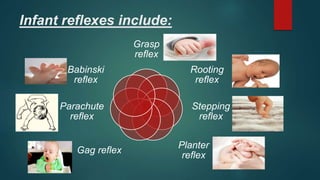
Infant reflexes include:
Grasp
reflex
Rooting
reflex
Stepping
reflex
Planter
reflex
Gag reflex
Parachute
reflex
Babinski
reflex
Some reflex which last into
adulthood are:
Blinking
reflex
Yawn
reflex
Sneeze
reflex
Gag
reflex
Cough
reflex
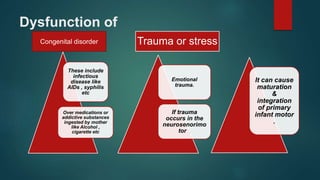
Dysfunction of
These include
infectious
disease like
AIDs , syphilis
etc
Over medications or
addictive substances
ingested by mother
like Alcohol ,
cigarette etc
Emotional
trauma.
If trauma
occurs in the
neurosenorimo
tor .
It can cause
maturation
&
integration
of primary
infant motor
.
Congenital disorder Trauma or stress
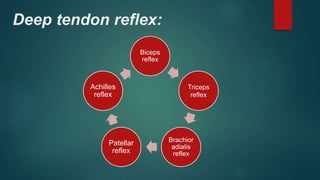
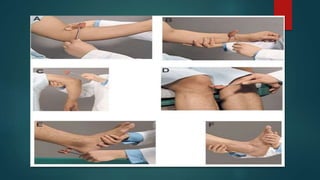
Deep tendon reflex:
Biceps
reflex
Triceps
reflex
Brachior
adialis
reflex
Patellar
reflex
Achilles
reflex
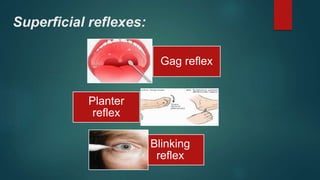
Superficial reflexes:
Gag reflex
Planter
reflex
Blinking
reflex
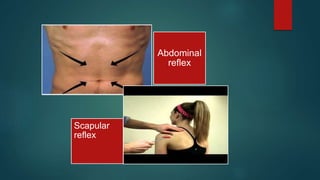
Abdominal
reflex
Scapular
reflex
Pathological reflexes:
chaddock’s
reflex
Babinski reflex
Gordon’s reflex
Schaffer’s
reflex
Hoffman’s
reflex
Clonus reflex
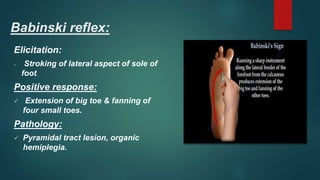
Babinski reflex:
Elicitation:
 Stroking of lateral aspect of sole of
foot.
Positive response:
 Extension of big toe & fanning of
four small toes.
Pathology:
 Pyramidal tract lesion, organic
hemiplegia.
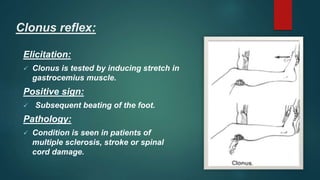
Clonus reflex:
Elicitation:
 Clonus is tested by inducing stretch in
gastrocemius muscle.
Positive sign:
 Subsequent beating of the foot.
Pathology:
 Condition is seen in patients of
multiple sclerosis, stroke or spinal
cord damage.
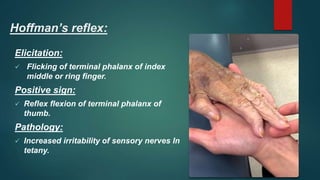
Hoffman’s reflex:
Elicitation:
 Flicking of terminal phalanx of index
middle or ring finger.
Positive sign:
 Reflex flexion of terminal phalanx of
thumb.
Pathology:
 Increased irritability of sensory nerves In
tetany.
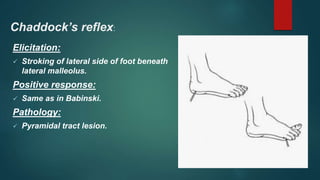
Chaddock’s reflex:
Elicitation:
 Stroking of lateral side of foot beneath
lateral malleolus.
Positive response:
 Same as in Babinski.
Pathology:
 Pyramidal tract lesion.
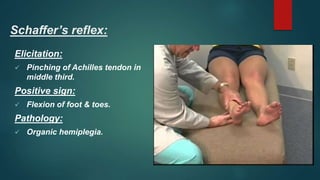
Schaffer’s reflex:
Elicitation:
 Pinching of Achilles tendon in
middle third.
Positive sign:
 Flexion of foot & toes.
Pathology:
 Organic hemiplegia.
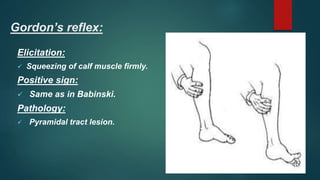
Gordon’s reflex:
Elicitation:
 Squeezing of calf muscle firmly.
Positive sign:
 Same as in Babinski.
Pathology:
 Pyramidal tract lesion.
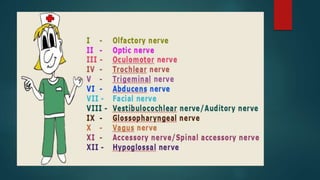
Cranial nerves
Cranial nerves:
 There are twelve pairs of cranial nerve in our body.
 They are called cranial nerve because these nerves
originates directly from the brain, inside the cranium.
 Cranial nerve may be sensory, motor both somatic or
parasympathetic or have mixed function.
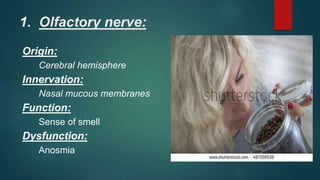
1. Olfactory nerve:
Origin:
Cerebral hemisphere
Innervation:
Nasal mucous membranes
Function:
Sense of smell
Dysfunction:
Anosmia
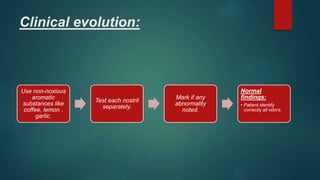
Clinical evolution:
Use non-noxious
aromatic
substances like
coffee, lemon ,
garlic.
Test each nostril
separately.
Mark if any
abnormality
noted.
Normal
findings:
• Patient identify
correctly all odors.
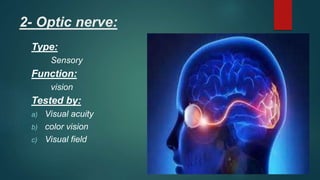
2- Optic nerve:
Type:
Sensory
Function:
vision
Tested by:
a) Visual acuity
b) color vision
c) Visual field
 Visual acuity:
Near vision Snellen chart
Far vision Jaegers chart
Color vision:
Color matching
Visual field:
Confrontation test
Dysfunction:
Visual loss
Cortical blindness
Hemianopia
Blurred vision or complete blindness
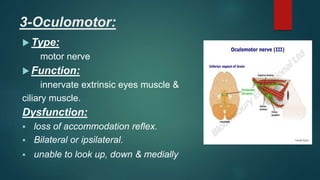
3-Oculomotor:
 Type:
motor nerve
 Function:
innervate extrinsic eyes muscle &
ciliary muscle.
Dysfunction:
 loss of accommodation reflex.
 Bilateral or ipsilateral.
 unable to look up, down & medially
4-Trochlear nerve:
 Type:
Motor
 Origin:
Midbrain
 Innervates:
Superior oblique muscle
Function:
down & inward movement of eye.
 Dysfunction:
Loss of movement of eye inward & downward
6- Abducens nerve:
 Origin:
Pons
 Innervation:
Lateral rectus muscle
 Function:
Outward & lateral movement of eye.
 Dysfunction:
Loss of lateral eye movement, dysconjugate gaze.
(3-Oculomotor 4-trochlear And 6abducens):
Important:
These three nerves operate as a unit & should be tested & evaluated
together.
Clinical Test:
 Observe for eye opening & symmetry.
 Pupil size & shape.
 Consensual response(present or absent).
 Direct light response.
 Accommodation
Test:
 Extraocular eye movement.
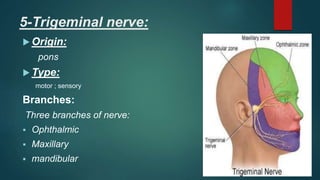
5-Trigeminal nerve:
 Origin:
pons
 Type:
motor ; sensory
Branches:
Three branches of nerve:
 Ophthalmic
 Maxillary
 mandibular
Trigeminal: (continue)
Motor innervation to:
 Masseter & temporal muscle
Sensory innervation to:
 Skin & mucous membrane in heads;
 teeth , tongue , external auditory canal & cornea.
Function:
 Chewing movement by innervation of masseter, temporal & pterygoid
muscle.
 Corneal & sneeze reflex.
 Sensation of face , scalp & teeth.
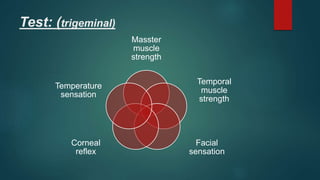
Test: (trigeminal)
Masster
muscle
strength
Temporal
muscle
strength
Facial
sensation
Corneal
reflex
Temperature
sensation
7-Facial nerve:
 Origin:
Pons & medulla
 Type:
Motor
 Function:
 Facial expression.
 Taste(anterior 2/3 of tongue.
 Salivary & lacrimal gland innervation.
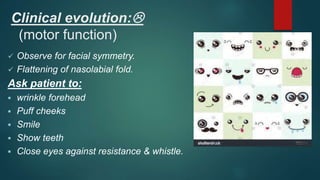
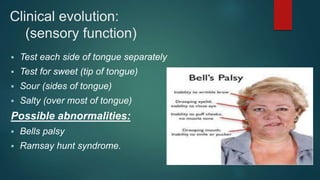
Clinical evolution:
(motor function)
 Observe for facial symmetry.
 Flattening of nasolabial fold.
Ask patient to:
 wrinkle forehead
 Puff cheeks
 Smile
 Show teeth
 Close eyes against resistance & whistle.
Clinical evolution:
(sensory function)
 Test each side of tongue separately
 Test for sweet (tip of tongue)
 Sour (sides of tongue)
 Salty (over most of tongue)
Possible abnormalities:
 Bells palsy
 Ramsay hunt syndrome.
8-vestibulocochlear nerve:
Origin:
Pons & medulla
Innervation:
 Cochlear ear
 Vestibular ear
Function:
 Hearing & sense of balance.
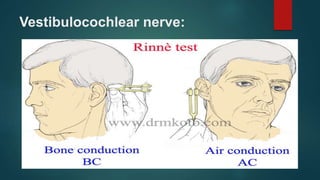
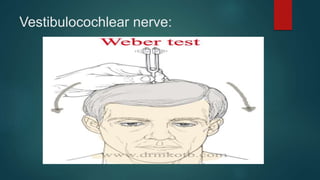
Test:
1. Rinne’test
2. Weber’s test
Vestibulocochlear nerve:
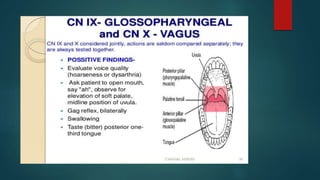
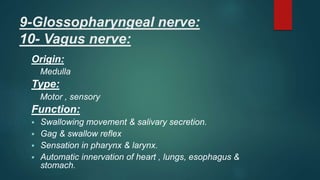
9-Glossopharyngeal nerve:
10- Vagus nerve:
Origin:
Medulla
Type:
Motor , sensory
Function:
 Swallowing movement & salivary secretion.
 Gag & swallow reflex
 Sensation in pharynx & larynx.
 Automatic innervation of heart , lungs, esophagus &
stomach.
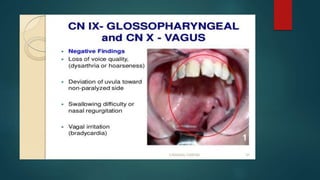
Dysfunction: (9 or 10)
Loss of taste;
neuralgia.
Loss of gag
& swallow
reflex.
Loss of
carotid sinus.
Oculocardiac
reflex.
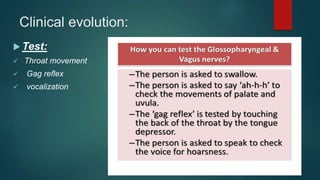
Clinical evolution:
 Test:
 Throat movement
 Gag reflex
 vocalization
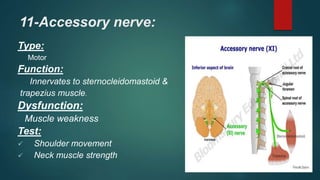
11-Accessory nerve:
Type:
Motor
Function:
Innervates to sternocleidomastoid &
trapezius muscle.
Dysfunction:
Muscle weakness
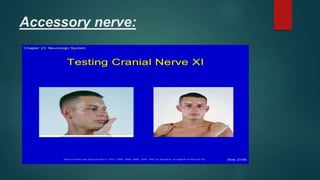
Test:
 Shoulder movement
 Neck muscle strength
Accessory nerve:
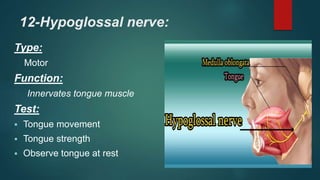
12-Hypoglossal nerve:
Type:
Motor
Function:
Innervates tongue muscle
Test:
 Tongue movement
 Tongue strength
 Observe tongue at rest
Reflexes and cranial nerves

Reflexes and cranial nerves