Using Reflective Practice In Your Career
Lessons from a reflective teacher
By Chris Upchurch, EF kids & teens Beijing
• Reflective practice is a state of mind, an ongoing attitude to life and work.
It enables us to make illuminative sense of where we are in our own
practice, and our relation to our profession.
• Reflective practice can enable professionals to learn more from
experience about: themselves; their work; the way they relate to home
and work, wider society and culture. – Bolton 2014
• Teachers regularly benefit from reflective practice at class and subject
level, but reflective practice is not limited to teaching or learning. Benefits
can be sought for all professions.
What is Reflective Practice?
Reflective Practice in Teaching
• Reflective practice is the ongoing process of intentional
reflection on all aspects of a lesson/teaching, incorporating
both student focused and teacher focused perspectives.
• “In a professional setting, reflection is:
– Deliberate;
– Purposeful;
– Structured;
– About linking theory and practice;
– To do with learning;
– About change and development – becoming a reflective teacher
(Scales, 2012, p. 8).”
“Reflection is a form of mental processing that we use to
fulfill a purpose or to achieve some anticipated outcome. It
is applied to gain a better understanding of relatively
complicated or unstructured ideas and is largely based on
the reprocessing of knowledge, understanding and, possibly,
emotions that we already possess
- Jenny Moon, quoted in Scales “The Reflective Teacher,” 2012, p.8
“Reflection is a form of mental processing that we use to
fulfill a purpose or to achieve some anticipated outcome.”
We often make plans in our daily lives, but the result may
not always be what we intended or expected. Reflection
helps the pratcioner analyse what worked, and why. As well
as what didn’t work, and what needs to change. From there
we can make more informed decisions.
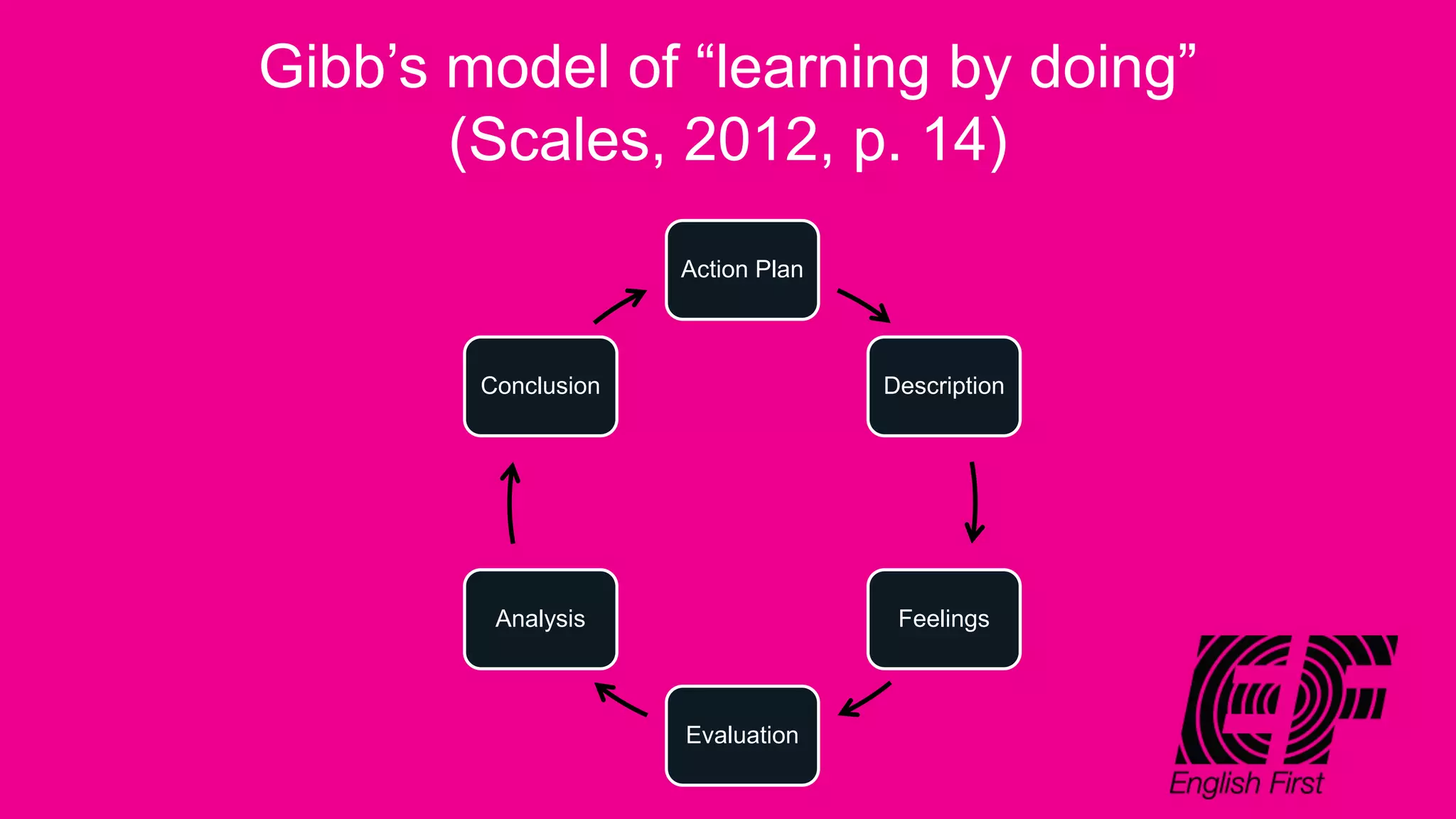
Gibb’s model of “learning by doing”
(Scales, 2012, p. 14)
Action Plan
Description
Feelings
Evaluation
Analysis
Conclusion
Gibb’s Model Continued
Description: What happened? Don’t make judgments yet or try to draw
conclusions; simply describe.
Feelings: What were your reactions and feelings? Again, don’t move on to
analyzing these yet.
Evaluation: What was good or bad about the experience? Make value
judgments.
Analysis: What sense can you make of the situation? Bring in ideas from
outside the experience to help you. What was really going on? Were different
people’s experiences similar or different in important ways?
Conclusions (general): What can be concluded, in a general sense, from
these experiences and the analyses you have undertaken?
Suggested strategies to support reflective
thinking
• Journaling: “This encourages [teachers] to reflect upon their practice, and
allows them to compare different reactions and re-evaluate the predictions
that were made based on what actually happened (Harmer, 2007, p. 346).”
• Video recording ourselves: can help teachers to see how proposed changes
effect outcomes in the classroom in real time (Harmer, 2007, p.346).
• Cooperative Development: working with other teachers to help understand a
situation and to hear their perspective (Harmer, 2007, p. 348)
Why is reflective practice valuable?
• Reflective practice can help us to move from “’unconscious incompetence’
(where we are unaware that we are doing something badly) to ‘unconscious
competence’ (where we do something well without having to think about
it)(Harmer, 2007, p.344).”
• Teaching requires us to examine the individual progress of each student.
Reflective practice is a tool that helps us to identify where each student is
and how we are supporting them.
• Teachers many times look at lessons uncritically and in terms of extremes:
either it was a success or it was a failure. “Teachers sometimes find
themselves diving from one extreme to the other in the space of a few
minutes….The alternative (and more difficult option) is to try to take an
objective, more balanced view of what happened: first to recall what
happened, then to reflect on that and look for what was successful and for
what could be improved (Scrivener, 2005, p. 347).”
Think and Discuss
• Reflect on a recent class or project that you think didn’t go well:
– What specific things happened to leave you with this
impression?
– What events or attitudes led to these things happening?
– What would you do differently next time?
• Reflect on a recent class or project that you think went well:
– What specific things happened to leave you with this
impression?
– What events or attitudes led to these things happening?
– Would you change anything for next time?
A quote of inspiration for teachers…
“Language teachers are privileged to work with a vital and
fascinating subject matter. Language is the way we express our
very being. It is the way we come to terms with the world….As a
teacher, you will often find yourself tied up in the nitty-gritty
atomistic side of language: the verb endings and the prepositions,
the schwas and the falling intonation patterns. But to keep hold of
the ‘whole’ as well. Don’t lose touch with the fact that people need
language to communicate with other people….Education is too
important to be lost amid a constant focus on smaller problems.”
- Scrivener, 2005, p. 380
A quote of inspiration for everyone…
“By three methods we may learn wisdom: First, by reflection, which
is noblest; Second, by imitation, which is easiest; and third by
experience, which is the bitterest.”
- Confucius
Reflection at EF
At EF English First, English teachers are encouraged to become
reflective practitioners. This is achieved through initiatives such as:
• Development Diaries for new teachers.
• CPD (Continual Professional Development) meetings. Sharing
opinions and feelings, and applying new concepts.
• Regional teacher forums to share opinions and feelings to foster
ideas, development and shared learning.
THANK YOU
Connect with us:
Twitter: https://www.facebook.com/EFteach
Facebook:https://twitter.com/EFteachers
LinkedIn: https://www.linkedin.com/company/ef-
english-first
Pay us a visit: http://www.englishfirst.com/esl-
jobs/
References
• Harmer, J. (2007) The Practice of English
Language Teaching. 3rd edn. Longman.
• Scrivener, J. (2005) Learning Teaching. 2nd edn.
Macmillan.
• Scales, P. (2012) The Reflective Teacher.

Using Reflective Practice in Your Career: Lessons from a reflective teacher

  • 1.
    Using Reflective PracticeIn Your Career Lessons from a reflective teacher By Chris Upchurch, EF kids & teens Beijing
  • 2.
    • Reflective practiceis a state of mind, an ongoing attitude to life and work. It enables us to make illuminative sense of where we are in our own practice, and our relation to our profession. • Reflective practice can enable professionals to learn more from experience about: themselves; their work; the way they relate to home and work, wider society and culture. – Bolton 2014 • Teachers regularly benefit from reflective practice at class and subject level, but reflective practice is not limited to teaching or learning. Benefits can be sought for all professions. What is Reflective Practice?
  • 3.
    Reflective Practice inTeaching • Reflective practice is the ongoing process of intentional reflection on all aspects of a lesson/teaching, incorporating both student focused and teacher focused perspectives. • “In a professional setting, reflection is: – Deliberate; – Purposeful; – Structured; – About linking theory and practice; – To do with learning; – About change and development – becoming a reflective teacher (Scales, 2012, p. 8).”
  • 4.
    “Reflection is aform of mental processing that we use to fulfill a purpose or to achieve some anticipated outcome. It is applied to gain a better understanding of relatively complicated or unstructured ideas and is largely based on the reprocessing of knowledge, understanding and, possibly, emotions that we already possess - Jenny Moon, quoted in Scales “The Reflective Teacher,” 2012, p.8
  • 5.
    “Reflection is aform of mental processing that we use to fulfill a purpose or to achieve some anticipated outcome.” We often make plans in our daily lives, but the result may not always be what we intended or expected. Reflection helps the pratcioner analyse what worked, and why. As well as what didn’t work, and what needs to change. From there we can make more informed decisions.
  • 6.
    Gibb’s model of“learning by doing” (Scales, 2012, p. 14) Action Plan Description Feelings Evaluation Analysis Conclusion
  • 7.
    Gibb’s Model Continued Description:What happened? Don’t make judgments yet or try to draw conclusions; simply describe. Feelings: What were your reactions and feelings? Again, don’t move on to analyzing these yet. Evaluation: What was good or bad about the experience? Make value judgments. Analysis: What sense can you make of the situation? Bring in ideas from outside the experience to help you. What was really going on? Were different people’s experiences similar or different in important ways? Conclusions (general): What can be concluded, in a general sense, from these experiences and the analyses you have undertaken?
  • 8.
    Suggested strategies tosupport reflective thinking • Journaling: “This encourages [teachers] to reflect upon their practice, and allows them to compare different reactions and re-evaluate the predictions that were made based on what actually happened (Harmer, 2007, p. 346).” • Video recording ourselves: can help teachers to see how proposed changes effect outcomes in the classroom in real time (Harmer, 2007, p.346). • Cooperative Development: working with other teachers to help understand a situation and to hear their perspective (Harmer, 2007, p. 348)
  • 9.
    Why is reflectivepractice valuable? • Reflective practice can help us to move from “’unconscious incompetence’ (where we are unaware that we are doing something badly) to ‘unconscious competence’ (where we do something well without having to think about it)(Harmer, 2007, p.344).” • Teaching requires us to examine the individual progress of each student. Reflective practice is a tool that helps us to identify where each student is and how we are supporting them. • Teachers many times look at lessons uncritically and in terms of extremes: either it was a success or it was a failure. “Teachers sometimes find themselves diving from one extreme to the other in the space of a few minutes….The alternative (and more difficult option) is to try to take an objective, more balanced view of what happened: first to recall what happened, then to reflect on that and look for what was successful and for what could be improved (Scrivener, 2005, p. 347).”
  • 10.
    Think and Discuss •Reflect on a recent class or project that you think didn’t go well: – What specific things happened to leave you with this impression? – What events or attitudes led to these things happening? – What would you do differently next time? • Reflect on a recent class or project that you think went well: – What specific things happened to leave you with this impression? – What events or attitudes led to these things happening? – Would you change anything for next time?
  • 11.
    A quote ofinspiration for teachers… “Language teachers are privileged to work with a vital and fascinating subject matter. Language is the way we express our very being. It is the way we come to terms with the world….As a teacher, you will often find yourself tied up in the nitty-gritty atomistic side of language: the verb endings and the prepositions, the schwas and the falling intonation patterns. But to keep hold of the ‘whole’ as well. Don’t lose touch with the fact that people need language to communicate with other people….Education is too important to be lost amid a constant focus on smaller problems.” - Scrivener, 2005, p. 380
  • 12.
    A quote ofinspiration for everyone… “By three methods we may learn wisdom: First, by reflection, which is noblest; Second, by imitation, which is easiest; and third by experience, which is the bitterest.” - Confucius
  • 13.
    Reflection at EF AtEF English First, English teachers are encouraged to become reflective practitioners. This is achieved through initiatives such as: • Development Diaries for new teachers. • CPD (Continual Professional Development) meetings. Sharing opinions and feelings, and applying new concepts. • Regional teacher forums to share opinions and feelings to foster ideas, development and shared learning.
  • 14.
    THANK YOU Connect withus: Twitter: https://www.facebook.com/EFteach Facebook:https://twitter.com/EFteachers LinkedIn: https://www.linkedin.com/company/ef- english-first Pay us a visit: http://www.englishfirst.com/esl- jobs/
  • 15.
    References • Harmer, J.(2007) The Practice of English Language Teaching. 3rd edn. Longman. • Scrivener, J. (2005) Learning Teaching. 2nd edn. Macmillan. • Scales, P. (2012) The Reflective Teacher.