Introduction to
Referencing
Learning Outcomes
By the end of this seminar you should:
 Understand what a citation is.
 Recognise when a citation is required.
 Recognise appropriate use of quotation in
academic work
 Understand a range of purposes of citations.
Citations (The in-text reference)
 In academic work, the writer should inform the
reader of the source of their information.
 This should occur as close to the point at which
the material is used as possible.
 The writer should place a reference to the
original material within the text.
 References placed within the text is called a citation.
Using Citations
Citations should show who originated:
 All quoted material.
 All information used,
(even when it is in your own words).
 Diagrams.
 In other words - everything, unless:
 It is common knowledge.
 It is the product of logical deduction.
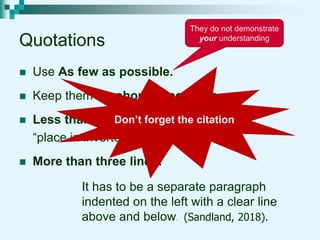
Quotations
 Use As few as possible.
 Keep them As short as possible.
 Less than three lines:
“place in inverted comma’s”.
 More than three lines:
It has to be a separate paragraph
indented on the left with a clear line
above and below.
They do not demonstrate
your understanding
Don’t forget the citation
(Sandland, 2018).
Getting technical
Plagiarism
Plagiarism is defined as:
“The unauthorized use or close imitation of the
language and thoughts of another author and
the representation of them as one's own original
work.” (Dictionary.com)
 Unreferenced work is plagiarism
 Referenced quotations that do not look like
quotations is plagiarism.
Beware:
Plagiarism can happen by accident especially if you:
1. Read the source material.
2. Copy out useful passages into your notes.
3. Read your notes as you write the report.
 You keep reading the same words.
 You will remember the words when you write.
 You risk quoting the original material without
knowing it.
Acknowledging the source.
 An essential requirement for academic work.
It is a Breach of Regulations to:
 Present material as a quotation but not
acknowledge the originator
 Quote material or make slight alterations to the
original without presenting it as a quotation.
 Even if it is correctly cited
But there are
advantages as well…
Justifying your answer.
 Citations help to differentiate between
opinion / hearsay and established concepts.
 Academic work should stand up to criticism:
Established concepts have already withstood the
test.
 Citations add quality to your work.
Justifying the Answer
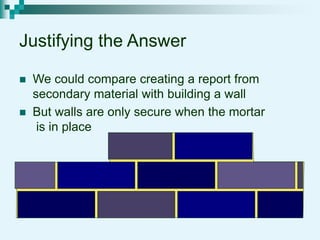
 We could compare creating a report from
secondary material with building a wall
 But walls are only secure when the mortar
is in place
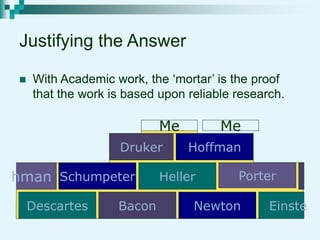
Me
Justifying the Answer
Descartes Bacon Newton
Schumpeter Heller Porter
Druker Hoffman
Einste
hman
Me
 With Academic work, the ‘mortar’ is the proof
that the work is based upon reliable research.
Providing more information
 Citations tell the reader where you found
information.
 This can help the reader extend their research.
 You could use the references in documents you
find in a similar way.
The danger of the short cut
Referencing material can be tedious,
but beware of the short cut…
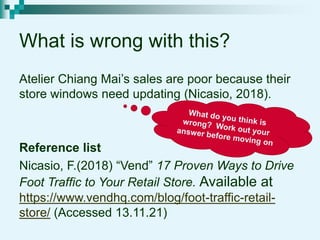
What is wrong with this?
Atelier Chiang Mai’s sales are poor because their
store windows need updating (Nicasio, 2018).
Reference list
Nicasio, F.(2018) “Vend” 17 Proven Ways to Drive
Foot Traffic to Your Retail Store. Available at
https://www.vendhq.com/blog/foot-traffic-retail-
store/ (Accessed 13.11.21)
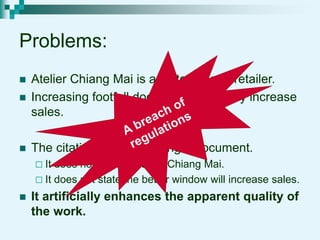
Problems:
 Atelier Chiang Mai is a factory, not a retailer.
 Increasing footfall does not necessarily increase
sales.
 The citation is not to the right document.
 It does not refer to Atelier Chiang Mai.
 It does not state the better window will increase sales.
 It artificially enhances the apparent quality of
the work.
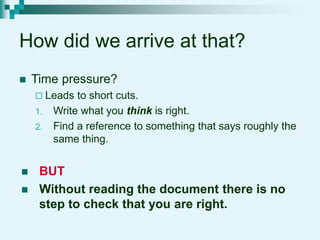
How did we arrive at that?
 Time pressure?
 Leads to short cuts.
1. Write what you think is right.
2. Find a reference to something that says roughly the
same thing.
 BUT
 Without reading the document there is no
step to check that you are right.
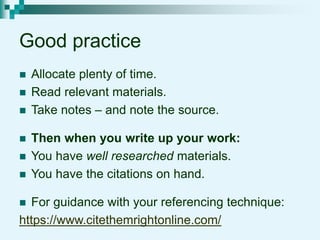
Good practice
 Allocate plenty of time.
 Read relevant materials.
 Take notes – and note the source.
 Then when you write up your work:
 You have well researched materials.
 You have the citations on hand.
 For guidance with your referencing technique:
https://www.citethemrightonline.com/
We have
 Defined the citation.
 Recognised when a citation is required.
 Recognised appropriate use of quotation in
academic work
 Understand a range of purposes of citations.

Introducing referencing.ppt

  • 1.
  • 2.
    Learning Outcomes By theend of this seminar you should:  Understand what a citation is.  Recognise when a citation is required.  Recognise appropriate use of quotation in academic work  Understand a range of purposes of citations.
  • 3.
    Citations (The in-textreference)  In academic work, the writer should inform the reader of the source of their information.  This should occur as close to the point at which the material is used as possible.  The writer should place a reference to the original material within the text.  References placed within the text is called a citation.
  • 4.
    Using Citations Citations shouldshow who originated:  All quoted material.  All information used, (even when it is in your own words).  Diagrams.  In other words - everything, unless:  It is common knowledge.  It is the product of logical deduction.
  • 5.
    Quotations  Use Asfew as possible.  Keep them As short as possible.  Less than three lines: “place in inverted comma’s”.  More than three lines: It has to be a separate paragraph indented on the left with a clear line above and below. They do not demonstrate your understanding Don’t forget the citation (Sandland, 2018).
  • 6.
  • 7.
    Plagiarism Plagiarism is definedas: “The unauthorized use or close imitation of the language and thoughts of another author and the representation of them as one's own original work.” (Dictionary.com)  Unreferenced work is plagiarism  Referenced quotations that do not look like quotations is plagiarism.
  • 8.
    Beware: Plagiarism can happenby accident especially if you: 1. Read the source material. 2. Copy out useful passages into your notes. 3. Read your notes as you write the report.  You keep reading the same words.  You will remember the words when you write.  You risk quoting the original material without knowing it.
  • 9.
    Acknowledging the source. An essential requirement for academic work. It is a Breach of Regulations to:  Present material as a quotation but not acknowledge the originator  Quote material or make slight alterations to the original without presenting it as a quotation.  Even if it is correctly cited
  • 10.
  • 11.
    Justifying your answer. Citations help to differentiate between opinion / hearsay and established concepts.  Academic work should stand up to criticism: Established concepts have already withstood the test.  Citations add quality to your work.
  • 12.
    Justifying the Answer We could compare creating a report from secondary material with building a wall  But walls are only secure when the mortar is in place
  • 13.
    Me Justifying the Answer DescartesBacon Newton Schumpeter Heller Porter Druker Hoffman Einste hman Me  With Academic work, the ‘mortar’ is the proof that the work is based upon reliable research.
  • 14.
    Providing more information Citations tell the reader where you found information.  This can help the reader extend their research.  You could use the references in documents you find in a similar way.
  • 15.
    The danger ofthe short cut Referencing material can be tedious, but beware of the short cut…
  • 16.
    What is wrongwith this? Atelier Chiang Mai’s sales are poor because their store windows need updating (Nicasio, 2018). Reference list Nicasio, F.(2018) “Vend” 17 Proven Ways to Drive Foot Traffic to Your Retail Store. Available at https://www.vendhq.com/blog/foot-traffic-retail- store/ (Accessed 13.11.21)
  • 17.
    Problems:  Atelier ChiangMai is a factory, not a retailer.  Increasing footfall does not necessarily increase sales.  The citation is not to the right document.  It does not refer to Atelier Chiang Mai.  It does not state the better window will increase sales.  It artificially enhances the apparent quality of the work.
  • 18.
    How did wearrive at that?  Time pressure?  Leads to short cuts. 1. Write what you think is right. 2. Find a reference to something that says roughly the same thing.  BUT  Without reading the document there is no step to check that you are right.
  • 19.
    Good practice  Allocateplenty of time.  Read relevant materials.  Take notes – and note the source.  Then when you write up your work:  You have well researched materials.  You have the citations on hand.  For guidance with your referencing technique: https://www.citethemrightonline.com/
  • 20.
    We have  Definedthe citation.  Recognised when a citation is required.  Recognised appropriate use of quotation in academic work  Understand a range of purposes of citations.