Are Agile Teams More Effective? 
Findings from the Teamwork Literature and 
Empirical Studies of Agile Teams 
National University of Ireland, Galway 
10 September 2014 
Torgeir Dingsøyr 
Senior scientist, SINTEF ICT 
Adjunct professor, Norwegian University of Science and Technology
2 
Overview 
n Agile Software Development 
n Teamwork and Team Effectiveness 
n Teamwork in Agile Software Development: A Case Study 
n Are Agile Teams more Effective? 
n References and Resources
3 
Agile Software Development
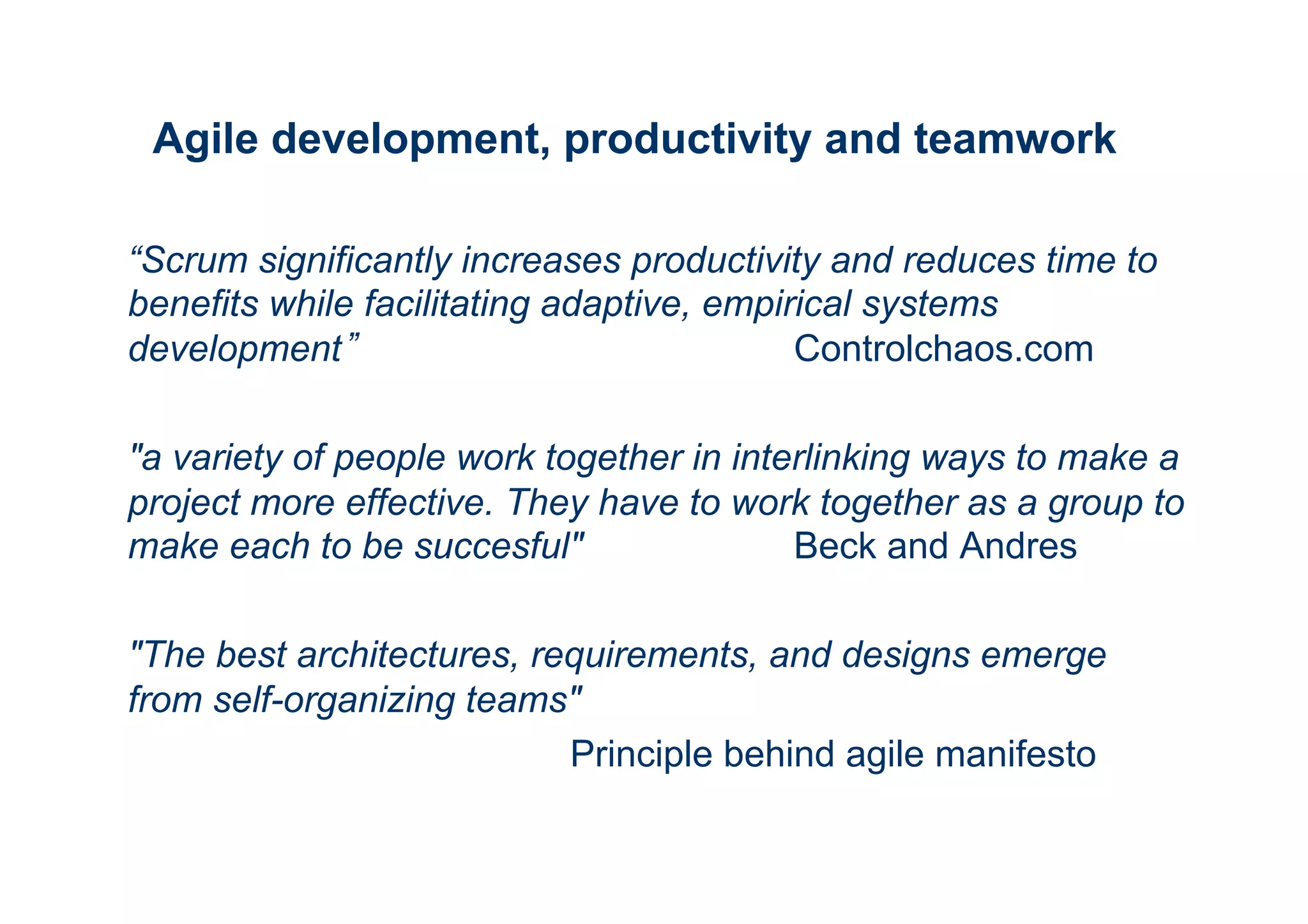
Agile development, productivity and teamwork 
“Scrum significantly increases productivity and reduces time to 
benefits while facilitating adaptive, empirical systems 
development” Controlchaos.com 
"a variety of people work together in interlinking ways to make a 
project more effective. They have to work together as a group to 
make each to be succesful" Beck and Andres 
"The best architectures, requirements, and designs emerge 
from self-organizing teams" 
Principle behind agile manifesto
5 
Teamwork and Team 
Performance
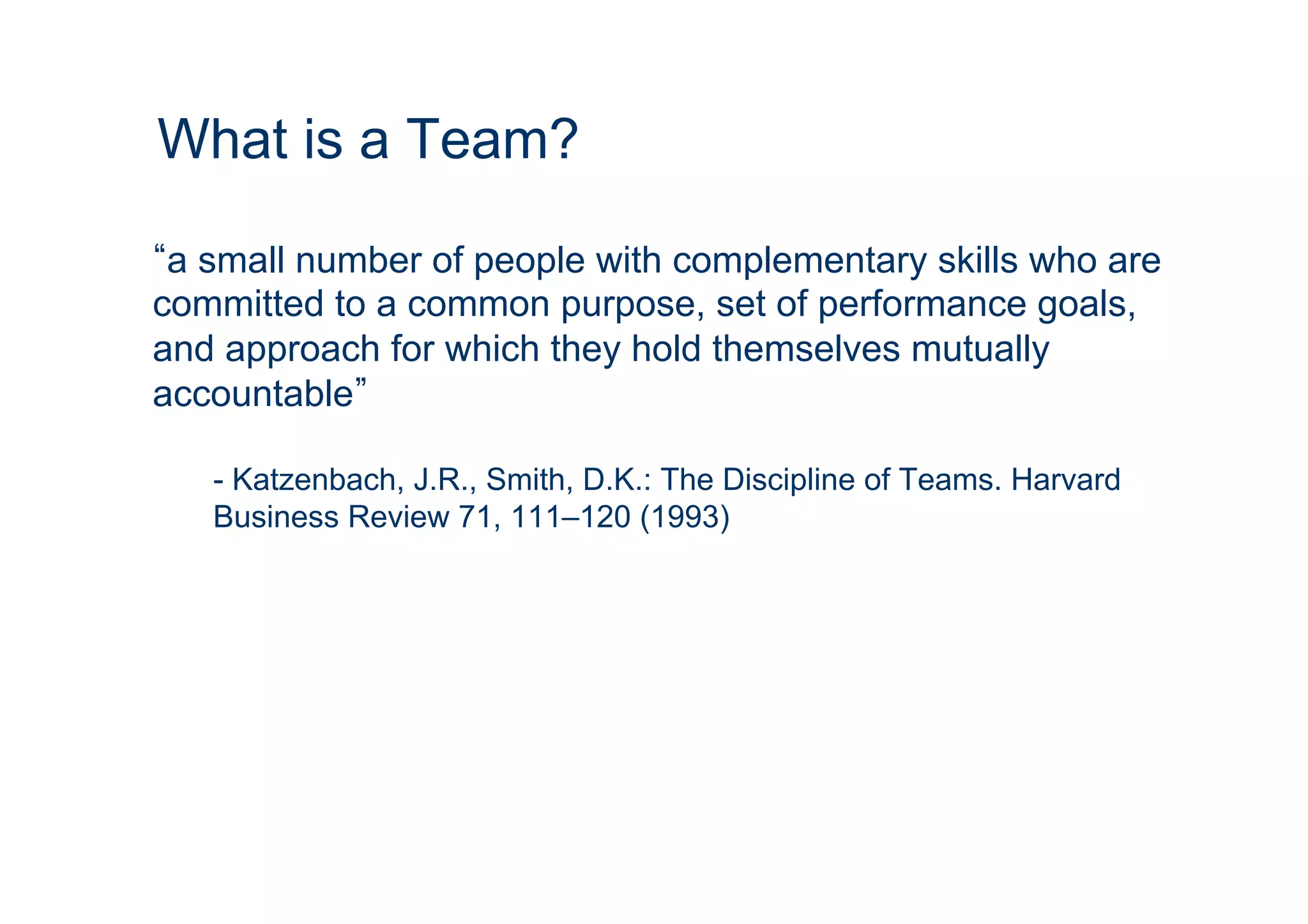
What is a Team? 
“a small number of people with complementary skills who are 
committed to a common purpose, set of performance goals, 
and approach for which they hold themselves mutually 
accountable” 
- Katzenbach, J.R., Smith, D.K.: The Discipline of Teams. Harvard 
Business Review 71, 111–120 (1993) 
IKT
IKT 
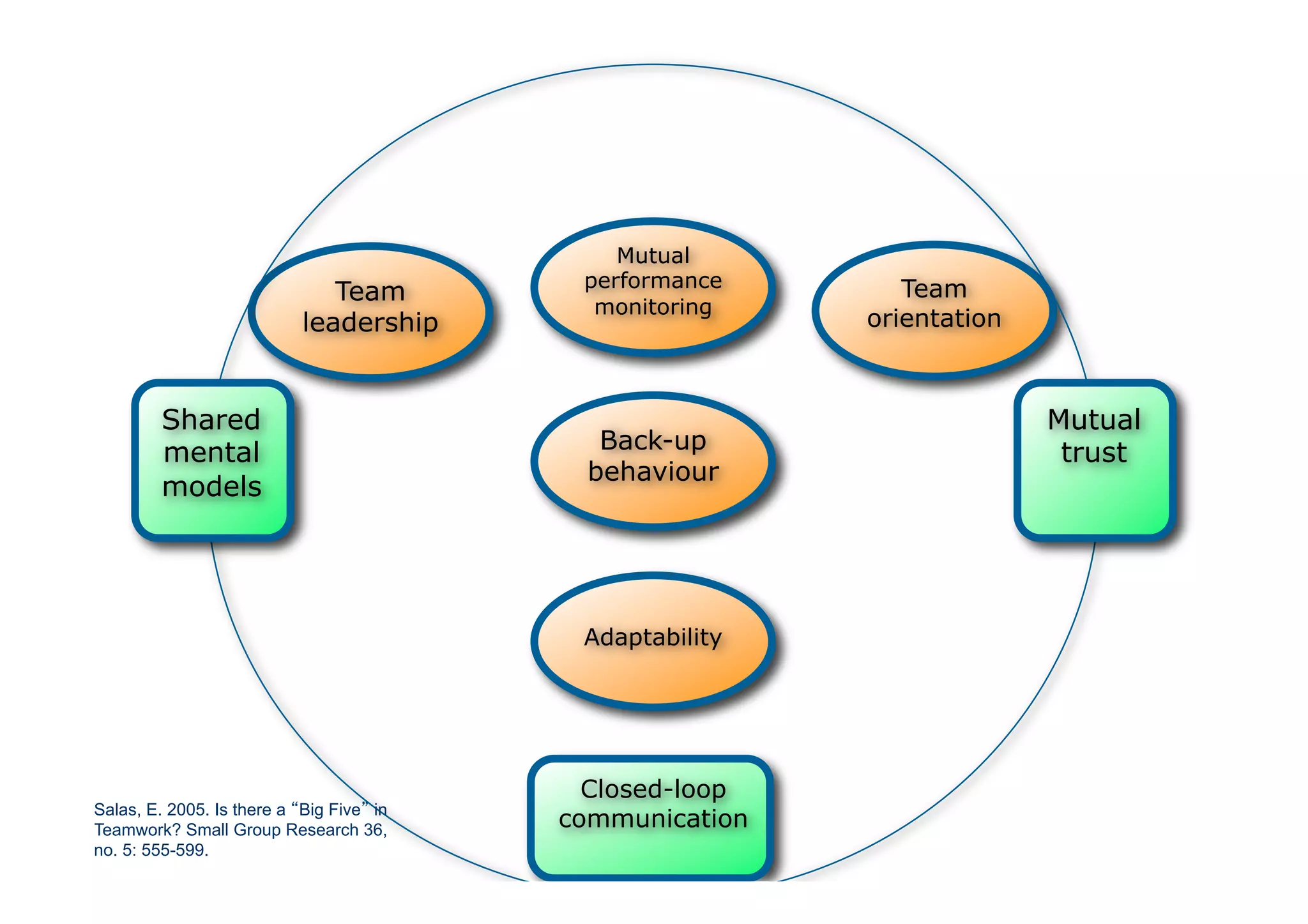
Team 
leadership 
Team 
orientation 
Mutual 
performance 
monitoring 
Back-up 
behaviour 
Adaptability 
Shared 
mental 
models 
Mutual 
trust 
Closed-loop 
Salas, E. 2005. Is there a “Big Five” in communication 
Teamwork? Small Group Research 36, 
no. 5: 555-599.
8 
Teamwork in Agile Software 
Development: A Case Study
ICT 
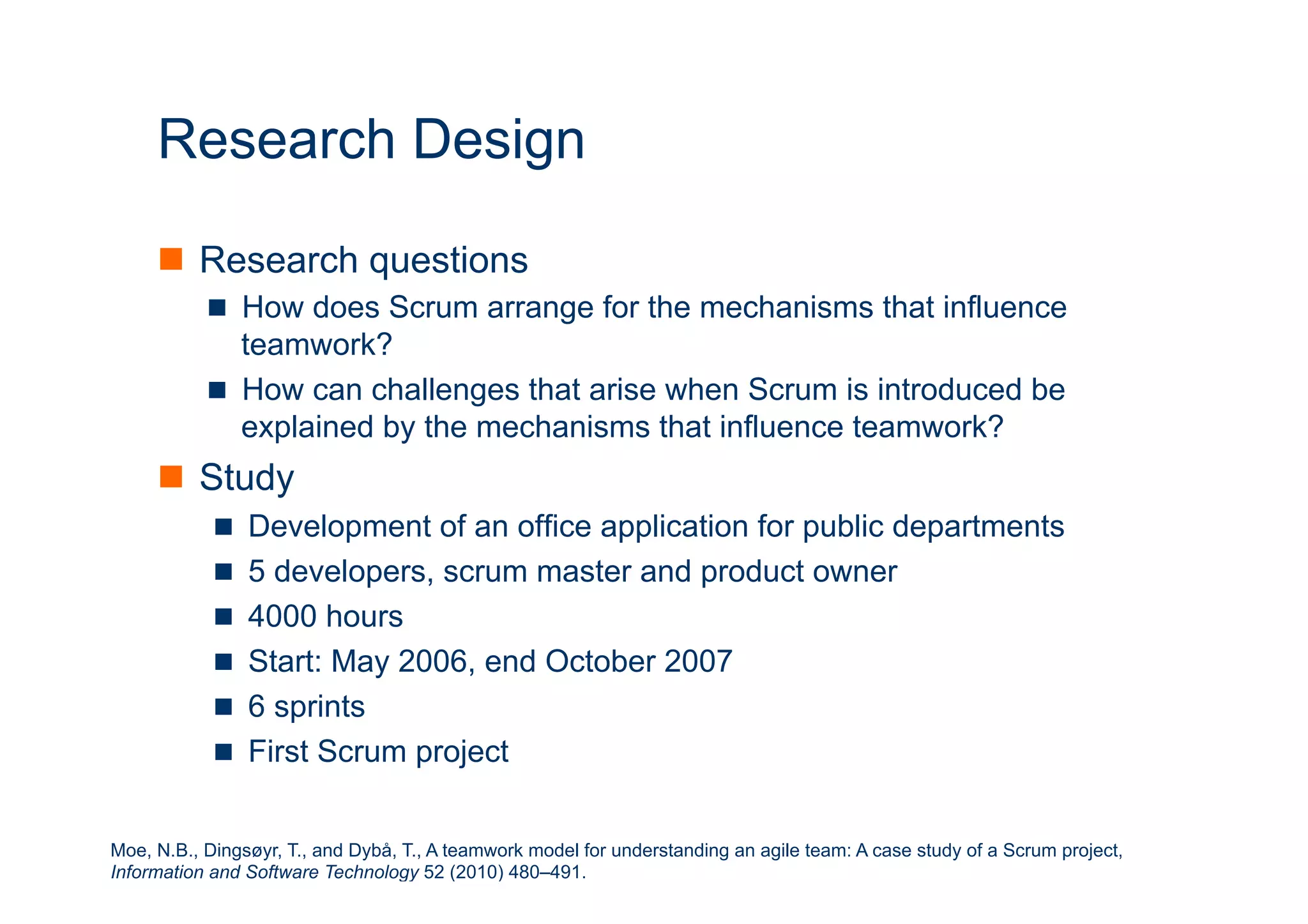
Research Design 
n Research questions 
n How does Scrum arrange for the mechanisms that influence 
teamwork? 
n How can challenges that arise when Scrum is introduced be 
explained by the mechanisms that influence teamwork? 
n Study 
n Development of an office application for public departments 
n 5 developers, scrum master and product owner 
n 4000 hours 
n Start: May 2006, end October 2007 
n 6 sprints 
n First Scrum project 
Moe, N.B., Dingsøyr, T., and Dybå, T., A teamwork model for understanding an agile team: A case study of a Scrum project, 
Information and Software Technology 52 (2010) 480–491.
ICT 
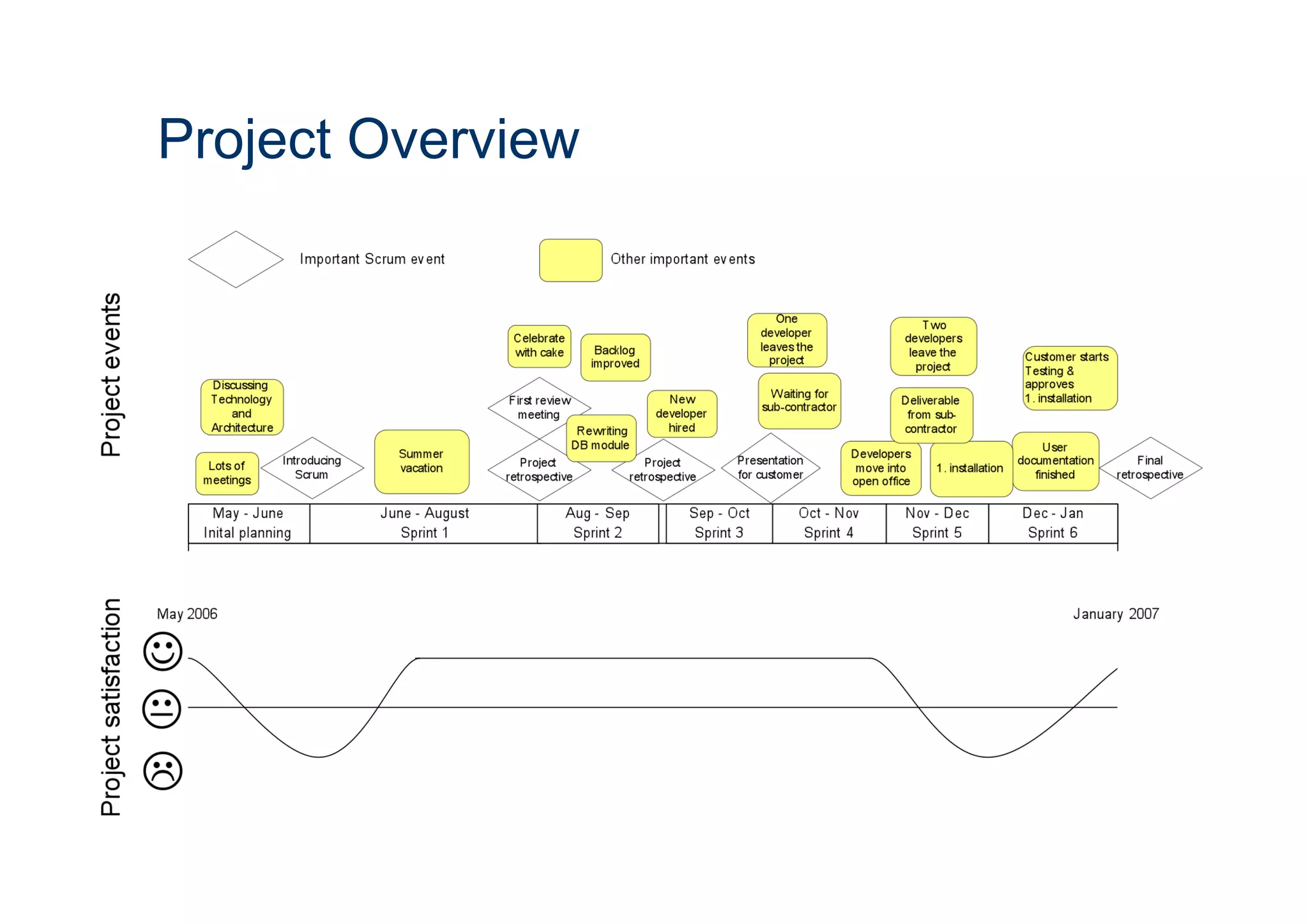
Project Overview
9 
Data Collection and Analysis 
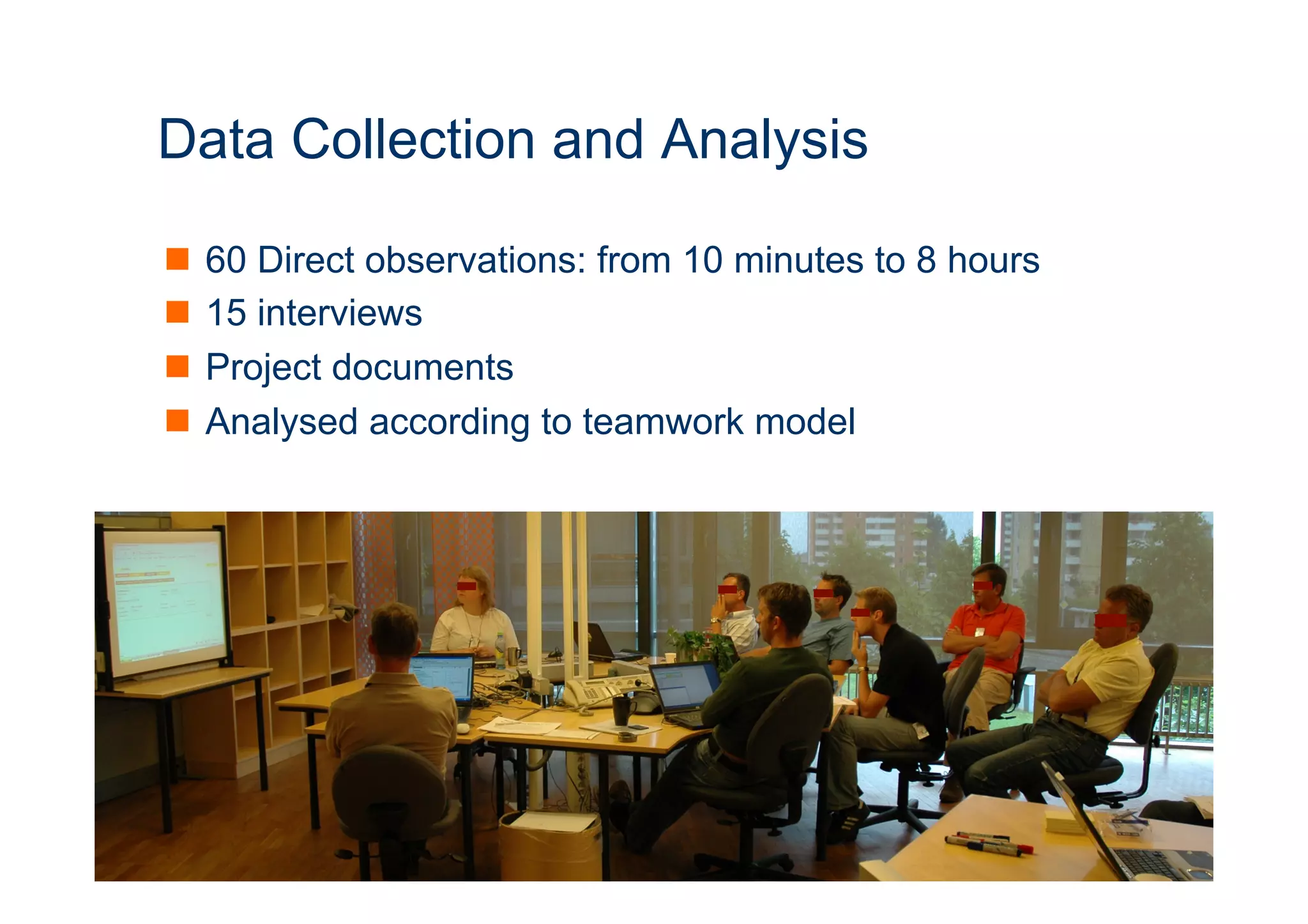
n 60 Direct observations: from 10 minutes to 8 hours 
n 15 interviews 
n Project documents 
n Analysed according to teamwork model
ICT 
In Theory: Team Leadership 
n Definition: 
n Direct and coordinate the 
activities of other team 
members 
n Assess team performance 
n Assign tasks 
n Develop team knowledge, 
skills, and abilities 
n Motivate team members 
n Plan, organize, and establish a 
positive atmosphere 
n The Scrum team: 
n Planning 
n Scheduling 
n Assigning tasks to members 
n Making decisions 
n The Scrum master: 
n Removes impediments of the 
process 
n Facilitates meetings
In Practice: Team Leadership 
n Problems not reported 
n “We classified tasks as finished before they were completed, and we 
knew there was still work to be done. It seems that the scrum master 
wants to show progress and make us look a little better than we really 
are” – developer 
n “It turned out that certain parts of the system were simply forgotten. 
There has been a failure somewhere... The product owner and the 
client asked for things that no-one had thought of and that were not in 
the backlog” – developer 
n “The daily meetings are mostly about reporting to the Scrum master. 
When he is not there, the meetings are better because then we 
communicate with each other” – developer 
ICT
ICT 
In Theory: Team Orientation 
n Definition: 
n Take other’s behaviour into 
account during group 
interaction 
n The belief in the importance 
of team goal’s over 
individual members’ goals 
n Scrum: 
n The team does high level goal 
setting 
n The Product owner provides a 
vision 
n Sprint planning, daily meetings 
and retrospectives
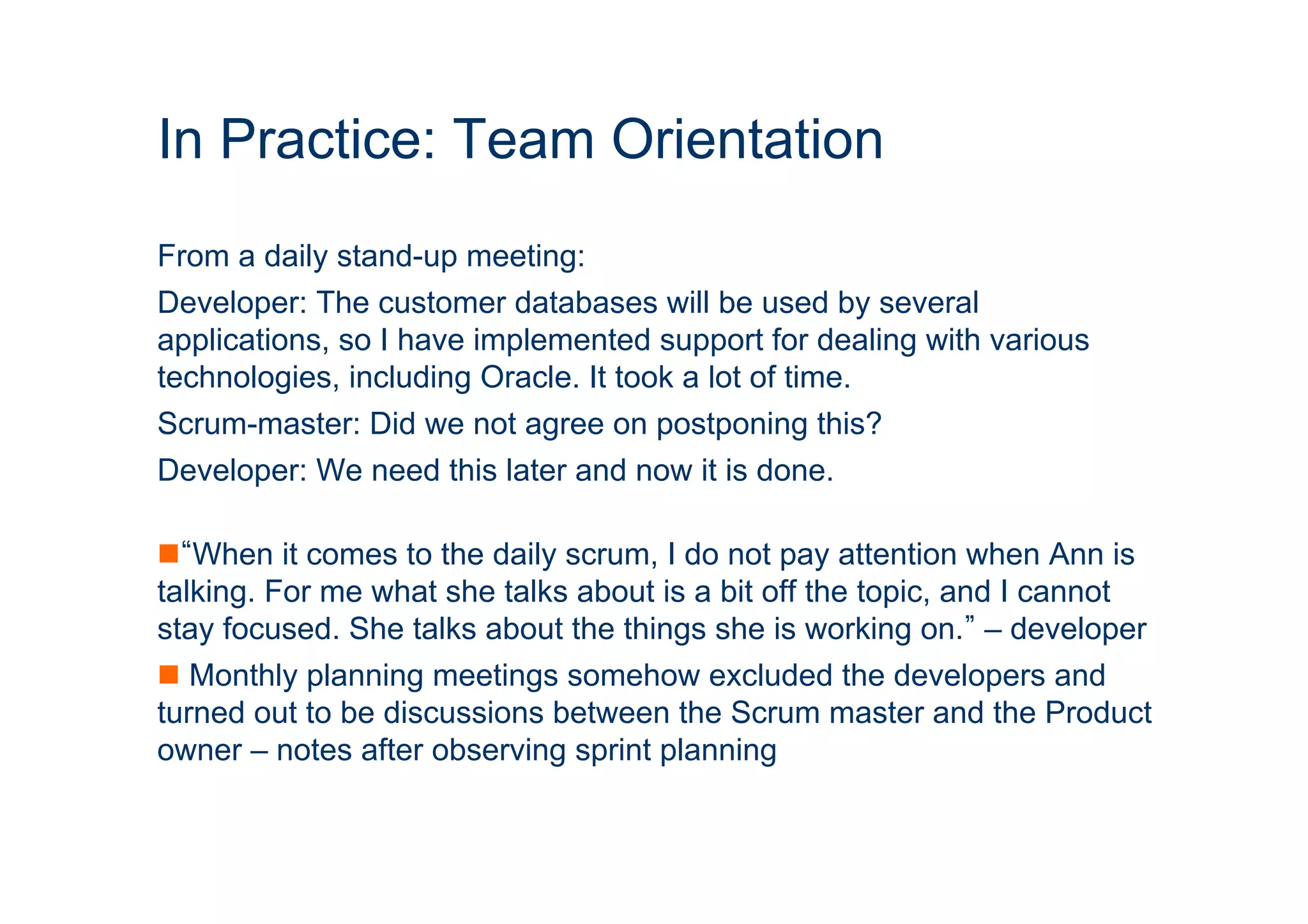
In Practice: Team Orientation 
From a daily stand-up meeting: 
Developer: The customer databases will be used by several 
applications, so I have implemented support for dealing with various 
technologies, including Oracle. It took a lot of time. 
Scrum-master: Did we not agree on postponing this? 
Developer: We need this later and now it is done. 
n “When it comes to the daily scrum, I do not pay attention when Ann is 
talking. For me what she talks about is a bit off the topic, and I cannot 
stay focused. She talks about the things she is working on.” – developer 
n Monthly planning meetings somehow excluded the developers and 
turned out to be discussions between the Scrum master and the Product 
owner – notes after observing sprint planning 
ICT
In Practice: Team Orientation 
n “When we discover new problems, we feel we own them 
ourselves, and that we will manage to solve them before 
the next meeting tomorrow. But this is not the case, it 
always takes longer time” – developer 
ICT
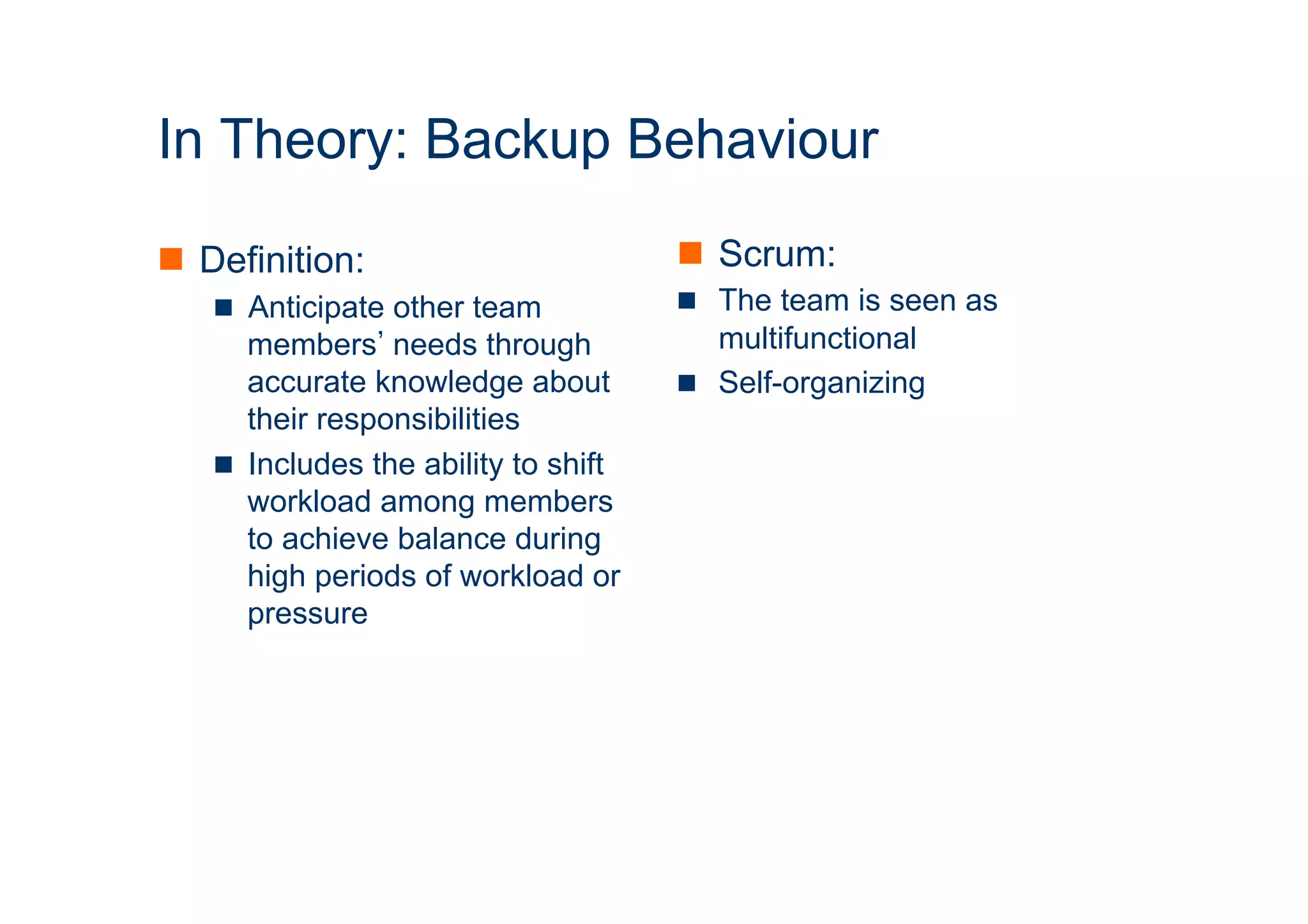
In Theory: Backup Behaviour 
ICT 
n Definition: 
n Anticipate other team 
members’ needs through 
accurate knowledge about 
their responsibilities 
n Includes the ability to shift 
workload among members 
to achieve balance during 
high periods of workload or 
pressure 
n Scrum: 
n The team is seen as 
multifunctional 
n Self-organizing
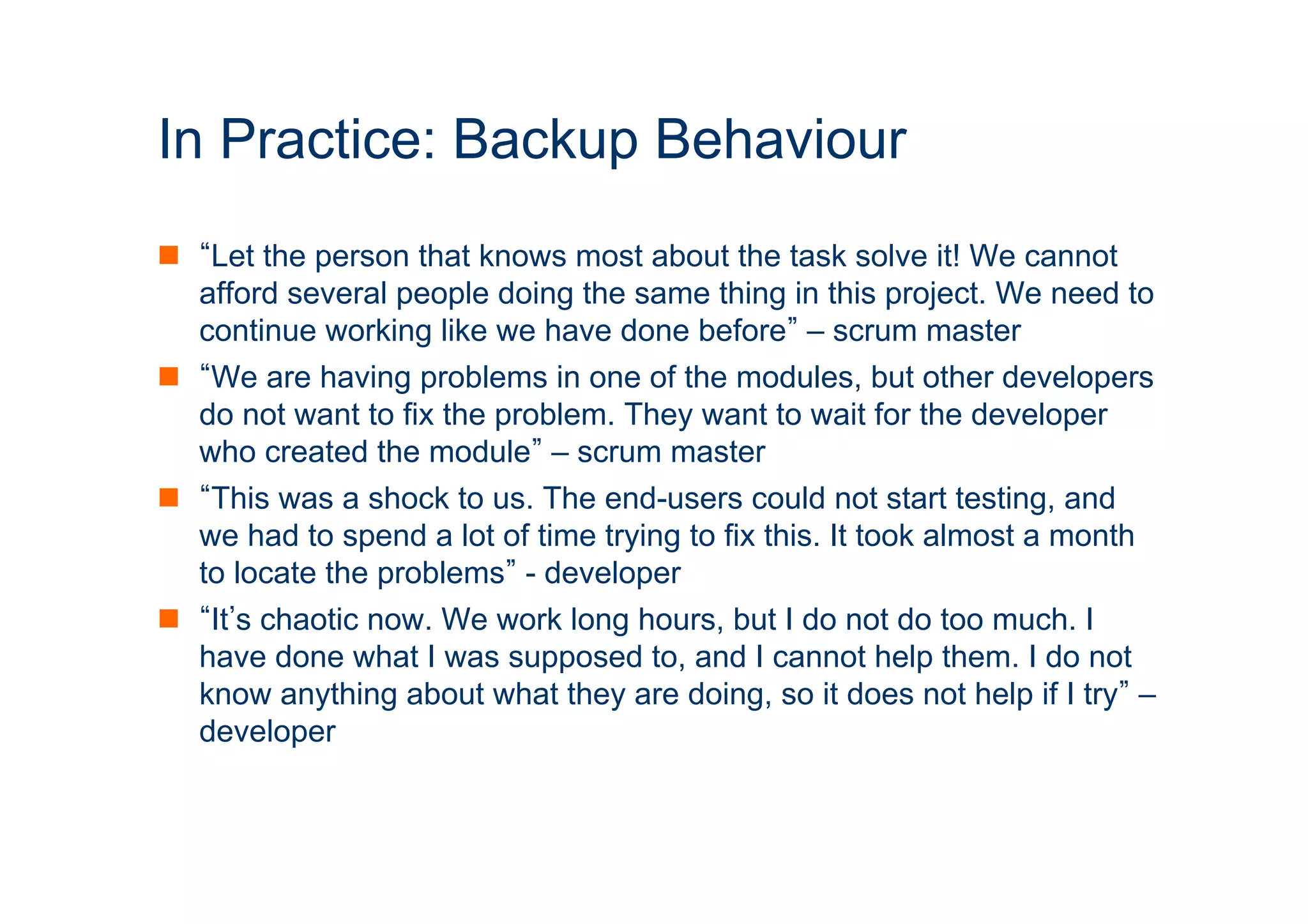
In Practice: Backup Behaviour 
n “Let the person that knows most about the task solve it! We cannot 
afford several people doing the same thing in this project. We need to 
continue working like we have done before” – scrum master 
n “We are having problems in one of the modules, but other developers 
do not want to fix the problem. They want to wait for the developer 
who created the module” – scrum master 
n “This was a shock to us. The end-users could not start testing, and 
we had to spend a lot of time trying to fix this. It took almost a month 
to locate the problems” - developer 
n “It’s chaotic now. We work long hours, but I do not do too much. I 
have done what I was supposed to, and I cannot help them. I do not 
know anything about what they are doing, so it does not help if I try” – 
developer 
ICT
20 
Are Agile Teams more 
Effective?
ICT 
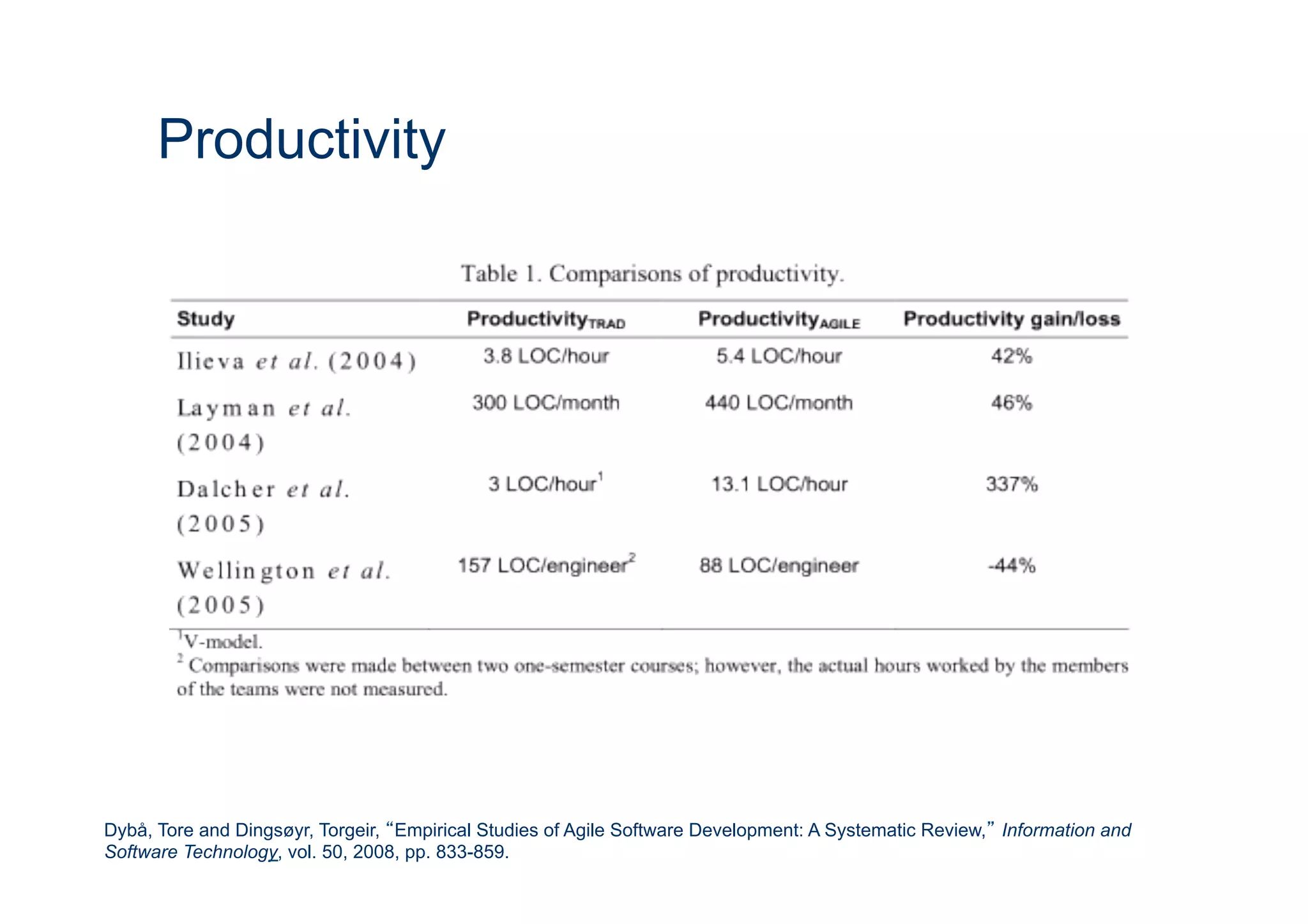
Productivity 
Dybå, Tore and Dingsøyr, Torgeir, “Empirical Studies of Agile Software Development: A Systematic Review,” Information and 
Software Technology, vol. 50, 2008, pp. 833-859.
IKT 
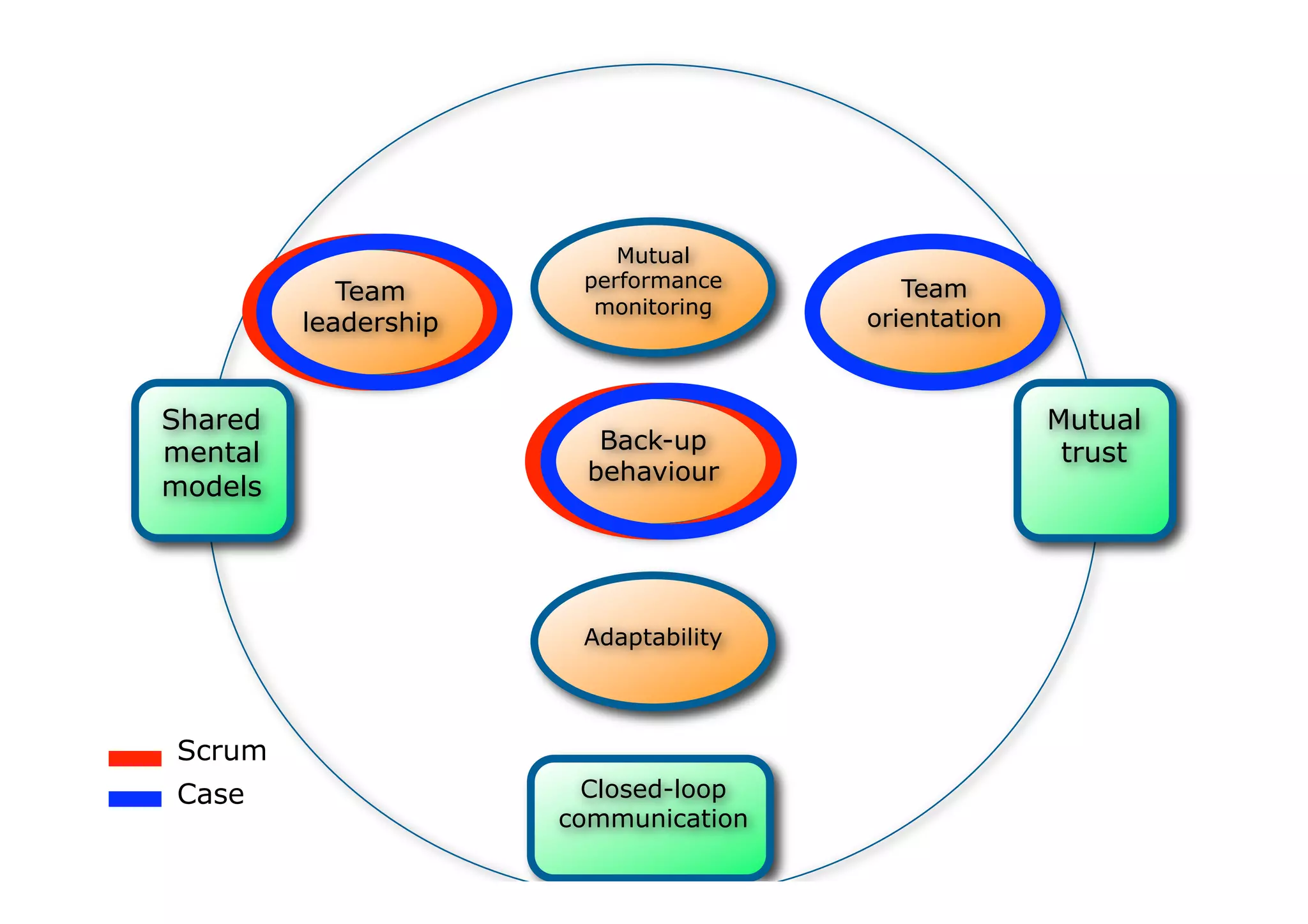
Team 
leadership 
Team 
orientation 
Mutual 
performance 
monitoring 
Back-up 
behaviour 
Adaptability 
Shared 
mental 
models 
Mutual 
trust 
Closed-loop 
communication 
Scrum 
Case
ICT 
Conclusion 
n Difficult transition from individual work to teamwork 
n There are many factors that influence team performance 
in established team performance models 
n Scrum has many mechanisms for teamwork in place, but 
some were difficult to implement in the case organization 
n There is a vast literature on teamwork that is very relevant 
for agile development and that deserves more attention
24 
References and Resources
IKT 
Rising, L. and Janoff, N.S., The Scrum software 
development process for small teams, IEEE Software 17 
(2000).!
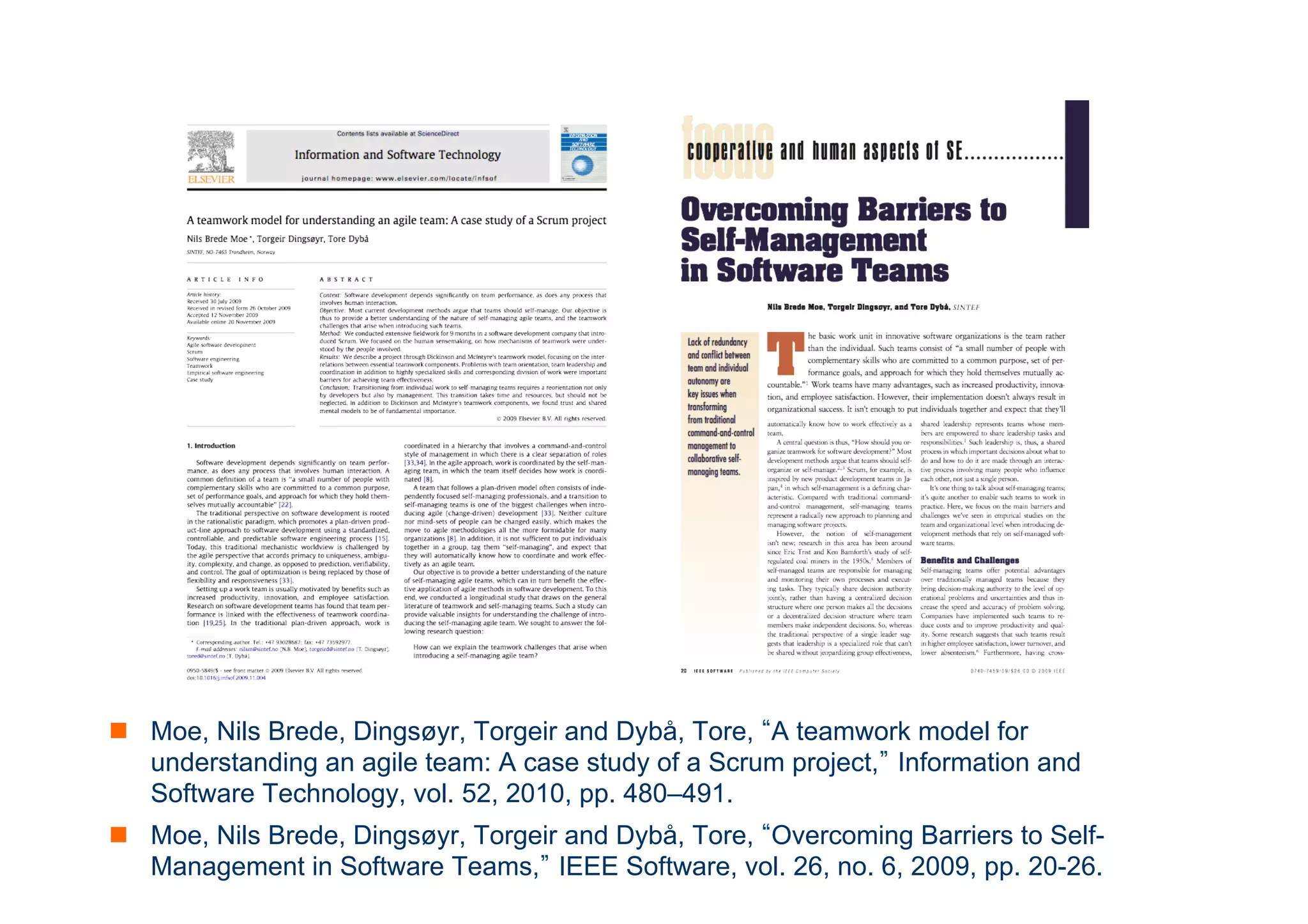
n Moe, Nils Brede, Dingsøyr, Torgeir and Dybå, Tore, “A teamwork model for 
understanding an agile team: A case study of a Scrum project,” Information and 
Software Technology, vol. 52, 2010, pp. 480–491. 
n Moe, Nils Brede, Dingsøyr, Torgeir and Dybå, Tore, “Overcoming Barriers to Self- 
Management in Software Teams,” IEEE Software, vol. 26, no. ICT 
6, 2009, pp. 20-26.

2014.09.10 Are Agile Teams More Effective? Findings from the Teamwork Literature and Empirical Studies of Agile Teams

  • 1.
    Are Agile TeamsMore Effective? Findings from the Teamwork Literature and Empirical Studies of Agile Teams National University of Ireland, Galway 10 September 2014 Torgeir Dingsøyr Senior scientist, SINTEF ICT Adjunct professor, Norwegian University of Science and Technology
  • 2.
    2 Overview nAgile Software Development n Teamwork and Team Effectiveness n Teamwork in Agile Software Development: A Case Study n Are Agile Teams more Effective? n References and Resources
  • 3.
    3 Agile SoftwareDevelopment
  • 4.
    Agile development, productivityand teamwork “Scrum significantly increases productivity and reduces time to benefits while facilitating adaptive, empirical systems development” Controlchaos.com "a variety of people work together in interlinking ways to make a project more effective. They have to work together as a group to make each to be succesful" Beck and Andres "The best architectures, requirements, and designs emerge from self-organizing teams" Principle behind agile manifesto
  • 5.
    5 Teamwork andTeam Performance
  • 6.
    What is aTeam? “a small number of people with complementary skills who are committed to a common purpose, set of performance goals, and approach for which they hold themselves mutually accountable” - Katzenbach, J.R., Smith, D.K.: The Discipline of Teams. Harvard Business Review 71, 111–120 (1993) IKT
  • 7.
    IKT Team leadership Team orientation Mutual performance monitoring Back-up behaviour Adaptability Shared mental models Mutual trust Closed-loop Salas, E. 2005. Is there a “Big Five” in communication Teamwork? Small Group Research 36, no. 5: 555-599.
  • 8.
    8 Teamwork inAgile Software Development: A Case Study
  • 9.
    ICT Research Design n Research questions n How does Scrum arrange for the mechanisms that influence teamwork? n How can challenges that arise when Scrum is introduced be explained by the mechanisms that influence teamwork? n Study n Development of an office application for public departments n 5 developers, scrum master and product owner n 4000 hours n Start: May 2006, end October 2007 n 6 sprints n First Scrum project Moe, N.B., Dingsøyr, T., and Dybå, T., A teamwork model for understanding an agile team: A case study of a Scrum project, Information and Software Technology 52 (2010) 480–491.
  • 10.
  • 11.
    9 Data Collectionand Analysis n 60 Direct observations: from 10 minutes to 8 hours n 15 interviews n Project documents n Analysed according to teamwork model
  • 12.
    ICT In Theory:Team Leadership n Definition: n Direct and coordinate the activities of other team members n Assess team performance n Assign tasks n Develop team knowledge, skills, and abilities n Motivate team members n Plan, organize, and establish a positive atmosphere n The Scrum team: n Planning n Scheduling n Assigning tasks to members n Making decisions n The Scrum master: n Removes impediments of the process n Facilitates meetings
  • 13.
    In Practice: TeamLeadership n Problems not reported n “We classified tasks as finished before they were completed, and we knew there was still work to be done. It seems that the scrum master wants to show progress and make us look a little better than we really are” – developer n “It turned out that certain parts of the system were simply forgotten. There has been a failure somewhere... The product owner and the client asked for things that no-one had thought of and that were not in the backlog” – developer n “The daily meetings are mostly about reporting to the Scrum master. When he is not there, the meetings are better because then we communicate with each other” – developer ICT
  • 15.
    ICT In Theory:Team Orientation n Definition: n Take other’s behaviour into account during group interaction n The belief in the importance of team goal’s over individual members’ goals n Scrum: n The team does high level goal setting n The Product owner provides a vision n Sprint planning, daily meetings and retrospectives
  • 16.
    In Practice: TeamOrientation From a daily stand-up meeting: Developer: The customer databases will be used by several applications, so I have implemented support for dealing with various technologies, including Oracle. It took a lot of time. Scrum-master: Did we not agree on postponing this? Developer: We need this later and now it is done. n “When it comes to the daily scrum, I do not pay attention when Ann is talking. For me what she talks about is a bit off the topic, and I cannot stay focused. She talks about the things she is working on.” – developer n Monthly planning meetings somehow excluded the developers and turned out to be discussions between the Scrum master and the Product owner – notes after observing sprint planning ICT
  • 17.
    In Practice: TeamOrientation n “When we discover new problems, we feel we own them ourselves, and that we will manage to solve them before the next meeting tomorrow. But this is not the case, it always takes longer time” – developer ICT
  • 18.
    In Theory: BackupBehaviour ICT n Definition: n Anticipate other team members’ needs through accurate knowledge about their responsibilities n Includes the ability to shift workload among members to achieve balance during high periods of workload or pressure n Scrum: n The team is seen as multifunctional n Self-organizing
  • 19.
    In Practice: BackupBehaviour n “Let the person that knows most about the task solve it! We cannot afford several people doing the same thing in this project. We need to continue working like we have done before” – scrum master n “We are having problems in one of the modules, but other developers do not want to fix the problem. They want to wait for the developer who created the module” – scrum master n “This was a shock to us. The end-users could not start testing, and we had to spend a lot of time trying to fix this. It took almost a month to locate the problems” - developer n “It’s chaotic now. We work long hours, but I do not do too much. I have done what I was supposed to, and I cannot help them. I do not know anything about what they are doing, so it does not help if I try” – developer ICT
  • 20.
    20 Are AgileTeams more Effective?
  • 21.
    ICT Productivity Dybå,Tore and Dingsøyr, Torgeir, “Empirical Studies of Agile Software Development: A Systematic Review,” Information and Software Technology, vol. 50, 2008, pp. 833-859.
  • 22.
    IKT Team leadership Team orientation Mutual performance monitoring Back-up behaviour Adaptability Shared mental models Mutual trust Closed-loop communication Scrum Case
  • 23.
    ICT Conclusion nDifficult transition from individual work to teamwork n There are many factors that influence team performance in established team performance models n Scrum has many mechanisms for teamwork in place, but some were difficult to implement in the case organization n There is a vast literature on teamwork that is very relevant for agile development and that deserves more attention
  • 24.
  • 25.
    IKT Rising, L.and Janoff, N.S., The Scrum software development process for small teams, IEEE Software 17 (2000).!
  • 26.
    n Moe, NilsBrede, Dingsøyr, Torgeir and Dybå, Tore, “A teamwork model for understanding an agile team: A case study of a Scrum project,” Information and Software Technology, vol. 52, 2010, pp. 480–491. n Moe, Nils Brede, Dingsøyr, Torgeir and Dybå, Tore, “Overcoming Barriers to Self- Management in Software Teams,” IEEE Software, vol. 26, no. ICT 6, 2009, pp. 20-26.