REDOX REACTIONS USING
OXIDATION NUMBERS
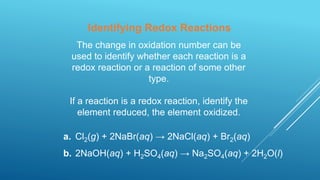
Identifying Redox Reactions
The change in oxidation number can be
used to identify whether each reaction is a
redox reaction or a reaction of some other
type.
If a reaction is a redox reaction, identify the
element reduced, the element oxidized.
a. Cl2(g) + 2NaBr(aq) → 2NaCl(aq) + Br2(aq)
b. 2NaOH(aq) + H2SO4(aq) → Na2SO4(aq) + 2H2O(l)
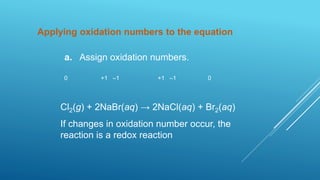
Applying oxidation numbers to the equation
a. Assign oxidation numbers.
0 +1 –1 +1 –1 0
Cl2(g) + 2NaBr(aq) → 2NaCl(aq) + Br2(aq)
If changes in oxidation number occur, the
reaction is a redox reaction
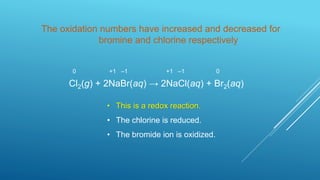
The oxidation numbers have increased and decreased for
bromine and chlorine respectively
• This is a redox reaction.
• The chlorine is reduced.
• The bromide ion is oxidized.
0 +1 –1 +1 –1 0
Cl2(g) + 2NaBr(aq) → 2NaCl(aq) + Br2(aq)
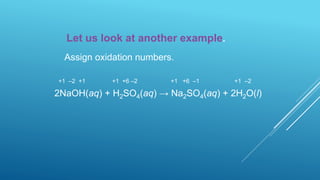
Let us look at another example.
Assign oxidation numbers.
+1 –2 +1 +1 +6 –2 +1 +6 –1 +1 –2
2NaOH(aq) + H2SO4(aq) → Na2SO4(aq) + 2H2O(l)
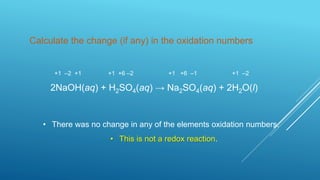
Calculate the change (if any) in the oxidation numbers
• There was no change in any of the elements oxidation numbers.
• This is not a redox reaction.
+1 –2 +1 +1 +6 –2 +1 +6 –1 +1 –2
2NaOH(aq) + H2SO4(aq) → Na2SO4(aq) + 2H2O(l)
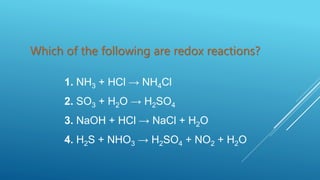
Which of the following are redox reactions?
1. NH3 + HCl → NH4Cl
2. SO3 + H2O → H2SO4
3. NaOH + HCl → NaCl + H2O
4. H2S + NHO3 → H2SO4 + NO2 + H2O
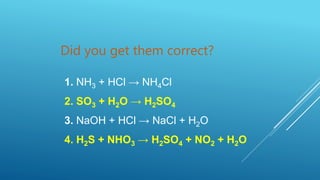
Did you get them correct?
1. NH3 + HCl → NH4Cl
2. SO3 + H2O → H2SO4
3. NaOH + HCl → NaCl + H2O
4. H2S + NHO3 → H2SO4 + NO2 + H2O

Redox reactions using oxidation numbers

  • 1.
  • 2.
    Identifying Redox Reactions Thechange in oxidation number can be used to identify whether each reaction is a redox reaction or a reaction of some other type. If a reaction is a redox reaction, identify the element reduced, the element oxidized. a. Cl2(g) + 2NaBr(aq) → 2NaCl(aq) + Br2(aq) b. 2NaOH(aq) + H2SO4(aq) → Na2SO4(aq) + 2H2O(l)
  • 3.
    Applying oxidation numbersto the equation a. Assign oxidation numbers. 0 +1 –1 +1 –1 0 Cl2(g) + 2NaBr(aq) → 2NaCl(aq) + Br2(aq) If changes in oxidation number occur, the reaction is a redox reaction
  • 4.
    The oxidation numbershave increased and decreased for bromine and chlorine respectively • This is a redox reaction. • The chlorine is reduced. • The bromide ion is oxidized. 0 +1 –1 +1 –1 0 Cl2(g) + 2NaBr(aq) → 2NaCl(aq) + Br2(aq)
  • 5.
    Let us lookat another example. Assign oxidation numbers. +1 –2 +1 +1 +6 –2 +1 +6 –1 +1 –2 2NaOH(aq) + H2SO4(aq) → Na2SO4(aq) + 2H2O(l)
  • 6.
    Calculate the change(if any) in the oxidation numbers • There was no change in any of the elements oxidation numbers. • This is not a redox reaction. +1 –2 +1 +1 +6 –2 +1 +6 –1 +1 –2 2NaOH(aq) + H2SO4(aq) → Na2SO4(aq) + 2H2O(l)
  • 7.
    Which of thefollowing are redox reactions? 1. NH3 + HCl → NH4Cl 2. SO3 + H2O → H2SO4 3. NaOH + HCl → NaCl + H2O 4. H2S + NHO3 → H2SO4 + NO2 + H2O
  • 8.
    Did you getthem correct? 1. NH3 + HCl → NH4Cl 2. SO3 + H2O → H2SO4 3. NaOH + HCl → NaCl + H2O 4. H2S + NHO3 → H2SO4 + NO2 + H2O