PRESENTED BY: Pawan Nagar
Reg. no.: 04-2690-2015
M.Sc.(Fruit Science)
HYBRID SEED PRODUCTIOIN
IN BAJARA
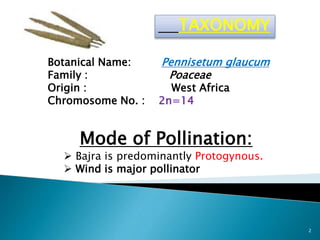
Botanical Name: Pennisetum glaucum
Family : Poaceae
Origin : West Africa
Chromosome No. : 2n=14
Mode of Pollination:
 Bajra is predominantly Protogynous.
 Wind is major pollinator
2
TAXONOMY
 Floral Biology
 The Spike emerge about 10 week after sowing.
 Stigma remains receptive for 12-24 hours.
 The anther emergence starts from middle of the spike and
proceed upwards and downwards.
 Anthesis occurs throughout the day and night with the peak
between 8.00 PM- 2.00 PM.
 The plant is thus markedly Protogynous and Cross –
pollination normally occurs.
 Enhancement of grain and fodder yield
 Improvement of quality
 Increase resistance to pests and diseases
 Increase wider adaptability
 Varieties for new season
 Involve less labour
 Low cost of production
 Tolerant to biotic and abiotic stresses
 Uniformity & high productivity
4
Why Hybrid Bajra ?
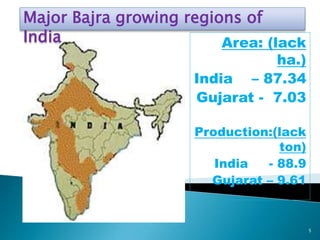
Area: (lack
ha.)
India – 87.34
Gujarat - 7.03
Production:(lack
ton)
India - 88.9
Gujarat – 9.61
5
Major Bajra growing regions of
India
1. Cytoplasmic genetic male sterility system
(CGMS)
2. Line involved – A, B, and R line
 History of bajara hybrid Seed production
 The first report on CGMS line was
made by Burton and his co- workers at
Tifton Georgia USA.
 The line is Tift 23A.
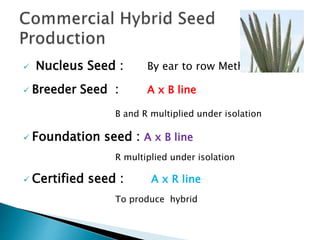
 Nucleus Seed : By ear to row Method
 Breeder Seed : A x B line
B and R multiplied under isolation
 Foundation seed : A x B line
R multiplied under isolation
 Certified seed : A x R line
To produce hybrid
 It should be fertile ,
 problematic soils should be avoided.
 The previous crop should not be the same crop.
 If the variety is same , it should have been certified
by seed certification agency.
 Isolation : Foundation seed : 1000 m
Certified seed : 200 m
 Season : Irrigated : March – April,
January – February
Rain fed : June – July
 Seed rate : A line(female) : 6 kg ha-1
R line(male) : 2 kg ha-1
 Main field preparation : Formed into Ridges
and furrows
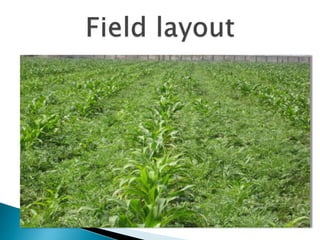
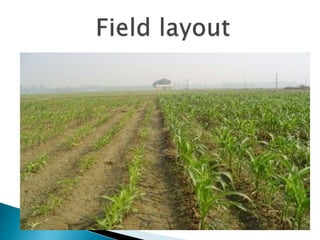
Planting ratio : Foundation Seed :- 4 : 2 (female :
male)
Certified Seed :- 6 : 2
Pusa 23 :- 8 : 2
 Border rows : Foundation Seed : 8 (B line)
Certified Seed : 4 (R line)
 Spacing : A line : 45 x 20 cm
B line : 45 x solid row.
Nursery : Seedling can also be raised in raise
bed nursery and can transplanted to the main field at
20 – 25 days after sowing.
 Done in both lines
• A line : seek for offtypes pollen shedder
and partials
• R line : Seek for early flowering plants,
rouges and diseased plants.
 Character of offtypes : Variation in leaf
colour, leaf waviness, grain colour, earhead
, shape, size, etc.
 No. of field inspection : Three
• Seedling stage
• Tillering stage
• Grain formation stage.
 Nursery :
750 kg / 7.5 cents for transplanting in one ha.
 Main field :
Compost : 12.t ton/ha
NPK : 100:50:50 kg ha-1
Basal : 50:50:50 kg ha-1
Top dressing : 50:0:0 kg ha-1 (30-35 day At tillering
phase)
 Foliar spray : DAP 1% at peak flowering to enhance
flowering and Seed set.
 Withholding irrigation
 Application of DAP 1%
 Staggered sowing
 Jerking
 Jerking
 It is done 20-25 days after transplanting or 30-40 days
after direct sowing. The early formed earheads of the first
tillers are pulled out or removed which will result in
uniform flowering of all the tillers.
 The synchronization problem is less in
bajara due to
 Tillering habit
 Supply of continuous pollen
 Lesser pollen weight
 Flight capacity of pollen
 Pollen viability & stigma receptivity are longer.
 Pest
1. Shoot fly : To avoid shoot fly infestation a prophaylactic
spray with monocrotophos can be practiced one week
after transplanting.
2. Blister bittle :To spray contact insecticide for control.
 Diseases
1. Downy mildew
2. Ergot
3. Smut
4. Rust
 For the control used systematic fungicide, like
mancozeb , kavach, carbendazim , topsin ,etc..
1.Hairy caterpillar
 Spray 0.1 % Thiodan or Fenitrothion @ 500 litres per hectare.
2. Shoot fly
 Apply Furadan 3G @ 25-30 kg per hectare or Thimet 10 G @
15-20 kg per hectare in the furrows or broadcast to mix with
the soil at the time of sowing.
3. White grub
 Apply Furadan 3 G -30 kg per hectare or Thimet 10 G -
15 kg per hectare or Heptachlor 5% -20 kg per hectare.
4. Stem borer
 Spray the crop with Parathion 50 EC -500 ml per hectare
or Endrin 20 EC 2000 ml per hectare.
5. Termites
 Before sowing of the crop mix 5-10% BHC or Heptachlor
or Aldrin -20-25 kg per hectare.
 There are a number of diseases which attack the crop
during its growth, cause low yield and economic loss to
the peasant and finally to the nation as a whole. Some
of the diseases are as under.
 seeds treatment with Agrosan GN (2.5 g/kg seed)
 spray the crop with 0.2 % Dithane Z- 78 at boot leaf
stage.
 Sow disease resistant varieties like NHB-5, PHB-10,
PHB-14.
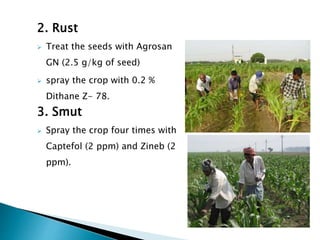
2. Rust
 Treat the seeds with Agrosan
GN (2.5 g/kg of seed)
 spray the crop with 0.2 %
Dithane Z- 78.
3. Smut
 Spray the crop four times with
Captefol (2 ppm) and Zineb (2
ppm).
4. Ergot of bajra
 Spray the crop at boot leaf stage with 0.15% Ziram.
The 2nd or 3rd spray at 10 days interval is repeated
5. Leaf blast
 Spray the crop 2-3 times with 0.2 % Zineb.
 Treat the seeds with
 Agrosan GN (2.5 gm per kg of seed)
 Field is irrigated immediately after sowing and
3rd day life irrigation is given.
 Then once in 10 days irrigation has to be given.
 The critical stages of irrigation are tillering ,
milky stage and maturation stage.
 Proper and adequate irrigation increase the
seed set and yield of quality seed.
 Seed attain physiological maturation at 30-35 days after
50% flowering.
 The moisture count of seed at this stage will be 30 – 35 %.
 Due to tillering habit, harvest the panicle / earhead in 2
picking (to avoid delayed harvest)
 Select 5-7 tillers for seed purpose.
 Processing : Grade with 4/64” round perforated
metal sieve as middle screen
 Use OSAW (industrial product) cleaner cum grader
 Seed Treatment : Thiram / Bavistin @3g kg-1 seed
Harvesting techniques:
 The earheads are dried for 2-3 days on
the threshing floor.
 Threshing is done at a moisture content
of 15-18% either manually (stick
beating) or mechanically (LCT thresher).
27
 Bajara crop yields 30-35 quintals of grains
and 100 quintals of dry straw per hectare.
 under irrigated condition and under rainfed
condition, 12-15 quintals of grain and 75
quintal of fodder per hectare.
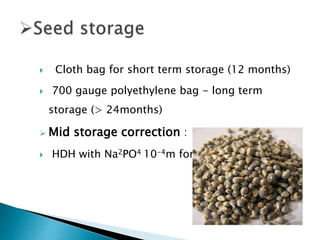
 Cloth bag for short term storage (12 months)
 700 gauge polyethylene bag - long term
storage (> 24months)
 Mid storage correction :
 HDH with Na2PO4 10-4m for 4h.
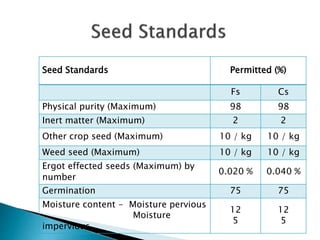
Seed Standards Permitted (%)
Fs Cs
Physical purity (Maximum) 98 98
Inert matter (Maximum) 2 2
Other crop seed (Maximum) 10 / kg 10 / kg
Weed seed (Maximum) 10 / kg 10 / kg
Ergot effected seeds (Maximum) by
number
0.020 % 0.040 %
Germination 75 75
Moisture content - Moisture pervious
Moisture
impervious
12
5
12
5
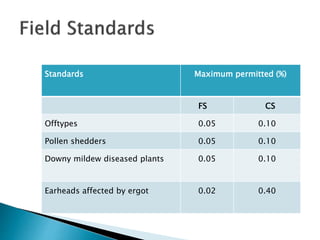
Standards Maximum permitted (%)
FS CS
Offtypes 0.05 0.10
Pollen shedders 0.05 0.10
Downy mildew diseased plants 0.05 0.10
Earheads affected by ergot 0.02 0.40
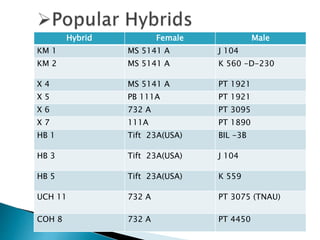
Hybrid Female Male
KM 1 MS 5141 A J 104
KM 2 MS 5141 A K 560 -D-230
X 4 MS 5141 A PT 1921
X 5 PB 111A PT 1921
X 6 732 A PT 3095
X 7 111A PT 1890
HB 1 Tift 23A(USA) BIL -3B
HB 3 Tift 23A(USA) J 104
HB 5 Tift 23A(USA) K 559
UCH 11 732 A PT 3075 (TNAU)
COH 8 732 A PT 4450
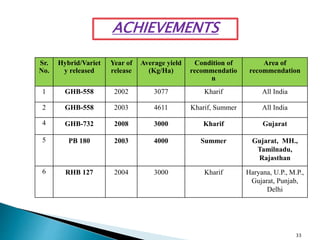
Sr.
No.
Hybrid/Variet
y released
Year of
release
Average yield
(Kg/Ha)
Condition of
recommendatio
n
Area of
recommendation
1 GHB-558 2002 3077 Kharif All India
2 GHB-558 2003 4611 Kharif, Summer All India
4 GHB-732 2008 3000 Kharif Gujarat
5 PB 180 2003 4000 Summer Gujarat, MH.,
Tamilnadu,
Rajasthan
6 RHB 127 2004 3000 Kharif Haryana, U.P., M.P.,
Gujarat, Punjab,
Delhi
ACHIEVEMENTS
33
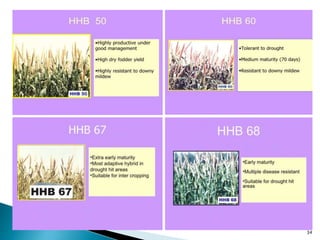
34
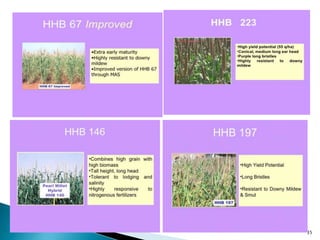
35
Hybrid seed production

Hybrid seed production

  • 1.
    PRESENTED BY: PawanNagar Reg. no.: 04-2690-2015 M.Sc.(Fruit Science) HYBRID SEED PRODUCTIOIN IN BAJARA
  • 2.
    Botanical Name: Pennisetumglaucum Family : Poaceae Origin : West Africa Chromosome No. : 2n=14 Mode of Pollination:  Bajra is predominantly Protogynous.  Wind is major pollinator 2 TAXONOMY
  • 3.
     Floral Biology The Spike emerge about 10 week after sowing.  Stigma remains receptive for 12-24 hours.  The anther emergence starts from middle of the spike and proceed upwards and downwards.  Anthesis occurs throughout the day and night with the peak between 8.00 PM- 2.00 PM.  The plant is thus markedly Protogynous and Cross – pollination normally occurs.
  • 4.
     Enhancement ofgrain and fodder yield  Improvement of quality  Increase resistance to pests and diseases  Increase wider adaptability  Varieties for new season  Involve less labour  Low cost of production  Tolerant to biotic and abiotic stresses  Uniformity & high productivity 4 Why Hybrid Bajra ?
  • 5.
    Area: (lack ha.) India –87.34 Gujarat - 7.03 Production:(lack ton) India - 88.9 Gujarat – 9.61 5 Major Bajra growing regions of India
  • 7.
    1. Cytoplasmic geneticmale sterility system (CGMS) 2. Line involved – A, B, and R line  History of bajara hybrid Seed production  The first report on CGMS line was made by Burton and his co- workers at Tifton Georgia USA.  The line is Tift 23A.
  • 9.
     Nucleus Seed: By ear to row Method  Breeder Seed : A x B line B and R multiplied under isolation  Foundation seed : A x B line R multiplied under isolation  Certified seed : A x R line To produce hybrid
  • 12.
     It shouldbe fertile ,  problematic soils should be avoided.  The previous crop should not be the same crop.  If the variety is same , it should have been certified by seed certification agency.
  • 13.
     Isolation :Foundation seed : 1000 m Certified seed : 200 m  Season : Irrigated : March – April, January – February Rain fed : June – July  Seed rate : A line(female) : 6 kg ha-1 R line(male) : 2 kg ha-1  Main field preparation : Formed into Ridges and furrows
  • 14.
    Planting ratio :Foundation Seed :- 4 : 2 (female : male) Certified Seed :- 6 : 2 Pusa 23 :- 8 : 2  Border rows : Foundation Seed : 8 (B line) Certified Seed : 4 (R line)  Spacing : A line : 45 x 20 cm B line : 45 x solid row. Nursery : Seedling can also be raised in raise bed nursery and can transplanted to the main field at 20 – 25 days after sowing.
  • 15.
     Done inboth lines • A line : seek for offtypes pollen shedder and partials • R line : Seek for early flowering plants, rouges and diseased plants.  Character of offtypes : Variation in leaf colour, leaf waviness, grain colour, earhead , shape, size, etc.  No. of field inspection : Three • Seedling stage • Tillering stage • Grain formation stage.
  • 16.
     Nursery : 750kg / 7.5 cents for transplanting in one ha.  Main field : Compost : 12.t ton/ha NPK : 100:50:50 kg ha-1 Basal : 50:50:50 kg ha-1 Top dressing : 50:0:0 kg ha-1 (30-35 day At tillering phase)  Foliar spray : DAP 1% at peak flowering to enhance flowering and Seed set.
  • 17.
     Withholding irrigation Application of DAP 1%  Staggered sowing  Jerking  Jerking  It is done 20-25 days after transplanting or 30-40 days after direct sowing. The early formed earheads of the first tillers are pulled out or removed which will result in uniform flowering of all the tillers.
  • 18.
     The synchronizationproblem is less in bajara due to  Tillering habit  Supply of continuous pollen  Lesser pollen weight  Flight capacity of pollen  Pollen viability & stigma receptivity are longer.
  • 19.
     Pest 1. Shootfly : To avoid shoot fly infestation a prophaylactic spray with monocrotophos can be practiced one week after transplanting. 2. Blister bittle :To spray contact insecticide for control.  Diseases 1. Downy mildew 2. Ergot 3. Smut 4. Rust  For the control used systematic fungicide, like mancozeb , kavach, carbendazim , topsin ,etc..
  • 20.
    1.Hairy caterpillar  Spray0.1 % Thiodan or Fenitrothion @ 500 litres per hectare. 2. Shoot fly  Apply Furadan 3G @ 25-30 kg per hectare or Thimet 10 G @ 15-20 kg per hectare in the furrows or broadcast to mix with the soil at the time of sowing.
  • 21.
    3. White grub Apply Furadan 3 G -30 kg per hectare or Thimet 10 G - 15 kg per hectare or Heptachlor 5% -20 kg per hectare. 4. Stem borer  Spray the crop with Parathion 50 EC -500 ml per hectare or Endrin 20 EC 2000 ml per hectare. 5. Termites  Before sowing of the crop mix 5-10% BHC or Heptachlor or Aldrin -20-25 kg per hectare.
  • 22.
     There area number of diseases which attack the crop during its growth, cause low yield and economic loss to the peasant and finally to the nation as a whole. Some of the diseases are as under.  seeds treatment with Agrosan GN (2.5 g/kg seed)  spray the crop with 0.2 % Dithane Z- 78 at boot leaf stage.  Sow disease resistant varieties like NHB-5, PHB-10, PHB-14.
  • 23.
    2. Rust  Treatthe seeds with Agrosan GN (2.5 g/kg of seed)  spray the crop with 0.2 % Dithane Z- 78. 3. Smut  Spray the crop four times with Captefol (2 ppm) and Zineb (2 ppm).

  • 24.
    4. Ergot ofbajra  Spray the crop at boot leaf stage with 0.15% Ziram. The 2nd or 3rd spray at 10 days interval is repeated 5. Leaf blast  Spray the crop 2-3 times with 0.2 % Zineb.  Treat the seeds with  Agrosan GN (2.5 gm per kg of seed)
  • 25.
     Field isirrigated immediately after sowing and 3rd day life irrigation is given.  Then once in 10 days irrigation has to be given.  The critical stages of irrigation are tillering , milky stage and maturation stage.  Proper and adequate irrigation increase the seed set and yield of quality seed.
  • 26.
     Seed attainphysiological maturation at 30-35 days after 50% flowering.  The moisture count of seed at this stage will be 30 – 35 %.  Due to tillering habit, harvest the panicle / earhead in 2 picking (to avoid delayed harvest)  Select 5-7 tillers for seed purpose.  Processing : Grade with 4/64” round perforated metal sieve as middle screen  Use OSAW (industrial product) cleaner cum grader  Seed Treatment : Thiram / Bavistin @3g kg-1 seed Harvesting techniques:
  • 27.
     The earheadsare dried for 2-3 days on the threshing floor.  Threshing is done at a moisture content of 15-18% either manually (stick beating) or mechanically (LCT thresher). 27
  • 28.
     Bajara cropyields 30-35 quintals of grains and 100 quintals of dry straw per hectare.  under irrigated condition and under rainfed condition, 12-15 quintals of grain and 75 quintal of fodder per hectare.
  • 29.
     Cloth bagfor short term storage (12 months)  700 gauge polyethylene bag - long term storage (> 24months)  Mid storage correction :  HDH with Na2PO4 10-4m for 4h.
  • 30.
    Seed Standards Permitted(%) Fs Cs Physical purity (Maximum) 98 98 Inert matter (Maximum) 2 2 Other crop seed (Maximum) 10 / kg 10 / kg Weed seed (Maximum) 10 / kg 10 / kg Ergot effected seeds (Maximum) by number 0.020 % 0.040 % Germination 75 75 Moisture content - Moisture pervious Moisture impervious 12 5 12 5
  • 31.
    Standards Maximum permitted(%) FS CS Offtypes 0.05 0.10 Pollen shedders 0.05 0.10 Downy mildew diseased plants 0.05 0.10 Earheads affected by ergot 0.02 0.40
  • 32.
    Hybrid Female Male KM1 MS 5141 A J 104 KM 2 MS 5141 A K 560 -D-230 X 4 MS 5141 A PT 1921 X 5 PB 111A PT 1921 X 6 732 A PT 3095 X 7 111A PT 1890 HB 1 Tift 23A(USA) BIL -3B HB 3 Tift 23A(USA) J 104 HB 5 Tift 23A(USA) K 559 UCH 11 732 A PT 3075 (TNAU) COH 8 732 A PT 4450
  • 33.
    Sr. No. Hybrid/Variet y released Year of release Averageyield (Kg/Ha) Condition of recommendatio n Area of recommendation 1 GHB-558 2002 3077 Kharif All India 2 GHB-558 2003 4611 Kharif, Summer All India 4 GHB-732 2008 3000 Kharif Gujarat 5 PB 180 2003 4000 Summer Gujarat, MH., Tamilnadu, Rajasthan 6 RHB 127 2004 3000 Kharif Haryana, U.P., M.P., Gujarat, Punjab, Delhi ACHIEVEMENTS 33
  • 34.
  • 35.