Prepared by-
Harsh Pathak
Guided by – Prof. Rohit Singh
Gandhinagar Institute of Technology
SUBJECT-CPU (2110003)
Recursive Function
Contents
1 What is Recursive Function?
2 Advantage and Disadvantage
3 Program
4 Output
Recursive Function
2
What is Recursive Function?
When a called function in turns calls another
function a process of ‘chaining’ occurs. Recursion
is a simple special case of this process, where a
function call itself.
Recursive Function
3
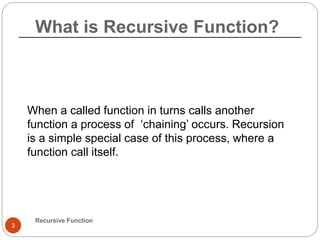
A very simple example of recursion is presented
below:
main( )
{
printf(“This is an example of recursion n”);
main( );
}
When executed this program will produce an output
:
This is an example of recursion
The Execution will continue indefinitely.
Recursive Function
4
Advantage and Disadvantage
• Advantages
*Easy solution for recursively defined problems.
*Complex programs can be easily written in less
code.
• Disadvantage
*Recursive code is difficult to understand and
debug
*Terminating condition is must, otherwise it will go
in infinite loop.
*Execution speed decreases because of function
call and return activity many times.Recursive Function
5
PROGRAM
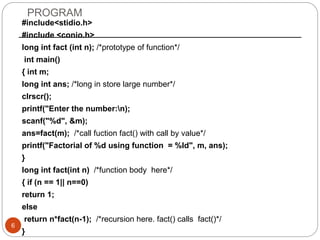
#include<stidio.h>
#include <conio.h>
long int fact (int n); /*prototype of function*/
int main()
{ int m;
long int ans; /*long in store large number*/
clrscr();
printf("Enter the number:n);
scanf("%d", &m);
ans=fact(m); /*call fuction fact() with call by value*/
printf("Factorial of %d using function = %ld", m, ans);
}
long int fact(int n) /*function body here*/
{ if (n == 1|| n==0)
return 1;
else
return n*fact(n-1); /*recursion here. fact() calls fact()*/
}
6
OUTPUT
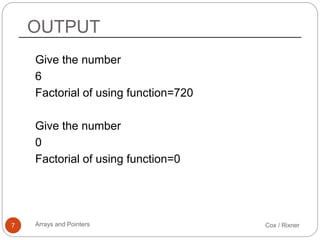
Give the number
6
Factorial of using function=720
Give the number
0
Factorial of using function=0
Cox / RixnerArrays and Pointers7
8

Recursive Function

  • 1.
    Prepared by- Harsh Pathak Guidedby – Prof. Rohit Singh Gandhinagar Institute of Technology SUBJECT-CPU (2110003) Recursive Function
  • 2.
    Contents 1 What isRecursive Function? 2 Advantage and Disadvantage 3 Program 4 Output Recursive Function 2
  • 3.
    What is RecursiveFunction? When a called function in turns calls another function a process of ‘chaining’ occurs. Recursion is a simple special case of this process, where a function call itself. Recursive Function 3
  • 4.
    A very simpleexample of recursion is presented below: main( ) { printf(“This is an example of recursion n”); main( ); } When executed this program will produce an output : This is an example of recursion This is an example of recursion This is an example of recursion The Execution will continue indefinitely. Recursive Function 4
  • 5.
    Advantage and Disadvantage •Advantages *Easy solution for recursively defined problems. *Complex programs can be easily written in less code. • Disadvantage *Recursive code is difficult to understand and debug *Terminating condition is must, otherwise it will go in infinite loop. *Execution speed decreases because of function call and return activity many times.Recursive Function 5
  • 6.
    PROGRAM #include<stidio.h> #include <conio.h> long intfact (int n); /*prototype of function*/ int main() { int m; long int ans; /*long in store large number*/ clrscr(); printf("Enter the number:n); scanf("%d", &m); ans=fact(m); /*call fuction fact() with call by value*/ printf("Factorial of %d using function = %ld", m, ans); } long int fact(int n) /*function body here*/ { if (n == 1|| n==0) return 1; else return n*fact(n-1); /*recursion here. fact() calls fact()*/ } 6
  • 7.
    OUTPUT Give the number 6 Factorialof using function=720 Give the number 0 Factorial of using function=0 Cox / RixnerArrays and Pointers7
  • 8.