High-order Numerical 
Methods for Predictive Science on 
Large-scale High-performance 
Computing Architectures 
Dongwook Lee 
Applied Mathematics & Statistics 
University of California, Santa Cruz 
Mathematics Colloquium, November 18, 2014 
FLASH Simulation of a 3D Core-collapse Supernova 
Courtesy of S. Couch 
MIRA, BG/Q, Argonne National Lab 
49,152 nodes, 786,432 cores OMEGA Laser (US)
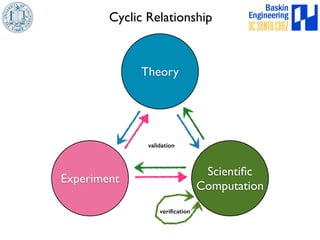
Cyclic Relationship 
Theory 
Experiment Scientific 
Computation 
validation 
verification
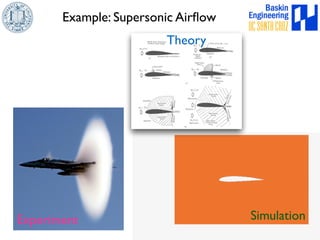
Example: Supersonic Airflow 
Theory 
Experiment Simulation
Topics for Today 
1. High Performance Computing 
2. Ideas on Numerical Methods 
3. Validation & Predictive Science
First Episode 
1. High Performance Computing 
2. Ideas on Numerical Methods 
3. Validation & Predictive Science
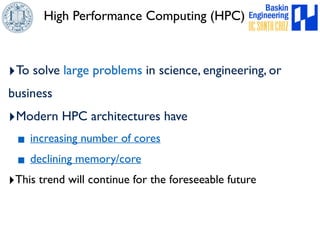
High Performance Computing (HPC) 
‣To solve large problems in science, engineering, or 
business 
‣Modern HPC architectures have 
▪ increasing number of cores 
▪ declining memory/core 
‣This trend will continue for the foreseeable future
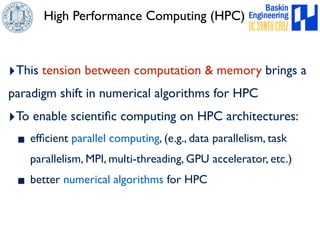
High Performance Computing (HPC) 
‣This tension between computation & memory brings a 
paradigm shift in numerical algorithms for HPC 
‣To enable scientific computing on HPC architectures: 
▪ efficient parallel computing, (e.g., data parallelism, task 
parallelism, MPI, multi-threading, GPU accelerator, etc.) 
▪ better numerical algorithms for HPC
Numerical Algorithms for HPC 
‣Numerical algorithms should conform to the 
abundance of computing power and the scarcity of 
memory. 
‣But… 
▪ without losing solution accuracy. 
▪ with maintaining maximum solution stability. 
▪ with faster convergence to a “correct” solution.
High-Order Numerical Algorithms 
‣ A good solution to this is to use high-order algorithms. 
‣ They provide more accurate numerical solutions using 
▪ less grid points (=memory save). 
▪ higher-order mathematical approximations (promoting 
more floating point operations, or computation). 
▪ faster convergence to solution.
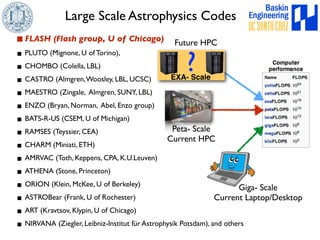
Large Scale Astrophysics Codes 
▪FLASH (Flash group, U of Chicago) 
Future HPC 
▪ PLUTO (Mignone, U of Torino), 
▪ CHOMBO (Colella, LBL) 
▪ CASTRO (Almgren, Woosley, LBL, UCSC) 
▪ MAESTRO (Zingale, Almgren, SUNY, LBL) 
▪ ENZO (Bryan, Norman, Abel, Enzo group) 
▪ BATS-R-US (CSEM, U of Michigan) 
▪ RAMSES (Teyssier, CEA) 
Peta- Scale 
▪ Current HPC 
CHARM (Miniati, ETH) 
▪ AMRVAC (Toth, Keppens, CPA, K.U.Leuven) 
▪ ATHENA (Stone, Princeton) 
▪ ORION (Klein, McKee, U of Berkeley) 
▪ ASTROBear (Frank, U of Rochester) 
▪ ART (Kravtsov, Klypin, U of Chicago) 
▪ NIRVANA (Ziegler, Leibniz-Institut für Astrophysik Potsdam), and others 
Giga- Scale 
Current Laptop/Desktop 
?
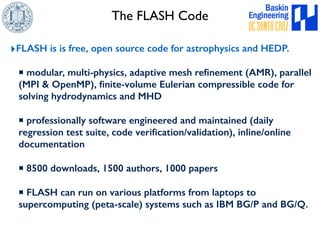
The FLASH Code 
‣FLASH is is free, open source code for astrophysics and HEDP. 
▪ modular, multi-physics, adaptive mesh refinement (AMR), parallel 
(MPI & OpenMP), finite-volume Eulerian compressible code for 
solving hydrodynamics and MHD 
▪ professionally software engineered and maintained (daily 
regression test suite, code verification/validation), inline/online 
documentation 
▪ 8500 downloads, 1500 authors, 1000 papers 
▪ FLASH can run on various platforms from laptops to 
supercomputing (peta-scale) systems such as IBM BG/P and BG/Q.
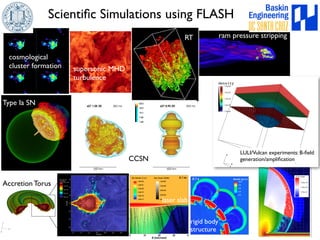
Scientific Simulations using FLASH 
cosmological 
cluster formation supersonic MHD 
turbulence 
Type Ia SN 
RT 
CCSN 
ram pressure stripping 
laser slab 
rigid body 
structure 
Accretion Torus 
LULI/Vulcan experiments: B-field 
generation/amplification
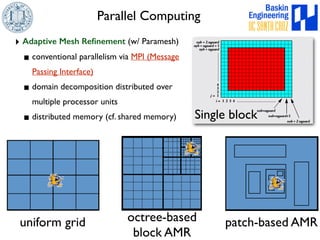
Parallel Computing 
‣ Adaptive Mesh Refinement (w/ Paramesh) 
▪conventional parallelism via MPI (Message 
Passing Interface) 
▪domain decomposition distributed over 
multiple processor units 
▪distributed memory (cf. shared memory) 
Single block 
uniform grid octree-based 
block AMR 
patch-based AMR
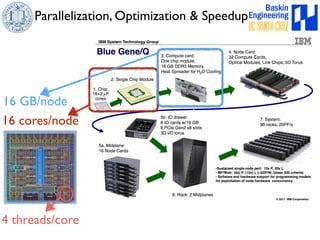
Parallelization, Optimization & Speedup 
16 GB/node 
16 cores/node 
4 threads/core
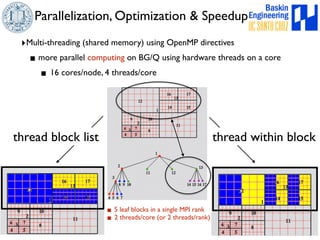
Parallelization, Optimization & Speedup 
‣Multi-threading (shared memory) using OpenMP directives 
▪more parallel computing on BG/Q using hardware threads on a core 
▪ 16 cores/node, 4 threads/core 
thread block list thread within block 
▪ 5 leaf blocks in a single MPI rank 
▪ 2 threads/core (or 2 threads/rank)
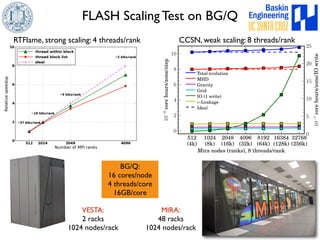
FLASH Scaling Test on BG/Q 
RTFlame, strong scaling: 4 threads/rank CCSN, weak scaling: 8 threads/rank 
VESTA: 
2 racks 
1024 nodes/rack 
10 
8 
6 
4 
2 
MIRA: 
48 racks 
1024 nodes/rack 
BG/Q: 
16 cores/node 
4 threads/core 
16GB/core 
512 
(4k) 
1024 
(8k) 
2048 
(16k) 
4096 
(32k) 
8192 
(64k) 
16384 
(128k) 
25 
20 
15 
10 
5 
32768 
(256k) 
Mira nodes (ranks), 8 threads/rank 
0 
108 core hours/zone/step 
0 
107 core hours/zone/IO write 
Total evolution 
MHD 
Gravity 
Grid 
IO (1 write) 
⌫-Leakage 
Ideal
Second Episode 
1. High Performance Computing 
2. Ideas on Numerical Methods 
3. Validation  Predictive Science
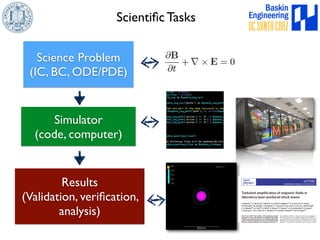
Scientific Tasks 
Science Problem 
(IC, BC, ODE/PDE) 
Simulator 
(code, computer) 
Results 
(Validation, verification, 
analysis)
1. Mathematical Models 
Hydrodynamics (gas dynamics) 
@⇢ 
@t 
+ r · (⇢v) = 0 mass eqn 
@⇢v 
@t 
+ r · (⇢vv) + rP = ⇢g momentum eqn 
@⇢E 
@t 
+ r · [(⇢E + P)v] = ⇢v · g total energy eqn 
P = (!  1)⇢✏ 
E = ✏ + 
1 
2|v|2 
@⇢✏ 
@t 
+ r · [(⇢✏ + P)v] − v · rP = 0 
Equation of State
2. Mathematical Models 
Magnetohydrodynamics (MHD) 
@⇢ 
@t 
+ r · (⇢v) = 0 mass eqn 
@⇢v 
@t 
+ r · (⇢vv − BB) + rP⇤ = ⇢g + r · ⌧ momentum eqn 
@⇢E 
@t 
+ r · [v(⇢E + P⇤) − B(v · B)] = ⇢g · v + r · (v · ⌧ + $rT) + r · (B ⇥ (⌘r⇥B)) 
total energy eqn 
@B 
@t 
+ r · (vB − Bv) = −r ⇥ (⌘r⇥B) induction eqn 
P⇤ = p + 
B2 
2 
E = 
v2 
2 
+ ✏ + 
B2 
2⇢ 
Equation of State 
⌧ = μ[(rv) + (rv)T − 
2 
3 
solenodidal constraint 
(r · v)I] 
viscosityr · B = 0
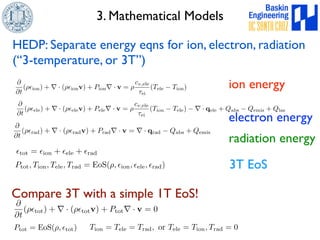
3. Mathematical Models 
HEDP: Separate energy eqns for ion, electron, radiation 
(“3-temperature, or 3T”) 
@ 
@t 
(⇢✏ion) + r · (⇢✏ionv) + Pionr · v = ⇢ 
cv,ele 
⌧ei 
(Tele − Tion) ion energy 
@ 
@t 
(⇢✏ele) + r · (⇢✏elev) + Peler · v = ⇢ 
cv,ele 
⌧ei 
(Tion − Tele)−r· qele + Qabs − Qemis + Qlas electron energy 
@ 
@t 
(⇢✏rad) + r · (⇢✏radv) + Pradr · v = r · qrad − Qabs + Qemis radiation energy 
✏tot = ✏ion + ✏ele + ✏rad 
Ptot, Tion, Tele, Trad = EoS(⇢, ✏ion, ✏ele, ✏rad) 3T EoS 
Compare 3T with a simple 1T EoS! 
@ 
@t 
(⇢✏tot) + r · (⇢✏totv) + Ptotr · v = 0 
Ptot = EoS(⇢, ✏tot) 
Tion = Tele = Trad, or Tele = Tion, Trad = 0
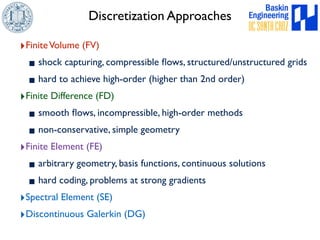
Discretization Approaches 
‣Finite Volume (FV) 
▪shock capturing, compressible flows, structured/unstructured grids 
▪hard to achieve high-order (higher than 2nd order) 
‣Finite Difference (FD) 
▪smooth flows, incompressible, high-order methods 
▪non-conservative, simple geometry 
‣Finite Element (FE) 
▪arbitrary geometry, basis functions, continuous solutions 
▪hard coding, problems at strong gradients 
‣Spectral Element (SE) 
‣Discontinuous Galerkin (DG)
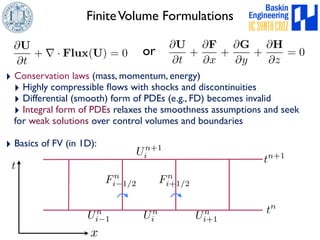
Finite Volume Formulations 
@U 
@t 
+ 
@F 
@x 
+ 
@G 
@y 
+ 
@H 
@z 
= 0 
@U 
@t 
+ r · Flux(U) = 0 
‣ Conservation laws (mass, momentum, energy) 
‣ Highly compressible flows with shocks and discontinuities 
‣ Differential (smooth) form of PDEs (e.g., FD) becomes invalid 
‣ Integral form of PDEs relaxes the smoothness assumptions and seek 
for weak solutions over control volumes and boundaries 
‣ Basics of FV (in 1D): 
U i+1 n 
x 
t 
Un+1 
i 
Un 
i Un 
i1 
tn+1 
tn 
Fn 
i1/2 Fn 
i+1/2 
or
Finite Volume Formulations 
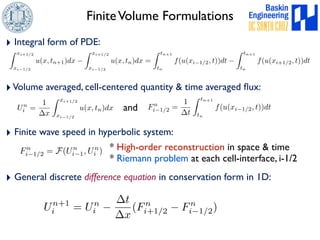
‣ Integral form of PDE: 
Z xi+1/2 
xi1/2 
u(x, tn+1)dx  
Z xi+1/2 
xi1/2 
u(x, tn)dx = 
Z tn+1 
tn 
f(u(xi1/2, t))dt  
Z tn+1 
tn 
f(u(xi+1/2, t))dt 
‣ Volume averaged, cell-centered quantity  time averaged flux: 
Un 
i = 
1 
x 
Z xi+1/2 
xi1/2 
and f(u(xi1/2, t))dt 
u(x, tn)dx Fn 
i1/2 = 
‣ Finite wave speed in hyperbolic system: 
1 
t 
Z tn+1 
tn 
Fn 
i1/2 = F(Un 
i ) * High-order reconstruction in space  time 
i1, Un 
* Riemann problem at each cell-interface, i-1/2 
‣ General discrete difference equation in conservation form in 1D: 
Un+1 
i = Un 
i  
t 
x 
(Fn 
i+1/2  Fn 
i1/2)
Riemann Problem  Godunov Method 
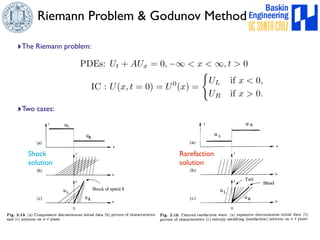
‣The Riemann problem: 
‣Two cases: 
PDEs: Ut + AUx = 0,−1  x  1, t  0 
IC : U(x, t = 0) = U0(x) = 
( 
UL if x  0, 
UR if x  0. 
Shock 
solution 
Rarefaction 
solution
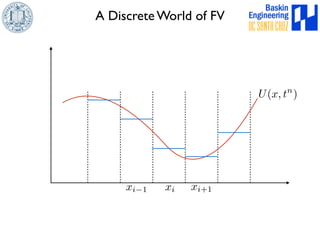
A Discrete World of FV 
U(x, tn) 
xi1 xi xi+1
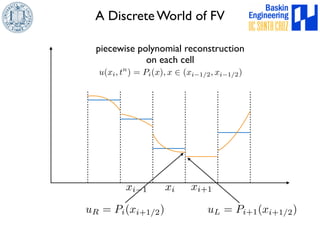
A Discrete World of FV 
piecewise polynomial reconstruction 
on each cell 
u(xi, tn) = Pi(x), x 2 (xi1/2, xi1/2) 
xi1 xi xi+1 
uR = Pi(xi+1/2) uL = Pi+1(xi+1/2)
A Discrete World of FV 
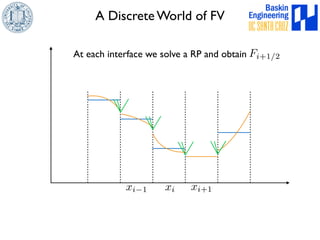
At each interface we solve a RP and obtain Fi+1/2 
xi1 xi xi+1
A Discrete World of FV 
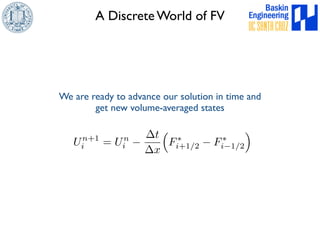
We are ready to advance our solution in time and 
get new volume-averaged states 
Un+1 
i = Un 
i  
t 
x 
⇣ 
F⇤ i+1/2  F⇤ i−1/2 
⌘
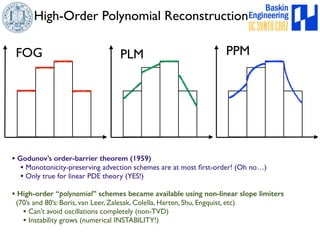
High-Order Polynomial Reconstruction 
PLM PPM 
FOG 
• Godunov’s order-barrier theorem (1959) 
• Monotonicity-preserving advection schemes are at most first-order! (Oh no…) 
• Only true for linear PDE theory (YES!) 
• High-order “polynomial” schemes became available using non-linear slope limiters 
(70’s and 80’s: Boris, van Leer, Zalesak, Colella, Harten, Shu, Engquist, etc) 
• Can’t avoid oscillations completely (non-TVD) 
• Instability grows (numerical INSTABILITY!)
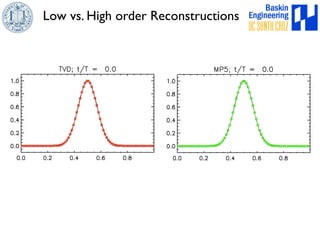
Low vs. High order Reconstructions
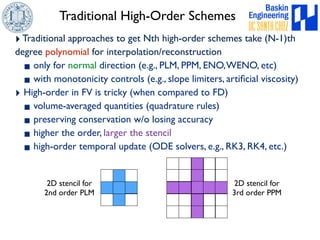
Traditional High-Order Schemes 
‣ Traditional approaches to get Nth high-order schemes take (N-1)th 
degree polynomial for interpolation/reconstruction 
▪only for normal direction (e.g., PLM, PPM, ENO, WENO, etc) 
▪with monotonicity controls (e.g., slope limiters, artificial viscosity) 
‣ High-order in FV is tricky (when compared to FD) 
▪volume-averaged quantities (quadrature rules) 
▪preserving conservation w/o losing accuracy 
▪higher the order, larger the stencil 
▪high-order temporal update (ODE solvers, e.g., RK3, RK4, etc.) 
2D stencil for 
2nd order PLM 
2D stencil for 
3rd order PPM
Stability, Consistency and Convergence 
‣Lax Equivalence Theorem (for linear problem, P. Lax, 1956) 
▪The only convergent schemes are those that are both consistent and stable. 
▪Hard to show that the numerical solution converges to the original 
solution of PDE; relatively easy to show consistency and stability of 
numerical schemes 
‣In practice, non-linear problems adopts the linear theory as guidance. 
▪code verification (code-to-code comparison) 
▪code validation (code-to-experiment, code-to-analytical solution 
comparisons) 
▪self-convergence test over grid resolutions (a good measurement for 
numerical accuracy)
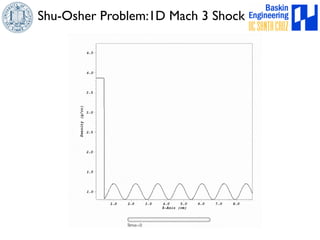
Shu-Osher Problem:1D Mach 3 Shock
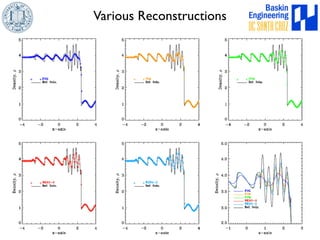
Various Reconstructions
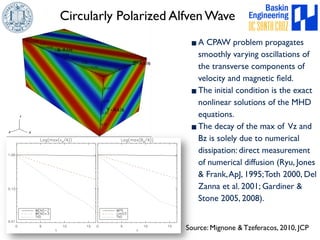
Circularly Polarized Alfven Wave 
▪A CPAW problem propagates 
smoothly varying oscillations of 
the transverse components of 
velocity and magnetic field. 
▪The initial condition is the exact 
nonlinear solutions of the MHD 
equations. 
▪The decay of the max of Vz and 
Bz is solely due to numerical 
dissipation: direct measurement 
of numerical diffusion (Ryu, Jones 
 Frank, ApJ, 1995; Toth 2000, Del 
Zanna et al. 2001; Gardiner  
Stone 2005, 2008). 
A. Mignone et al. / Journal of Computational Physics 229 (2010) 5896–5920 5907 
Source: Mignone  Tzeferacos, 2010, JCP 
Fig. A.3. Long term decay of circularly polarized Alfvén waves after 16.5 time units, corresponding to ) 100 wave periods. In the left panel, we plot the 
maximum value of the vertical component of velocity as a function of time for the WENO $ Z (solid line) and WENO + 3 (dashed line) schemes. For
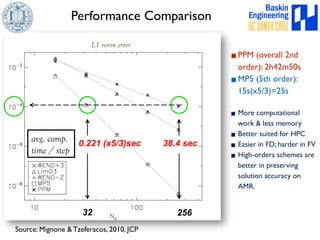
Performance Comparison 
L1 norm error 
avg. comp. 
time / step 
0.221 (x5/3)sec 38.4 sec 
32 256 
Source: Mignone  Tzeferacos, 2010, JCP 
▪PPM (overall 2nd 
order): 2h42m50s 
▪MP5 (5th order): 
15s(x5/3)=25s 
▪More computational 
work  less memory 
▪Better suited for HPC 
▪Easier in FD; harder in FV 
▪High-orders schemes are 
better in preserving 
solution accuracy on 
AMR.
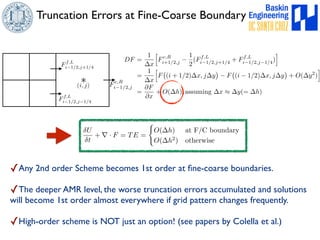
Truncation Errors at Fine-Coarse Boundary 
Ff,L 
i1/2,j+1/4 
DF = 
(i⇤, j) i1/2,j 
Ff,L 
i1/2,j1/4 
Fc,R 
U 
t 
1 
x 
= 
1 
x 
+ r · F = TE = 
h 
Fc,R 
i+1/2,j − 
1 
2 
(Ff,L 
i1/2,j+1/4 + Ff,L 
h 
F 
# 
(i + 1/2)x, jy 
$ 
− F 
# 
(i − 1/2)x, jy 
( 
O(h) at F/C boundary 
O(h2) otherwise 
i1/2,j1/4) 
i 
$ 
+ O(y2) 
✓Any 2nd order Scheme becomes 1st order at fine-coarse boundaries. 
✓The deeper AMR level, the worse truncation errors accumulated and solutions 
will become 1st order almost everywhere if grid pattern changes frequently. 
✓High-order scheme is NOT just an option! (see papers by Colella et al.) 
i 
= 
@F 
@x 
+ O(h), assuming x ⇡ y(= h)
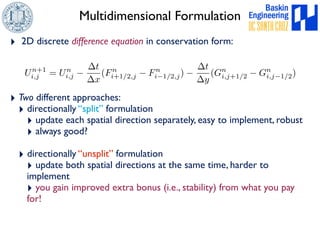
Multidimensional Formulation 
‣ 2D discrete difference equation in conservation form: 
Un+1 
i,j = Un 
i,j  
t 
x 
(Fn 
i+1/2,j  Fn 
‣ Two different approaches: 
‣ directionally “split” formulation 
i1/2,j)  
t 
y 
(Gn 
i,j+1/2  Gn 
i,j1/2) 
‣ update each spatial direction separately, easy to implement, robust 
‣ always good? 
‣ directionally “unsplit” formulation 
‣ update both spatial directions at the same time, harder to 
implement 
‣ you gain improved extra bonus (i.e., stability) from what you pay 
for!
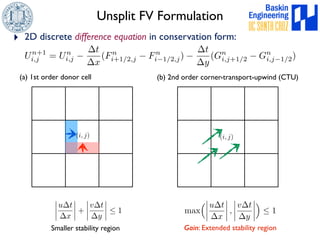
Unsplit FV Formulation 
‣ 2D discrete difference equation in conservation form: 
Un+1 
i,j = Un 
i,j  
ut 
x 
[Un 
i,j  Un 
i1,j ]  
vt 
y 
[Un 
i,j1] Un+1 
i,j  Un 
i,j = Un 
i,j  
ut 
x 
[Un 
i,j  Un 
i1,j ]  
vt 
y 
[Un 
i,j  Un 
i,j1] 
+ 
t2 
2 
n u 
x 
⇥ v 
y 
(Un 
i,j  Un 
i,j1)  
v 
y 
(Un 
i1,j  Un 
i1,j1) 
⇤ 
+ 
v 
y 
⇥ v 
y 
(Un 
i,j  Un 
i1,j)  
v 
y 
(Un 
i,j1  Un 
i1,j1) 
⇤o 
Extra cost for corner coupling! 
(a) 1st order donor cell 
(i, j) 
Un+1 
i,j = Un 
i,j  
t 
x 
(Fn 
i+1/2,j  Fn 
i1/2,j)  
t 
y 
(Gn 
i,j+1/2  Gn 
i,j1/2) 
(b) 2nd order corner-transport-upwind (CTU) 
(i, j)
Unsplit FV Formulation 
‣ 2D discrete difference equation in conservation form: 
Un+1 
i,j = Un 
i,j  
t 
x 
(Fn 
i+1/2,j  Fn 
i1/2,j)  
t 
y 
(Gn 
i,j+1/2  Gn 
i,j1/2) 
(a) 1st order donor cell 
 
ut 
x 
(i, j) 
 
+ 
 
vt 
y 
 
(b) 2nd order corner-transport-upwind (CTU) 
 1 max 
⇣ 
(i, j) 
ut 
x 
 
, 
 
vt 
y 
 
⌘ 
 1 
Smaller stability region Gain: Extended stability region
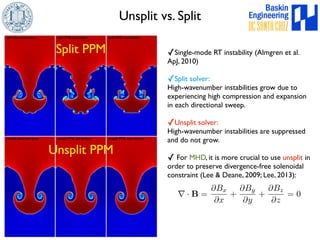
Unsplit vs. Split 
✓Single-mode RT instability (Almgren et al. 
ApJ, 2010) 
✓Split solver: 
High-wavenumber instabilities grow due to 
experiencing high compression and expansion 
in each directional sweep. 
✓Unsplit solver: 
High-wavenumber instabilities are suppressed 
and do not grow. 
✓ For MHD, it is more crucial to use unsplit in 
order to preserve divergence-free solenoidal 
constraint (Lee  Deane, 2009; Lee, 2013): 
Split PPM 
Unsplit PPM 
r · B = 
@Bx 
@x 
+ 
@By 
@y 
+ 
@Bz 
@z 
= 0
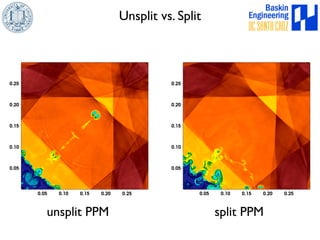
Unsplit vs. Split 
unsplit PPM split PPM
Excellent Resources
Last Episode 
1. High Performance Computing 
2. Ideas on Numerical Methods 
3. Validation  Predictive Science
In Collaboration with 
U of Chicago: 
D. Q. Lamb 
P. Tzeferacos 
N. Flocke 
C. Graziani 
K. Weide 
U of Oxford: 
G. Gregori 
J. Meinecke
To Investigate B-field in the Universe 
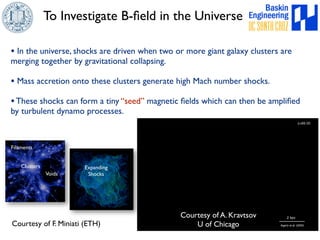
• In the universe, shocks are driven when two or more giant galaxy clusters are 
merging together by gravitational collapsing. 
• Mass accretion onto these clusters generate high Mach number shocks. 
• These shocks can form a tiny “seed” magnetic fields which can then be amplified 
by turbulent dynamo processes. 
Filaments 
Clusters 
Voids 
Expanding 
Shocks 
Courtesy of F. Miniati (ETH) 
Courtesy of A. Kravtsov 
U of Chicago
Shock Waves In SNR 
Cool 
Ejecta 
Shocked 
Ejecta 
due to 
Reverse Shocks 
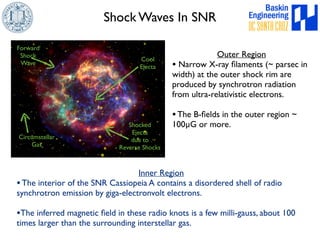
• Narrow X-ray filaments (~ parsec in 
width) at the outer shock rim are 
produced by synchrotron radiation 
from ultra-relativistic electrons. 
• The B-fields in the outer region ~ 
100μG or more. 
Inner Region 
Forward 
Shock 
Wave 
Circumstellar 
Gas 
Outer Region 
• The interior of the SNR Cassiopeia A contains a disordered shell of radio 
synchrotron emission by giga-electronvolt electrons. 
•The inferred magnetic field in these radio knots is a few milli-gauss, about 100 
times larger than the surrounding interstellar gas.
Biermann Battery Mechanism 
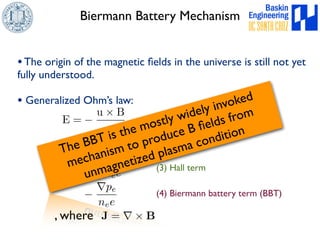
• The origin of the magnetic fields in the universe is still not yet 
fully understood. 
• Generalized Ohm’s law: 
The BBT is the mostly widely invoked 
mechanism to produce B fields from 
unmagnetized plasma condition 
, where J = r ⇥ B 
(1) dynamo term 
(2) resistive term 
(3) Hall term 
(4) Biermann battery term (BBT) 
E =− 
u ⇥ B 
c 
+ ⌘J 
+ 
J ⇥ B 
cnee 
− rpe 
nee
Takeaway 
@B 
@t 
 
BBT 
= crPe ⇥rne 
qen2e 
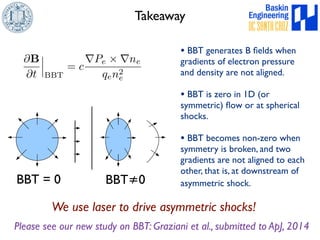
• BBT generates B fields when 
gradients of electron pressure 
and density are not aligned. 
• BBT is zero in 1D (or 
symmetric) flow or at spherical 
shocks. 
• BBT becomes non-zero when 
symmetry is broken, and two 
gradients are not aligned to each 
other, that is, at downstream of 
BBT = 0 BBT≠0 asymmetric shock. 
We use laser to drive asymmetric shocks! 
Please see our new study on BBT: Graziani et al., submitted to ApJ, 2014
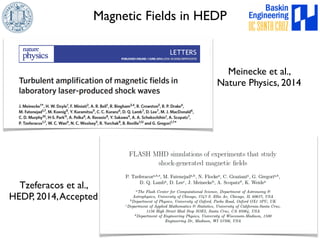
Magnetic Fields in HEDP 
Tzeferacos et al., 
HEDP, 2014, Accepted 
Meinecke et al., 
Nature Physics, 2014
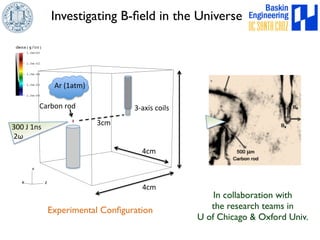
Investigating B-field in the Universe 
300$J$1ns$ 3cm$ 
$2ω$ 
3,axis$coils$ 
Ar$(1atm)$ 
4cm$ 
Carbon$rod$ 
4cm$ 
In collaboration with 
the research teams in 
U of Chicago  Oxford Univ. 
Experimental Configuration
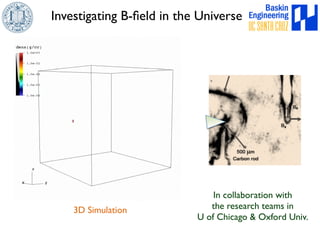
Investigating B-field in the Universe 
In collaboration with 
the research teams in 
U of Chicago  Oxford Univ. 
3D Simulation
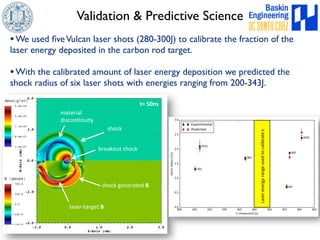
Validation  Predictive Science 
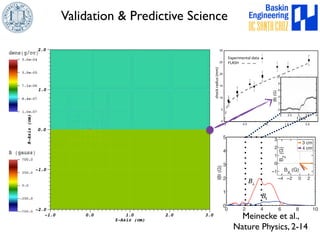
• We used five Vulcan laser shots (280-300J) to calibrate the fraction of the 
laser energy deposited in the carbon rod target. 
• With the calibrated amount of laser energy deposition we predicted the 
shock radius of six laser shots with energies ranging from 200-343J. 
breakout)shock) 
material) 
discon2nuity) 
shock) 
shock)generated)B 
laser5target)B 
t=50ns 
Laserenergyrangeusedtocalibrateε
Validation  Predictive Science 
Experimental,data, 
FLASH, 
shock,radius,(mm), 
t,(μs), 
Meinecke et al., 
Nature Physics, 2-14
Summary 
▪Novel ideas of numerical algorithms can play the key fundamental 
role in many areas in modern science. 
▪Computational mathematics is one of the corner stone research 
areas that can provide major predictive scientific tools. 
▪Numerical simulations can help designing better scientific 
directions in wide ranges of research applications, especially in 
physical science and engineering.
Thanks! Questions? 
Dongwook Lee: 
dlee79@ucsc.edu 
ams.soe.ucsc.edu/people/dongwook 
FLASH: 
www.flash.uchicago.edu
Supplementary Slides
Relavant Questions 
‣ What is scientific computing? 
‣ How do we want to use computer for it? 
‣ What should we do in order to use computing 
resources in a better way? 
‣ Can numerical algorithms and computational 
mathematics improve computations? 
‣ High-performance computing: petascale (or exascale ?)
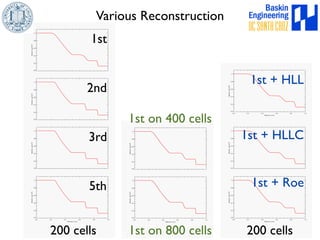
Various Reconstruction 
1st 
2nd 
3rd 
5th 
200 cells 
1st on 400 cells 
1st on 800 cells 
1st + HLL 
1st + HLLC 
1st + Roe 
200 cells
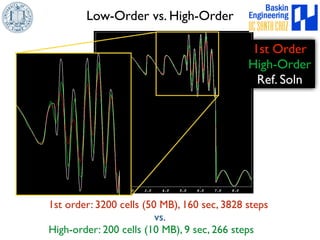
Low-Order vs. High-Order 
1st Order 
High-Order 
Ref. Soln 
1st order: 3200 cells (50 MB), 160 sec, 3828 steps 
vs. 
High-order: 200 cells (10 MB), 9 sec, 266 steps

Mathematics Colloquium, UCSC

  • 1.
    High-order Numerical Methodsfor Predictive Science on Large-scale High-performance Computing Architectures Dongwook Lee Applied Mathematics & Statistics University of California, Santa Cruz Mathematics Colloquium, November 18, 2014 FLASH Simulation of a 3D Core-collapse Supernova Courtesy of S. Couch MIRA, BG/Q, Argonne National Lab 49,152 nodes, 786,432 cores OMEGA Laser (US)
  • 2.
    Cyclic Relationship Theory Experiment Scientific Computation validation verification
  • 3.
    Example: Supersonic Airflow Theory Experiment Simulation
  • 4.
    Topics for Today 1. High Performance Computing 2. Ideas on Numerical Methods 3. Validation & Predictive Science
  • 5.
    First Episode 1.High Performance Computing 2. Ideas on Numerical Methods 3. Validation & Predictive Science
  • 6.
    High Performance Computing(HPC) ‣To solve large problems in science, engineering, or business ‣Modern HPC architectures have ▪ increasing number of cores ▪ declining memory/core ‣This trend will continue for the foreseeable future
  • 7.
    High Performance Computing(HPC) ‣This tension between computation & memory brings a paradigm shift in numerical algorithms for HPC ‣To enable scientific computing on HPC architectures: ▪ efficient parallel computing, (e.g., data parallelism, task parallelism, MPI, multi-threading, GPU accelerator, etc.) ▪ better numerical algorithms for HPC
  • 8.
    Numerical Algorithms forHPC ‣Numerical algorithms should conform to the abundance of computing power and the scarcity of memory. ‣But… ▪ without losing solution accuracy. ▪ with maintaining maximum solution stability. ▪ with faster convergence to a “correct” solution.
  • 9.
    High-Order Numerical Algorithms ‣ A good solution to this is to use high-order algorithms. ‣ They provide more accurate numerical solutions using ▪ less grid points (=memory save). ▪ higher-order mathematical approximations (promoting more floating point operations, or computation). ▪ faster convergence to solution.
  • 10.
    Large Scale AstrophysicsCodes ▪FLASH (Flash group, U of Chicago) Future HPC ▪ PLUTO (Mignone, U of Torino), ▪ CHOMBO (Colella, LBL) ▪ CASTRO (Almgren, Woosley, LBL, UCSC) ▪ MAESTRO (Zingale, Almgren, SUNY, LBL) ▪ ENZO (Bryan, Norman, Abel, Enzo group) ▪ BATS-R-US (CSEM, U of Michigan) ▪ RAMSES (Teyssier, CEA) Peta- Scale ▪ Current HPC CHARM (Miniati, ETH) ▪ AMRVAC (Toth, Keppens, CPA, K.U.Leuven) ▪ ATHENA (Stone, Princeton) ▪ ORION (Klein, McKee, U of Berkeley) ▪ ASTROBear (Frank, U of Rochester) ▪ ART (Kravtsov, Klypin, U of Chicago) ▪ NIRVANA (Ziegler, Leibniz-Institut für Astrophysik Potsdam), and others Giga- Scale Current Laptop/Desktop ?
  • 11.
    The FLASH Code ‣FLASH is is free, open source code for astrophysics and HEDP. ▪ modular, multi-physics, adaptive mesh refinement (AMR), parallel (MPI & OpenMP), finite-volume Eulerian compressible code for solving hydrodynamics and MHD ▪ professionally software engineered and maintained (daily regression test suite, code verification/validation), inline/online documentation ▪ 8500 downloads, 1500 authors, 1000 papers ▪ FLASH can run on various platforms from laptops to supercomputing (peta-scale) systems such as IBM BG/P and BG/Q.
  • 12.
    Scientific Simulations usingFLASH cosmological cluster formation supersonic MHD turbulence Type Ia SN RT CCSN ram pressure stripping laser slab rigid body structure Accretion Torus LULI/Vulcan experiments: B-field generation/amplification
  • 13.
    Parallel Computing ‣Adaptive Mesh Refinement (w/ Paramesh) ▪conventional parallelism via MPI (Message Passing Interface) ▪domain decomposition distributed over multiple processor units ▪distributed memory (cf. shared memory) Single block uniform grid octree-based block AMR patch-based AMR
  • 14.
    Parallelization, Optimization &Speedup 16 GB/node 16 cores/node 4 threads/core
  • 15.
    Parallelization, Optimization &Speedup ‣Multi-threading (shared memory) using OpenMP directives ▪more parallel computing on BG/Q using hardware threads on a core ▪ 16 cores/node, 4 threads/core thread block list thread within block ▪ 5 leaf blocks in a single MPI rank ▪ 2 threads/core (or 2 threads/rank)
  • 16.
    FLASH Scaling Teston BG/Q RTFlame, strong scaling: 4 threads/rank CCSN, weak scaling: 8 threads/rank VESTA: 2 racks 1024 nodes/rack 10 8 6 4 2 MIRA: 48 racks 1024 nodes/rack BG/Q: 16 cores/node 4 threads/core 16GB/core 512 (4k) 1024 (8k) 2048 (16k) 4096 (32k) 8192 (64k) 16384 (128k) 25 20 15 10 5 32768 (256k) Mira nodes (ranks), 8 threads/rank 0 108 core hours/zone/step 0 107 core hours/zone/IO write Total evolution MHD Gravity Grid IO (1 write) ⌫-Leakage Ideal
  • 17.
    Second Episode 1.High Performance Computing 2. Ideas on Numerical Methods 3. Validation Predictive Science
  • 18.
    Scientific Tasks ScienceProblem (IC, BC, ODE/PDE) Simulator (code, computer) Results (Validation, verification, analysis)
  • 19.
    1. Mathematical Models Hydrodynamics (gas dynamics) @⇢ @t + r · (⇢v) = 0 mass eqn @⇢v @t + r · (⇢vv) + rP = ⇢g momentum eqn @⇢E @t + r · [(⇢E + P)v] = ⇢v · g total energy eqn P = (! 1)⇢✏ E = ✏ + 1 2|v|2 @⇢✏ @t + r · [(⇢✏ + P)v] − v · rP = 0 Equation of State
  • 20.
    2. Mathematical Models Magnetohydrodynamics (MHD) @⇢ @t + r · (⇢v) = 0 mass eqn @⇢v @t + r · (⇢vv − BB) + rP⇤ = ⇢g + r · ⌧ momentum eqn @⇢E @t + r · [v(⇢E + P⇤) − B(v · B)] = ⇢g · v + r · (v · ⌧ + $rT) + r · (B ⇥ (⌘r⇥B)) total energy eqn @B @t + r · (vB − Bv) = −r ⇥ (⌘r⇥B) induction eqn P⇤ = p + B2 2 E = v2 2 + ✏ + B2 2⇢ Equation of State ⌧ = μ[(rv) + (rv)T − 2 3 solenodidal constraint (r · v)I] viscosityr · B = 0
  • 21.
    3. Mathematical Models HEDP: Separate energy eqns for ion, electron, radiation (“3-temperature, or 3T”) @ @t (⇢✏ion) + r · (⇢✏ionv) + Pionr · v = ⇢ cv,ele ⌧ei (Tele − Tion) ion energy @ @t (⇢✏ele) + r · (⇢✏elev) + Peler · v = ⇢ cv,ele ⌧ei (Tion − Tele)−r· qele + Qabs − Qemis + Qlas electron energy @ @t (⇢✏rad) + r · (⇢✏radv) + Pradr · v = r · qrad − Qabs + Qemis radiation energy ✏tot = ✏ion + ✏ele + ✏rad Ptot, Tion, Tele, Trad = EoS(⇢, ✏ion, ✏ele, ✏rad) 3T EoS Compare 3T with a simple 1T EoS! @ @t (⇢✏tot) + r · (⇢✏totv) + Ptotr · v = 0 Ptot = EoS(⇢, ✏tot) Tion = Tele = Trad, or Tele = Tion, Trad = 0
  • 22.
    Discretization Approaches ‣FiniteVolume (FV) ▪shock capturing, compressible flows, structured/unstructured grids ▪hard to achieve high-order (higher than 2nd order) ‣Finite Difference (FD) ▪smooth flows, incompressible, high-order methods ▪non-conservative, simple geometry ‣Finite Element (FE) ▪arbitrary geometry, basis functions, continuous solutions ▪hard coding, problems at strong gradients ‣Spectral Element (SE) ‣Discontinuous Galerkin (DG)
  • 23.
    Finite Volume Formulations @U @t + @F @x + @G @y + @H @z = 0 @U @t + r · Flux(U) = 0 ‣ Conservation laws (mass, momentum, energy) ‣ Highly compressible flows with shocks and discontinuities ‣ Differential (smooth) form of PDEs (e.g., FD) becomes invalid ‣ Integral form of PDEs relaxes the smoothness assumptions and seek for weak solutions over control volumes and boundaries ‣ Basics of FV (in 1D): U i+1 n x t Un+1 i Un i Un i1 tn+1 tn Fn i1/2 Fn i+1/2 or
  • 24.
    Finite Volume Formulations ‣ Integral form of PDE: Z xi+1/2 xi1/2 u(x, tn+1)dx Z xi+1/2 xi1/2 u(x, tn)dx = Z tn+1 tn f(u(xi1/2, t))dt Z tn+1 tn f(u(xi+1/2, t))dt ‣ Volume averaged, cell-centered quantity time averaged flux: Un i = 1 x Z xi+1/2 xi1/2 and f(u(xi1/2, t))dt u(x, tn)dx Fn i1/2 = ‣ Finite wave speed in hyperbolic system: 1 t Z tn+1 tn Fn i1/2 = F(Un i ) * High-order reconstruction in space time i1, Un * Riemann problem at each cell-interface, i-1/2 ‣ General discrete difference equation in conservation form in 1D: Un+1 i = Un i t x (Fn i+1/2 Fn i1/2)
  • 25.
    Riemann Problem Godunov Method ‣The Riemann problem: ‣Two cases: PDEs: Ut + AUx = 0,−1 x 1, t 0 IC : U(x, t = 0) = U0(x) = ( UL if x 0, UR if x 0. Shock solution Rarefaction solution
  • 26.
    A Discrete Worldof FV U(x, tn) xi1 xi xi+1
  • 27.
    A Discrete Worldof FV piecewise polynomial reconstruction on each cell u(xi, tn) = Pi(x), x 2 (xi1/2, xi1/2) xi1 xi xi+1 uR = Pi(xi+1/2) uL = Pi+1(xi+1/2)
  • 28.
    A Discrete Worldof FV At each interface we solve a RP and obtain Fi+1/2 xi1 xi xi+1
  • 29.
    A Discrete Worldof FV We are ready to advance our solution in time and get new volume-averaged states Un+1 i = Un i t x ⇣ F⇤ i+1/2 F⇤ i−1/2 ⌘
  • 30.
    High-Order Polynomial Reconstruction PLM PPM FOG • Godunov’s order-barrier theorem (1959) • Monotonicity-preserving advection schemes are at most first-order! (Oh no…) • Only true for linear PDE theory (YES!) • High-order “polynomial” schemes became available using non-linear slope limiters (70’s and 80’s: Boris, van Leer, Zalesak, Colella, Harten, Shu, Engquist, etc) • Can’t avoid oscillations completely (non-TVD) • Instability grows (numerical INSTABILITY!)
  • 31.
    Low vs. Highorder Reconstructions
  • 32.
    Traditional High-Order Schemes ‣ Traditional approaches to get Nth high-order schemes take (N-1)th degree polynomial for interpolation/reconstruction ▪only for normal direction (e.g., PLM, PPM, ENO, WENO, etc) ▪with monotonicity controls (e.g., slope limiters, artificial viscosity) ‣ High-order in FV is tricky (when compared to FD) ▪volume-averaged quantities (quadrature rules) ▪preserving conservation w/o losing accuracy ▪higher the order, larger the stencil ▪high-order temporal update (ODE solvers, e.g., RK3, RK4, etc.) 2D stencil for 2nd order PLM 2D stencil for 3rd order PPM
  • 33.
    Stability, Consistency andConvergence ‣Lax Equivalence Theorem (for linear problem, P. Lax, 1956) ▪The only convergent schemes are those that are both consistent and stable. ▪Hard to show that the numerical solution converges to the original solution of PDE; relatively easy to show consistency and stability of numerical schemes ‣In practice, non-linear problems adopts the linear theory as guidance. ▪code verification (code-to-code comparison) ▪code validation (code-to-experiment, code-to-analytical solution comparisons) ▪self-convergence test over grid resolutions (a good measurement for numerical accuracy)
  • 34.
  • 35.
  • 36.
    Circularly Polarized AlfvenWave ▪A CPAW problem propagates smoothly varying oscillations of the transverse components of velocity and magnetic field. ▪The initial condition is the exact nonlinear solutions of the MHD equations. ▪The decay of the max of Vz and Bz is solely due to numerical dissipation: direct measurement of numerical diffusion (Ryu, Jones Frank, ApJ, 1995; Toth 2000, Del Zanna et al. 2001; Gardiner Stone 2005, 2008). A. Mignone et al. / Journal of Computational Physics 229 (2010) 5896–5920 5907 Source: Mignone Tzeferacos, 2010, JCP Fig. A.3. Long term decay of circularly polarized Alfvén waves after 16.5 time units, corresponding to ) 100 wave periods. In the left panel, we plot the maximum value of the vertical component of velocity as a function of time for the WENO $ Z (solid line) and WENO + 3 (dashed line) schemes. For
  • 37.
    Performance Comparison L1norm error avg. comp. time / step 0.221 (x5/3)sec 38.4 sec 32 256 Source: Mignone Tzeferacos, 2010, JCP ▪PPM (overall 2nd order): 2h42m50s ▪MP5 (5th order): 15s(x5/3)=25s ▪More computational work less memory ▪Better suited for HPC ▪Easier in FD; harder in FV ▪High-orders schemes are better in preserving solution accuracy on AMR.
  • 38.
    Truncation Errors atFine-Coarse Boundary Ff,L i1/2,j+1/4 DF = (i⇤, j) i1/2,j Ff,L i1/2,j1/4 Fc,R U t 1 x = 1 x + r · F = TE = h Fc,R i+1/2,j − 1 2 (Ff,L i1/2,j+1/4 + Ff,L h F # (i + 1/2)x, jy $ − F # (i − 1/2)x, jy ( O(h) at F/C boundary O(h2) otherwise i1/2,j1/4) i $ + O(y2) ✓Any 2nd order Scheme becomes 1st order at fine-coarse boundaries. ✓The deeper AMR level, the worse truncation errors accumulated and solutions will become 1st order almost everywhere if grid pattern changes frequently. ✓High-order scheme is NOT just an option! (see papers by Colella et al.) i = @F @x + O(h), assuming x ⇡ y(= h)
  • 39.
    Multidimensional Formulation ‣2D discrete difference equation in conservation form: Un+1 i,j = Un i,j t x (Fn i+1/2,j Fn ‣ Two different approaches: ‣ directionally “split” formulation i1/2,j) t y (Gn i,j+1/2 Gn i,j1/2) ‣ update each spatial direction separately, easy to implement, robust ‣ always good? ‣ directionally “unsplit” formulation ‣ update both spatial directions at the same time, harder to implement ‣ you gain improved extra bonus (i.e., stability) from what you pay for!
  • 40.
    Unsplit FV Formulation ‣ 2D discrete difference equation in conservation form: Un+1 i,j = Un i,j ut x [Un i,j Un i1,j ] vt y [Un i,j1] Un+1 i,j Un i,j = Un i,j ut x [Un i,j Un i1,j ] vt y [Un i,j Un i,j1] + t2 2 n u x ⇥ v y (Un i,j Un i,j1) v y (Un i1,j Un i1,j1) ⇤ + v y ⇥ v y (Un i,j Un i1,j) v y (Un i,j1 Un i1,j1) ⇤o Extra cost for corner coupling! (a) 1st order donor cell (i, j) Un+1 i,j = Un i,j t x (Fn i+1/2,j Fn i1/2,j) t y (Gn i,j+1/2 Gn i,j1/2) (b) 2nd order corner-transport-upwind (CTU) (i, j)
  • 41.
    Unsplit FV Formulation ‣ 2D discrete difference equation in conservation form: Un+1 i,j = Un i,j t x (Fn i+1/2,j Fn i1/2,j) t y (Gn i,j+1/2 Gn i,j1/2) (a) 1st order donor cell ut x (i, j) + vt y (b) 2nd order corner-transport-upwind (CTU)  1 max ⇣ (i, j) ut x , vt y ⌘  1 Smaller stability region Gain: Extended stability region
  • 42.
    Unsplit vs. Split ✓Single-mode RT instability (Almgren et al. ApJ, 2010) ✓Split solver: High-wavenumber instabilities grow due to experiencing high compression and expansion in each directional sweep. ✓Unsplit solver: High-wavenumber instabilities are suppressed and do not grow. ✓ For MHD, it is more crucial to use unsplit in order to preserve divergence-free solenoidal constraint (Lee Deane, 2009; Lee, 2013): Split PPM Unsplit PPM r · B = @Bx @x + @By @y + @Bz @z = 0
  • 43.
    Unsplit vs. Split unsplit PPM split PPM
  • 44.
  • 45.
    Last Episode 1.High Performance Computing 2. Ideas on Numerical Methods 3. Validation Predictive Science
  • 46.
    In Collaboration with U of Chicago: D. Q. Lamb P. Tzeferacos N. Flocke C. Graziani K. Weide U of Oxford: G. Gregori J. Meinecke
  • 47.
    To Investigate B-fieldin the Universe • In the universe, shocks are driven when two or more giant galaxy clusters are merging together by gravitational collapsing. • Mass accretion onto these clusters generate high Mach number shocks. • These shocks can form a tiny “seed” magnetic fields which can then be amplified by turbulent dynamo processes. Filaments Clusters Voids Expanding Shocks Courtesy of F. Miniati (ETH) Courtesy of A. Kravtsov U of Chicago
  • 48.
    Shock Waves InSNR Cool Ejecta Shocked Ejecta due to Reverse Shocks • Narrow X-ray filaments (~ parsec in width) at the outer shock rim are produced by synchrotron radiation from ultra-relativistic electrons. • The B-fields in the outer region ~ 100μG or more. Inner Region Forward Shock Wave Circumstellar Gas Outer Region • The interior of the SNR Cassiopeia A contains a disordered shell of radio synchrotron emission by giga-electronvolt electrons. •The inferred magnetic field in these radio knots is a few milli-gauss, about 100 times larger than the surrounding interstellar gas.
  • 49.
    Biermann Battery Mechanism • The origin of the magnetic fields in the universe is still not yet fully understood. • Generalized Ohm’s law: The BBT is the mostly widely invoked mechanism to produce B fields from unmagnetized plasma condition , where J = r ⇥ B (1) dynamo term (2) resistive term (3) Hall term (4) Biermann battery term (BBT) E =− u ⇥ B c + ⌘J + J ⇥ B cnee − rpe nee
  • 50.
    Takeaway @B @t BBT = crPe ⇥rne qen2e • BBT generates B fields when gradients of electron pressure and density are not aligned. • BBT is zero in 1D (or symmetric) flow or at spherical shocks. • BBT becomes non-zero when symmetry is broken, and two gradients are not aligned to each other, that is, at downstream of BBT = 0 BBT≠0 asymmetric shock. We use laser to drive asymmetric shocks! Please see our new study on BBT: Graziani et al., submitted to ApJ, 2014
  • 51.
    Magnetic Fields inHEDP Tzeferacos et al., HEDP, 2014, Accepted Meinecke et al., Nature Physics, 2014
  • 52.
    Investigating B-field inthe Universe 300$J$1ns$ 3cm$ $2ω$ 3,axis$coils$ Ar$(1atm)$ 4cm$ Carbon$rod$ 4cm$ In collaboration with the research teams in U of Chicago Oxford Univ. Experimental Configuration
  • 53.
    Investigating B-field inthe Universe In collaboration with the research teams in U of Chicago Oxford Univ. 3D Simulation
  • 54.
    Validation PredictiveScience • We used five Vulcan laser shots (280-300J) to calibrate the fraction of the laser energy deposited in the carbon rod target. • With the calibrated amount of laser energy deposition we predicted the shock radius of six laser shots with energies ranging from 200-343J. breakout)shock) material) discon2nuity) shock) shock)generated)B laser5target)B t=50ns Laserenergyrangeusedtocalibrateε
  • 55.
    Validation PredictiveScience Experimental,data, FLASH, shock,radius,(mm), t,(μs), Meinecke et al., Nature Physics, 2-14
  • 56.
    Summary ▪Novel ideasof numerical algorithms can play the key fundamental role in many areas in modern science. ▪Computational mathematics is one of the corner stone research areas that can provide major predictive scientific tools. ▪Numerical simulations can help designing better scientific directions in wide ranges of research applications, especially in physical science and engineering.
  • 57.
    Thanks! Questions? DongwookLee: dlee79@ucsc.edu ams.soe.ucsc.edu/people/dongwook FLASH: www.flash.uchicago.edu
  • 58.
  • 59.
    Relavant Questions ‣What is scientific computing? ‣ How do we want to use computer for it? ‣ What should we do in order to use computing resources in a better way? ‣ Can numerical algorithms and computational mathematics improve computations? ‣ High-performance computing: petascale (or exascale ?)
  • 60.
    Various Reconstruction 1st 2nd 3rd 5th 200 cells 1st on 400 cells 1st on 800 cells 1st + HLL 1st + HLLC 1st + Roe 200 cells
  • 61.
    Low-Order vs. High-Order 1st Order High-Order Ref. Soln 1st order: 3200 cells (50 MB), 160 sec, 3828 steps vs. High-order: 200 cells (10 MB), 9 sec, 266 steps