RECORDERS
By:
Somesh Kumar Malhotra
Lecturer,ECE Deptt.,UIET,CSJM
University
Recorders
• A graphic recorder is basically a measuring device
which is able to produce in real time a hard copy of a
set of time functions with the purpose of immediate
and/or later visual inspection.
• The curves/lines are mostly drawn on a (long) strip of
paper (from a roll), often called strip chart recorder.
• When two independent variables are to be recorded
on a piece of paper with respect to each other, it is
called an X-Y recorder.
Strip chart Recorder
• A strip chart recorder records physical variable with respect
to the independent variable time on a long paper kept in
the form of a roll.
• The independent variable time (t) then corresponds to the
strip-length axis and the physical variables measured (y) are
related to the chart width.
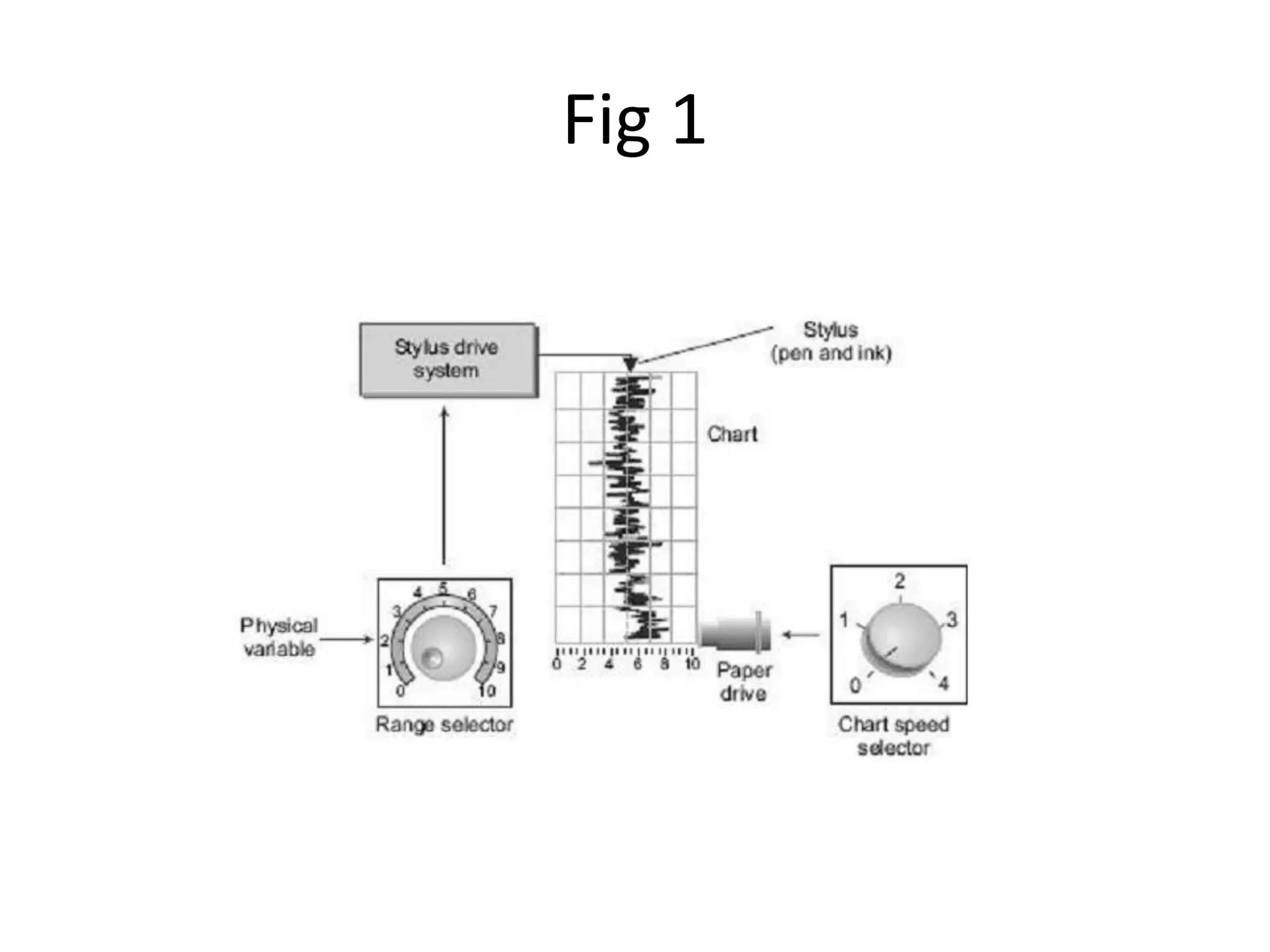
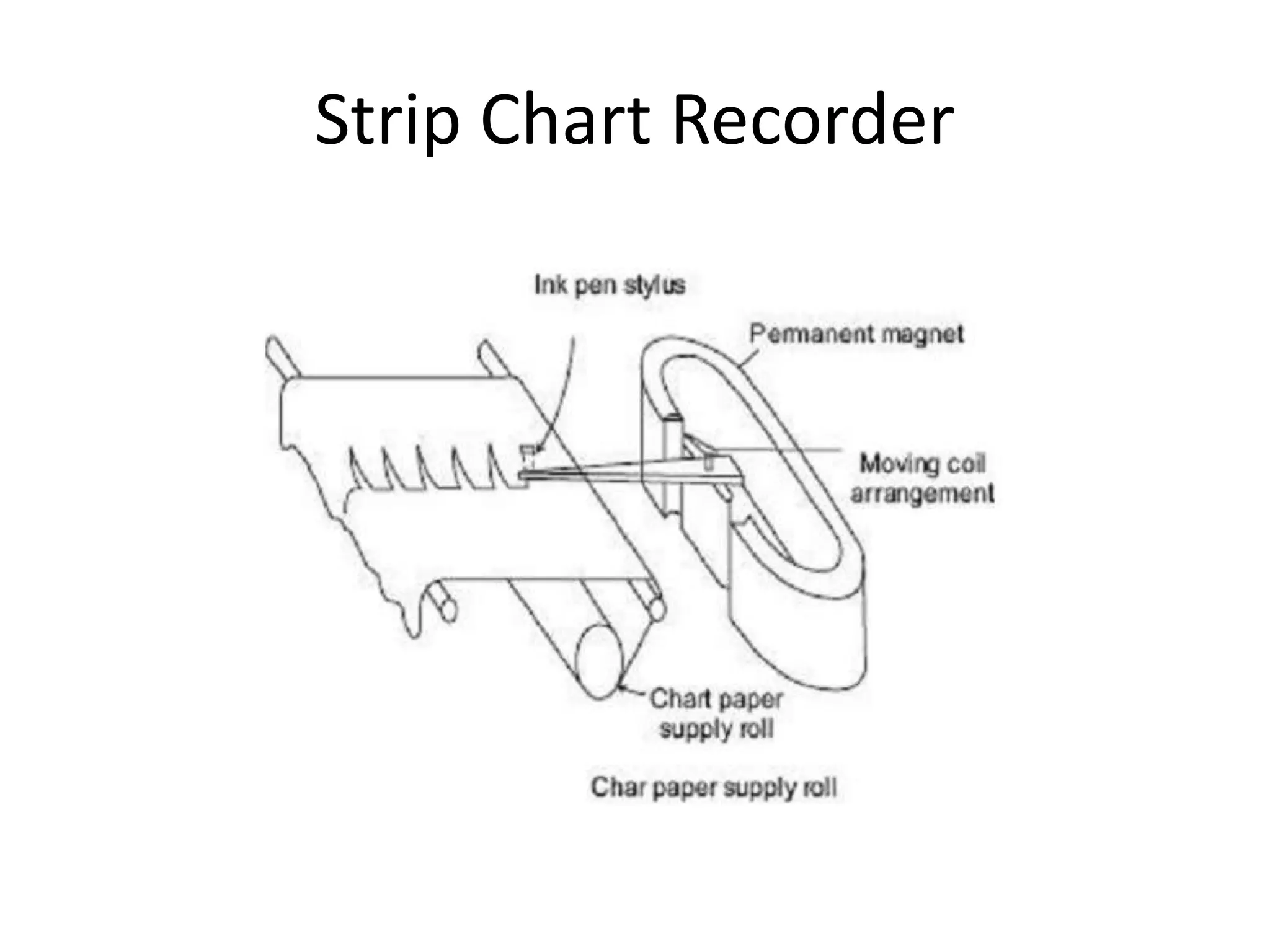
• Figure 1 shows different components of a strip chart
recorder. A typical industrial strip chart recorder is shown in
Figure 2.
Fig 1
Fig 2
Strip chart Recorder
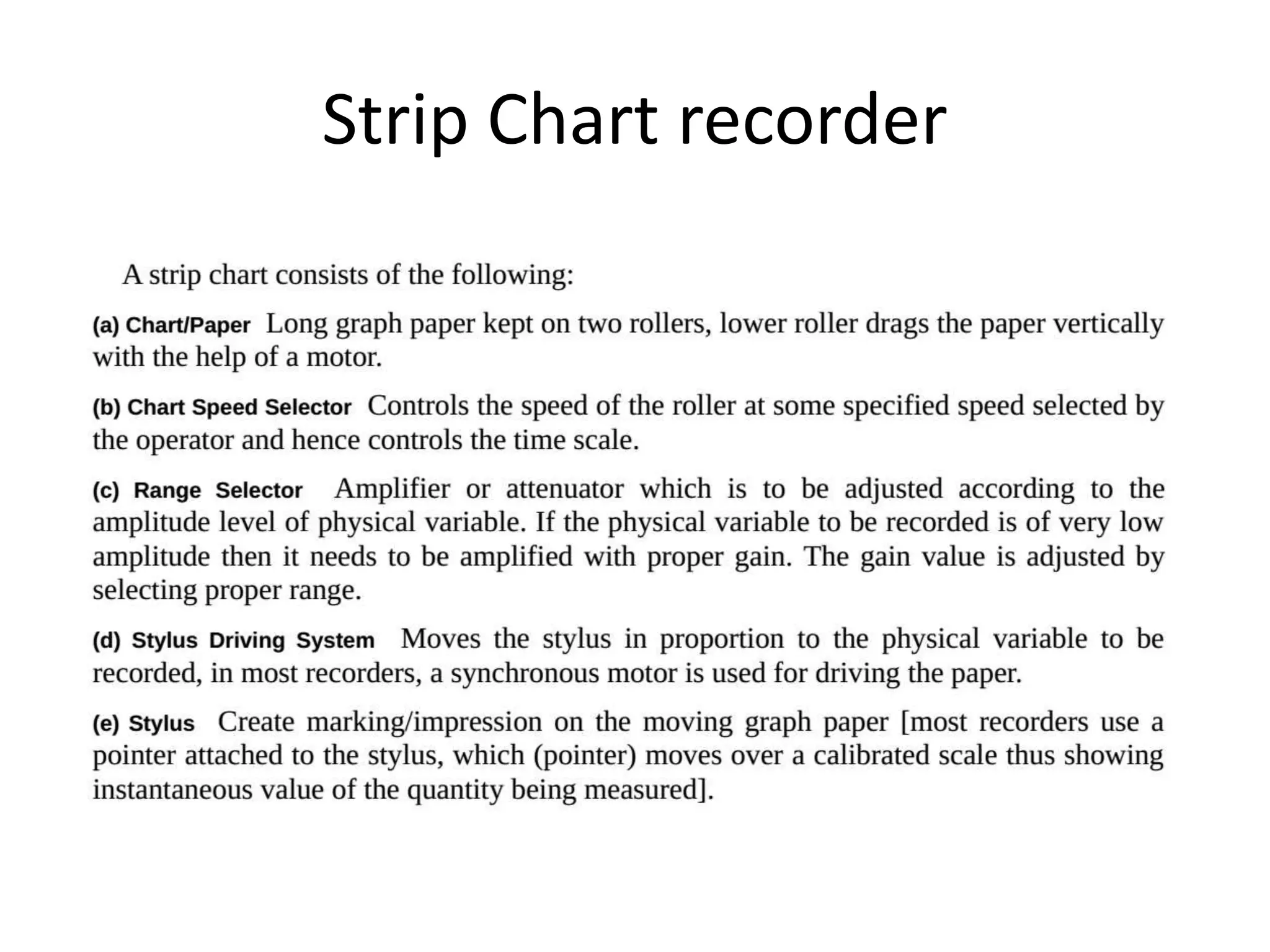
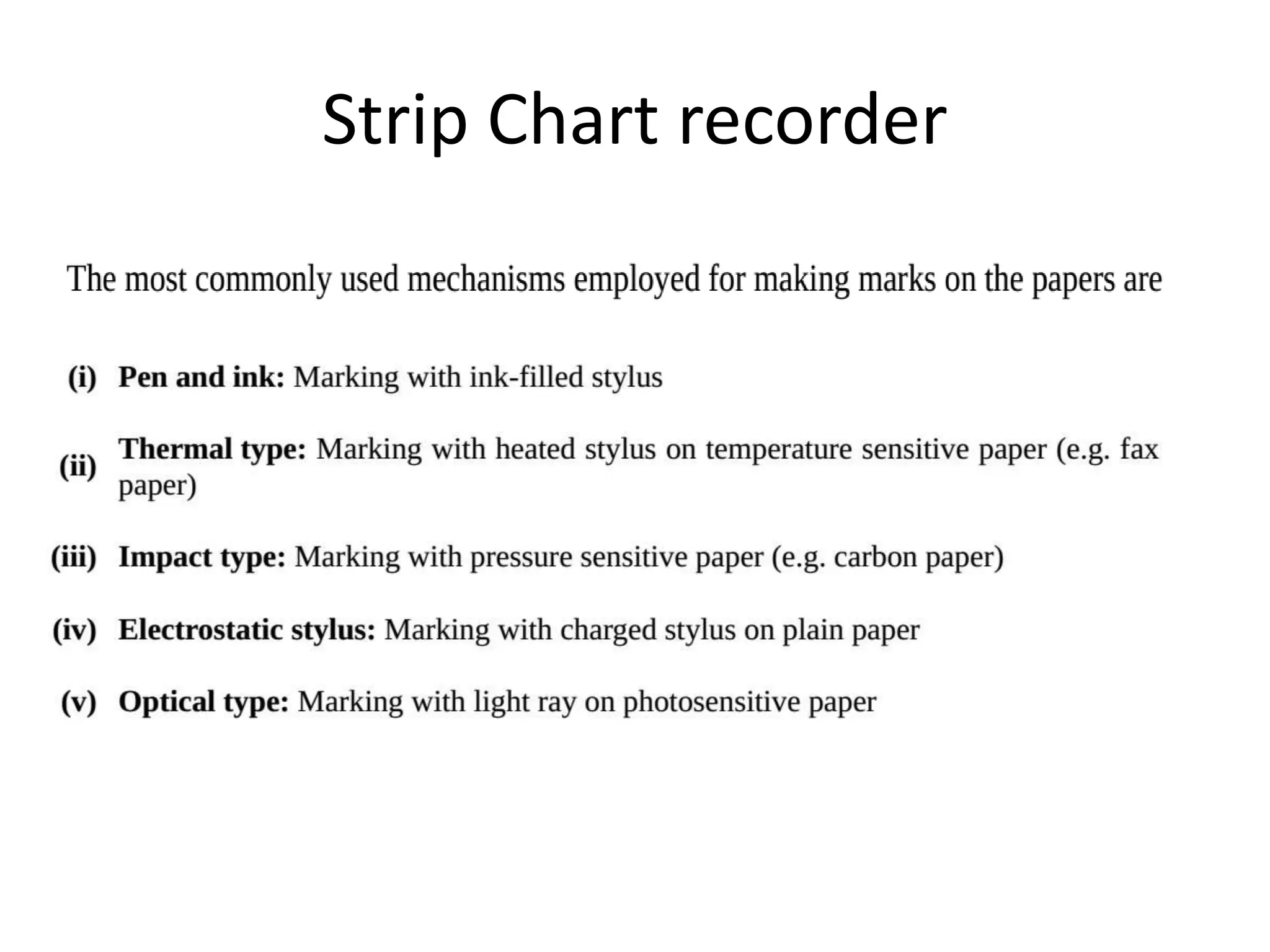
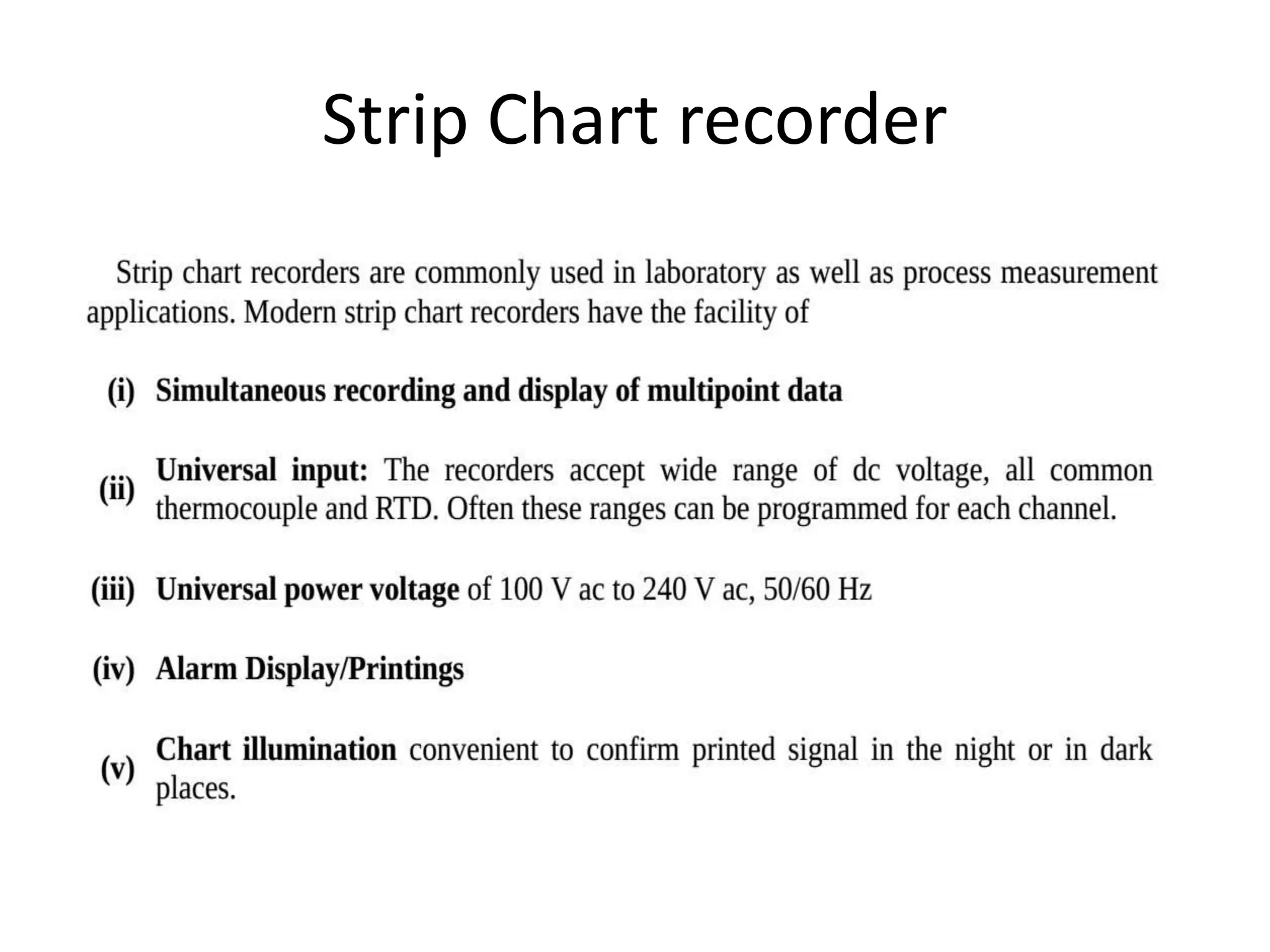
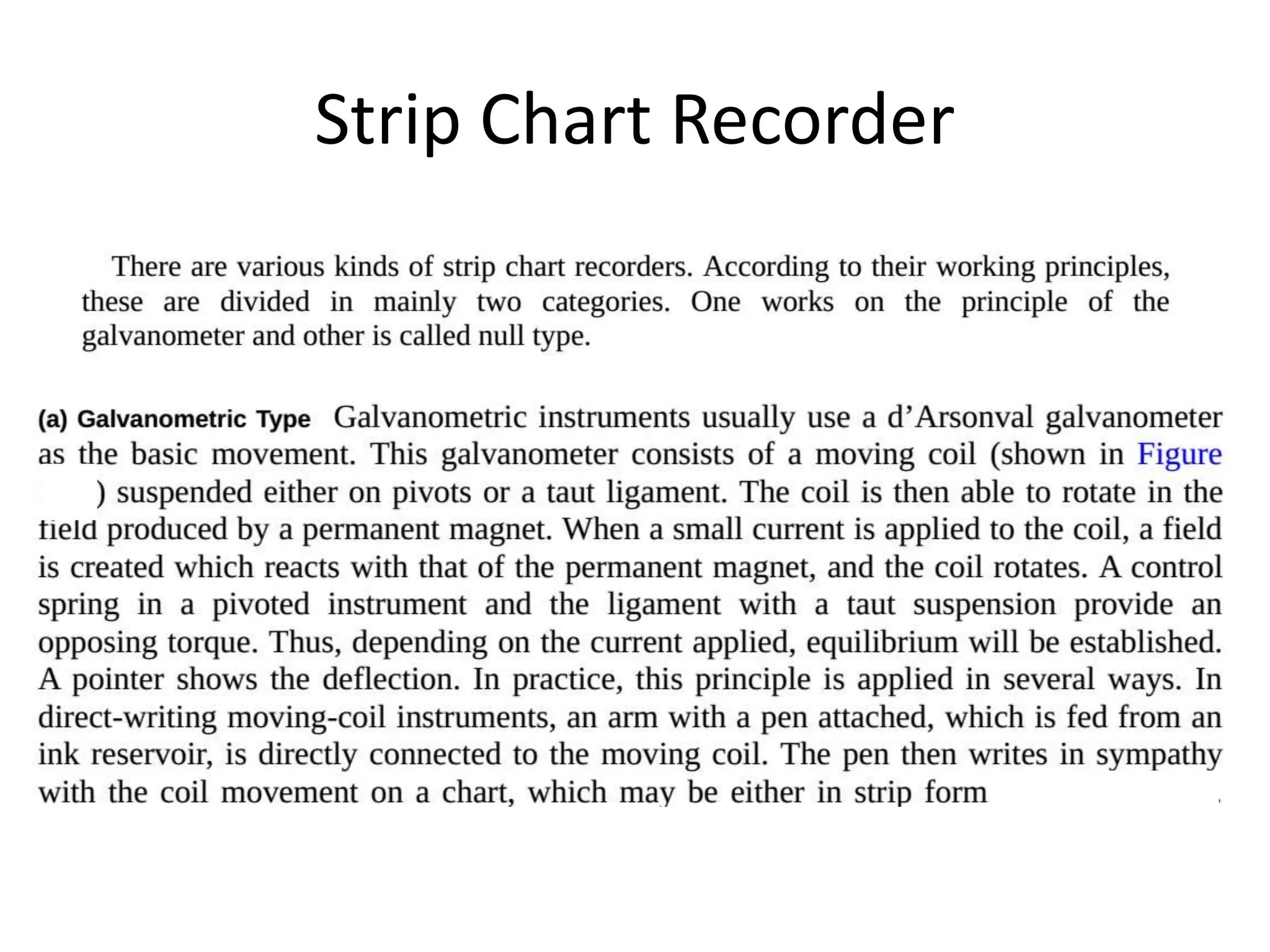
• Strip chart recorders consist of a roll or strip of
paper that is passed linearly beneath one
or more pens. As the signal changes, the pens
deflect producing the resultant chart. Strip
chart recorders are well suited for recording of
continuous processes..
Strip Chart recorder
Strip Chart Recorder
31 May 2024 12
X-Y Recorder
• Records one or more parameters with respect to
some other
• Or
• x-y recorder is an instrument which gives a
graphic record of the relationship between two
variables.
• In some type recorders ,Pen moves in two axes
• In X-Y recorders, an emf is plotted as a function
of another emf.
31 May 2024 13
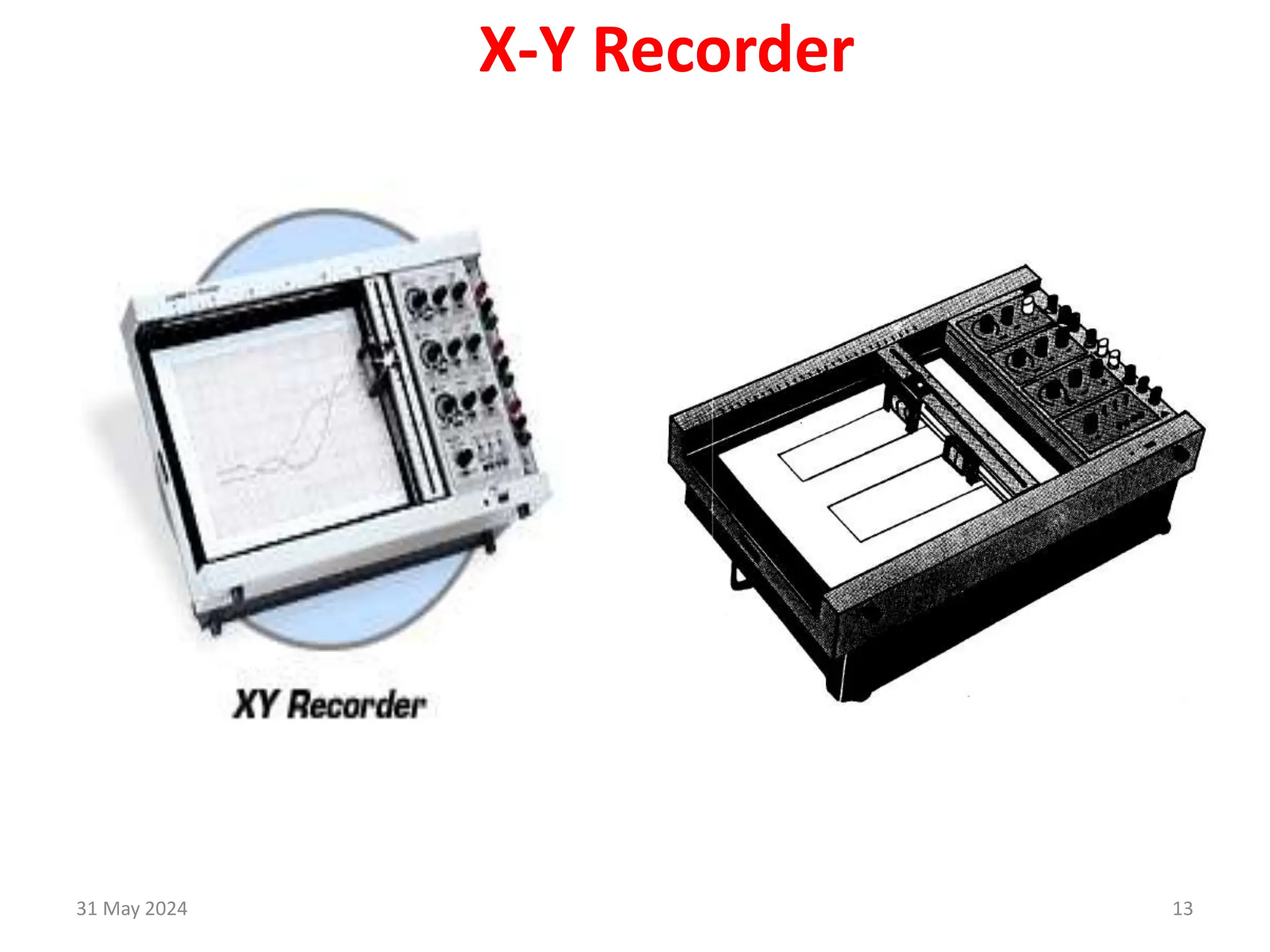
X-Y Recorder
31 May 2024 14
X-Y Recorder
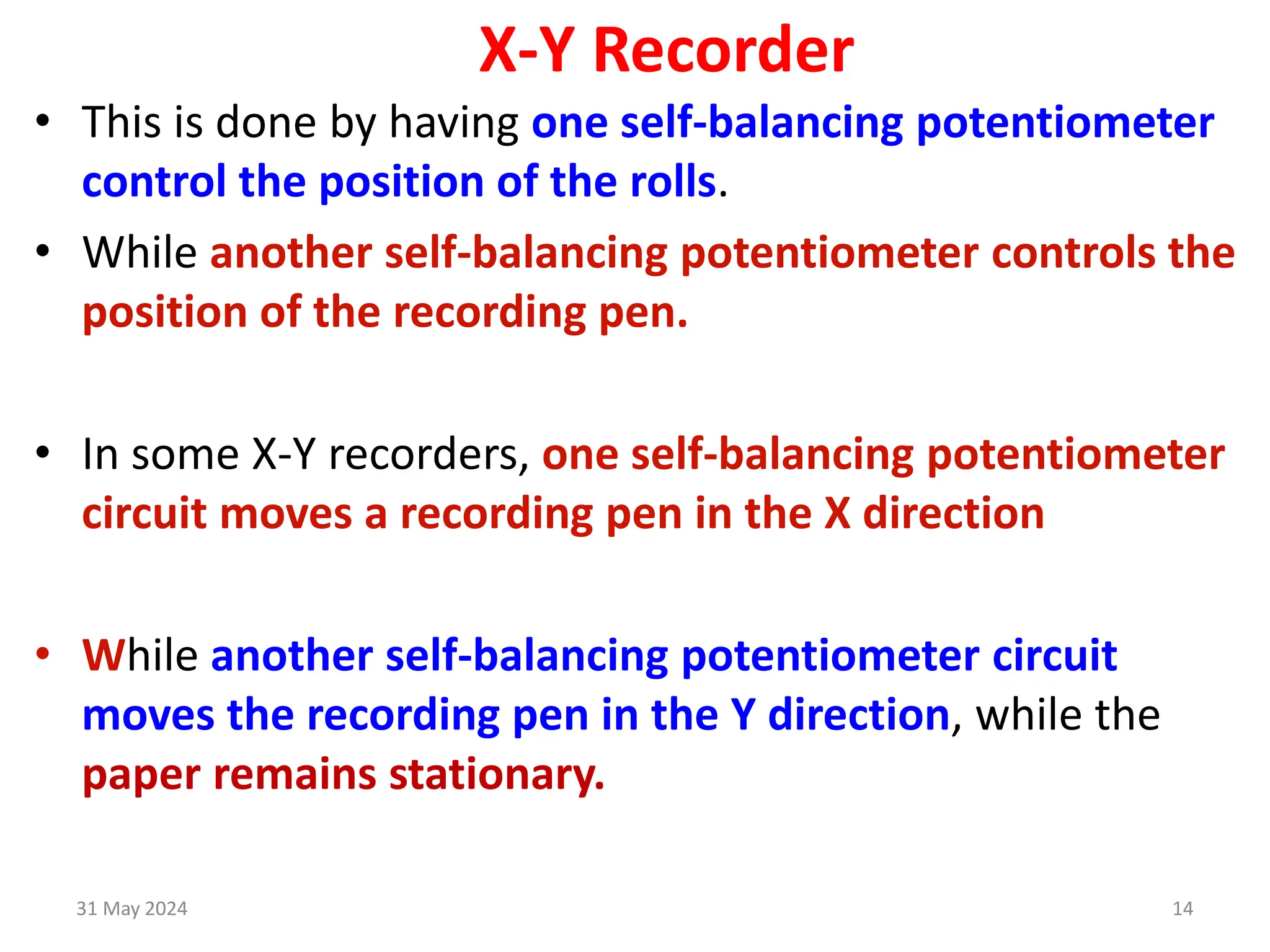
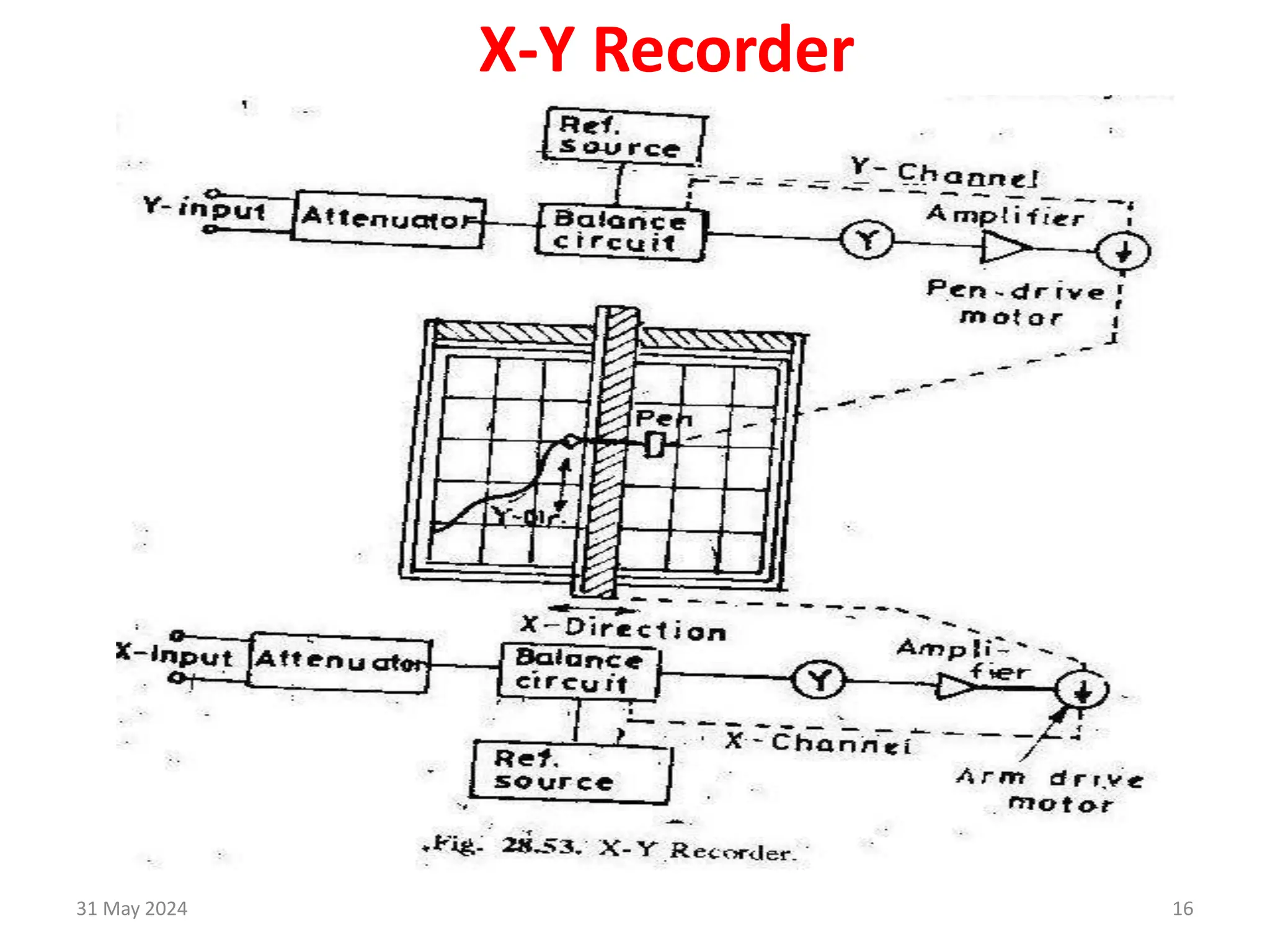
• This is done by having one self-balancing potentiometer
control the position of the rolls.
• While another self-balancing potentiometer controls the
position of the recording pen.
• In some X-Y recorders, one self-balancing potentiometer
circuit moves a recording pen in the X direction
• While another self-balancing potentiometer circuit
moves the recording pen in the Y direction, while the
paper remains stationary.
31 May 2024 15
X-Y Recorder
• Attenuators are used to bring the input
signals to the levels acceptable by the
recorder.
• XY recorder is Expensive than strip chart
recorder
31 May 2024 16
X-Y Recorder
31 May 2024 17
X-Y Recorder
• A signal enters each of the two channels.
• The signals are attenuated to the inherent full
scale range of the recorder, the signal then
passes to a balance circuit where it is
compared with an internal reference voltage.
• The error signal ,the difference between the
input signal voltage and the reference voltage
is fed to a chopper which converts d.c signal
to an a.c signal.
31 May 2024 18
X-Y Recorder
• The signal is then amplified in order to
actuate a servomotor which is used to
balance the system and hold it in balance as
the value of the quantity being recorder
changes.
31 May 2024 19
Application X-Y Recorder
• Speed torque characteristics of motors
• Plotting of characteristics of vaccum tubes, zener diodes
rectifiers and transistors etc
• Regulation curves of power supplies
• Plotting stress-strain curves, hysteresis curves and
vibrations amplitude against swept frequency
• Electrical characteristics of materials such as resistance
versus and temperature plotting the output from
Magnetic Tape Recorder
The magnetic tape is made of a thin sheet of
tough plastic material; one side of it is coated with
a magnetic material (iron oxide).
The plastic base is usually polyvinyl chloride (PVC)
or polyethylene terephthalate.
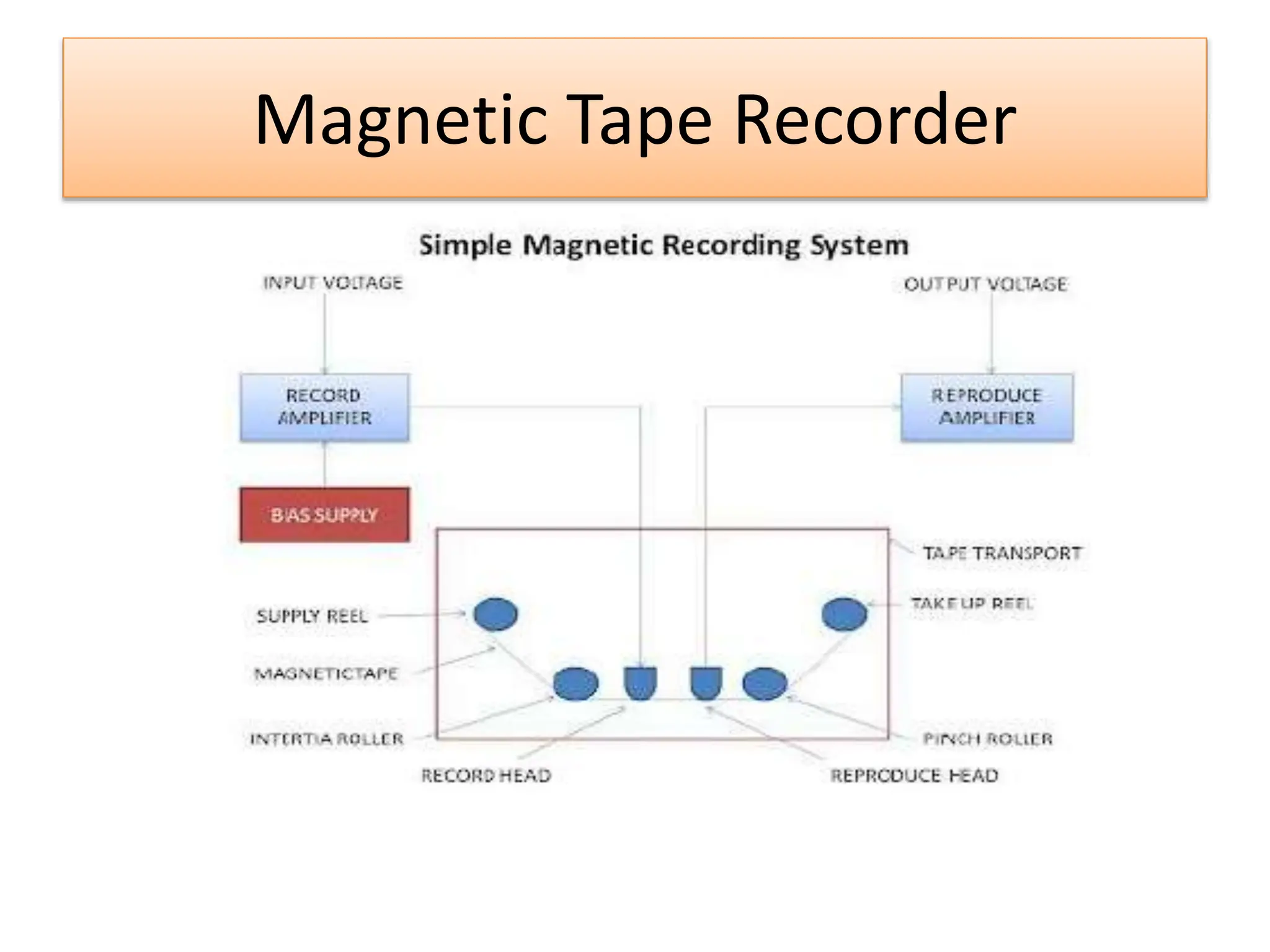
Recording head, reproducing head and tape
transport mechanism are also present.
Magnetic Tape Recorder
Operation of Magnetic Tape
Recorders:
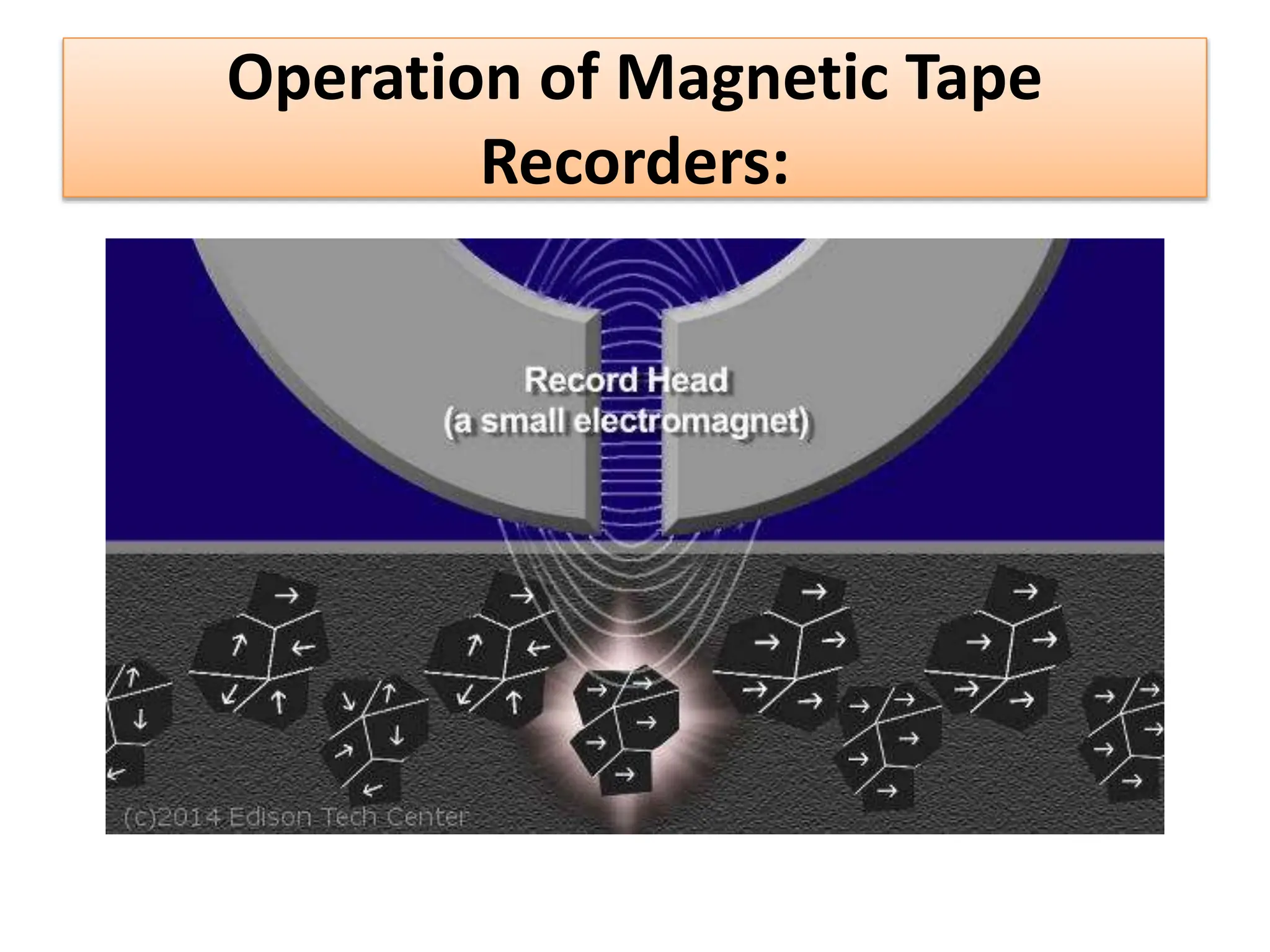
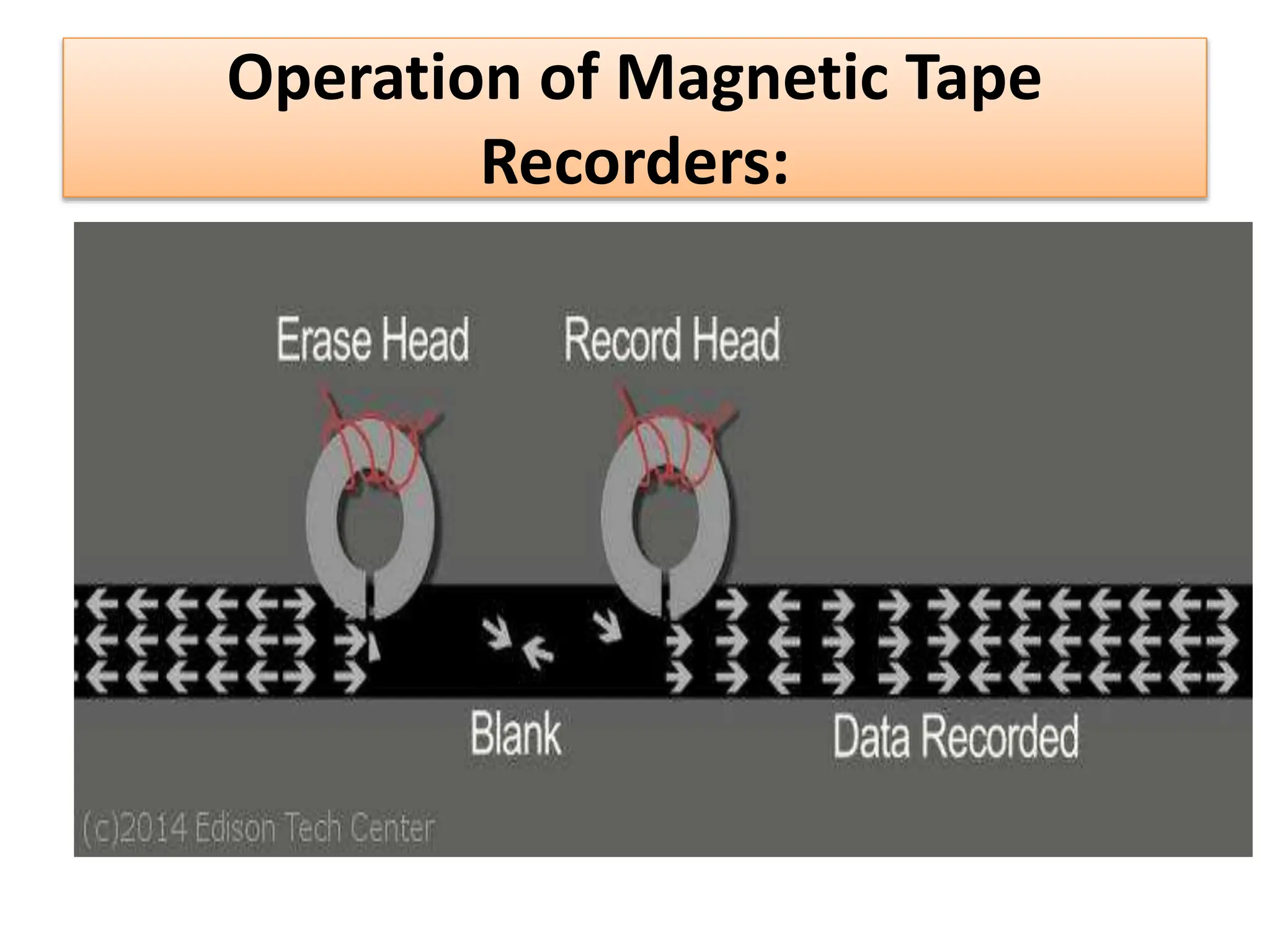
1. The recording head consists of core, coil and a
fine air gap of about 10 micrometer. The coil
current creates a flux, which passes through
the air gap to the magnetic tape and
magnetizes the iron oxide particles as they
pass the air gap. So the actual recording takes
place at the trailing edge of the gap.
Operation of Magnetic Tape
Recorders:
Operation of Magnetic Tape
Recorders:
Operation of Magnetic Tape
Recorders:
2. The reproducing head is similar to that of a
recording head in appearance. The magnetic
tape is passes over a reproducing head,
thereby resulting in an output voltage
proportional to the magnetic flux in the tape,
across the coil of the reproducing head. Thus
the magnetic pattern in the tape is detected
and converted back into original electrical
signal.
Operation of Magnetic Tape
Recorders:
3. The tape transport mechanism moves the
tape below the head at constant speed
without any strain, distortion or wear. The
mechanism much be such as to guide the tape
passed by the magnetic heads with great
precision, maintain proper tension and have
sufficient tape to magnetic head contact.
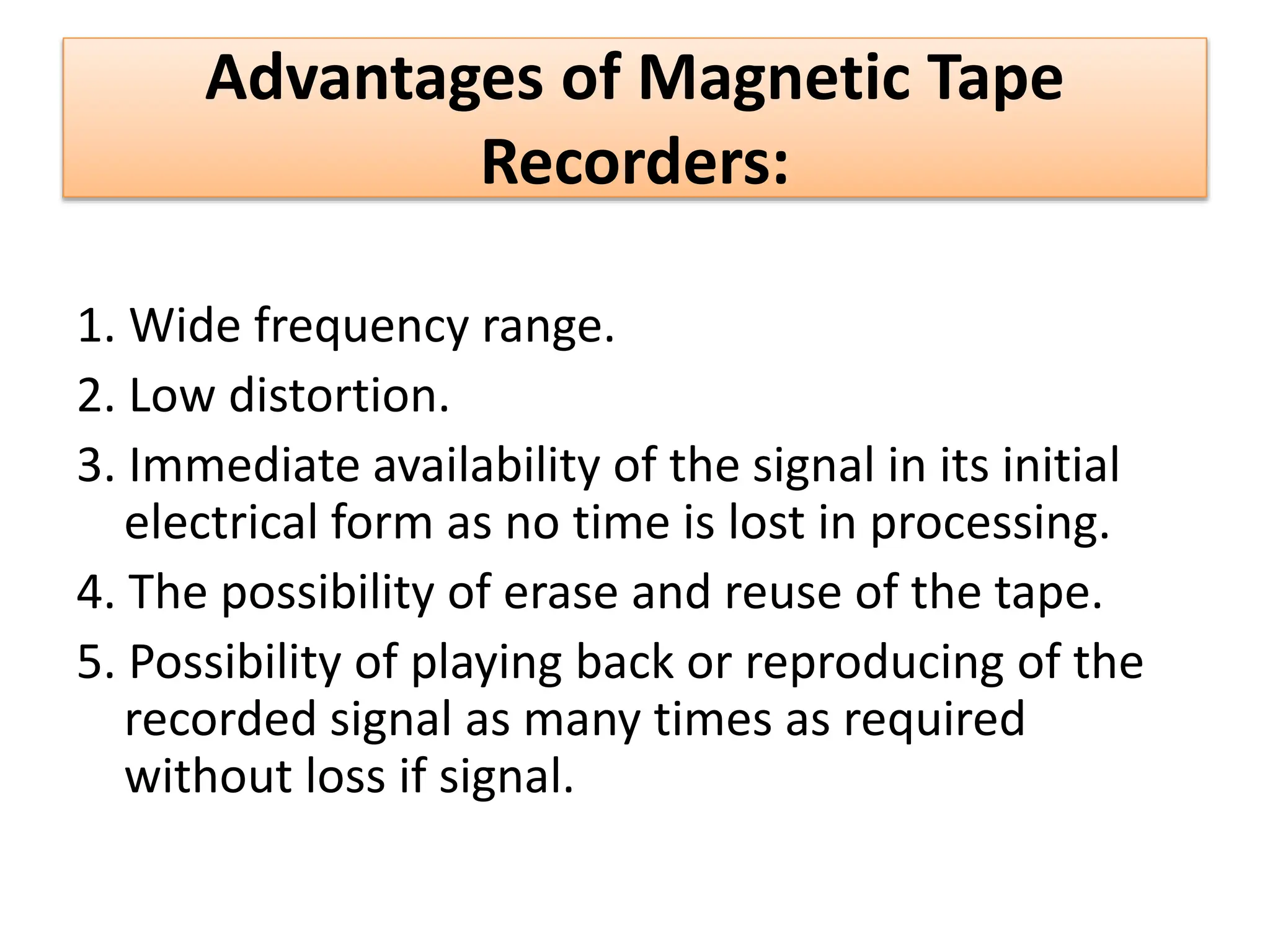
Advantages of Magnetic Tape
Recorders:
1. Wide frequency range.
2. Low distortion.
3. Immediate availability of the signal in its initial
electrical form as no time is lost in processing.
4. The possibility of erase and reuse of the tape.
5. Possibility of playing back or reproducing of the
recorded signal as many times as required
without loss if signal.
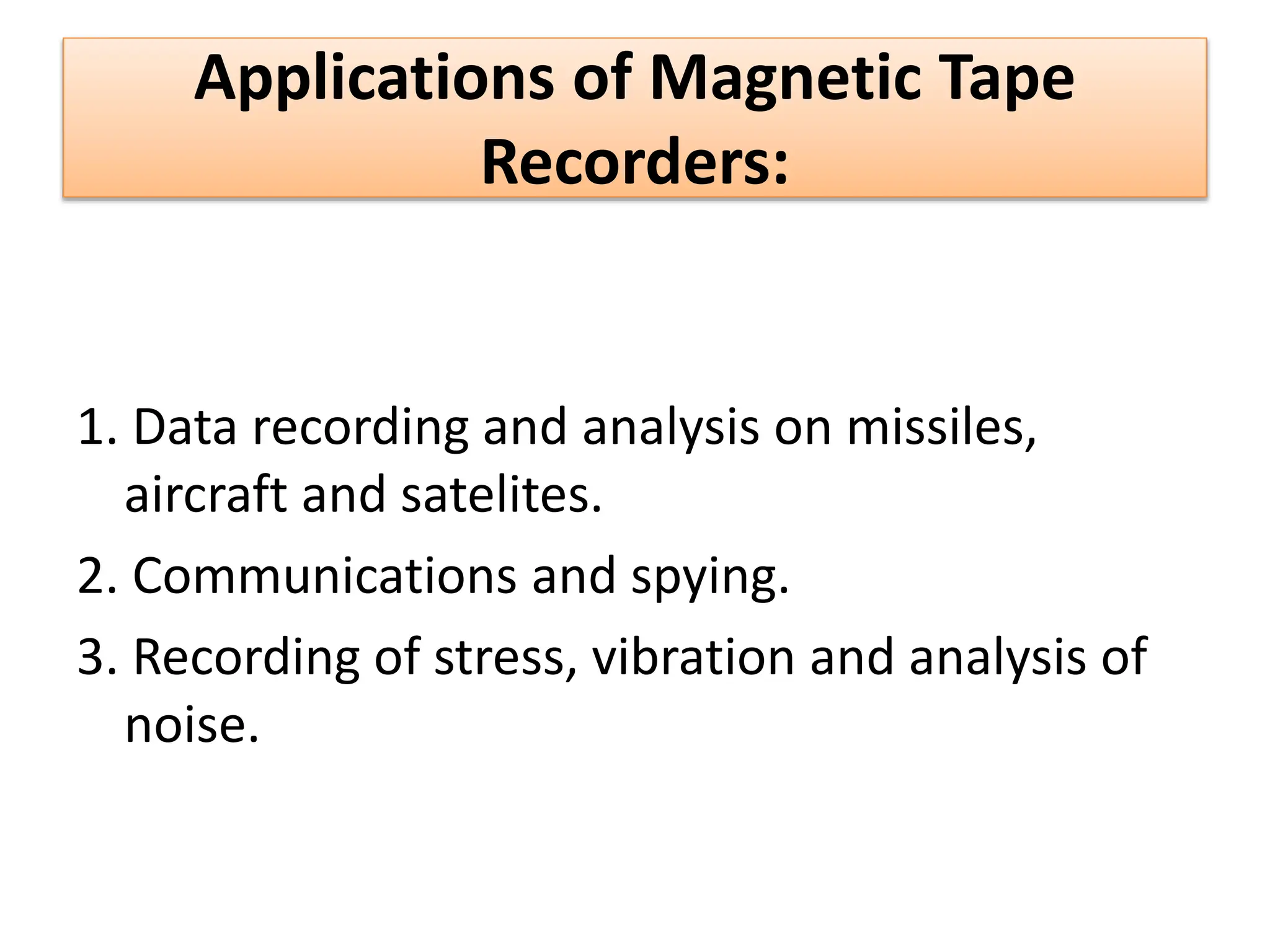
Applications of Magnetic Tape
Recorders:
1. Data recording and analysis on missiles,
aircraft and satelites.
2. Communications and spying.
3. Recording of stress, vibration and analysis of
noise.

RECORDERS and display devices, types and uses.pptx

  • 1.
  • 2.
    Recorders • A graphicrecorder is basically a measuring device which is able to produce in real time a hard copy of a set of time functions with the purpose of immediate and/or later visual inspection. • The curves/lines are mostly drawn on a (long) strip of paper (from a roll), often called strip chart recorder. • When two independent variables are to be recorded on a piece of paper with respect to each other, it is called an X-Y recorder.
  • 3.
    Strip chart Recorder •A strip chart recorder records physical variable with respect to the independent variable time on a long paper kept in the form of a roll. • The independent variable time (t) then corresponds to the strip-length axis and the physical variables measured (y) are related to the chart width. • Figure 1 shows different components of a strip chart recorder. A typical industrial strip chart recorder is shown in Figure 2.
  • 4.
  • 5.
  • 6.
    Strip chart Recorder •Strip chart recorders consist of a roll or strip of paper that is passed linearly beneath one or more pens. As the signal changes, the pens deflect producing the resultant chart. Strip chart recorders are well suited for recording of continuous processes..
  • 7.
  • 8.
  • 9.
  • 10.
  • 11.
  • 12.
    31 May 202412 X-Y Recorder • Records one or more parameters with respect to some other • Or • x-y recorder is an instrument which gives a graphic record of the relationship between two variables. • In some type recorders ,Pen moves in two axes • In X-Y recorders, an emf is plotted as a function of another emf.
  • 13.
    31 May 202413 X-Y Recorder
  • 14.
    31 May 202414 X-Y Recorder • This is done by having one self-balancing potentiometer control the position of the rolls. • While another self-balancing potentiometer controls the position of the recording pen. • In some X-Y recorders, one self-balancing potentiometer circuit moves a recording pen in the X direction • While another self-balancing potentiometer circuit moves the recording pen in the Y direction, while the paper remains stationary.
  • 15.
    31 May 202415 X-Y Recorder • Attenuators are used to bring the input signals to the levels acceptable by the recorder. • XY recorder is Expensive than strip chart recorder
  • 16.
    31 May 202416 X-Y Recorder
  • 17.
    31 May 202417 X-Y Recorder • A signal enters each of the two channels. • The signals are attenuated to the inherent full scale range of the recorder, the signal then passes to a balance circuit where it is compared with an internal reference voltage. • The error signal ,the difference between the input signal voltage and the reference voltage is fed to a chopper which converts d.c signal to an a.c signal.
  • 18.
    31 May 202418 X-Y Recorder • The signal is then amplified in order to actuate a servomotor which is used to balance the system and hold it in balance as the value of the quantity being recorder changes.
  • 19.
    31 May 202419 Application X-Y Recorder • Speed torque characteristics of motors • Plotting of characteristics of vaccum tubes, zener diodes rectifiers and transistors etc • Regulation curves of power supplies • Plotting stress-strain curves, hysteresis curves and vibrations amplitude against swept frequency • Electrical characteristics of materials such as resistance versus and temperature plotting the output from
  • 20.
    Magnetic Tape Recorder Themagnetic tape is made of a thin sheet of tough plastic material; one side of it is coated with a magnetic material (iron oxide). The plastic base is usually polyvinyl chloride (PVC) or polyethylene terephthalate. Recording head, reproducing head and tape transport mechanism are also present.
  • 21.
  • 22.
    Operation of MagneticTape Recorders: 1. The recording head consists of core, coil and a fine air gap of about 10 micrometer. The coil current creates a flux, which passes through the air gap to the magnetic tape and magnetizes the iron oxide particles as they pass the air gap. So the actual recording takes place at the trailing edge of the gap.
  • 23.
    Operation of MagneticTape Recorders:
  • 24.
    Operation of MagneticTape Recorders:
  • 25.
    Operation of MagneticTape Recorders: 2. The reproducing head is similar to that of a recording head in appearance. The magnetic tape is passes over a reproducing head, thereby resulting in an output voltage proportional to the magnetic flux in the tape, across the coil of the reproducing head. Thus the magnetic pattern in the tape is detected and converted back into original electrical signal.
  • 26.
    Operation of MagneticTape Recorders: 3. The tape transport mechanism moves the tape below the head at constant speed without any strain, distortion or wear. The mechanism much be such as to guide the tape passed by the magnetic heads with great precision, maintain proper tension and have sufficient tape to magnetic head contact.
  • 27.
    Advantages of MagneticTape Recorders: 1. Wide frequency range. 2. Low distortion. 3. Immediate availability of the signal in its initial electrical form as no time is lost in processing. 4. The possibility of erase and reuse of the tape. 5. Possibility of playing back or reproducing of the recorded signal as many times as required without loss if signal.
  • 28.
    Applications of MagneticTape Recorders: 1. Data recording and analysis on missiles, aircraft and satelites. 2. Communications and spying. 3. Recording of stress, vibration and analysis of noise.