Reconciliation of Financial and Cost Accounts
 Account reconciliation is the process of comparing
internal financial records against monthly statements
from external sources—such as a bank, credit card
company, or other financial institution—to make sure
they match up.
 Knowing how to reconcile your accounts accurately is
essential for the financial health of your business, as it
helps to detect any errors, discrepancies, or fraud.
 The term Reconciliation has taken from the word
“Reconcile” which means to tally, check, equate.
 The Reconciliation is done to reconcile the
Profits/Loss as per the Financial Accounts with the
Cost Accounts.
 When Cost and Financial Accounts are prepared separately
in different set of books, results or profits/losses in both the
accounts don’t match with each other.
 In this Case, both the accounts results are necessary to
reconcile. It is prepared by showing the reasons for the
difference in the results of accounts. It is done to make the
arithmetical accuracy.
 Reconciliation Statement is a Memorandum Reconciliation
Account to know the items required to make the profits of
Cost Accounts with the Financial Accounts.
 Earlier we have studied how Cost Accounts (or Cost
Sheets) help to ascertain the cost of products.
 Cost Accounts also reveal the profit or loss in respect of
the products.
 Such profit or loss as per the Cost Accounts is, however,
likely to be different from the profit or loss shown by the
Financial Accounts of the concern for many reasons.
 Some items of income and expenses appearing only in the
Financial Accounts and not in the Cost Accounts.
For Example, Income from dividends, Goodwill written off etc.
 Some items of income and expenses appearing only in Cost
Accounts,
For Example, Notional Interest on Owner’s Capital etc. and
 Different treatment given to some items in the two sets of
Accounts,
For Example, Different methods of valuation of stock, Different
methods of charging depreciation, or the Overheads being taken
on estimated basis in Cost Accounts etc.
Main reasons for difference in the profits (or losses) disclosed
by the Cost Accounts and the Financial Accounts are…..
(A) Items Appearing in Financial Accounts Only
(1) Expenses/Losses/Appropriations Debited in Financial
Accounts only.
(2) Income Credited in Financial Accounts only.
(B) Item Appearing In Cost Accounts Only
(1) Expenses Debited in Cost Accounts only.
(2) Income Credited in Cost Accounts only.
(C) Different Treatment in Two Accounts
(1) Valuation of Opening and Closing Stocks.
(2) Methods of Charging Depreciation.
(3) Methods of Recovery/Absorption of Prime Cost/Overheads
in Cost Accounts.
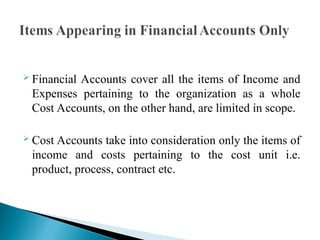
 Financial Accounts cover all the items of Income and
Expenses pertaining to the organization as a whole
Cost Accounts, on the other hand, are limited in scope.
 Cost Accounts take into consideration only the items of
income and costs pertaining to the cost unit i.e.
product, process, contract etc.
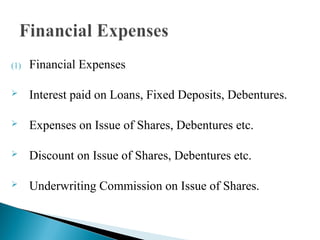
(1) Financial Expenses
 Interest paid on Loans, Fixed Deposits, Debentures.
 Expenses on Issue of Shares, Debentures etc.
 Discount on Issue of Shares, Debentures etc.
 Underwriting Commission on Issue of Shares.
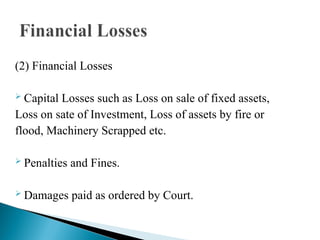
(2) Financial Losses
 Capital Losses such as Loss on sale of fixed assets,
Loss on sate of Investment, Loss of assets by fire or
flood, Machinery Scrapped etc.
 Penalties and Fines.
 Damages paid as ordered by Court.
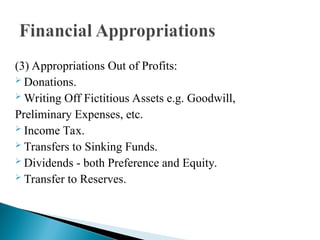
(3) Appropriations Out of Profits:
 Donations.
 Writing Off Fictitious Assets e.g. Goodwill,
Preliminary Expenses, etc.
 Income Tax.
 Transfers to Sinking Funds.
 Dividends - both Preference and Equity.
 Transfer to Reserves.
 Interest Received on Loans / Fixed Deposits / Bank
Deposits / Debentures etc.
 Dividend Received on Investments made in Shares.
 Premium on Issue of Shares/ Debentures credited to the
Profit and Loss Account.
 Rent Received.
 Transfer Fees Received in respect of Share Transfers.
 Capital Gains such as Profit on sale of fixed assets,
profit on sale of Investments.
 Penalties and Fines or Discounts Received from
customers etc.
 Damages Received as ordered by Court.
Similarly, there are certain items of Income and
Expenses which appear only in Cost Accounts and not
in Financial Accounts.
1. Expenses Debited in Cost Accounts Only
Notional interest on Owner’s Capital.
Notional Remuneration to Owner for his Labour and
Management.
Notional Rent to Owner for use of his premises for
business.
Notional interest charged to owner for drawings (debit
balance in Capital Account).
Notional Rent charged to owner for personal use of
business premises.
 There are several items of income and expenses which
are treated differently in the two sets of accounts viz, the
Cost Accounts and the Financial Accounts.
 The amounts of such items in two sets of accounts are
different due to the different treatment.
 The difference in the amounts has to be ascertained and
adjusted in order to reconcile the respective profits as per
the two accounts. These items are explained in detail
below.
Raw Materials may be valued on FIFO basis in Cost
Accounts and LIFO basis in Financial Accounts.
 Work in Progress maybe valued at actual prime cost
plus an estimated percentage of overheads in Cost
Accounts, while in Financial Accounts, work-in-
progress may be valued only at prime cost.
 Work in progress in respect of a long term contract,
may be valued by different methods in the Cost
Accounts and the Financial Accounts.
Finished Goods may be valued at Cost of Good Sold
including Office Overheads in Cost Accounts, while in
Financial Accounts, they may be valued at production
cost excluding Office expenses.
Finished goods maybe valued in the Financial
Accounts at market price if it is lower than cost.
However, in Cost Accounts, Finished Goods may be
valued only at Cost, irrespective of the market price.
The method adopted for charging depreciation in the two
accounts - Cost Accounts and Financial Accounts - may be
different.
While the Cost Accounts may follow the Straight Line
Method.
Financial Accounts may follow the Written Down Value
Method.
This obviously leads to either Overcharging or
Undercharging of depreciation in the Financial Accounts.
Materials: Sometimes in Cost Accounts, the cost of Materials,
Labour or Overheads is taken at an estimated or pre-determined
value instead of the actual expenditure.
Thus Raw Materials may be taken at a cost equal to
Actual Quantity Consumed x Fixed Rate.
The actual cost of raw materials debited in the Financial
Accounts will be different from such cost of materials debited in
the Cost Accounts. Some difference in the value of consumption
of materials may also arise due to different treatment of Wastage
and Loss of materials in the two sets of accounts.
Wages: Like materials, Wages too may be debited in the
Cost Accounts at an estimated amount equal to
Actual labour Hours x Fixed Wage Rate
The actual amount of Wages debited in the Financial
Accounts will be different from the Wages debited in the
Cost Accounts.
The treatment of Idle Time and Overtime may be
different in the two sets of Accounts leading to
difference between the Financial Profits and the Costing
Profits.
Overheads: Overheads are frequently debited or charged
to products, processes etc. on estimated basis in Cost
Accounts.
The amount of overheads thus recovered or absorbed in
the Cost Accounts is bound to be different from the actual
amount of overheads appearing in the Financial Accounts.
The overheads are likely to be either over recovered or
under recovered in the Cost Accounts leading to difference
between the Financial Profit and the Cost Profit.
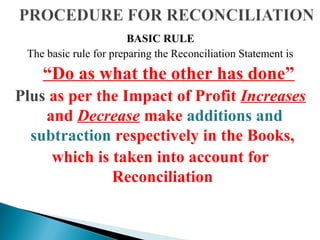
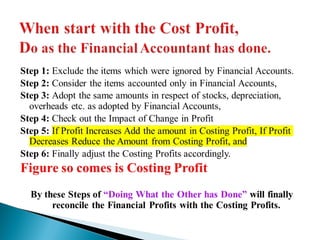
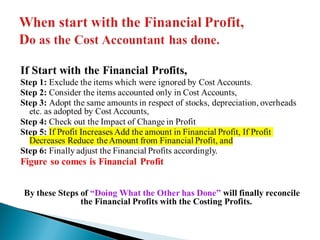
BASIC RULE
The basic rule for preparing the Reconciliation Statement is
“Do as what the other has done”
Plus as per the Impact of Profit Increases
and Decrease make additions and
subtraction respectively in the Books,
which is taken into account for
Reconciliation
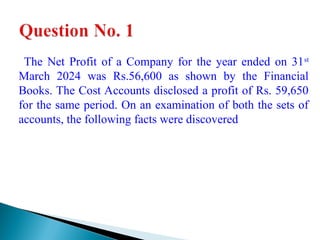
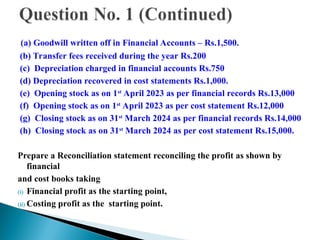
The Net Profit of a Company for the year ended on 31st
March 2024 was Rs.56,600 as shown by the Financial
Books. The Cost Accounts disclosed a profit of Rs. 59,650
for the same period. On an examination of both the sets of
accounts, the following facts were discovered
(a) Goodwill written off in Financial Accounts – Rs.1,500.
(b) Transfer fees received during the year Rs.200
(c) Depreciation charged in financial accounts Rs.750
(d) Depreciation recovered in cost statements Rs.1,000.
(e) Opening stock as on 1st
April 2023 as per financial records Rs.13,000
(f) Opening stock as on 1st
April 2023 as per cost statement Rs.12,000
(g) Closing stock as on 31st
March 2024 as per financial records Rs.14,000
(h) Closing stock as on 31st
March 2024 as per cost statement Rs.15,000.
Prepare a Reconciliation statement reconciling the profit as shown by
financial
and cost books taking
(i) Financial profit as the starting point,
(ii) Costing profit as the starting point.
WASDAWSDAEASCASCECESCACSCSZCASCSDCAECASCASCSPPT.ppt

WASDAWSDAEASCASCECESCACSCSZCASCSDCAECASCASCSPPT.ppt

  • 1.
    Reconciliation of Financialand Cost Accounts
  • 2.
     Account reconciliationis the process of comparing internal financial records against monthly statements from external sources—such as a bank, credit card company, or other financial institution—to make sure they match up.  Knowing how to reconcile your accounts accurately is essential for the financial health of your business, as it helps to detect any errors, discrepancies, or fraud.
  • 3.
     The termReconciliation has taken from the word “Reconcile” which means to tally, check, equate.  The Reconciliation is done to reconcile the Profits/Loss as per the Financial Accounts with the Cost Accounts.
  • 4.
     When Costand Financial Accounts are prepared separately in different set of books, results or profits/losses in both the accounts don’t match with each other.  In this Case, both the accounts results are necessary to reconcile. It is prepared by showing the reasons for the difference in the results of accounts. It is done to make the arithmetical accuracy.  Reconciliation Statement is a Memorandum Reconciliation Account to know the items required to make the profits of Cost Accounts with the Financial Accounts.
  • 5.
     Earlier wehave studied how Cost Accounts (or Cost Sheets) help to ascertain the cost of products.  Cost Accounts also reveal the profit or loss in respect of the products.  Such profit or loss as per the Cost Accounts is, however, likely to be different from the profit or loss shown by the Financial Accounts of the concern for many reasons.
  • 6.
     Some itemsof income and expenses appearing only in the Financial Accounts and not in the Cost Accounts. For Example, Income from dividends, Goodwill written off etc.  Some items of income and expenses appearing only in Cost Accounts, For Example, Notional Interest on Owner’s Capital etc. and  Different treatment given to some items in the two sets of Accounts, For Example, Different methods of valuation of stock, Different methods of charging depreciation, or the Overheads being taken on estimated basis in Cost Accounts etc.
  • 7.
    Main reasons fordifference in the profits (or losses) disclosed by the Cost Accounts and the Financial Accounts are….. (A) Items Appearing in Financial Accounts Only (1) Expenses/Losses/Appropriations Debited in Financial Accounts only. (2) Income Credited in Financial Accounts only.
  • 8.
    (B) Item AppearingIn Cost Accounts Only (1) Expenses Debited in Cost Accounts only. (2) Income Credited in Cost Accounts only. (C) Different Treatment in Two Accounts (1) Valuation of Opening and Closing Stocks. (2) Methods of Charging Depreciation. (3) Methods of Recovery/Absorption of Prime Cost/Overheads in Cost Accounts.
  • 9.
     Financial Accountscover all the items of Income and Expenses pertaining to the organization as a whole Cost Accounts, on the other hand, are limited in scope.  Cost Accounts take into consideration only the items of income and costs pertaining to the cost unit i.e. product, process, contract etc.
  • 10.
    (1) Financial Expenses Interest paid on Loans, Fixed Deposits, Debentures.  Expenses on Issue of Shares, Debentures etc.  Discount on Issue of Shares, Debentures etc.  Underwriting Commission on Issue of Shares.
  • 11.
    (2) Financial Losses Capital Losses such as Loss on sale of fixed assets, Loss on sate of Investment, Loss of assets by fire or flood, Machinery Scrapped etc.  Penalties and Fines.  Damages paid as ordered by Court.
  • 12.
    (3) Appropriations Outof Profits:  Donations.  Writing Off Fictitious Assets e.g. Goodwill, Preliminary Expenses, etc.  Income Tax.  Transfers to Sinking Funds.  Dividends - both Preference and Equity.  Transfer to Reserves.
  • 13.
     Interest Receivedon Loans / Fixed Deposits / Bank Deposits / Debentures etc.  Dividend Received on Investments made in Shares.  Premium on Issue of Shares/ Debentures credited to the Profit and Loss Account.  Rent Received.
  • 14.
     Transfer FeesReceived in respect of Share Transfers.  Capital Gains such as Profit on sale of fixed assets, profit on sale of Investments.  Penalties and Fines or Discounts Received from customers etc.  Damages Received as ordered by Court.
  • 15.
    Similarly, there arecertain items of Income and Expenses which appear only in Cost Accounts and not in Financial Accounts.
  • 16.
    1. Expenses Debitedin Cost Accounts Only Notional interest on Owner’s Capital. Notional Remuneration to Owner for his Labour and Management. Notional Rent to Owner for use of his premises for business.
  • 17.
    Notional interest chargedto owner for drawings (debit balance in Capital Account). Notional Rent charged to owner for personal use of business premises.
  • 18.
     There areseveral items of income and expenses which are treated differently in the two sets of accounts viz, the Cost Accounts and the Financial Accounts.  The amounts of such items in two sets of accounts are different due to the different treatment.  The difference in the amounts has to be ascertained and adjusted in order to reconcile the respective profits as per the two accounts. These items are explained in detail below.
  • 19.
    Raw Materials maybe valued on FIFO basis in Cost Accounts and LIFO basis in Financial Accounts.
  • 20.
     Work inProgress maybe valued at actual prime cost plus an estimated percentage of overheads in Cost Accounts, while in Financial Accounts, work-in- progress may be valued only at prime cost.  Work in progress in respect of a long term contract, may be valued by different methods in the Cost Accounts and the Financial Accounts.
  • 21.
    Finished Goods maybe valued at Cost of Good Sold including Office Overheads in Cost Accounts, while in Financial Accounts, they may be valued at production cost excluding Office expenses. Finished goods maybe valued in the Financial Accounts at market price if it is lower than cost. However, in Cost Accounts, Finished Goods may be valued only at Cost, irrespective of the market price.
  • 22.
    The method adoptedfor charging depreciation in the two accounts - Cost Accounts and Financial Accounts - may be different. While the Cost Accounts may follow the Straight Line Method. Financial Accounts may follow the Written Down Value Method. This obviously leads to either Overcharging or Undercharging of depreciation in the Financial Accounts.
  • 23.
    Materials: Sometimes inCost Accounts, the cost of Materials, Labour or Overheads is taken at an estimated or pre-determined value instead of the actual expenditure. Thus Raw Materials may be taken at a cost equal to Actual Quantity Consumed x Fixed Rate. The actual cost of raw materials debited in the Financial Accounts will be different from such cost of materials debited in the Cost Accounts. Some difference in the value of consumption of materials may also arise due to different treatment of Wastage and Loss of materials in the two sets of accounts.
  • 24.
    Wages: Like materials,Wages too may be debited in the Cost Accounts at an estimated amount equal to Actual labour Hours x Fixed Wage Rate The actual amount of Wages debited in the Financial Accounts will be different from the Wages debited in the Cost Accounts. The treatment of Idle Time and Overtime may be different in the two sets of Accounts leading to difference between the Financial Profits and the Costing Profits.
  • 25.
    Overheads: Overheads arefrequently debited or charged to products, processes etc. on estimated basis in Cost Accounts. The amount of overheads thus recovered or absorbed in the Cost Accounts is bound to be different from the actual amount of overheads appearing in the Financial Accounts. The overheads are likely to be either over recovered or under recovered in the Cost Accounts leading to difference between the Financial Profit and the Cost Profit.
  • 26.
    BASIC RULE The basicrule for preparing the Reconciliation Statement is “Do as what the other has done” Plus as per the Impact of Profit Increases and Decrease make additions and subtraction respectively in the Books, which is taken into account for Reconciliation
  • 29.
    The Net Profitof a Company for the year ended on 31st March 2024 was Rs.56,600 as shown by the Financial Books. The Cost Accounts disclosed a profit of Rs. 59,650 for the same period. On an examination of both the sets of accounts, the following facts were discovered
  • 30.
    (a) Goodwill writtenoff in Financial Accounts – Rs.1,500. (b) Transfer fees received during the year Rs.200 (c) Depreciation charged in financial accounts Rs.750 (d) Depreciation recovered in cost statements Rs.1,000. (e) Opening stock as on 1st April 2023 as per financial records Rs.13,000 (f) Opening stock as on 1st April 2023 as per cost statement Rs.12,000 (g) Closing stock as on 31st March 2024 as per financial records Rs.14,000 (h) Closing stock as on 31st March 2024 as per cost statement Rs.15,000. Prepare a Reconciliation statement reconciling the profit as shown by financial and cost books taking (i) Financial profit as the starting point, (ii) Costing profit as the starting point.