VIVEKANANDHA
ARTS AND SCIENCE COLLEGE FOR WOMEN
VEERCHIPALYAM-637303,SANKAGIRI,SALEM Dt.,TAMILNADU,INDIA.
AFFILIATED TO PERIYAR UNIVERSITY,SALEM;RECOGNISED UNDER SECTION 2(F)&12(B) OF THE UGC ACT 1956)
SUBJECT INCHARGE;
R.PANDIYAN,
ASSISTANT PROFESSOR,
DEPARTMENT OF MICROBIOLOGY,
VIAAS,SANKAGIRI.
DEPARTMENT OF MICROBIOLOGY
SUBJECT : MICROBIAL BIOTECHNOLOGY
SUBMITTED BY;
GOPIKA.K,
III B.SC.MICROBIOLOGY,
DEPARTMENT OF MICROBIOLGY,
VIAAS,Sankagiri.
TITLE : MICROINJECTION
OVER VIEW;
 INTRODUCTION
 HISTROY
 PRINCIPLE OF
MICROINJECCTION
STEPS IN
MICROINJECTION
APPLICATION
ADVANTAGES
DISADVANTAGES
INTRODUCTION;
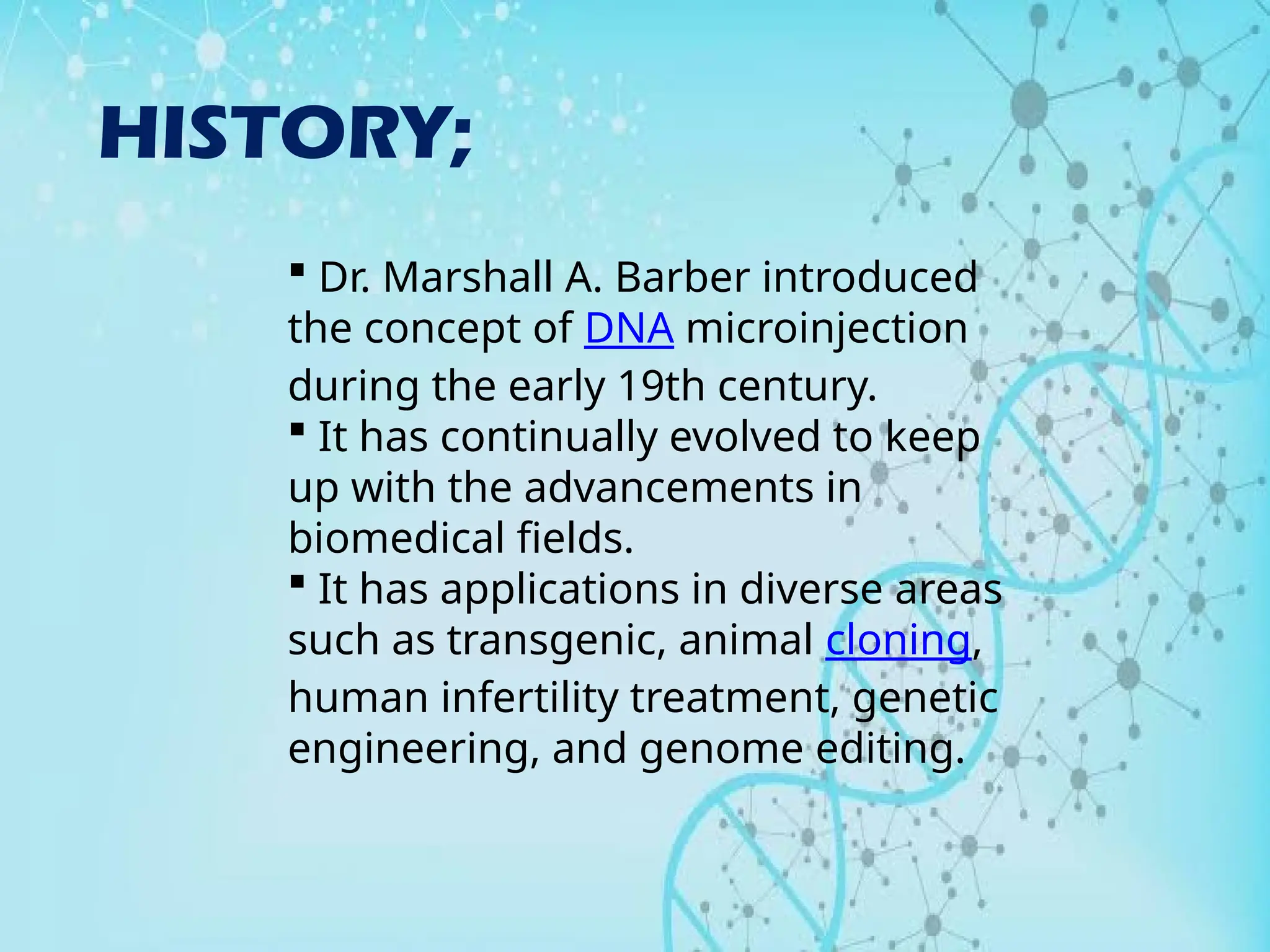
 Microinjection is one of the physical
methods of gene transfer used to
introduce DNA or other genetic materials
directly into a cell using a small needle or
micropipette.
 It’s a method that uses a glass
micropipette to infects a liquid substances
into a living cell or intercellular space at a
microscopic or borderline macroscopic
level.
HISTORY;
 Dr. Marshall A. Barber introduced
the concept of DNA microinjection
during the early 19th century.
 It has continually evolved to keep
up with the advancements in
biomedical fields.
 It has applications in diverse areas
such as transgenic, animal cloning,
human infertility treatment, genetic
engineering, and genome editing.
PRINCIPLE OF MICROINFECTION;
The principle of microinjection is based on the
direct delivery of genetic material into individual
cells using a fine glass needle called a
micropipette, a positioning device known as a
micromanipulator, and a microinjector. The
process is performed under a powerful
microscope. The genetic material is delivered
into the cell by applying hydrostatic pressure to
release a fluid containing the DNA through the
micropipette. The small tip diameter of the
micropipette and the precise movements
enabled by the micromanipulator allows the
precise delivery of desired materials.
STEPS IN MICROINFECTION;
 First, the glass micropipette or needle is prepared by heating
and stretching the glass to form a fine tip at the heated end.
The resulting tip size is usually around 0.5 mm in diameter,
resembling an injection needle.
 The entire process of delivering foreign materials using
microinjection is performed under a powerful microscope for
precise manipulation and observation.
 The cells to be microinjected are placed in a container.
 A holding pipette is placed near the target cell. It uses gentle
suction to hold the cell during the injection process.
 The micropipette, containing the desired contents, is
mounted on a micromanipulator, which allows precise
positioning and movement of the pipette. The micropipette is
lowered near the cell.
 The micropipette is carefully inserted into the cell membrane,
either into the cytoplasm or the nucleus, depending on the
target location for the genetic material. The contents of the
micropipette are then injected into the cell by applying
hydrostatic pressure using a microinjector. The pressure forces
the fluid containing the genetic material to be released through
the micropipette into the cell.
 After delivering the contents into the cell, the empty
micropipette needle is slowly and carefully withdrawn from the
cell, minimizing damage to the cell and its membrane. Proper
technique and high-quality micropipettes help minimize cell
death during this step.
APPLICATIONS;
Some major applications of microinjection are:
 Microinjection is commonly used in the production of
transgenic animals, introducing foreign DNA into
fertilized eggs to study gene function and create
disease models.
 Microinjection was used to produce the first chimeric
transgenic mice. Chimeric animals have been useful in
studying embryonic development, tissue
transplantation, and understanding cell lineage.
 In the field of in vitro fertilization, microinjection is
used in intracytoplasmic sperm injection (ICSI),
allowing successful fertilization in cases of male
infertility, and leading to term pregnancies and healthy
births. In ICSI, individual sperm with motility defects
are microinjected directly into isolated oocytes.
• Microinjection is also used in somatic cell nuclear
transfer (SCNT) to create genetically identical copies of
an organism by transferring a somatic cell into an
enucleated oocyte.
• Microinjection has been widely used in various studies,
including human embryo research and injection of
mitotic cells.
 In neuroscience, microinjection is useful for working
with primary cultured human neurons, delivering
proteins, peptides, and cDNA constructs into the cytosol
of human neurons which is difficult to perform using
other gene transfer techniques.
ADVANTAGES;
• Unlike other gene transfer methods, microinjection does not
require the use of selection markers such as antibiotic-resistance
genes. This makes the process easier and removes the need for
additional steps to identify and isolate transformed cells.
• Microinjection allows precise delivery of materials in terms of
volume and timing, which can be challenging with other methods
like electroporation or transfection.
Injected cells can be easily identified by co-injecting a marker dye or
fluorescently labeled proteins.
• Microinjection requires less protein preparation compared to
electroporation, making it advantageous for experiments involving
less abundant or expensive proteins and peptides.
• Microinjection is less stressful to cells, reducing cell death that is
commonly observed with chemical transfection or viral infection
methods.
DISADVANTAGES;
• Microinjection requires vehicle controls to assess potential
effects on cell viability and to ensure accurate results.
• The technical expertise required to master the microinjection
method and maintain cell viability is another limitation of this
method.
• The use of alternative techniques like transfection, infection,
and electroporation has become more popular compared to
microinjection for delivering non-permeable foreign materials
into single cells.
• Manual microinjection is labor-intensive and time-consuming,
making it less practical for large-scale experiments or high-
throughput applications.
• Microinjection typically involves injecting a small population of
cells within a larger cell culture, which can limit scalability.
• Microinjection is not an appropriate method for transferring
genetic material into a large number of cells for techniques like
Western blotting or purification.
• Direct microinjection of certain proteins, like membrane
proteins or neurotransmitter receptors, is challenging.
THANK YOU….

Microbial biotechnology ( micro infections)

  • 1.
    VIVEKANANDHA ARTS AND SCIENCECOLLEGE FOR WOMEN VEERCHIPALYAM-637303,SANKAGIRI,SALEM Dt.,TAMILNADU,INDIA. AFFILIATED TO PERIYAR UNIVERSITY,SALEM;RECOGNISED UNDER SECTION 2(F)&12(B) OF THE UGC ACT 1956) SUBJECT INCHARGE; R.PANDIYAN, ASSISTANT PROFESSOR, DEPARTMENT OF MICROBIOLOGY, VIAAS,SANKAGIRI. DEPARTMENT OF MICROBIOLOGY SUBJECT : MICROBIAL BIOTECHNOLOGY SUBMITTED BY; GOPIKA.K, III B.SC.MICROBIOLOGY, DEPARTMENT OF MICROBIOLGY, VIAAS,Sankagiri. TITLE : MICROINJECTION
  • 2.
    OVER VIEW;  INTRODUCTION HISTROY  PRINCIPLE OF MICROINJECCTION STEPS IN MICROINJECTION APPLICATION ADVANTAGES DISADVANTAGES
  • 3.
    INTRODUCTION;  Microinjection isone of the physical methods of gene transfer used to introduce DNA or other genetic materials directly into a cell using a small needle or micropipette.  It’s a method that uses a glass micropipette to infects a liquid substances into a living cell or intercellular space at a microscopic or borderline macroscopic level.
  • 4.
    HISTORY;  Dr. MarshallA. Barber introduced the concept of DNA microinjection during the early 19th century.  It has continually evolved to keep up with the advancements in biomedical fields.  It has applications in diverse areas such as transgenic, animal cloning, human infertility treatment, genetic engineering, and genome editing.
  • 5.
    PRINCIPLE OF MICROINFECTION; Theprinciple of microinjection is based on the direct delivery of genetic material into individual cells using a fine glass needle called a micropipette, a positioning device known as a micromanipulator, and a microinjector. The process is performed under a powerful microscope. The genetic material is delivered into the cell by applying hydrostatic pressure to release a fluid containing the DNA through the micropipette. The small tip diameter of the micropipette and the precise movements enabled by the micromanipulator allows the precise delivery of desired materials.
  • 6.
    STEPS IN MICROINFECTION; First, the glass micropipette or needle is prepared by heating and stretching the glass to form a fine tip at the heated end. The resulting tip size is usually around 0.5 mm in diameter, resembling an injection needle.  The entire process of delivering foreign materials using microinjection is performed under a powerful microscope for precise manipulation and observation.  The cells to be microinjected are placed in a container.  A holding pipette is placed near the target cell. It uses gentle suction to hold the cell during the injection process.  The micropipette, containing the desired contents, is mounted on a micromanipulator, which allows precise positioning and movement of the pipette. The micropipette is lowered near the cell.
  • 7.
     The micropipetteis carefully inserted into the cell membrane, either into the cytoplasm or the nucleus, depending on the target location for the genetic material. The contents of the micropipette are then injected into the cell by applying hydrostatic pressure using a microinjector. The pressure forces the fluid containing the genetic material to be released through the micropipette into the cell.  After delivering the contents into the cell, the empty micropipette needle is slowly and carefully withdrawn from the cell, minimizing damage to the cell and its membrane. Proper technique and high-quality micropipettes help minimize cell death during this step.
  • 9.
    APPLICATIONS; Some major applicationsof microinjection are:  Microinjection is commonly used in the production of transgenic animals, introducing foreign DNA into fertilized eggs to study gene function and create disease models.  Microinjection was used to produce the first chimeric transgenic mice. Chimeric animals have been useful in studying embryonic development, tissue transplantation, and understanding cell lineage.  In the field of in vitro fertilization, microinjection is used in intracytoplasmic sperm injection (ICSI), allowing successful fertilization in cases of male infertility, and leading to term pregnancies and healthy births. In ICSI, individual sperm with motility defects are microinjected directly into isolated oocytes.
  • 10.
    • Microinjection isalso used in somatic cell nuclear transfer (SCNT) to create genetically identical copies of an organism by transferring a somatic cell into an enucleated oocyte. • Microinjection has been widely used in various studies, including human embryo research and injection of mitotic cells.  In neuroscience, microinjection is useful for working with primary cultured human neurons, delivering proteins, peptides, and cDNA constructs into the cytosol of human neurons which is difficult to perform using other gene transfer techniques.
  • 11.
    ADVANTAGES; • Unlike othergene transfer methods, microinjection does not require the use of selection markers such as antibiotic-resistance genes. This makes the process easier and removes the need for additional steps to identify and isolate transformed cells. • Microinjection allows precise delivery of materials in terms of volume and timing, which can be challenging with other methods like electroporation or transfection. Injected cells can be easily identified by co-injecting a marker dye or fluorescently labeled proteins. • Microinjection requires less protein preparation compared to electroporation, making it advantageous for experiments involving less abundant or expensive proteins and peptides. • Microinjection is less stressful to cells, reducing cell death that is commonly observed with chemical transfection or viral infection methods.
  • 12.
    DISADVANTAGES; • Microinjection requiresvehicle controls to assess potential effects on cell viability and to ensure accurate results. • The technical expertise required to master the microinjection method and maintain cell viability is another limitation of this method. • The use of alternative techniques like transfection, infection, and electroporation has become more popular compared to microinjection for delivering non-permeable foreign materials into single cells. • Manual microinjection is labor-intensive and time-consuming, making it less practical for large-scale experiments or high- throughput applications. • Microinjection typically involves injecting a small population of cells within a larger cell culture, which can limit scalability. • Microinjection is not an appropriate method for transferring genetic material into a large number of cells for techniques like Western blotting or purification. • Direct microinjection of certain proteins, like membrane proteins or neurotransmitter receptors, is challenging.
  • 13.