Recombinant
Thrombopoietin
Presented to: Prof. Dr. Ali Raza Awan
Presented By: RimshaKhan
Ph.D Scholor in
Molecular Biology & Biotechnology
(IBBT UVAS)
(2020-phd-1187)
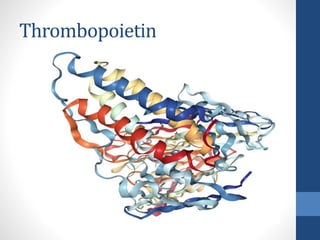
Thrombopoietin
Thrombopoietin
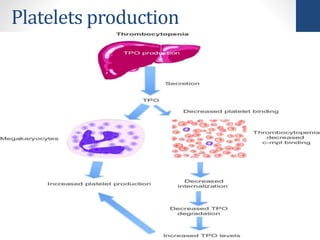
• Thrombopoietin is a glycoprotein hormone produced by
the liver and kidney which regulates the production of platelets.
• It stimulates the production and differentiation of megakaryocytes,
the bone marrow cells that bud off large numbers of platelets.
• Thrombopoietin (THPO) are also known as megakaryocyte growth
and development factor (MGDF) .
• These are protein that in humans is encoded by the THPO gene.
Megakaryocytes
• Megakaryocytes are cells in the bone marrow responsible
for making platelets, which are necessary for blood
clotting.
• Megakaryocytes grow so large because the DNA within
the cell duplicates many times — but without the cell
undergoing cell division: a process called endomitosis.
Megakaryocytopoiesis
• Megakaryocytopoiesis is the cellular development
process that leads to platelet production.
• The protein encoded by this gene is a humoral growth
factor necessary for megakaryocyte proliferation and
maturation, as well as for thrombopoiesis.
• This protein is the ligand for product of
myeloproliferative leukemia virus oncogene.
Discovery of Thrombopoietin
• Thrombopoietin was cloned by five independent teams in
1994.
•
• Before its identification, its function has been hypothesized for
as much as 30 years as being linked to the cell surface receptor.
• In older publications thrombopoietin is described as cell
surface receptor ligand (the agent that binds to the
thrombopoietin receptor molecule).
• Thrombopoietin is one of the Class I hematopoietic cytokines.
Structure of Thrombopoietin
• The cloned human THPO cDNA encodes thrombopoietin
(TPO, THPO)
• A polypeptide of 353 amino acids including the 21 amino acid
secretory leader sequence.
• The mature protein consists of two domains.
Genetics of Thromobopoietin:
• The thrombopoietin gene is located on the long arm
of chromosome 3 (q26.3-27).
• Abnormalities in this gene occur in
some hereditary forms of thrombocytosis (high platelet
count) and in some cases of leukemia.
• The first 155 amino acids of the protein
share homology with erythropoietin
Sites of Production of Thrombopoietin:
• Thrombopoietin is produced in the liver by both
parenchymal cells and sinusoidal endothelial cells, as
well as in the kidney by proximal convoluted tubule cells.
• Small amounts are also made by striated muscle and bone
marrow stromal cells.
• In the liver, its production is augmented by interleukin
6 (IL-6).
• The liver and the kidney are the primary sites of
thrombopoietin production
Thrombocytopenia
• Thrombocytopenia is a condition in which you have a low
blood platelet count. Platelets (thrombocytes) are colorless
blood cells that help blood clot. Platelets stop bleeding by
clumping and forming plugs in blood vessel injuries.
• It’s a type of bleeding disorder is called thrombocytopenia.
•
• Thrombocytopenia is a dangerous drop in the number of
platelets in the blood. This decrease can increase the risk
of bleeding.
• Thrombocytopenia occurs in people without cancer as well.
What causes Thrombocytopenia?
• Use of Alcohol and alcoholism.
• Autoimmune disease which causes ITP.
• Bone marrow diseases, including
1. Aplastic anemia,
2. Leukemia,
3. Certain lymphomas
4. Myelodysplastic syndromes.
• Cancer treatments like chemotherapy and radiation therapy.
Treatment of ITP
• The thrombopoietin receptor agonists (TPO-RAs) are a class
of platelet growth factors commonly used
to treat immune thrombocytopenia (ITP).
• There are three agents that have been investigated for
the treatment of chronic ITP:
1. The peptide agent romiplostim (fusion Protein)
2. The small molecule agents eltrombopag
3. Avatrombopag.
Use of TPO
• Other clinical studies have investigated the use of TPO in
treating chronic nonchemotherapy-induced thrombocytopenia
associated with
1. Myelodysplastic syndromes
2. Idiopathic thrombocytopenic purpura
3. Thrombocytopenia due to human immunodeficiency virus
4. Liver disease.
• TPO may be effective in reducing surgical thrombocytopenia
and bleeding, ex vivo expansion of pluripotent stem cells, and
as a radioprotectant.
• The clinical role of recombinant TPO and TPO mimetics in the
treatment of chemotherapy- and nonchemotherapy-induced
thrombocytopenia.
Platelets production
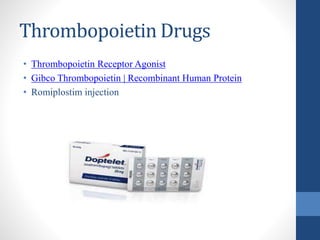
Thrombopoietin Drugs
• Thrombopoietin Receptor Agonist
• Gibco Thrombopoietin | Recombinant Human Protein
• Romiplostim injection
Side Effects
• Side effects include
1. Headaches
2. Nausea
3. Vomiting
4. Thromboembolic events
5. Elevations in alanine transaminase and bilirubin.
• Early reports in romiplostim-treated patients had raised
concerns about increased reticulin deposition in the bone
marrow.
Which medicine is best to increase
platelets?
• Romiplostim injection is used to increase the number of
platelets (cells that help the blood to clot) in order to
decrease the risk of bleeding in adults who have
immune thrombocytopenia (ITP; idiopathic
thrombocytopenic purpura; an ongoing condition that may
cause easy bruising or bleeding due to an abnormally low
levels of platelets.
Thankyou for Listening!!

Recombinant thrombopoietin.pptx

  • 1.
    Recombinant Thrombopoietin Presented to: Prof.Dr. Ali Raza Awan Presented By: RimshaKhan Ph.D Scholor in Molecular Biology & Biotechnology (IBBT UVAS) (2020-phd-1187)
  • 2.
  • 3.
    Thrombopoietin • Thrombopoietin isa glycoprotein hormone produced by the liver and kidney which regulates the production of platelets. • It stimulates the production and differentiation of megakaryocytes, the bone marrow cells that bud off large numbers of platelets. • Thrombopoietin (THPO) are also known as megakaryocyte growth and development factor (MGDF) . • These are protein that in humans is encoded by the THPO gene.
  • 4.
    Megakaryocytes • Megakaryocytes arecells in the bone marrow responsible for making platelets, which are necessary for blood clotting. • Megakaryocytes grow so large because the DNA within the cell duplicates many times — but without the cell undergoing cell division: a process called endomitosis.
  • 5.
    Megakaryocytopoiesis • Megakaryocytopoiesis isthe cellular development process that leads to platelet production. • The protein encoded by this gene is a humoral growth factor necessary for megakaryocyte proliferation and maturation, as well as for thrombopoiesis. • This protein is the ligand for product of myeloproliferative leukemia virus oncogene.
  • 6.
    Discovery of Thrombopoietin •Thrombopoietin was cloned by five independent teams in 1994. • • Before its identification, its function has been hypothesized for as much as 30 years as being linked to the cell surface receptor. • In older publications thrombopoietin is described as cell surface receptor ligand (the agent that binds to the thrombopoietin receptor molecule). • Thrombopoietin is one of the Class I hematopoietic cytokines.
  • 7.
    Structure of Thrombopoietin •The cloned human THPO cDNA encodes thrombopoietin (TPO, THPO) • A polypeptide of 353 amino acids including the 21 amino acid secretory leader sequence. • The mature protein consists of two domains.
  • 8.
    Genetics of Thromobopoietin: •The thrombopoietin gene is located on the long arm of chromosome 3 (q26.3-27). • Abnormalities in this gene occur in some hereditary forms of thrombocytosis (high platelet count) and in some cases of leukemia. • The first 155 amino acids of the protein share homology with erythropoietin
  • 9.
    Sites of Productionof Thrombopoietin: • Thrombopoietin is produced in the liver by both parenchymal cells and sinusoidal endothelial cells, as well as in the kidney by proximal convoluted tubule cells. • Small amounts are also made by striated muscle and bone marrow stromal cells. • In the liver, its production is augmented by interleukin 6 (IL-6). • The liver and the kidney are the primary sites of thrombopoietin production
  • 10.
    Thrombocytopenia • Thrombocytopenia isa condition in which you have a low blood platelet count. Platelets (thrombocytes) are colorless blood cells that help blood clot. Platelets stop bleeding by clumping and forming plugs in blood vessel injuries. • It’s a type of bleeding disorder is called thrombocytopenia. • • Thrombocytopenia is a dangerous drop in the number of platelets in the blood. This decrease can increase the risk of bleeding. • Thrombocytopenia occurs in people without cancer as well.
  • 11.
    What causes Thrombocytopenia? •Use of Alcohol and alcoholism. • Autoimmune disease which causes ITP. • Bone marrow diseases, including 1. Aplastic anemia, 2. Leukemia, 3. Certain lymphomas 4. Myelodysplastic syndromes. • Cancer treatments like chemotherapy and radiation therapy.
  • 12.
    Treatment of ITP •The thrombopoietin receptor agonists (TPO-RAs) are a class of platelet growth factors commonly used to treat immune thrombocytopenia (ITP). • There are three agents that have been investigated for the treatment of chronic ITP: 1. The peptide agent romiplostim (fusion Protein) 2. The small molecule agents eltrombopag 3. Avatrombopag.
  • 13.
    Use of TPO •Other clinical studies have investigated the use of TPO in treating chronic nonchemotherapy-induced thrombocytopenia associated with 1. Myelodysplastic syndromes 2. Idiopathic thrombocytopenic purpura 3. Thrombocytopenia due to human immunodeficiency virus 4. Liver disease. • TPO may be effective in reducing surgical thrombocytopenia and bleeding, ex vivo expansion of pluripotent stem cells, and as a radioprotectant. • The clinical role of recombinant TPO and TPO mimetics in the treatment of chemotherapy- and nonchemotherapy-induced thrombocytopenia.
  • 14.
  • 15.
    Thrombopoietin Drugs • ThrombopoietinReceptor Agonist • Gibco Thrombopoietin | Recombinant Human Protein • Romiplostim injection
  • 16.
    Side Effects • Sideeffects include 1. Headaches 2. Nausea 3. Vomiting 4. Thromboembolic events 5. Elevations in alanine transaminase and bilirubin. • Early reports in romiplostim-treated patients had raised concerns about increased reticulin deposition in the bone marrow.
  • 17.
    Which medicine isbest to increase platelets? • Romiplostim injection is used to increase the number of platelets (cells that help the blood to clot) in order to decrease the risk of bleeding in adults who have immune thrombocytopenia (ITP; idiopathic thrombocytopenic purpura; an ongoing condition that may cause easy bruising or bleeding due to an abnormally low levels of platelets.
  • 18.