Recombinant DNA Technology.pptx Advace slides for BS level
1.
MUHAMMAD UMAR :Lecturer In
Zoology GDC Shabqadar Charsadda
Recombinant DNA Technology
2.
Introduction
Recombinant DNAis a form of artificial DNA that is made
through the combination or insertion of one or more DNA
strands, therefore combining DNA sequences as per our
requirement, within different species i.e. DNA sequences that
would not normally occur together
It is also popularly known as genetic engineering which is
performed under highly controllable laboratory conditions so
that the cell can perform completely new functions
3.
Insulin Isolation fromPigs
Before 1978, insulin was extracted from the pancreas
glands of slaughtered pigs.
Process: Pig pancreases were collected, ground up, and
treated with acidified alcohol to extract insulin.
Purification: The mixture was subjected to multiple
chemical processes and crystallization, including high-
performance liquid chromatography (HPLC), to remove
impurities, though some contaminating substances often
remained.
Yield: It took approximately two tons of animal pancreas
tissue to produce 8 ounces (about 227 grams) of purified
insulin
4.
Drawbacks of PigDerived Insulin
Position: The substitution occurs at the carboxyl-terminal
(C-terminal) of the B-chain, which is position B30.
Amino Acid Change: Pig insulin has Alanine (Ala),
whereas human insulin has Threonine (Thr).
Effect: The substitution of a hydrophobic amino acid
(Alanine) in pig insulin for a hydrophilic one (Threonine) in
humans can make pig insulin slightly less soluble and
slightly slower acting, although it has historically been used
to treat diabetes.
Immunogenicity: Because of this single amino acid
difference, pig insulin can, in rare cases, trigger an immune
response, although it is very close to human insulin.
5.
Historical Background
RecombinantDNA (rDNA) technology, developed
in the early 1970s, originated from the discovery
of restriction enzymes and the ability to splice
DNA. Key milestones include Paul Berg
producing the first recombinant molecule in
1972, and Stanley Cohen and Herbert Boyer
creating the first transgenic organism (using E.
coli) in 1973.
6.
Basic principles ofrDNA technology:
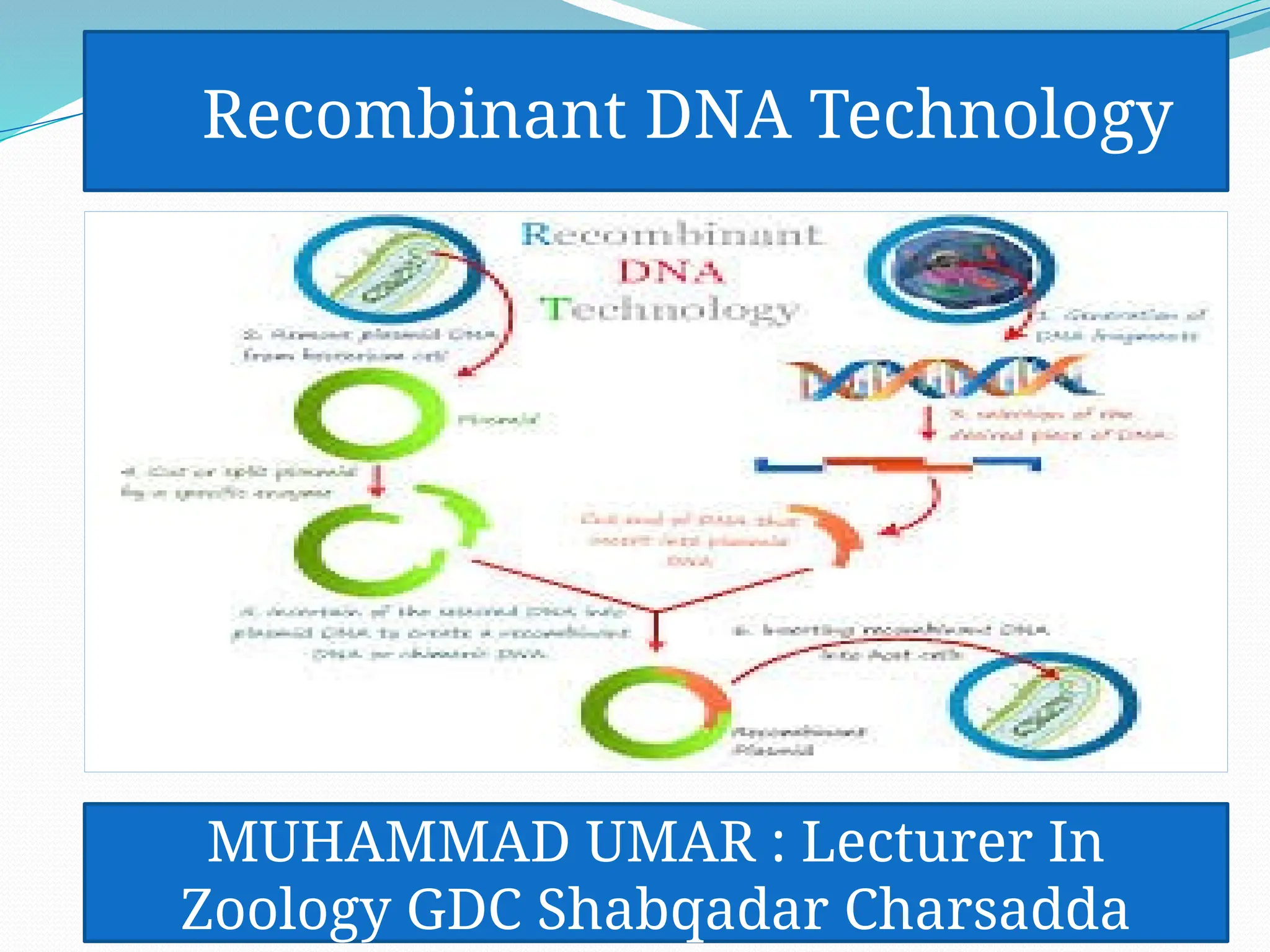
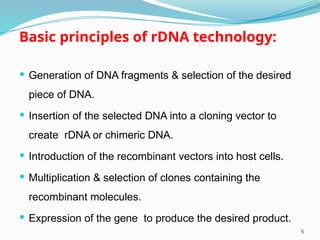
Generation of DNA fragments & selection of the desired
piece of DNA.
Insertion of the selected DNA into a cloning vector to
create rDNA or chimeric DNA.
Introduction of the recombinant vectors into host cells.
Multiplication & selection of clones containing the
recombinant molecules.
Expression of the gene to produce the desired product.
6
How is RecombinantDNA made
There are three different methods by which
Recombinant DNA is made.
Transformation
Phage Introduction,
Non-Bacterial Transformation.
10.
Transformation
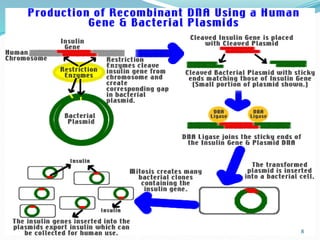
The firststep in transformation is to select a piece of
DNA to be inserted into a vector.
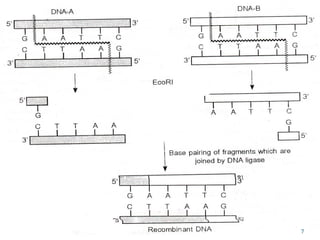
The second step is to cut that piece of DNA with a
restriction enzyme and then ligate the DNA insert into
the vector with DNA Ligase.
The insert contains a selectable marker which allows for
identification of recombinant molecules.
The vector is inserted into a host cell, in a process called
transformation. One example of a possible host cell is E.
Coli. The host cells must be specially prepared to take
up the foreign DNA.
11.
Non-bacterial Transformation
Thisis a process very similar to Transformation,
The only difference between the two is non-bacterial
does not use bacteria such as E. Coli for the host.
In micro-injection, the DNA is injected directly into
the nucleus of the cell being transformed.
In biolistic, the host cells are bombarded with high
velocity micro projectiles, such as particles of gold or
tungsten that have been coated with DNA.
12.
Phage Introduction
Phageintroduction is the process of transfection, which is
equivalent to transformation, except a phage is used
instead of bacteria. In vitro packaging of a vector is
used. This uses lambda or MI3 phages to produce phage
plaques which contain recombinants. The recombinants
that are created can be identified by differences in
the recombinants and non-recombinants using various
selection methods.
13.
Applications of rDNAtechnology
Manufacture of proteins/hormones Interferon,
plasminogen activating factor, blood clotting factors,
insulin, growth hormone.
AIDS test: Has become simple & rapid
Diagnosis of molecular diseases: sickle cell anaemia
thalassaemia, familial hyper cholesterolaemia, cystic
fibrosis
Prenatal diagnosis: DNA from cells collected from
amniotic fluid, chorionic villi
13
14.
Gene Therapy:
Thisis achieved by cloning a gene into a
vector that will readily be taken up &
incorporated into genome of a host cell.
ADA deficiency has been successfully treated
Application in Agriculture:
Genetically engineered plants are developed
to resist draught & diseases. Good quality of
food & increased yield of crops is also
possible.
14
15.
Industrial Application:
Enzymes---useto produce sugars, cheese, detergents.
Protein products---used as food additives, increases
nutritive value, besides imparting flavour.
Application in forensic medicine: The restriction analysis
pattern of DNA of one individual will be very specific(DNA
fingerprinting, but the pattern will be different from
person to person. Helps to identify criminals & to settle
disputes of parenthood of children.
Transgenesis: Gene replacement therapy will not pass on
to offspring. Therefore genes are transferred into
fertilized ovum which will be found in somatic as well as
germ cells & passed on to the successive generations.
15