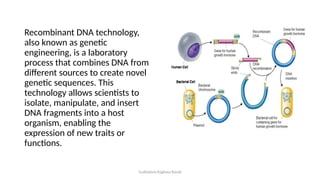
Recombinant DNA technology involves combining DNA from different sources to create new genetic combinations. This process, also known as genetic engineering, allows scientists to manipulate genes and produce organisms with desirable traits. It has revolutionized various fields like medicine, agriculture, and research.
Key Concepts:
Recombinant DNA (rDNA):
A DNA molecule formed by combining genetic material from different sources.
Vectors:
Carriers, like plasmids or bacteriophages, used to introduce the desired gene into a host organism.
Restriction Enzymes:
Enzymes that cut DNA at specific sequences, allowing for the isolation and insertion of genes.
DNA Ligase:
An enzyme that joins DNA fragments together, forming the recombinant DNA molecule.
Host Organism:
The organism (e.g., bacteria, yeast, or plant cells) that receives and replicates the recombinant DNA.
Steps Involved:
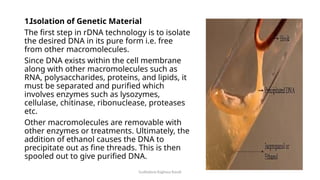
Isolation of DNA: Extracting DNA from the source organism containing the gene of interest.
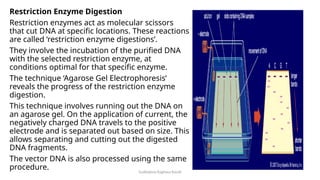
Fragmentation of DNA: Using restriction enzymes to cut the DNA into specific fragments.
Selection of Gene of Interest: Identifying and isolating the desired gene from the DNA fragments.
Ligation with Vector: Joining the gene of interest to a vector DNA molecule (e.g., a plasmid).
Transformation: Introducing the recombinant vector into a host organism.
Obtaining Foreign Gene Product: The host organism replicates the recombinant DNA, producing the desired protein or trait.
Applications:
Medicine:
Production of insulin, human growth hormone, and other therapeutic proteins, as well as diagnostic tools.
Agriculture:
Development of crops with improved traits like pest resistance and herbicide tolerance.
Research:
Studying gene function, developing new therapies, and understanding biological processes.
Industry:
Production of enzymes, biofuels, and other valuable products.
Examples:
Recombinant Insulin:
Human insulin produced by bacteria using recombinant DNA technology, making it widely available for treating diabetes.
Recombinant Human Growth Hormone:
Produced using recombinant DNA technology to treat growth hormone deficiencies.
Genetically Modified Crops:
Crops engineered for pest resistance, herbicide tolerance, and increased yield.
Recombinant Vaccines:
Development of vaccines using recombinant DNA technology, like the hepatitis B vaccine. Steps involved
Isolation of the Genetic Material: Extracting the desired gene from the donor organism's DNA, and the vector DNA.
Cutting the DNA: Using restriction enzymes to cut both the donor DNA and the vector DNA at specific locations, creating complementary ends.
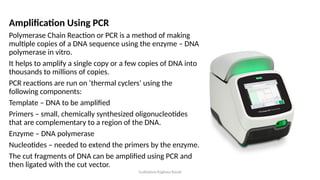
Amplifying the Gene of Interest (Optional): If starting with a small amount of DNA, polymerase chain reaction (PCR) can be used to make numerous copies of the desired gene.
Ligation: Joining the cut DNA fragments (donor gene and vector) using DNA ligase, creating the recombinant DNA molecule.
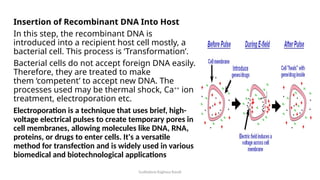
Insertion of Recombinant DNA into the Host Cell: Introducing the recombinant D