PRESENTATION
ON
SERVICES
BY
REBOUND HAMMER
About us
 SGM lab solutions an initiative of sigma test and research center

which was established in 2009 by technocrat educationist who
have over 30 years of experience in the area of education,
administration, manufacturing and marketing.
 SGM lab solutions came on floor with an objective to provide
excellence in testing services, equipments, training, calibration,
lab set up facility and aimed at providing its clients technology
that is conducive to fast changing environment and backed by a
group of professionals who have dedicated its formative years in
quality control across various industries.
 We offer a complete line of Rebound Hammers for the occasional

user as well as the engineering professional. All hammers are
spring activated and conform to ASTM C-805 as well as other
European and Asian Standards. All are made to the most exacting
machine tolerances to provide the end user with a consistent test
every time.
 A Schmidt Hammer or a rebound hammer is a device to measure

the elastic properties or strength of concrete or rock, mainly
surface hardness and penetration resistance. Hammer test is done
as per IS: 13311 (part 2) -1992 or ASTM C805/C805 M or ACI
228.
Mission
 Our Mission at REBOUND HAMMER is to offer innovative and

exceptional analytical process and methodologies that help
industries & organizations of all sizes to achieve
predictable, improved product quality level, turnaround time &
cost associated with testing integrity requirements.
 Imagination is threaded into the very fabric of science and

technology. It is the inspiration behind new thoughts and ideas for
doing and creating things that once seemed impossible.
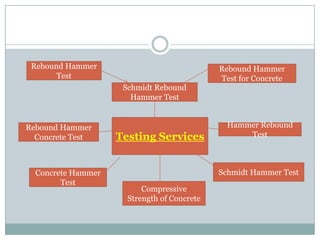
Testing Services
 REBOUND HAMMER

Rebound hammer test is done to find out the compressive strength of
concrete by using rebound hammer as per IS: 13311 (Part 2) - 1992. The
underlying principle of the rebound hammer test is :
The rebound of an elastic mass depends on the hardness of the surface
against which its mass strikes. When the plunger of the rebound hammer is
pressed against the surface of the concrete, the Spring-controlled mass
rebounds and the extent of such a rebound depends upon the surface
hardness of the concrete.
The surface hardness and therefore the rebound is taken to be related to
the compressive strength of the concrete. The rebound value is read from a
graduated scale and is designated as the rebound number or rebound index.
The compressive strength can be read directly from the graph provided on
the body of the hammer.
Rebound Hammer
Test
Schmidt Rebound
Hammer Test

Rebound Hammer
Concrete Test

Concrete Hammer
Test

Testing Services

Rebound Hammer
Test for Concrete

Hammer Rebound
Test

Schmidt Hammer Test

Compressive
Strength of Concrete
Calibration
 Rebound Hammer Calibration- Calibration of Anvil Rebound

Hammer is what you will get here at Sigma Test Calibration
laboratory. Our calibration services are spread all over the India
and overseas also.
 It include:
 Calibration Of Rebound Hammer
 Rebound Hammer Calibration
 Calibration Anvil Rebound Hammer

 Calibration Of Rebound Hammer
Equipment
 A simple equipment known as Rebound Hammer or Schmidt

Hammer is used for this purpose. Surface hardness measured
during the test give an idea about the soundness and quality of
cover concrete.
 Locations having very low rebound numbers indicate weak

surface concrete and may be affected by corrosion. The quality of
concrete may be interpreted as shown in the above table.
 SGM lab solutions was established with an aim to serve a wide

variety of laboratory and NDT equipments. We believe in serving
products of quality. we offer a complete range of Rebound
hammer and RCPT including its testing & calibration service. We
provided accuracy and assurance for significant experiments.
 We constantly work harder to improve the over all quality within

the industry. We are constantly bringing together the best
technical expertise to provide viable and cost-effective solution to
laboratories, while answering the need for affordable, outstanding
and exceptional after sales services and support thus enabling our
customer to attain the highest value for their purchases. We strive
to advance people's knowledge and there ability to enhance their
quality of life. Trust in a strong brand that stands for quality and
innovation in the lab for decades.
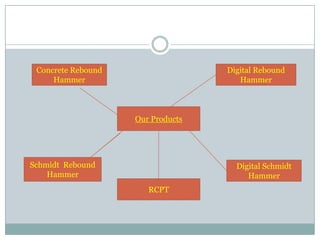
Concrete Rebound
Hammer

Digital Rebound
Hammer

Our Products

Schmidt Rebound
Hammer

Digital Schmidt
Hammer

RCPT
Hammer
 Concrete Test Hammer, ideally suited for on-site tests of concrete

and is widely used instrument for analyzing the uniformity and
compressive strength characteristics of concrete structures and
Detection of weak spots in the concrete. Rebound values are read
from a scale for subsequent calculation of the mean. Compressive
strength values can be read from a conversion diagram.
Digital rebound hammer
 Digital test hammers are an advanced, completely automated

system for estimating concrete compressive strength. Its
calculation, memory and recording functions allow for quick,
easy and accurate test results.
 Discard values for multiple test results can be set; the mean,

median and compressive strength can also be calculated. The
addition of modern microprocessor technology allows the data to
be stored, printed and transferred to a personal computer for
further analysis, or inclusion in your reports.
Hammer
 The Schmidt rebound hammer is principally a surface hardness

tester. The Original Schmidt is available in models with different
impact energies, each test hammer designed for a specific test
application.
 The Romans were aware of the fact that good mortar (opus

caementicium) is hard and of a high compressive strength. They
tested its quality subjectively by scratching the surface with an
iron nail.
 But only in the mid-20th century was this know-how utilized. A

device was invented which made non-destructive compressive
strength testing feasible.
hammer
 Digital Schmidt rebound hammer is the most advanced

instrument in its category with follows:
 The instruments body lies very comfortably in the hand. The

display is highly readable under any conditions.
 A two-layer seal prevents dust and dirt from penetrating to the
interior of the instrument.
 The forward and the rebound velocity of the hammer mass are
both measured in close proximity to the point of impact. The
rebound value requires no angular correction.
 A larger number of measurement points can be easily collected by
the instrument and automatically evaluated according to
statistical criteria.
permeability test
apparatus
 The PROOVE it system is used to evaluate the resistance of concrete to

the ingress of chloride ions in two ways:
By determining how easy it is to force chloride ions into saturated concrete
by applying an electrical potential across a test specimen in accordance
with AASHTO T 277 or ASTM C1202. This is known as the "Coulomb
Test" or the "Rapid Chloride Permeability Test (RCPT)."
By measuring the penetration depth of chloride ions, after an electric
potential has been applied to the specimen in accordance with
NORDTEST BUILD 492 (Chloride Migration Coefficient from NonSteady State Migration Experiments) to determine the "Chloride Migration
Coefficient," which can be used to estimate the chloride diffusion
coefficient for service life calculations.
 A water-saturated concrete specimen, 100 mm diameter and 50

mm thick, is positioned in a cell (right and page 104) containing
fluid reservoirs on both sides. For the RCPT or Coulomb Test,
one reservoir is filled with a 3 % NaCl solution and the other with
a 0.3N NaOH solution. A potential of 60 VDC is applied across
the cell. The negative terminal is connected to the electrode in the
reservoir with the NaCl solution and the positive terminal is
connected to the electrode in the NaOH solution. The negatively
charged chloride ions will migrate towards the positive terminal.
 The more permeable is the concrete, the more chloride ions will
migrate through the specimen, and a higher current will be
measured. The current is measured for 6 hours. The area under
the curve of current versus time is determined, which represents
the total charge or Coulombs passed across the specimen.
Rebound Hammer Services

Rebound Hammer Services

  • 1.
  • 2.
    About us  SGMlab solutions an initiative of sigma test and research center which was established in 2009 by technocrat educationist who have over 30 years of experience in the area of education, administration, manufacturing and marketing.  SGM lab solutions came on floor with an objective to provide excellence in testing services, equipments, training, calibration, lab set up facility and aimed at providing its clients technology that is conducive to fast changing environment and backed by a group of professionals who have dedicated its formative years in quality control across various industries.
  • 3.
     We offera complete line of Rebound Hammers for the occasional user as well as the engineering professional. All hammers are spring activated and conform to ASTM C-805 as well as other European and Asian Standards. All are made to the most exacting machine tolerances to provide the end user with a consistent test every time.  A Schmidt Hammer or a rebound hammer is a device to measure the elastic properties or strength of concrete or rock, mainly surface hardness and penetration resistance. Hammer test is done as per IS: 13311 (part 2) -1992 or ASTM C805/C805 M or ACI 228.
  • 4.
    Mission  Our Missionat REBOUND HAMMER is to offer innovative and exceptional analytical process and methodologies that help industries & organizations of all sizes to achieve predictable, improved product quality level, turnaround time & cost associated with testing integrity requirements.  Imagination is threaded into the very fabric of science and technology. It is the inspiration behind new thoughts and ideas for doing and creating things that once seemed impossible.
  • 5.
    Testing Services  REBOUNDHAMMER Rebound hammer test is done to find out the compressive strength of concrete by using rebound hammer as per IS: 13311 (Part 2) - 1992. The underlying principle of the rebound hammer test is : The rebound of an elastic mass depends on the hardness of the surface against which its mass strikes. When the plunger of the rebound hammer is pressed against the surface of the concrete, the Spring-controlled mass rebounds and the extent of such a rebound depends upon the surface hardness of the concrete. The surface hardness and therefore the rebound is taken to be related to the compressive strength of the concrete. The rebound value is read from a graduated scale and is designated as the rebound number or rebound index. The compressive strength can be read directly from the graph provided on the body of the hammer.
  • 6.
    Rebound Hammer Test Schmidt Rebound HammerTest Rebound Hammer Concrete Test Concrete Hammer Test Testing Services Rebound Hammer Test for Concrete Hammer Rebound Test Schmidt Hammer Test Compressive Strength of Concrete
  • 7.
    Calibration  Rebound HammerCalibration- Calibration of Anvil Rebound Hammer is what you will get here at Sigma Test Calibration laboratory. Our calibration services are spread all over the India and overseas also.  It include:  Calibration Of Rebound Hammer  Rebound Hammer Calibration  Calibration Anvil Rebound Hammer  Calibration Of Rebound Hammer
  • 8.
    Equipment  A simpleequipment known as Rebound Hammer or Schmidt Hammer is used for this purpose. Surface hardness measured during the test give an idea about the soundness and quality of cover concrete.  Locations having very low rebound numbers indicate weak surface concrete and may be affected by corrosion. The quality of concrete may be interpreted as shown in the above table.
  • 9.
     SGM labsolutions was established with an aim to serve a wide variety of laboratory and NDT equipments. We believe in serving products of quality. we offer a complete range of Rebound hammer and RCPT including its testing & calibration service. We provided accuracy and assurance for significant experiments.  We constantly work harder to improve the over all quality within the industry. We are constantly bringing together the best technical expertise to provide viable and cost-effective solution to laboratories, while answering the need for affordable, outstanding and exceptional after sales services and support thus enabling our customer to attain the highest value for their purchases. We strive to advance people's knowledge and there ability to enhance their quality of life. Trust in a strong brand that stands for quality and innovation in the lab for decades.
  • 10.
    Concrete Rebound Hammer Digital Rebound Hammer OurProducts Schmidt Rebound Hammer Digital Schmidt Hammer RCPT
  • 11.
    Hammer  Concrete TestHammer, ideally suited for on-site tests of concrete and is widely used instrument for analyzing the uniformity and compressive strength characteristics of concrete structures and Detection of weak spots in the concrete. Rebound values are read from a scale for subsequent calculation of the mean. Compressive strength values can be read from a conversion diagram.
  • 12.
    Digital rebound hammer Digital test hammers are an advanced, completely automated system for estimating concrete compressive strength. Its calculation, memory and recording functions allow for quick, easy and accurate test results.  Discard values for multiple test results can be set; the mean, median and compressive strength can also be calculated. The addition of modern microprocessor technology allows the data to be stored, printed and transferred to a personal computer for further analysis, or inclusion in your reports.
  • 13.
    Hammer  The Schmidtrebound hammer is principally a surface hardness tester. The Original Schmidt is available in models with different impact energies, each test hammer designed for a specific test application.  The Romans were aware of the fact that good mortar (opus caementicium) is hard and of a high compressive strength. They tested its quality subjectively by scratching the surface with an iron nail.  But only in the mid-20th century was this know-how utilized. A device was invented which made non-destructive compressive strength testing feasible.
  • 14.
    hammer  Digital Schmidtrebound hammer is the most advanced instrument in its category with follows:  The instruments body lies very comfortably in the hand. The display is highly readable under any conditions.  A two-layer seal prevents dust and dirt from penetrating to the interior of the instrument.  The forward and the rebound velocity of the hammer mass are both measured in close proximity to the point of impact. The rebound value requires no angular correction.  A larger number of measurement points can be easily collected by the instrument and automatically evaluated according to statistical criteria.
  • 15.
    permeability test apparatus  ThePROOVE it system is used to evaluate the resistance of concrete to the ingress of chloride ions in two ways: By determining how easy it is to force chloride ions into saturated concrete by applying an electrical potential across a test specimen in accordance with AASHTO T 277 or ASTM C1202. This is known as the "Coulomb Test" or the "Rapid Chloride Permeability Test (RCPT)." By measuring the penetration depth of chloride ions, after an electric potential has been applied to the specimen in accordance with NORDTEST BUILD 492 (Chloride Migration Coefficient from NonSteady State Migration Experiments) to determine the "Chloride Migration Coefficient," which can be used to estimate the chloride diffusion coefficient for service life calculations.
  • 16.
     A water-saturatedconcrete specimen, 100 mm diameter and 50 mm thick, is positioned in a cell (right and page 104) containing fluid reservoirs on both sides. For the RCPT or Coulomb Test, one reservoir is filled with a 3 % NaCl solution and the other with a 0.3N NaOH solution. A potential of 60 VDC is applied across the cell. The negative terminal is connected to the electrode in the reservoir with the NaCl solution and the positive terminal is connected to the electrode in the NaOH solution. The negatively charged chloride ions will migrate towards the positive terminal.  The more permeable is the concrete, the more chloride ions will migrate through the specimen, and a higher current will be measured. The current is measured for 6 hours. The area under the curve of current versus time is determined, which represents the total charge or Coulombs passed across the specimen.