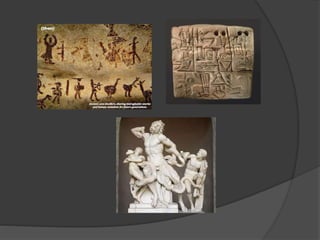






The quest for 
human knowledge
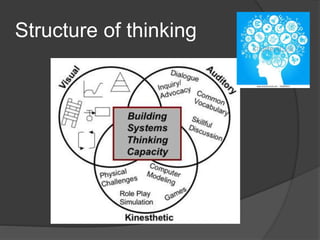
Structure of thinking
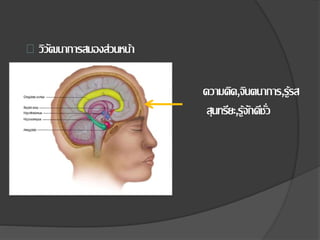
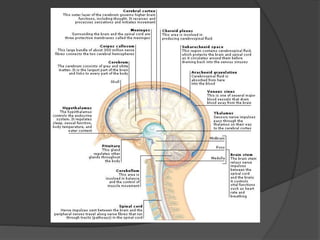
วิวฒันาการสมองส่วนหน้า 
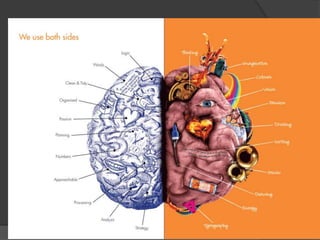
ความคิด,จนิตนาการ,รู้รส 
สุนทรียะ,รู้จกัดีชวั่
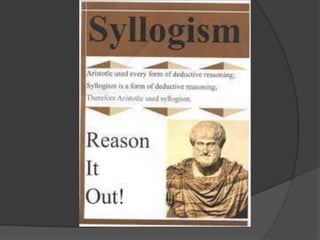
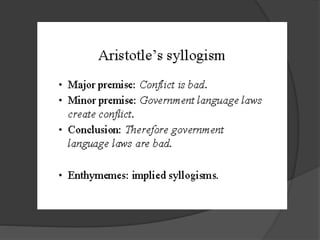
2) Deductive argument 
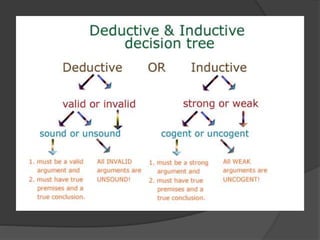
Deductive argument is the process of 
reasoning from one or more general 
statements (premises) to reach a 
logically certain conclusion.
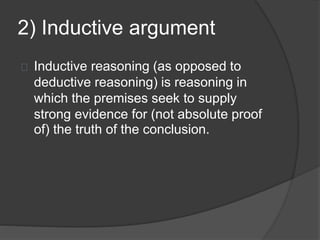
2) Inductive argument 
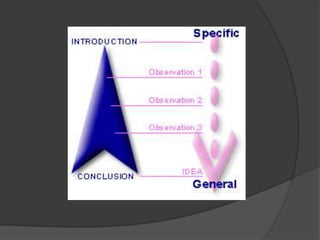
Inductive reasoning (as opposed to 
deductive reasoning) is reasoning in 
which the premises seek to supply 
strong evidence for (not absolute proof 
of) the truth of the conclusion.
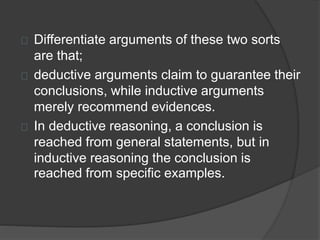
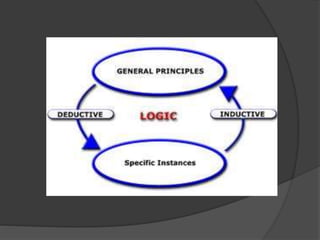
Differentiate arguments of these two sorts 
are that; 
deductive arguments claim to guarantee their 
conclusions, while inductive arguments 
merely recommend evidences. 
In deductive reasoning, a conclusion is 
reached from general statements, but in 
inductive reasoning the conclusion is 
reached from specific examples.
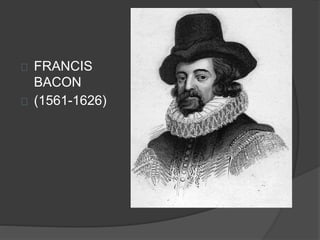
FRANCIS 
BACON 
(1561-1626)
Novum Organum
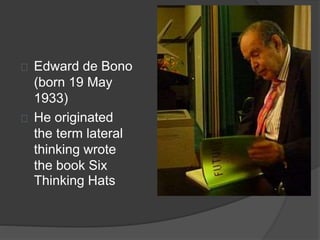
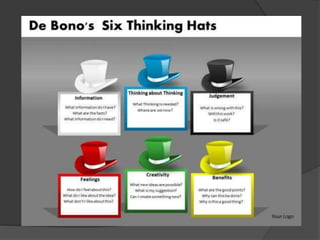
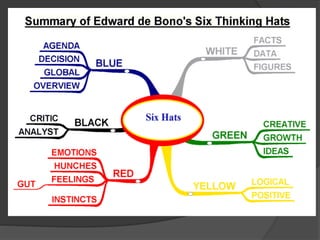
Edward de Bono 
(born 19 May 
1933) 
He originated 
the term lateral 
thinking wrote 
the book Six 
Thinking Hats
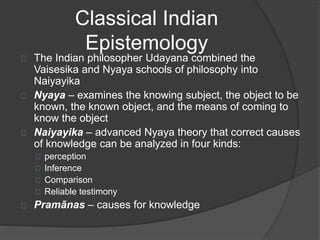
Classical Indian 
Epistemology 
The Indian philosopher Udayana combined the 
Vaisesika and Nyaya schools of philosophy into 
Naiyayika 
Nyaya – examines the knowing subject, the object to be 
known, the known object, and the means of coming to 
know the object 
Naiyayika – advanced Nyaya theory that correct causes 
of knowledge can be analyzed in four kinds: 
perception 
Inference 
Comparison 
Reliable testimony 
Pramānas – causes for knowledge
Levels of knowledge in 
Buddhism 
Sensual knowledge 
Thinking knowledge 
Intuitive knowledge
Joy Paul 
Guilford 
(1897 – 1987)
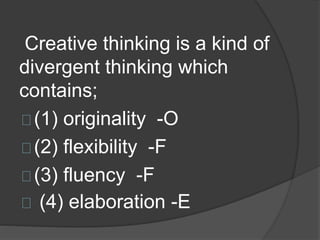
Creative thinking is a kind of 
divergent thinking which 
contains; 
(1) originality -O 
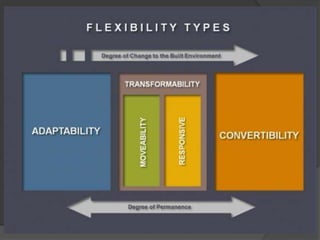
(2) flexibility -F 
(3) fluency -F 
(4) elaboration -E
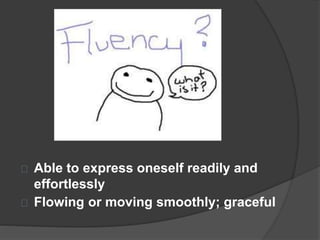
Able to express oneself readily and 
effortlessly 
Flowing or moving smoothly; graceful
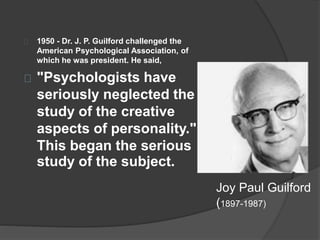
1950 - Dr. J. P. Guilford challenged the 
American Psychological Association, of 
which he was president. He said, 
"Psychologists have 
seriously neglected the 
study of the creative 
aspects of personality." 
This began the serious 
study of the subject. 
Joy Paul Guilford 
(1897-1987)
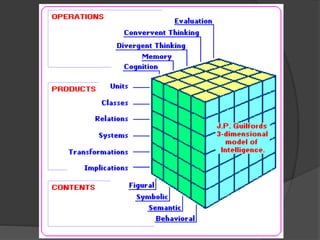
Dimension of creativity 
Operation 
Product 
Content
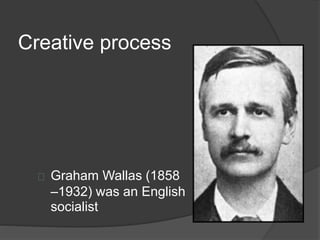
Creative process 
Graham Wallas (1858 
–1932) was an English 
socialist
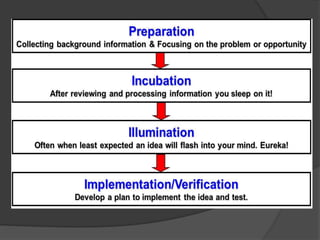
4 stages for creative 
thinking 
(P) Preparation 
(I) Incubation 
(I) Illumination 
(V) Verification
(P) Preparation: 
An assessment of the desired, 
creative application in the appropriate 
field of study
(I) Incubation 
Disengagement from the creative 
process; encouraging detachment from 
the creative objective as a means of 
stimulating thought.
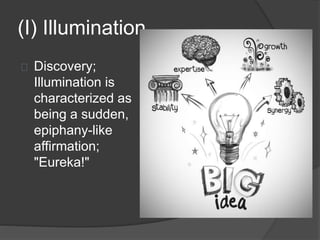
(I) Illumination 
Discovery; 
Illumination is 
characterized as 
being a sudden, 
epiphany-like 
affirmation; 
"Eureka!"
(V) Verification 
: The successful 
application of an 
"illumination" by 
the creative 
thinker
Value of creative thinking 
1) Making change 
2) Excitement or enjoy 
3) Training and exercise the brain for the 
best choice 
4) Build up self-confidence and self-satisfaction 
5) Being opened mind
Obstacles of creative 
thinking 
Outside -not allowing inquiry 
-Easy to follow others or copied 
culture 
-Custom 
-Proud of success not failure 
-Never-changed or strict regulations 
Inside -fears of blames, stupid, out-classed 
-Accustom or familiarity (lazy) 
-Narrow view 
-Inactive or passive
Developing creative thinking 
1) Love knowledge, never stop to 
learn 
2) Memorizing or recall previous 
knowledge 
3) Reasoning 
4) Creative thoughtful and far-viewer
Some Additional Thoughts 
The creative person uses information to form new 
ideas. 
The real key to creative problem solving is what you do 
with the knowledge. 
Creative problem solving requires an attitude that 
allows you to search for new ideas and use your 
knowledge and experience. 
Change perspective and use knowledge to make the 
ordinary extraordinary and the usual commonplace. 
Optimist International 52
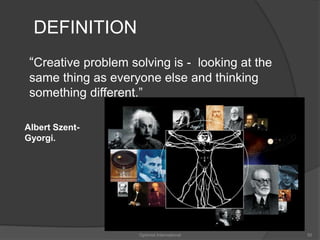
DEFINITION 
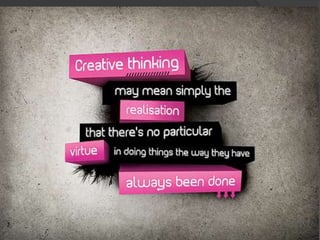
“Creative problem solving is - looking at the 
same thing as everyone else and thinking 
something different.” 
Optimist International 55 
Albert Szent- 
Gyorgi.
 Why don’t we think creatively 
more often? 
 What are the barriers that get in 
our way? 
56
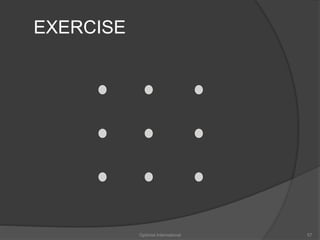
EXERCISE 
Optimist International 57
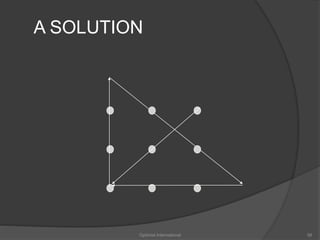
A SOLUTION 
Optimist International 58
Brainstorming
BARRIERS THAT GET IN OUR 
WAY 
Time 
Why change? 
Usually don’t need to be creative 
Habit 
Routine 
Haven’t been taught to be creative 
What are some other barriers that get in 
our way? 
Optimist International 60
MENTAL BLOCKS 
Mental blocks are 
reasons (attitudes) 
why we don’t “think 
something 
different.” 
Optimist International 61
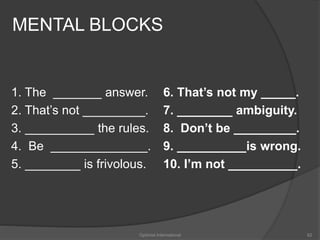
MENTAL BLOCKS 
1. The _______ answer. 
2. That’s not _________. 
3. __________ the rules. 
4. Be ______________. 
5. ________ is frivolous. 
6. That’s not my _____. 
7. ________ ambiguity. 
8. Don’t be _________. 
9. __________is wrong. 
10. I’m not __________. 
Optimist International 62
MENTAL BLOCK # 1 
1. The right answer. 
Only one? 
Optimist International 63
MENTAL BLOCK # 2 
1. The right answer. 
2. That’s not logical. 
Optimist International 64
MENTAL BLOCK # 3 
1. The right answer. 
2. That’s not logical. 
3. Follow the rules. 
Why rules should be 
challenged: 
1. We make rules based 
on reasons that make a lot 
of sense. 
2. We follow these rules. 
3. Time passes, and 
things change. 
4. The original reasons 
for the generation of these 
rules may no longer exist, 
but because the rules are 
still in place, we continue 
to follow them. 
Optimist International 65
MENTAL BLOCK # 4 
1. The right answer. 
2. That’s not logical. 
3. Follow the rules. 
4. Be practical. 
Optimist International 66
MENTAL BLOCK # 5 
1. The right answer. 
2. That’s not logical. 
3. Follow the rules. 
4. Be practical. 
5. Play is frivolous. 
“When do 
you get 
your best 
ideas?” 
Optimist International 67
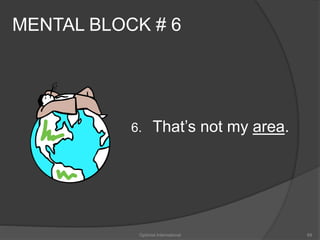
MENTAL BLOCK # 6 
6. That’s not my area. 
Optimist International 68
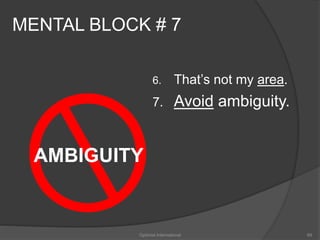
MENTAL BLOCK # 7 
6. That’s not my area. 
7. Avoid ambiguity. 
AMBIGUITY 
Optimist International 69
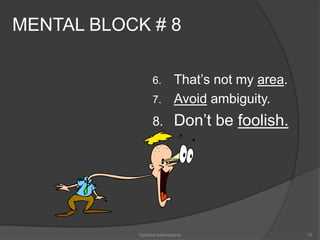
MENTAL BLOCK # 8 
6. That’s not my area. 
7. Avoid ambiguity. 
8. Don’t be foolish. 
Optimist International 70
MENTAL BLOCK # 9 
6. That’s not my area. 
7. Avoid ambiguity. 
8. Don’t be foolish. 
9. To err is wrong.
MENTAL BLOCK # 10 
6. That’s not my area. 
7. Avoid ambiguity. 
8. Don’t be foolish. 
9. To err is wrong. 
10. I’m not creative. 
Optimist International 72
BEING MORE 
CREATIVE 
How can we be more creative? 
Jot down at least 3 ideas that come to 
your mind. 
Optimist International 76
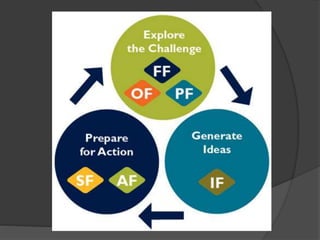
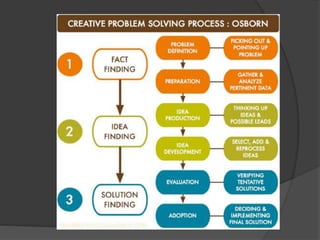
STEP 1. State what appears to be the 
problem. 
The real problem may not surface 
until facts have been gathered and 
analyzed. Therefore, start with what 
you assume to be the problem, that 
can later be confirmed or corrected.
STEP 2. Gather facts, feelings 
and opinions. 
 What happened? 
 Where, when and how did it occur? 
 What is it’s size, scope, and severity? 
 Who and what is affected? 
 Likely to happen again? 
 Need to be corrected? 
 May need to assign priorities to critical 
elements. 
Optimist International 78
STEP 3. Restate the problem. 
The real facts help make this possible, 
and provide supporting data. 
The actual problem may, or may not be 
the same as stated in Step 1. 
Optimist International 79
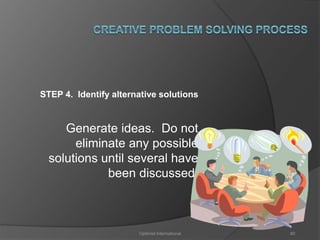
STEP 4. Identify alternative solutions 
Generate ideas. Do not 
eliminate any possible 
solutions until several have 
been discussed. 
Optimist International 80
STEP 5. Evaluate alternatives. 
 Which will provide the optimum solution? 
 What are the risks? 
 Are costs in keeping with the benefits? 
 Will the solution create new problems? 
Optimist International 81
STEP 6. Implement the decision! 
 Who must be involved? 
 To what extent? 
 How, when and where? 
 Who will the decision impact? 
 What might go wrong? 
 How will the results be reported and verified? 
Optimist International 82
STEP 7. Evaluate the 
results. 
 Test the solution against the 
desired results. 
 Make revisions if necessary. 
Optimist International 83
10 Questions To Encourage 
Ideas 
1. What if…? 
2. How can we improve…? 
3. How will the Optimist Member and/or 
the community benefit? 
4. Are we forgetting anything? 
5. What’s the next step? 
Optimist International 84
10 Questions To Encourage 
Ideas 
6. What can we do better…? 
7. What do you think about…? 
8. What should we add? 
9. What should we eliminate? 
10. What other ideas do you have...? 
Optimist International 85
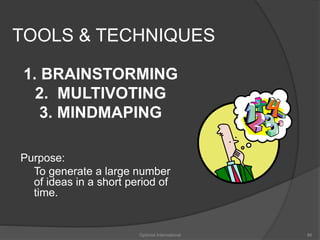
TOOLS & TECHNIQUES 
1. BRAINSTORMING 
2. MULTIVOTING 
3. MINDMAPING 
Purpose: 
To generate a large number 
of ideas in a short period of 
time. 
Optimist International 86
BRAINSTORMING 
Rules for Brainstorming: 
The more ideas the better! 
No discussion 
No idea is a bad idea 
Build on one another’s ideas 
Display all ideas
BRAINSTORMING EXERCISE 
How Do We Motivate Our Local 
Optimist Club Members? 
Ideas: Freely record your ideas as they come to your mind. 
Optimist International 88
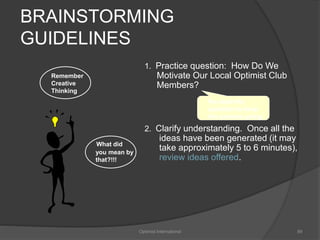
BRAINSTORMING 
GUIDELINES 
1. Practice question: How Do We 
Motivate Our Local Optimist Club 
Members? 
2. Clarify understanding. Once all the 
ideas have been generated (it may 
take approximately 5 to 6 minutes), 
review ideas offered. 
Optimist International 89 
Remember 
Creative 
Thinking 
What did 
you mean by 
that?!!! 
Re-state the 
question to keep 
the process going
BRAINSTORMING 
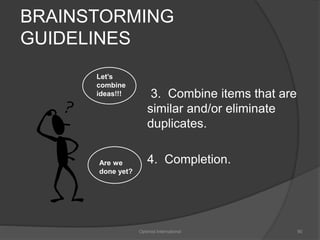
GUIDELINES 
3. Combine items that are 
similar and/or eliminate 
duplicates. 
4. Completion. 
Optimist International 90 
Let’s 
combine 
ideas!!! 
Are we 
done yet?
TOOLS & TECHNIQUES - 
MULTIVOTING 
Purpose: 
To help a group of people make a decision 
with which they are comfortable. 
Definition: 
A way to vote to select the most important or 
popular items (alternatives) from a list. 
Optimist International 91
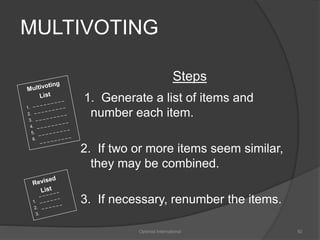
MULTIVOTING 
Steps 
1. Generate a list of items and 
number each item. 
2. If two or more items seem similar, 
they may be combined. 
3. If necessary, renumber the items. 
Optimist International 92
MULTIVOTING Steps 
(Continued) 
4. Write down the numbers of the items you feel 
are the major cause of the problem. 
5. Share your votes by a show of hands. 
6. Eliminate those items with the fewest votes. 
7. Repeat steps 3 (renumber) through 6 on the list 
of remaining items. Continue this process until 
only a few items remain. If a clear favorite does 
not emerge, the group may discuss the items listed 
and make a choice. 
Optimist International 93
MIND MAPPING 
Definition : A visual picture of a group of ideas, 
concepts or issues. 
Purpose : 
Unblock our thinking. 
See an entire idea or several ideas on one 
sheet of paper. 
See how ideas relate to one another. 
Look at things in a new and different way. 
Look at an idea in depth.
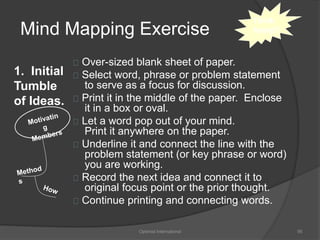
Mind Mapping Exercise 
Over-sized blank sheet of paper. 
Select word, phrase or problem statement 
to serve as a focus for discussion. 
Print it in the middle of the paper. Enclose 
it in a box or oval. 
Let a word pop out of your mind. 
Print it anywhere on the paper. 
Underline it and connect the line with the 
problem statement (or key phrase or word) 
you are working. 
Record the next idea and connect it to 
original focus point or the prior thought. 
Continue printing and connecting words. 
Optimist International 95 
1. Initial 
Tumble 
of Ideas. 
Think 
freely!!
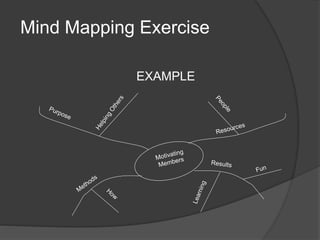
Mind Mapping Exercise 
EXAMPLE
Mind Mapping Exercise 
-- Helpful Hints 
 Keep your printing large 
and easy to read. 
 Feel free to use symbols 
and or pictures. 
 Have some fun using 
different colors. 
Optimist International 97 
A 

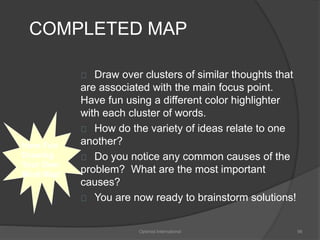
COMPLETED MAP 
Draw over clusters of similar thoughts that 
are associated with the main focus point. 
Have fun using a different color highlighter 
with each cluster of words. 
How do the variety of ideas relate to one 
another? 
Do you notice any common causes of the 
problem? What are the most important 
causes? 
You are now ready to brainstorm solutions! 
Optimist International 98 
Have Fun 
Drawing 
Your Own 
Mind Map!
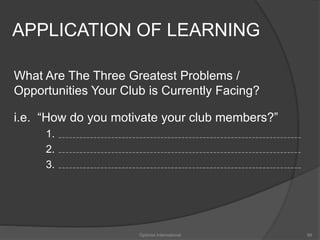
APPLICATION OF LEARNING 
What Are The Three Greatest Problems / 
Opportunities Your Club is Currently Facing? 
i.e. “How do you motivate your club members?” 
1. 
2. 
3. 
Optimist International 99
Reasoning

Reasoning

  • 1.
    The quest for human knowledge
  • 2.
  • 3.
  • 12.
    2) Deductive argument Deductive argument is the process of reasoning from one or more general statements (premises) to reach a logically certain conclusion.
  • 14.
    2) Inductive argument Inductive reasoning (as opposed to deductive reasoning) is reasoning in which the premises seek to supply strong evidence for (not absolute proof of) the truth of the conclusion.
  • 15.
    Differentiate arguments ofthese two sorts are that; deductive arguments claim to guarantee their conclusions, while inductive arguments merely recommend evidences. In deductive reasoning, a conclusion is reached from general statements, but in inductive reasoning the conclusion is reached from specific examples.
  • 18.
  • 19.
  • 23.
    Edward de Bono (born 19 May 1933) He originated the term lateral thinking wrote the book Six Thinking Hats
  • 26.
    Classical Indian Epistemology The Indian philosopher Udayana combined the Vaisesika and Nyaya schools of philosophy into Naiyayika Nyaya – examines the knowing subject, the object to be known, the known object, and the means of coming to know the object Naiyayika – advanced Nyaya theory that correct causes of knowledge can be analyzed in four kinds: perception Inference Comparison Reliable testimony Pramānas – causes for knowledge
  • 27.
    Levels of knowledgein Buddhism Sensual knowledge Thinking knowledge Intuitive knowledge
  • 30.
    Joy Paul Guilford (1897 – 1987)
  • 31.
    Creative thinking isa kind of divergent thinking which contains; (1) originality -O (2) flexibility -F (3) fluency -F (4) elaboration -E
  • 34.
    Able to expressoneself readily and effortlessly Flowing or moving smoothly; graceful
  • 36.
    1950 - Dr.J. P. Guilford challenged the American Psychological Association, of which he was president. He said, "Psychologists have seriously neglected the study of the creative aspects of personality." This began the serious study of the subject. Joy Paul Guilford (1897-1987)
  • 37.
    Dimension of creativity Operation Product Content
  • 39.
    Creative process GrahamWallas (1858 –1932) was an English socialist
  • 40.
    4 stages forcreative thinking (P) Preparation (I) Incubation (I) Illumination (V) Verification
  • 41.
    (P) Preparation: Anassessment of the desired, creative application in the appropriate field of study
  • 42.
    (I) Incubation Disengagementfrom the creative process; encouraging detachment from the creative objective as a means of stimulating thought.
  • 43.
    (I) Illumination Discovery; Illumination is characterized as being a sudden, epiphany-like affirmation; "Eureka!"
  • 44.
    (V) Verification :The successful application of an "illumination" by the creative thinker
  • 46.
    Value of creativethinking 1) Making change 2) Excitement or enjoy 3) Training and exercise the brain for the best choice 4) Build up self-confidence and self-satisfaction 5) Being opened mind
  • 50.
    Obstacles of creative thinking Outside -not allowing inquiry -Easy to follow others or copied culture -Custom -Proud of success not failure -Never-changed or strict regulations Inside -fears of blames, stupid, out-classed -Accustom or familiarity (lazy) -Narrow view -Inactive or passive
  • 51.
    Developing creative thinking 1) Love knowledge, never stop to learn 2) Memorizing or recall previous knowledge 3) Reasoning 4) Creative thoughtful and far-viewer
  • 52.
    Some Additional Thoughts The creative person uses information to form new ideas. The real key to creative problem solving is what you do with the knowledge. Creative problem solving requires an attitude that allows you to search for new ideas and use your knowledge and experience. Change perspective and use knowledge to make the ordinary extraordinary and the usual commonplace. Optimist International 52
  • 55.
    DEFINITION “Creative problemsolving is - looking at the same thing as everyone else and thinking something different.” Optimist International 55 Albert Szent- Gyorgi.
  • 56.
     Why don’twe think creatively more often?  What are the barriers that get in our way? 56
  • 57.
  • 58.
    A SOLUTION OptimistInternational 58
  • 59.
  • 60.
    BARRIERS THAT GETIN OUR WAY Time Why change? Usually don’t need to be creative Habit Routine Haven’t been taught to be creative What are some other barriers that get in our way? Optimist International 60
  • 61.
    MENTAL BLOCKS Mentalblocks are reasons (attitudes) why we don’t “think something different.” Optimist International 61
  • 62.
    MENTAL BLOCKS 1.The _______ answer. 2. That’s not _________. 3. __________ the rules. 4. Be ______________. 5. ________ is frivolous. 6. That’s not my _____. 7. ________ ambiguity. 8. Don’t be _________. 9. __________is wrong. 10. I’m not __________. Optimist International 62
  • 63.
    MENTAL BLOCK #1 1. The right answer. Only one? Optimist International 63
  • 64.
    MENTAL BLOCK #2 1. The right answer. 2. That’s not logical. Optimist International 64
  • 65.
    MENTAL BLOCK #3 1. The right answer. 2. That’s not logical. 3. Follow the rules. Why rules should be challenged: 1. We make rules based on reasons that make a lot of sense. 2. We follow these rules. 3. Time passes, and things change. 4. The original reasons for the generation of these rules may no longer exist, but because the rules are still in place, we continue to follow them. Optimist International 65
  • 66.
    MENTAL BLOCK #4 1. The right answer. 2. That’s not logical. 3. Follow the rules. 4. Be practical. Optimist International 66
  • 67.
    MENTAL BLOCK #5 1. The right answer. 2. That’s not logical. 3. Follow the rules. 4. Be practical. 5. Play is frivolous. “When do you get your best ideas?” Optimist International 67
  • 68.
    MENTAL BLOCK #6 6. That’s not my area. Optimist International 68
  • 69.
    MENTAL BLOCK #7 6. That’s not my area. 7. Avoid ambiguity. AMBIGUITY Optimist International 69
  • 70.
    MENTAL BLOCK #8 6. That’s not my area. 7. Avoid ambiguity. 8. Don’t be foolish. Optimist International 70
  • 71.
    MENTAL BLOCK #9 6. That’s not my area. 7. Avoid ambiguity. 8. Don’t be foolish. 9. To err is wrong.
  • 72.
    MENTAL BLOCK #10 6. That’s not my area. 7. Avoid ambiguity. 8. Don’t be foolish. 9. To err is wrong. 10. I’m not creative. Optimist International 72
  • 76.
    BEING MORE CREATIVE How can we be more creative? Jot down at least 3 ideas that come to your mind. Optimist International 76
  • 77.
    STEP 1. Statewhat appears to be the problem. The real problem may not surface until facts have been gathered and analyzed. Therefore, start with what you assume to be the problem, that can later be confirmed or corrected.
  • 78.
    STEP 2. Gatherfacts, feelings and opinions.  What happened?  Where, when and how did it occur?  What is it’s size, scope, and severity?  Who and what is affected?  Likely to happen again?  Need to be corrected?  May need to assign priorities to critical elements. Optimist International 78
  • 79.
    STEP 3. Restatethe problem. The real facts help make this possible, and provide supporting data. The actual problem may, or may not be the same as stated in Step 1. Optimist International 79
  • 80.
    STEP 4. Identifyalternative solutions Generate ideas. Do not eliminate any possible solutions until several have been discussed. Optimist International 80
  • 81.
    STEP 5. Evaluatealternatives.  Which will provide the optimum solution?  What are the risks?  Are costs in keeping with the benefits?  Will the solution create new problems? Optimist International 81
  • 82.
    STEP 6. Implementthe decision!  Who must be involved?  To what extent?  How, when and where?  Who will the decision impact?  What might go wrong?  How will the results be reported and verified? Optimist International 82
  • 83.
    STEP 7. Evaluatethe results.  Test the solution against the desired results.  Make revisions if necessary. Optimist International 83
  • 84.
    10 Questions ToEncourage Ideas 1. What if…? 2. How can we improve…? 3. How will the Optimist Member and/or the community benefit? 4. Are we forgetting anything? 5. What’s the next step? Optimist International 84
  • 85.
    10 Questions ToEncourage Ideas 6. What can we do better…? 7. What do you think about…? 8. What should we add? 9. What should we eliminate? 10. What other ideas do you have...? Optimist International 85
  • 86.
    TOOLS & TECHNIQUES 1. BRAINSTORMING 2. MULTIVOTING 3. MINDMAPING Purpose: To generate a large number of ideas in a short period of time. Optimist International 86
  • 87.
    BRAINSTORMING Rules forBrainstorming: The more ideas the better! No discussion No idea is a bad idea Build on one another’s ideas Display all ideas
  • 88.
    BRAINSTORMING EXERCISE HowDo We Motivate Our Local Optimist Club Members? Ideas: Freely record your ideas as they come to your mind. Optimist International 88
  • 89.
    BRAINSTORMING GUIDELINES 1.Practice question: How Do We Motivate Our Local Optimist Club Members? 2. Clarify understanding. Once all the ideas have been generated (it may take approximately 5 to 6 minutes), review ideas offered. Optimist International 89 Remember Creative Thinking What did you mean by that?!!! Re-state the question to keep the process going
  • 90.
    BRAINSTORMING GUIDELINES 3.Combine items that are similar and/or eliminate duplicates. 4. Completion. Optimist International 90 Let’s combine ideas!!! Are we done yet?
  • 91.
    TOOLS & TECHNIQUES- MULTIVOTING Purpose: To help a group of people make a decision with which they are comfortable. Definition: A way to vote to select the most important or popular items (alternatives) from a list. Optimist International 91
  • 92.
    MULTIVOTING Steps 1.Generate a list of items and number each item. 2. If two or more items seem similar, they may be combined. 3. If necessary, renumber the items. Optimist International 92
  • 93.
    MULTIVOTING Steps (Continued) 4. Write down the numbers of the items you feel are the major cause of the problem. 5. Share your votes by a show of hands. 6. Eliminate those items with the fewest votes. 7. Repeat steps 3 (renumber) through 6 on the list of remaining items. Continue this process until only a few items remain. If a clear favorite does not emerge, the group may discuss the items listed and make a choice. Optimist International 93
  • 94.
    MIND MAPPING Definition: A visual picture of a group of ideas, concepts or issues. Purpose : Unblock our thinking. See an entire idea or several ideas on one sheet of paper. See how ideas relate to one another. Look at things in a new and different way. Look at an idea in depth.
  • 95.
    Mind Mapping Exercise Over-sized blank sheet of paper. Select word, phrase or problem statement to serve as a focus for discussion. Print it in the middle of the paper. Enclose it in a box or oval. Let a word pop out of your mind. Print it anywhere on the paper. Underline it and connect the line with the problem statement (or key phrase or word) you are working. Record the next idea and connect it to original focus point or the prior thought. Continue printing and connecting words. Optimist International 95 1. Initial Tumble of Ideas. Think freely!!
  • 96.
  • 97.
    Mind Mapping Exercise -- Helpful Hints  Keep your printing large and easy to read.  Feel free to use symbols and or pictures.  Have some fun using different colors. Optimist International 97 A 
  • 98.
    COMPLETED MAP Drawover clusters of similar thoughts that are associated with the main focus point. Have fun using a different color highlighter with each cluster of words. How do the variety of ideas relate to one another? Do you notice any common causes of the problem? What are the most important causes? You are now ready to brainstorm solutions! Optimist International 98 Have Fun Drawing Your Own Mind Map!
  • 99.
    APPLICATION OF LEARNING What Are The Three Greatest Problems / Opportunities Your Club is Currently Facing? i.e. “How do you motivate your club members?” 1. 2. 3. Optimist International 99