PLOT & STRUCTURE
• Plot is the “why” that provides meaning to the story
• Conflict and resolution of conflict is the backbone of
plot.
• Some types of conflict:
• people versus people/ person vs. self/ person vs.
nature/ person vs. society
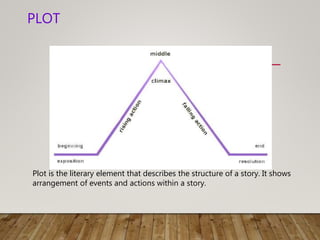
PLOT
Plot is the literary element that describes the structure of a story. It shows
arrangement of events and actions within a story.
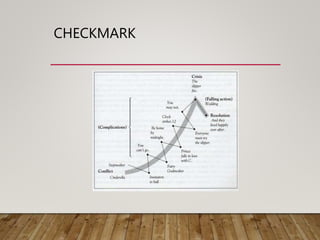
CHECKMARK
COMMON STORY-ORDERING
ELEMENTS
• Chronological
• Flash back
• In media res (in the middle of things) when a story
starts in the middle of the action
OTHER TYPES OF STRUCTURE
 Not all fiction needs to follow a linear/chronological
structure in order to have a crisis action and conflict
 Other types of structures to consider:
 Maze
 Iceberg
 Parallel lines
 A circle
 infinity
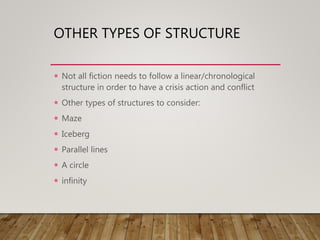
MAZE
• In which a character either physically, emotionally (or
both!) is trapped and has trouble getting out of his or
her maze
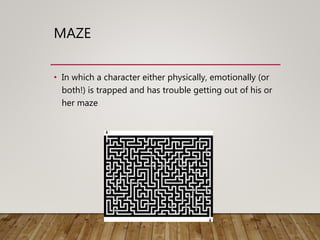
ICEBERG
• In which part of the story is submerged and unseen,
but felt (think of “Hills Like White Elephants”
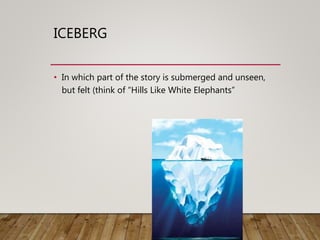
PARALLEL LINES
• In which two stories run, literally, parallel to one
another (perhaps characters facing similar challenges)
but the stories do not meet.
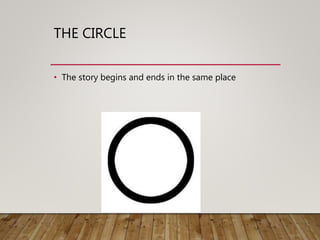
THE CIRCLE
• The story begins and ends in the same place
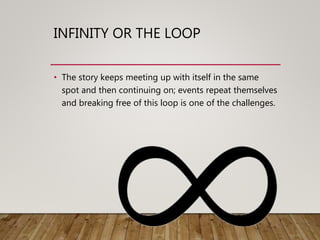
INFINITY OR THE LOOP
• The story keeps meeting up with itself in the same
spot and then continuing on; events repeat themselves
and breaking free of this loop is one of the challenges.
BRIEF WRITING ASSIGNMENT
• Write down a list of the actions that take place in your story.
• Write down the overall feeling or theme you want to express in your story
(love, confusion, freedom etc).
• Now, think about these shapes. Does one of them apply to what you’re
doing? And, if so, what changes would you make structurally to give the piece
the form of one of these shapes?
• Maze: A character is literally in a situation he/she can’t get out of, but this
should also be reflected internally.
• Iceberg: Where much is unknown, the actual story is underwater, what’s left
and how do we end up feeling?
• Parallel lines: Two parallel stories that match but don’t meet
• A circle: A story that begins and ends in the same place.
FULL-BLOWN REVISION
EXERCISE/YOU CHOOSE
1. Pick a character from your work in progress. Write a scene from
his or her most significant childhood memory (bad or good).
2. Tell the story of how one of your characters’ parents met.
3. Pick a written scene in which one of your main characters takes
action. Rewrite to have your character make a completely different
choice—what happens now?
4. Write a dream one of the character’s had the night before the
story you have written begins.
5. Write three new openings for your story—these can be brand-
new actions, or try starting your story from a point that currently
happens later in the piece.
ASSIGNMENTS FOR MAY 6
• On Monday, you will divide into your groups to discuss
your revisions.
• The focal point of these revisions will be your written
answers to the “writer’s interview” questions I’m giving
you to fill out.
• Bring copies of your revisions: one for each member of
the group and one for me
• You will meet to exchange manuscripts, discuss what you
have done/talk about your revision process/questions on
manuscript
WRITER’S QUESTIONS
• Write out the answers to these questions and bring for
your revision meeting. Bring one copy to turn into me.
• 1. What was the genesis of this idea?
• 2. What was the biggest challenge in writing this
story?
• 3. What types of revisions have you tried to
undertake?
• 4. What remaining questions do you have about your
story?
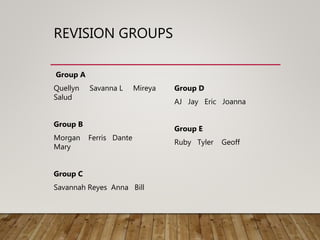
REVISION GROUPS
Group A
Quellyn Savanna L Mireya
Salud
Group B
Morgan Ferris Dante
Mary
Group C
Savannah Reyes Anna Bill
Group D
AJ Jay Eric Joanna
Group E
Ruby Tyler Geoff

SFCC Revision Workshop Spring 19

  • 1.
    PLOT & STRUCTURE •Plot is the “why” that provides meaning to the story • Conflict and resolution of conflict is the backbone of plot. • Some types of conflict: • people versus people/ person vs. self/ person vs. nature/ person vs. society
  • 2.
    PLOT Plot is theliterary element that describes the structure of a story. It shows arrangement of events and actions within a story.
  • 3.
  • 4.
    COMMON STORY-ORDERING ELEMENTS • Chronological •Flash back • In media res (in the middle of things) when a story starts in the middle of the action
  • 5.
    OTHER TYPES OFSTRUCTURE  Not all fiction needs to follow a linear/chronological structure in order to have a crisis action and conflict  Other types of structures to consider:  Maze  Iceberg  Parallel lines  A circle  infinity
  • 6.
    MAZE • In whicha character either physically, emotionally (or both!) is trapped and has trouble getting out of his or her maze
  • 7.
    ICEBERG • In whichpart of the story is submerged and unseen, but felt (think of “Hills Like White Elephants”
  • 8.
    PARALLEL LINES • Inwhich two stories run, literally, parallel to one another (perhaps characters facing similar challenges) but the stories do not meet.
  • 9.
    THE CIRCLE • Thestory begins and ends in the same place
  • 10.
    INFINITY OR THELOOP • The story keeps meeting up with itself in the same spot and then continuing on; events repeat themselves and breaking free of this loop is one of the challenges.
  • 11.
    BRIEF WRITING ASSIGNMENT •Write down a list of the actions that take place in your story. • Write down the overall feeling or theme you want to express in your story (love, confusion, freedom etc). • Now, think about these shapes. Does one of them apply to what you’re doing? And, if so, what changes would you make structurally to give the piece the form of one of these shapes? • Maze: A character is literally in a situation he/she can’t get out of, but this should also be reflected internally. • Iceberg: Where much is unknown, the actual story is underwater, what’s left and how do we end up feeling? • Parallel lines: Two parallel stories that match but don’t meet • A circle: A story that begins and ends in the same place.
  • 12.
    FULL-BLOWN REVISION EXERCISE/YOU CHOOSE 1.Pick a character from your work in progress. Write a scene from his or her most significant childhood memory (bad or good). 2. Tell the story of how one of your characters’ parents met. 3. Pick a written scene in which one of your main characters takes action. Rewrite to have your character make a completely different choice—what happens now? 4. Write a dream one of the character’s had the night before the story you have written begins. 5. Write three new openings for your story—these can be brand- new actions, or try starting your story from a point that currently happens later in the piece.
  • 13.
    ASSIGNMENTS FOR MAY6 • On Monday, you will divide into your groups to discuss your revisions. • The focal point of these revisions will be your written answers to the “writer’s interview” questions I’m giving you to fill out. • Bring copies of your revisions: one for each member of the group and one for me • You will meet to exchange manuscripts, discuss what you have done/talk about your revision process/questions on manuscript
  • 14.
    WRITER’S QUESTIONS • Writeout the answers to these questions and bring for your revision meeting. Bring one copy to turn into me. • 1. What was the genesis of this idea? • 2. What was the biggest challenge in writing this story? • 3. What types of revisions have you tried to undertake? • 4. What remaining questions do you have about your story?
  • 15.
    REVISION GROUPS Group A QuellynSavanna L Mireya Salud Group B Morgan Ferris Dante Mary Group C Savannah Reyes Anna Bill Group D AJ Jay Eric Joanna Group E Ruby Tyler Geoff

Editor's Notes

  • #3 Aristotle: beginning, middle and end, Freitag chart added the climax, and then we have
  • #6 A lot of writers have spoken of envisioning their stories as shapes. Henry James said the imaginary shape of th Ambassadors was that of an hourglass.
  • #12 You can use a piece of your current story. You can use your flash from last week.